Key takeaways
- Lingonberries need acid soil, so most UK gardeners grow them in pots
- Use peat-free ericaceous compost mixed with pine bark
- Water with rainwater, because tap water slowly makes the compost less acid
- 'Koralle' is a great all-rounder for crops
- Expect a small crop in year two and better crops after that
- The tart red berries make brilliant jam and sauce
Lingonberries are one of the easiest fruiting shrubs you can grow, yet hardly anyone does. The plant is small, evergreen and fully hardy, and it’s even native to our own hills. It can crop twice a year and keeps going for many years. The catch? It needs properly acid conditions, and most British garden soil isn’t acid enough.
Pots solve that neatly. A 35cm pot of peat-free ericaceous compost, a water butt and a young ‘Koralle’ or ‘Sussi’ plant is all you need. Here’s how to choose a variety, mix the compost, water, feed and pick, plus what to make with the berries.
What is a lingonberry?
A lingonberry is a low evergreen shrub in the heather family, Vaccinium vitis-idaea. It grows 15-30cm tall and slowly spreads by underground runners into a dense mat. The leaves are small, glossy and dark green. In spring and summer it has tiny white or pale pink bell flowers that bees love, followed by round berries that ripen bright scarlet.
It grows wild in the UK as cowberry, on acid moorland in Scotland, the Pennines, Dartmoor and parts of Wales. Garden varieties were mostly bred in Scandinavia and the Netherlands for bigger berries. The RHS plant profile is handy if you want the basics at a glance.
Two things matter for you. Being a native, it’s perfectly at home in our climate. But it simply won’t grow in chalky or limey soil, which rules out planting in the ground in many gardens.

Climate and hardiness across the UK
Cold is never a problem for lingonberries anywhere in Britain. Heat, drought and hard tap water are what hold them back. They come from cool, damp, acid moors, so the closer you get to that, the happier they are.
In Scotland and northern England, they’ll grow easily in full sun in pots or raised acid beds. In Wales and the south-west, full sun is fine near the coast, but inland gardens are better with a little afternoon shade. In the Midlands, the south-east and London, where summers are hottest, a spot with morning sun and afternoon shade works best.
They also dislike drying winds. Tuck them in by a fence, hedge or wall rather than out in an exposed corner.
Best lingonberry cultivars for UK growers
Four varieties are worth looking for. You’ll mostly find them at specialist fruit nurseries and online, rather than at the garden centre.
| Variety | Berries | Good for |
|---|---|---|
| ’Koralle’ | Medium to large | The best all-rounder for crops |
| ’Red Pearl’ | Medium | Compact and pretty, small patios |
| ’Sussi’ | Medium | Medium pots, good flavour |
| ’Linnea’ | Medium to large | Good crops, a little tarter |
| Wild cowberry | Small | Ground cover, smaller crops |
Wild cowberry is perfectly happy in a garden, but the berries are smaller, it spreads more and the crop is lighter. Grow it as ground cover, and grow ‘Koralle’ for jam.
A small plant in a 9cm pot is the cheaper way to start if you don’t mind waiting an extra season. Bigger two- or three-year-old plants crop sooner. Bare-root plants are rarely sold.
Soil and compost: getting the pH right
Get the soil acid and the plant pretty much grows itself. Get it wrong and nothing else helps. If your soil is chalky, limey or neutral, use pots. Many of the plants that love acid soil, like heathers and pieris, want exactly the same conditions.
A good pot mix is:
- About two-thirds peat-free ericaceous compost
- About one-third chunky pine bark
- A small handful of grit per 10 litres, for drainage
The bark matters. Ericaceous compost on its own packs down after a couple of years and holds too much water. Bark keeps it open and slowly feeds the plant. Our peat-free compost guide has more on what goes into a good ericaceous mix.
Avoid coir as the main ingredient, as it tends to drift less acid over time. Avoid ordinary garden compost too, which is usually neutral or limey. If you make your own compost at home, a well-rotted heap of pine needles and leaves makes a lovely top-dressing.
For a raised bed, dig out the soil to about 40cm. Line the sides (not the base) with thick polythene to stop lime seeping in from the soil around it. Refill with the same mix and add sulphur chips each spring, following the pack, to keep it acid.
Container setup, step by step
One plant needs a pot about 35cm wide and at least 25cm deep. Terracotta looks lovely and breathes well but dries faster. Thick plastic holds water better in hot southern gardens.

How to plant:
- Cover the drainage holes with broken crocks or a few centimetres of coarse grit.
- Half-fill the pot with your ericaceous and bark mix.
- Soak the rootball in a bucket of rainwater until the bubbles stop.
- Sit the plant on the mix so the top of the rootball is about 2cm below the rim.
- Fill in around it and firm gently with your fingers.
- Top with 2-3cm of pine bark or leaf mould to keep weeds down and moisture in.
- Water in slowly with rainwater until it drains from the bottom.
Plant from March to May, or September to early October. Avoid midsummer and hard frosts. Keep the new plant in light shade and well watered for four to six weeks while it settles.
Watering: rainwater only
Most UK tap water is hard enough to make the compost less acid over a summer. When that happens, new leaves go pale, flowers are weak and the crop is poor. Rainwater is naturally soft and keeps things just right.
A water butt on the shed or greenhouse downpipe is the easy answer. If it runs dry in a long drought, use bottled distilled water, or put up with slower growth until the rain comes back.

Aim for steady moisture: never soggy, never bone dry. The compost should feel like a wrung-out sponge. In a normal summer that’s a good soak every two or three days, and daily in a heatwave. In winter, water only if it’s been dry for a couple of weeks.
Feeding and the annual rhythm
Lingonberries aren’t hungry plants. One feed in early March is enough for the year. Use a slow-release ericaceous fertiliser at the rate on the pack.
Here’s how a typical year goes:
- March to April: new shoots appear, from old stems and from runners under the surface.
- Late May to early June: the first flowers open. Bumblebees do the pollinating.
- Mid to late June: the first berries turn scarlet. Pick when fully red.
- July to early August: a short rest while the leaves thicken up.
- Mid August to mid September: a second round of flowers and berries. This is usually the bigger crop and the one for jam.
- October to November: leaves pick up a bronze tint after the first frosts.
- December to February: resting. Pots can stay outside all winter. Lift terracotta pots onto pot feet in hard frost so they don’t crack.
Getting two crops a year makes lingonberries a bit special. Most soft fruit only gives you one.
Propagation: more plants for free
Lingonberries are easy to multiply in three ways.
Cuttings in July are the most reliable. Snip 8-10cm of this year’s growth, strip the lower leaves, dip in rooting powder and push into a half-and-half mix of perlite and ericaceous compost. Cover with a clear bag or pop in a propagator. They should root in six to eight weeks and be ready to pot up next spring.
Runners root on their own as they spread. Find one with its own little clump, slice it free with a sharp knife and pot it up. Do this in early spring or autumn.
Division is the quickest way to bulk up. In March or October, tip a mature plant out of its pot, cut the mat into four to six pieces and pot each one up in fresh compost.
Whichever way you go, water with rainwater and don’t feed in the first year.
Pests, diseases and what actually goes wrong
These are the problems you’re most likely to meet:
- Compost not acid enough. By far the most common. New growth goes pale, flowers are weak and the crop is tiny. Switch to rainwater, add sulphur chips and refresh the compost.
- Root rot. A waterlogged pot can cause sudden wilting even though the compost is wet. Add grit, improve drainage and take the pot off its saucer in winter.
- Scorch. In hot southern gardens, upper leaves get pale yellow patches in midsummer. Move the pot to some afternoon shade.
- Cracked pots. Wet compost freezing inside terracotta can crack it. Stand pots on feet and keep them out of the worst of the winter rain.
- Birds. An empty plant in June usually means blackbirds got there first. Throw a light net over while the berries ripen.
Blueberries and cranberries need the same acid conditions but have more pests. See our guides to growing blueberries and growing cranberries, a close relative that likes even more moisture. Of the three, lingonberries are the easiest on pests but the fussiest about acid soil.
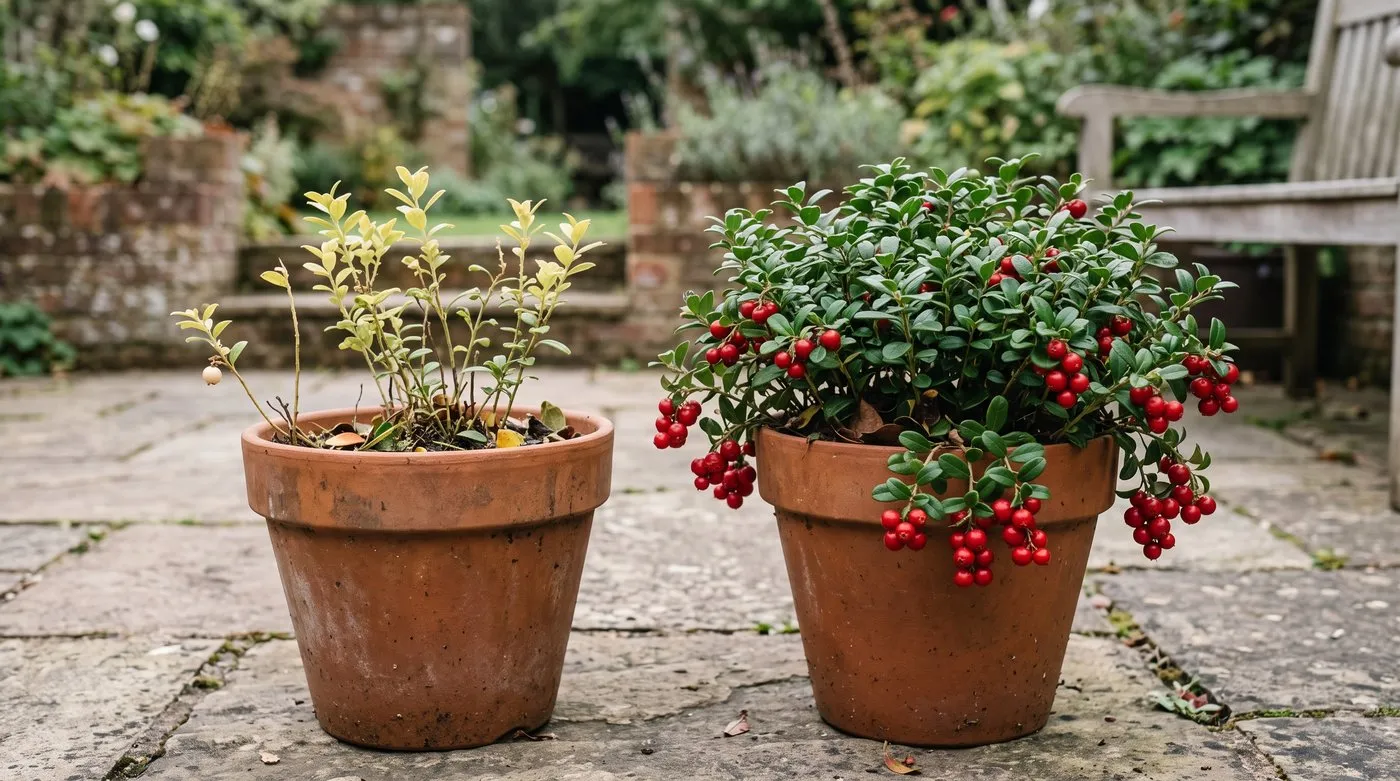
Pale new growth usually means the compost isn’t acid enough. Switch to rainwater, add sulphur chips and refresh the compost.
Building an ericaceous corner around the lingonberries
One pot on the patio is lovely. Group a few together, add some acid-loving friends, and you’ve got a feature that looks good all year.
Heathers flower in summer (Calluna) or winter (Erica carnea). Compact Yakushimanum rhododendrons stay small and flower in late spring. Pieris gives you bright new leaves and white spring flowers. Dwarf azaleas, dwarf conifers and the hard fern Blechnum spicant fill the gaps nicely. The lingonberries give you fruit while the others bring flowers and shape.
If you’ve got space and enthusiasm, a small bog garden with cranberries, sundews and sphagnum beside the lingonberries makes a striking little acid wetland. It needs more water, but it looks wonderful.
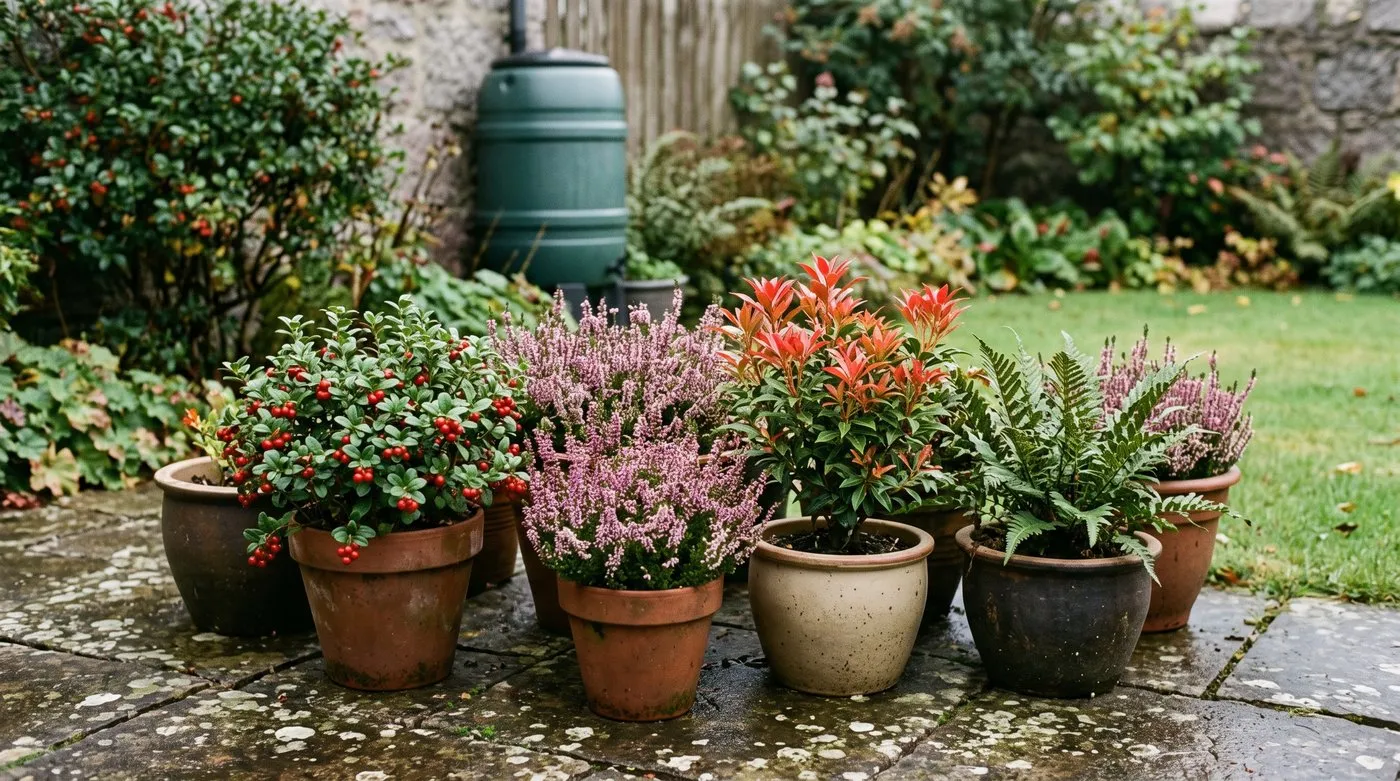
Acid-lovers like heather and pieris want the same compost and rainwater. Grouped together, they look good all year.
Harvest, yield and what the berries taste like
The first picking comes in June. It’s usually the smaller crop. Pick when the berries are fully scarlet by rolling them gently off the cluster with your thumb. Pale pink ones aren’t ready yet.
The second, bigger picking comes from late August into September. Pick on a dry day and pop them in the fridge soon after. They keep well there, much better than most soft fruit.
They taste like a cross between a cranberry and a redcurrant: bright, tart and a little resinous. They’re not really for eating by the handful. They shine in jams and sauces.

Lingonberries in the UK kitchen
Jam is the classic. Swedish lingonberry jam (lingonsylt) needs less sugar than many jams, because the berries set well on their own. A simple version is 500g lingonberries to 250g sugar, simmered for six to eight minutes. It’s lovely with game, roast pork and meatballs.
More ideas:
- Game sauce. Simmer 250g lingonberries with 100ml port and a sprig of thyme until thick and glossy. Great with pheasant or duck.
- Swedish meatballs. A spoonful of jam on the side is the classic Scandinavian plate.
- Baking. They fold into muffins without bleeding colour the way blackberries do.
If you like unusual fruit, the boysenberry and loganberry guide covers two hybrid berries that go nicely with lingonberries in mixed jams.
A five-year UK growing log
Here’s roughly what to expect. Year one is all about settling in, with little or no fruit. Year two gives a small taste. Year three brings the first useful harvest. By years four and five the pots are at full strength, and they’ll keep cropping for many years as long as the compost stays acid.
Frequently asked questions
Can you grow lingonberries in the UK?
Yes, lingonberries grow well in the UK. They grow wild on British upland moors, where they’re called cowberry, and they’re very hardy. The one must is acid soil. Most gardeners find it easiest to grow them in pots of ericaceous compost.
Is a lingonberry the same as a cowberry?
Yes, they’re the same plant, Vaccinium vitis-idaea. Cowberry is the old British name for the wild plant. Lingonberry is the Scandinavian name, now used for garden varieties such as ‘Koralle’. Garden varieties have bigger berries and heavier crops than the wild form.
How long do lingonberries take to fruit?
Expect a small first crop in the second year. Young plants may flower a little in their first summer. Crops grow each year as the plant spreads, and it reaches full production after a few years. Keep the soil acid and moist and it will crop for many years.
Do lingonberries need full sun in the UK?
Sun or light shade suits them. In cooler northern areas, full sun gives the best crops. In warmer southern gardens, some shade from the hot midday sun is better. They mind heat and dryness far more than a bit less light.
Can I grow lingonberries in a container?
Yes, and it’s often the easiest way. Use a pot 30-45cm across with good drainage holes. Fill it with peat-free ericaceous compost mixed with some pine bark and grit. Water with rainwater, as tap water can make the compost less acid. Top up with bark or leaf mould each year.
Related guides
Once your lingonberries are going, the rest of an acid-loving corner is easy. Try how to grow blueberries, how to grow cranberries and our list of the best plants for acid soil. The peat-free compost guide helps with the pot mix, and how to make compost covers the heap for your leaf mould. For more unusual fruit, see the boysenberry and loganberry guide.
Our team produces practical UK gardening guidance from source research, contributor records and established horticultural practice. Editorial standards are overseen by Matt W.