
Key takeaways
- Sow from April to July for leaves from June through to the next spring
- Bright Lights and Rainbow Chard give red, yellow, orange and white stems
- Pick outer leaves and leave the middle, and one plant keeps cropping for months
- Chard copes with light frost, and fleece helps it through colder winters
- Each seed is a cluster of 2-3 seeds, so thin to the strongest at 30cm apart
- It grows well in pots at least 30cm deep
Swiss chard is one of the easiest and most generous leafy veg you can grow. One spring sowing keeps giving you leaves for months, often right through winter. It copes with frost, doesn’t mind a dry spell and grows in most soils.
It’s the same species as beetroot, but bred for its leaves and stems instead of roots. The stems come in gorgeous colours: crimson, gold, orange and white. A row of rainbow chard looks as good as any flower border. Unlike spinach, it rarely bolts in summer heat, so it’s a far more reliable leafy green.
 Rainbow chard showing off its different stem colours in a raised bed.
Which Swiss chard varieties grow best in the UK?
All the common varieties grow well here. Choose whether you want the biggest harvest, the brightest colours or the mildest taste.
Bright Lights gives a mix of red, yellow, orange, pink and white stems from one packet. The leaves are glossy dark green. Plants grow about 45-50cm tall. Grow this if you want your veg patch to double as a flower bed.
Fordhook Giant is the workhorse. It has thick white stems and big, crinkly dark green leaves, and gives the most to eat per plant. The taste is mild and slightly sweet, and it stands up well to cold.
Rhubarb Chard has bright crimson stems and red-veined leaves, and the colour deepens in cool weather. It has a stronger, earthier taste than the others and looks lovely in a flower border.
Lucullus has wide, pale green stems and big, crinkly light green leaves. The flavour is the mildest of the lot, and it’s a good choice for early spring sowings.
Rainbow Chard is a colour mix similar to Bright Lights. Most seed firms sell their own blend, so the colours vary. It’s easy to find and usually cheaper, so it’s a nice one to start with.
Swiss chard variety comparison
| Variety | Stems | Taste | Best for |
|---|---|---|---|
| Bright Lights | Mixed colours | Mild | Colour, borders |
| Fordhook Giant | White | Mild, sweet | Big harvests, allotments |
| Rhubarb Chard | Deep red | Earthy | Looks, stronger flavour |
| Lucullus | Pale green | Very mild | Early sowings |
| Rainbow Chard | Mixed colours | Mild | Beginners |
When and how to sow Swiss chard
Sow outside from mid-April to July, or indoors from March. Each knobbly chard “seed” is actually a cluster of 2-3 seeds, just like beetroot, so you’ll always need to thin. Soaking them in warm water for a couple of hours before sowing helps them get going.
Sowing outdoors
Sow straight into the ground from mid-April to July, once the soil has warmed up a bit. In northern England and Scotland, wait until late April or early May.
Make drills 2cm deep and 40cm apart, and sow a seed cluster every 10cm. Water the drill first if the soil is dry. Cover and firm gently. Seedlings appear in 10-14 days. When they’re about 5cm tall, thin to 30cm apart. The thinnings are lovely in salads.
Starting indoors
For an earlier crop, sow in modules on a windowsill or in an unheated greenhouse from March. Sow one cluster per module, 1cm deep, in seed compost. Plant out after the last hard frost, usually late April in the south or mid-May further north.
Module-grown plants get going faster and suffer less from slugs. They’re also handy for filling gaps in raised beds.
 Planting out module-grown chard seedlings on the allotment.
Two sowings for leaves all year
Chard crops for so long that two sowings are plenty. Sow in April for summer and autumn, then again in July for autumn, winter and spring. It’s the same idea as a succession planting schedule, just with fewer sowings.
How to grow Swiss chard successfully
Chard isn’t fussy, but rich, moist soil gives the best plants. It grows in sun or part shade, in clay or sandy soil.
Soil and position
Dig in plenty of garden compost or well-rotted manure before sowing. Full sun gives the strongest stems and brightest colours. A bit of shade is fine too, and it helps in hot summers.
Avoid waterlogged ground, as chard copes with dry spells better than soggy roots. On heavy clay, grow it in raised beds where it drains better.
Watering and feeding
Water regularly in dry spells. Uneven watering makes the stems tough and the leaves bitter. A 5cm mulch of compost or straw around the plants holds in moisture and keeps weeds down.
From June, give a balanced liquid feed, such as a seaweed feed, every 3-4 weeks. Avoid high-nitrogen feeds, which make big, soft leaves that aphids love. If plants look pale or slow, a sprinkle of pelleted chicken manure along the row gives them a lift.
Common problems
Leaf miners are the most common pest. Tiny grubs tunnel inside the leaves, leaving pale wiggly trails. Pick off affected leaves and bin them. Covering plants with fine insect mesh from May stops the adults laying eggs. They don’t kill the plant, but badly mined leaves aren’t worth eating.
Slugs and snails go for young seedlings. Beer traps or a nematode biological control help. Once plants are big and growing strongly, slug damage is just cosmetic.
Downy mildew shows as yellow patches on top of the leaves with grey fuzz underneath. Give plants their full 30cm spacing, remove crowded leaves and avoid watering over the leaves in the evening.
Bolting (running to flower) is rare in spring-sown chard in its first year. If it happens, cut the flower stalk off at the base, and the plant may carry on making leaves. Overwintered plants are much more likely to bolt the next spring.
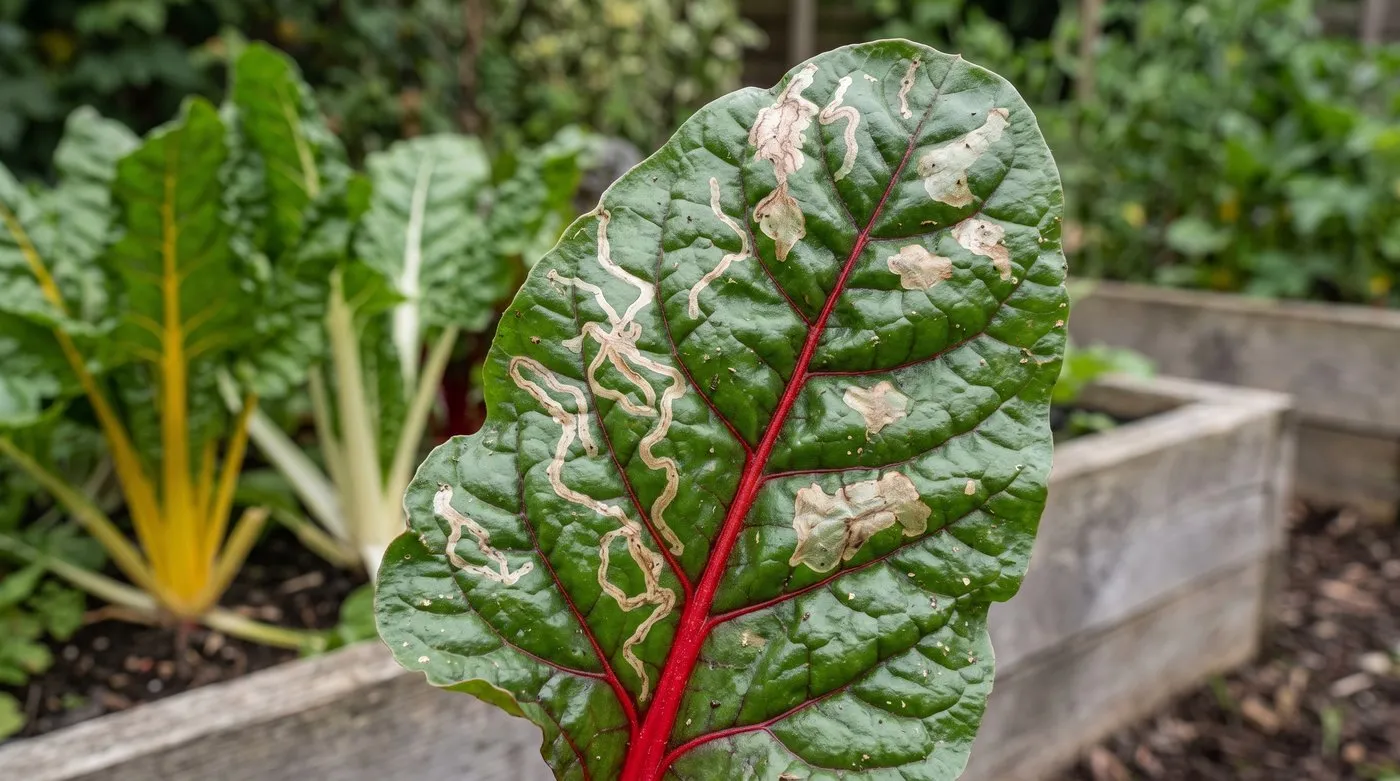
Pale, wiggly trails mean leaf miners are inside. Pick off those leaves and bin them, and use fine mesh from May to keep the flies off.
Cut-and-come-again harvesting
This is where chard really shines. Pick it the right way and one plant keeps making new leaves for months.
Start picking when leaves are 15-20cm long, usually 8-12 weeks after sowing. Smaller leaves are more tender. Big old leaves have thick, stringy stems.
Always pick the outer leaves first. Work from the outside in, snapping or cutting each leaf near the base. Leave the centre and at least 4-5 inner leaves alone.
Pick little and often. Taking 3-4 outer leaves from each plant every week keeps fresh leaves coming. Leave it for weeks and you’ll get a mass of tough, oversized leaves.
Pull off yellow or damaged leaves even if you’re not eating them. Old leaves hide slugs and spread disease.
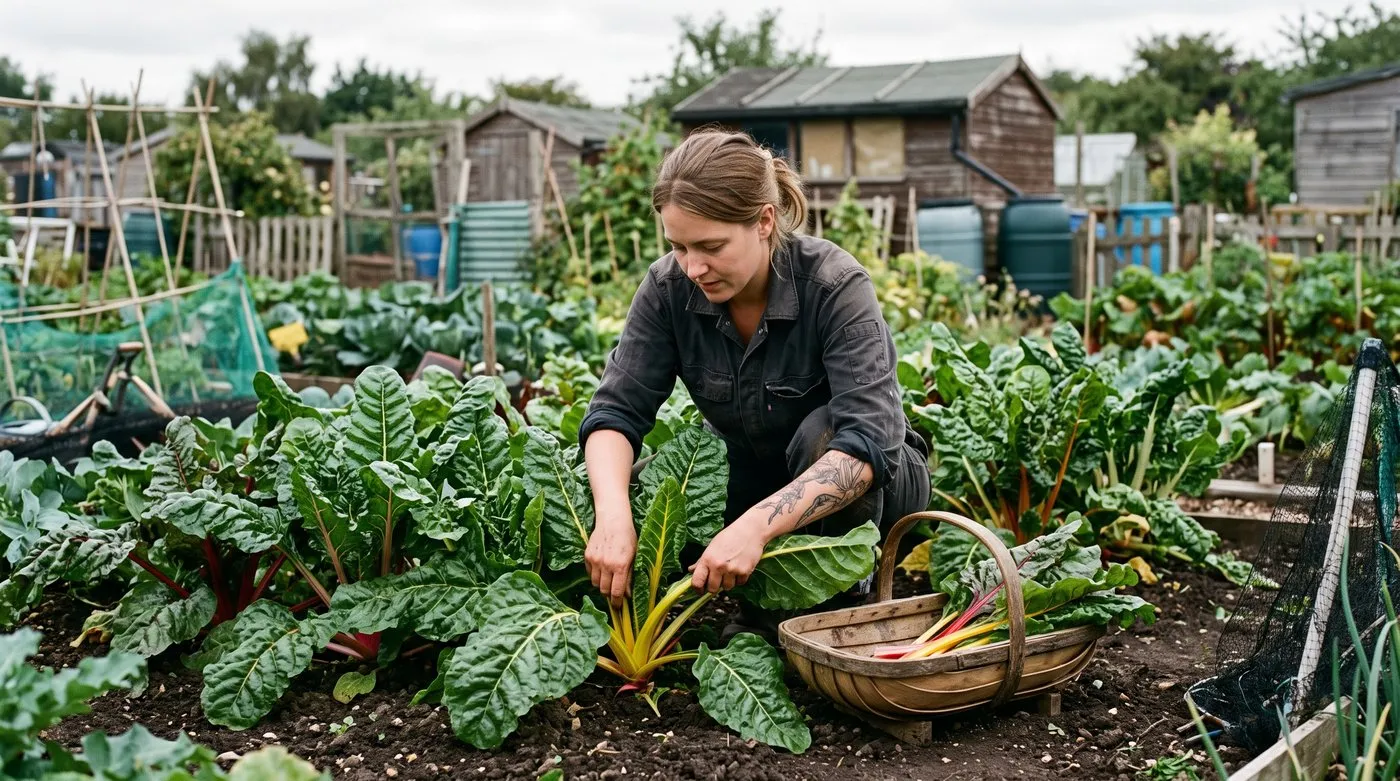
Work from the outside in and leave the heart alone. Picking three or four leaves a week keeps fresh, tender ones coming.
Growing Swiss chard in containers
Chard is one of the best leafy veg for container growing. The colourful stems look great on a patio, and a few pots give a steady supply.
Use a pot at least 30cm deep and 30cm wide for one plant. A 50cm trough fits 3 plants, and a half-barrel holds a small row.
Fill with multipurpose compost mixed with some perlite. Water daily in summer, as pots dry out much faster than the ground. Feed every 2 weeks from June to September.
In winter, move pots to a sheltered spot by a south-facing wall, and cover with fleece in hard frosts.
Mix varieties for a lovely display. Rhubarb Chard next to Fordhook Giant gives a smart red and white contrast.
Overwintering Swiss chard
Chard is tougher than most people expect. Established plants cope with light frost without help. In mild coastal and southern gardens, it often crops all winter with no cover at all.
In colder inland gardens, cover plants with fleece from November, held down with stones or pegs. That’s usually enough for most of England and Wales.
In Scotland and exposed northern sites, use cloches or a cold frame. Plants may die back to the base in a hard frost but usually regrow in March.
Overwintered plants run to flower the next spring, usually between April and June. Pick plenty before the flower stalk appears, as the leaves soon turn bitter. Then replace them with a fresh spring sowing.
How to cook Swiss chard
Cook the stems and leaves separately. The stems are crunchy and slightly sweet, and the leaves wilt down like spinach.
Separate them first. Cut the green leaf away from each side of the stem. Slice the stems into 2cm pieces and roughly chop the leaves. The stems need a few minutes longer, so start them first.
Quick fry: heat olive oil, cook the stems for 3 minutes, add the leaves and cook for 2 minutes more. Finish with salt, pepper, a squeeze of lemon and a grating of nutmeg.
Steaming: steam the stems for 4 minutes, pop the leaves on top and steam for 2 more. Toss with butter and a pinch of sea salt.
Raw: young leaves under 15cm are tender enough for salads. The stems add crunch to coleslaw.
Freezing a glut: blanch the stems and leaves separately for 2 minutes, cool in iced water, drain well and freeze in portions. Frozen chard is handy for soups, curries and pasta.
 A trug of freshly picked rainbow chard, ready for the kitchen.
Swiss chard growing calendar for the UK
| Month | What to do |
|---|---|
| March | Sow indoors in modules |
| April | Sow outside once the soil warms. Plant out indoor seedlings in the south |
| May | Thin outdoor seedlings to 30cm. Plant out module plants further north. Water regularly |
| June | Start picking outer leaves when 15-20cm long. Feed every 3-4 weeks |
| July | Sow again for autumn and winter. Keep picking weekly |
| August | Keep picking. Look out for leaf miners and remove affected leaves |
| September | Feed less. Plants keep cropping as it cools |
| October | Pick plenty before the frosts. Mulch around the plants |
| November | Cover with fleece in colder areas. Pick any good leaves |
| December to February | Pick overwintered plants lightly. They may die back in hard frost |
| March (year 2) | Overwintered plants regrow. Pick plenty before they run to flower |
Swiss chard or kale for a winter garden?
Grow both if you can. Both fill the winter gap, but kale is the tougher of the two, so it’s the safer bet in a cold, exposed garden.
Chard starts cropping earlier in summer and keeps going later into spring. Kale is at its best from autumn to early spring.
They taste quite different. Chard is mild and slightly sweet, a bit like spinach, and lovely in Mediterranean dishes. Kale is earthier with a slight bitterness that mellows after frost, and suits stews and roasting.
Chard covers summer and early autumn, and kale takes over through winter. Between them you’ll have fresh greens all year.
Companion planting with Swiss chard
Chard gets on with most veg. A few pairings work especially well.
Lettuce and salad leaves enjoy the light shade from bigger chard plants in hot weather. Plant lettuce between the rows from May.
Beans and peas add goodness to the soil. Grow climbing beans at the back of a bed with chard in front.
Keep it away from sweetcorn and sunflowers, which shade it too much and take a lot of water.
Move chard to a new spot each year, and don’t follow beetroot, spinach beet or perpetual spinach. Garden Organic explains crop rotation for the beet family, and the RHS chard guide has more growing tips.
Frequently asked questions
When should I sow Swiss chard in the UK?
Sow outside from April to July, once the soil has warmed a little. Seedlings usually appear in 10-14 days. April sowings give the longest picking season, from June into the next spring. A July sowing gives fresh leaves for autumn and winter. You can also start seeds indoors in modules from March.
Does Swiss chard grow back after cutting?
Yes, it keeps growing back again and again. As long as you leave the centre and a few inner leaves, the plant carries on making new leaves for months. That’s what makes it such good value.
Is Swiss chard the same as perpetual spinach?
No, but they’re close cousins. Both are leaf beets. Swiss chard has wider, often colourful stems and bigger leaves. Perpetual spinach has thin green stems and tastes more like true spinach. You eat both the stems and leaves of chard, but mostly just the leaves of perpetual spinach.
Can Swiss chard survive a UK winter?
Yes, it usually does, especially in milder areas. Established plants cope with light frost without cover. In colder inland gardens, cover them with fleece or cloches from late autumn. Even if hard frost kills the leaves, plants often regrow from the base in spring.
Why has my Swiss chard bolted?
Usually because it went through a cold spell followed by warmer weather. It’s most common in plants that have overwintered, as spring days get longer. Dry soil and stress can also set it off. Cut off the flower stalk, or replace the plant with a fresh sowing.
Can I grow Swiss chard in containers?
Yes, it does really well in pots. Use one at least 30cm deep and wide for one plant, or a trough for several. Fill with multipurpose compost and make sure it drains well. Water regularly and feed every couple of weeks in summer.
How do I harvest Swiss chard without killing the plant?
Pick the outer leaves first and leave the middle alone. Snap or cut them off at the base of the stem, and leave the centre and several inner leaves to keep growing. Pick young leaves for the best taste, and never strip the plant bare.
What is the difference between Swiss chard varieties?
Mostly stem colour, size and how much they crop. ‘Fordhook Giant’ has thick white stems and crops heavily. ‘Rhubarb Chard’ has deep red stems. ‘Bright Lights’ gives a mix of red, yellow, orange, white and pink. ‘Lucullus’ has pale green stems and a mild taste.
Our team produces practical UK gardening guidance from source research, contributor records and established horticultural practice. Editorial standards are overseen by Matt W.


