Key takeaways
- September is the best month to sow, with mid-April to May next best
- Use about 35g of seed per square metre for a new lawn and 25g for patching
- Good soil preparation matters more than the seed you buy
- Keep the surface moist with a fine spray until the grass is growing well
- Wait until the grass is 7-8cm tall before the first cut, on a high setting
Growing a lawn from seed is the cheapest way to get new grass. A bag of good seed costs far less than turf and lets you choose exactly the kind of grass you want. The catch is patience. A seeded lawn takes a few months to get going, while turf is instant.
Here’s every step, from picking a seed mix to the first mow. The same method works for a brand new lawn or for patching bare spots. Getting the timing and the soil right is what gives you a thick lawn rather than a thin, weedy one. The RHS lawn-from-seed guide is handy to have alongside.
When is the best time to sow grass seed in the UK?
September is the best month to sow grass seed. The soil is still warm from summer and autumn rain keeps it moist. Fewer weeds come up in autumn, so your grass has less competition.
Mid-April to May is the next best time. Spring-sown grass grows well once the soil warms up. The downside is that weeds sprout at the same time, so expect more hand-weeding.
Avoid summer, as it’s hard to keep the seed moist in hot, dry weather. Winter sowing fails because the soil is too cold and the seed just sits there and rots. If you’re planning spring gardening jobs, pencil in lawn sowing for mid-April at the earliest.
Soil temperature matters more than air temperature
A warm day in March doesn’t mean the soil is ready. The air can feel springlike while the ground is still cold. A cheap soil thermometer pushed in about 5cm takes the guesswork out. Aim for at least 8-10C. In northern England and Scotland, this usually arrives a few weeks later than in the south.
How to choose the right grass seed mix
Pick your seed by how you’ll use the lawn: a tough ryegrass mix for family lawns, fine fescues for a smart lawn, and a shade mix under trees.
Utility and hard-wearing mixes
The best choice for most family gardens. They’re mostly perennial ryegrass, which is tough, quick to come up and repairs itself fast. They cope with children, dogs and lots of feet, and look good without much fuss. If dogs are your main worry, our guide to dog-proofing your lawn covers the best mixes and how to stop yellow patches.
Ornamental and fine lawn mixes
For that neat, striped, bowling-green look. They’re made of fine fescues, which give a dense lawn of very fine blades. They don’t like heavy wear, take longer to come up and need more mowing and feeding to look their best.
Shade-tolerant mixes
For spots under trees or next to fences that get less than about four hours of sun. These mixes include grasses that cope with low light better than ryegrass. No grass loves deep shade, though, so trim overhanging branches if you can.
Drought-tolerant and low-maintenance mixes
These include tall fescue, which has deep roots and copes with dry spells. Good for sandy soil or if you want to water less. They’re slower to establish but need less looking after once grown.
Which seed mix should you choose?
| Seed mix | Comes up in | Copes with wear | Mowing | Best for |
|---|---|---|---|---|
| Hard-wearing | About a week | Very well | Weekly | Family gardens, play areas |
| Fine lawn | 2-3 weeks | Poorly | Often | Front lawns, smart gardens |
| Shade | 1-2 weeks | Fairly well | Weekly | Under trees, north-facing spots |
| Drought-tolerant | 1-2 weeks | Well | Less often | Sandy soil, dry areas |
| Patching | About a week | Very well | Weekly | Bare spots |
How to prepare soil for grass seed
Clear the weeds, dig, level, firm and rake to a fine crumb. Rushing this part is the surest way to a thin, patchy lawn.
Clear the site
Remove plants, rubble and big stones. Strip off old turf or weeds with a flat spade or a hired turf cutter. On really weedy ground, you can use a glyphosate weedkiller a few weeks before digging, following the label, to kill deep-rooted weeds. Adding compost to poor ground now helps a lot.
Dig and rotavate
Dig the soil to about a spade’s depth. For a big area, hire a rotavator for the day. Break up any hard layers and pick out stones.
On heavy clay, work in some sharp sand and plenty of organic matter to help drainage. Our guide on how to improve clay soil goes into more detail.
Level and firm
Rake the surface roughly level. Then shuffle across it on your heels with small overlapping steps. This is called treading. It squashes out air pockets and shows up any dips.
Rake again, then tread again. Two or three rounds should leave the soil firm, so your feet leave a light print but don’t sink in.
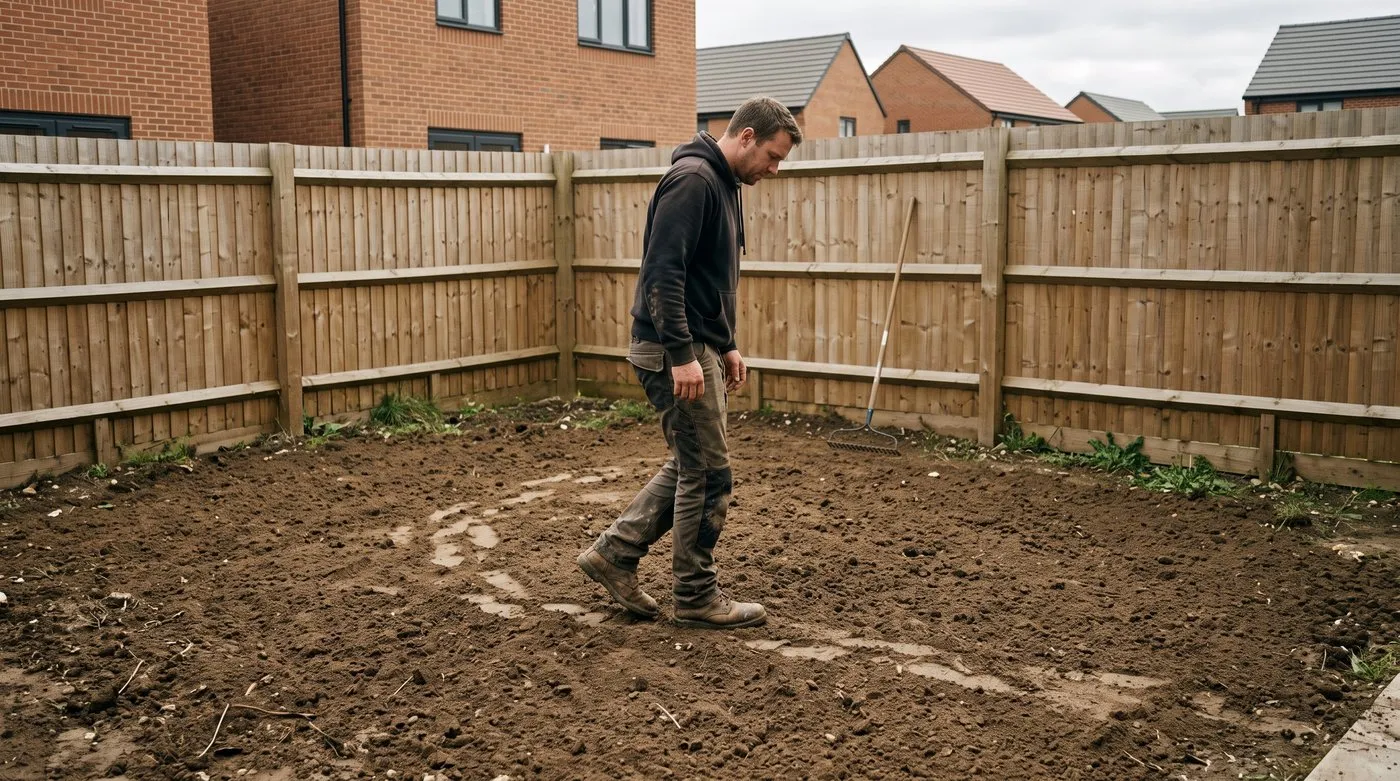
Shuffle across the soil on your heels, then rake and tread again. Your feet should leave a light print without sinking in.
Create a fine tilth
Finish with a rake to get a fine, crumbly surface, a bit like coarse breadcrumbs. This lets the seed sit snugly against the soil, which it needs to grow. Pick out any stones left on top.
What sowing rate should I use?
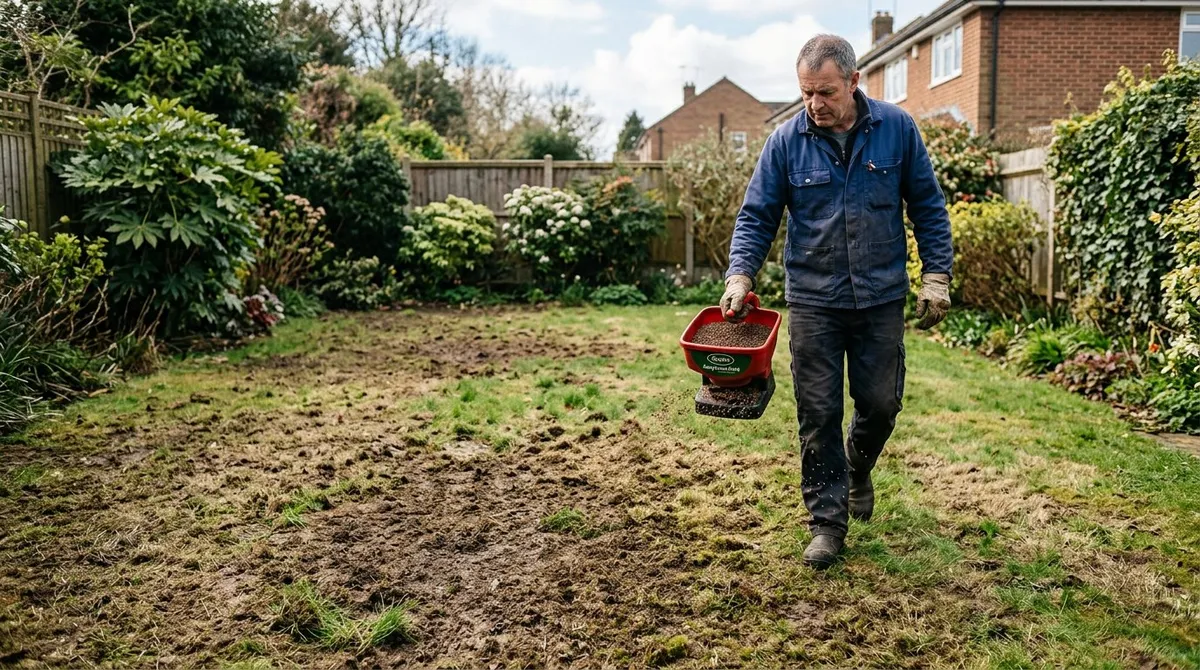
For a new lawn, use about 35g of seed per square metre. Too little gives a thin lawn that weeds move into. Too much gives crowded seedlings that fight each other.
For patching bare spots in an existing lawn, use about 25g per square metre.
How to work out how much seed you need
Measure the lawn in metres and multiply length by width. Multiply that by 35 to get the grams of seed. Add a little extra for edges and the birds.
Example: A 10m x 5m lawn is 50 square metres. At 35g per square metre that’s 1.75kg, so buy a 2kg bag.
How to spread seed evenly
Split the seed into two halves. Sow one half walking up and down, and the other half walking side to side. This criss-cross pattern avoids stripes and gaps.
To get your eye in, weigh 35g into a cup and see what it looks like. Then mark out a square metre with string and sow it. After that you can sow by eye. On a big lawn, a wheeled spreader gives the most even cover.
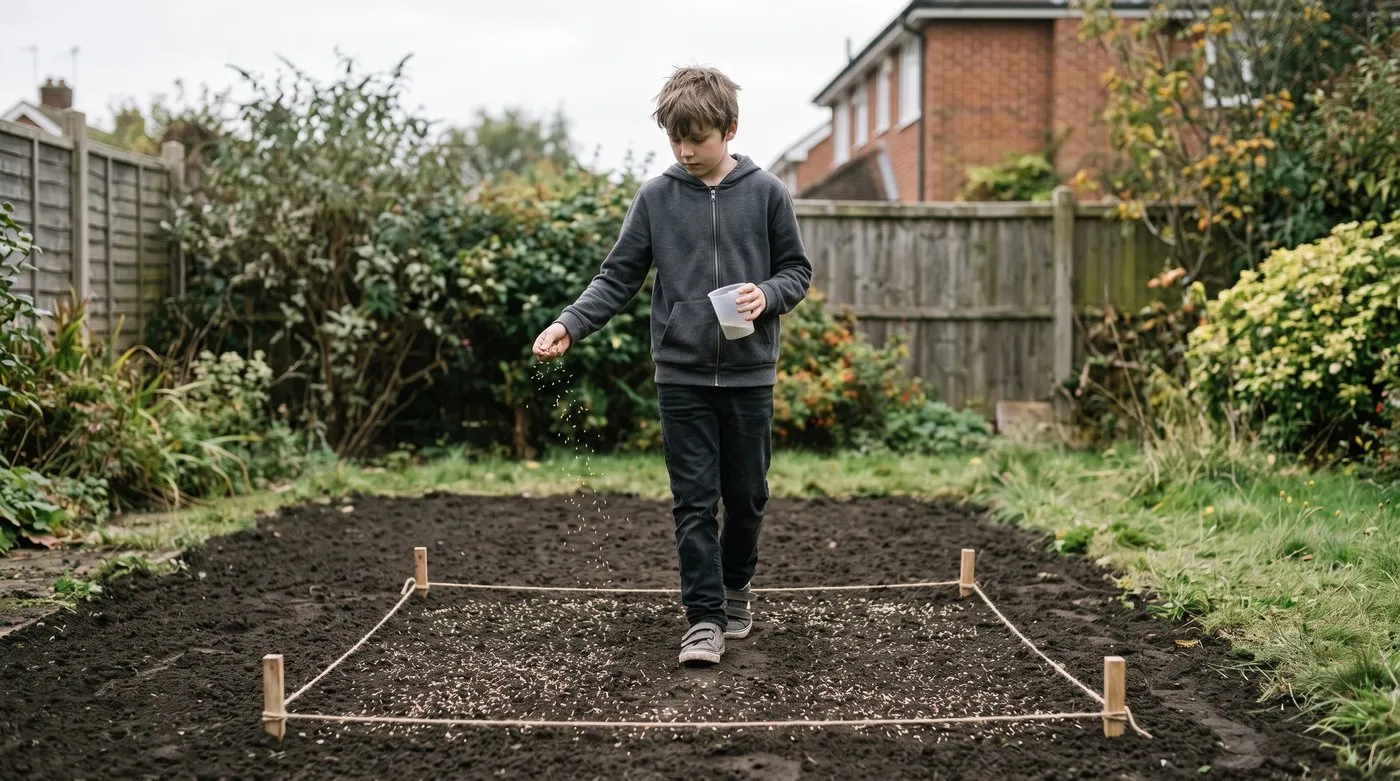
Mark out a square metre and sow it first to get your eye in. Then sow half the seed one way and half the other.
After sowing
Lightly rake the seed in. You want it partly covered, not buried. Keep it no deeper than 5mm.
Then roll it with a light roller or tread gently, so the seed is pressed onto the soil. Good contact means faster, more even growth.

Rake seed in lightly so it’s partly covered, no deeper than 5mm. Then roll or tread gently so it sits snugly against the soil.
How to water new grass seed
Water little and often, keeping the surface moist but never soggy. Too wet and the seed rots, too dry and it dies.
First few weeks
If there’s no rain, water lightly twice a day, morning and early evening. Use a fine sprinkler or a can with a rose. A strong jet washes the seed into clumps.
Just dampen the top couple of centimetres. On sandy soil you may need a third light watering as it dries out fast.
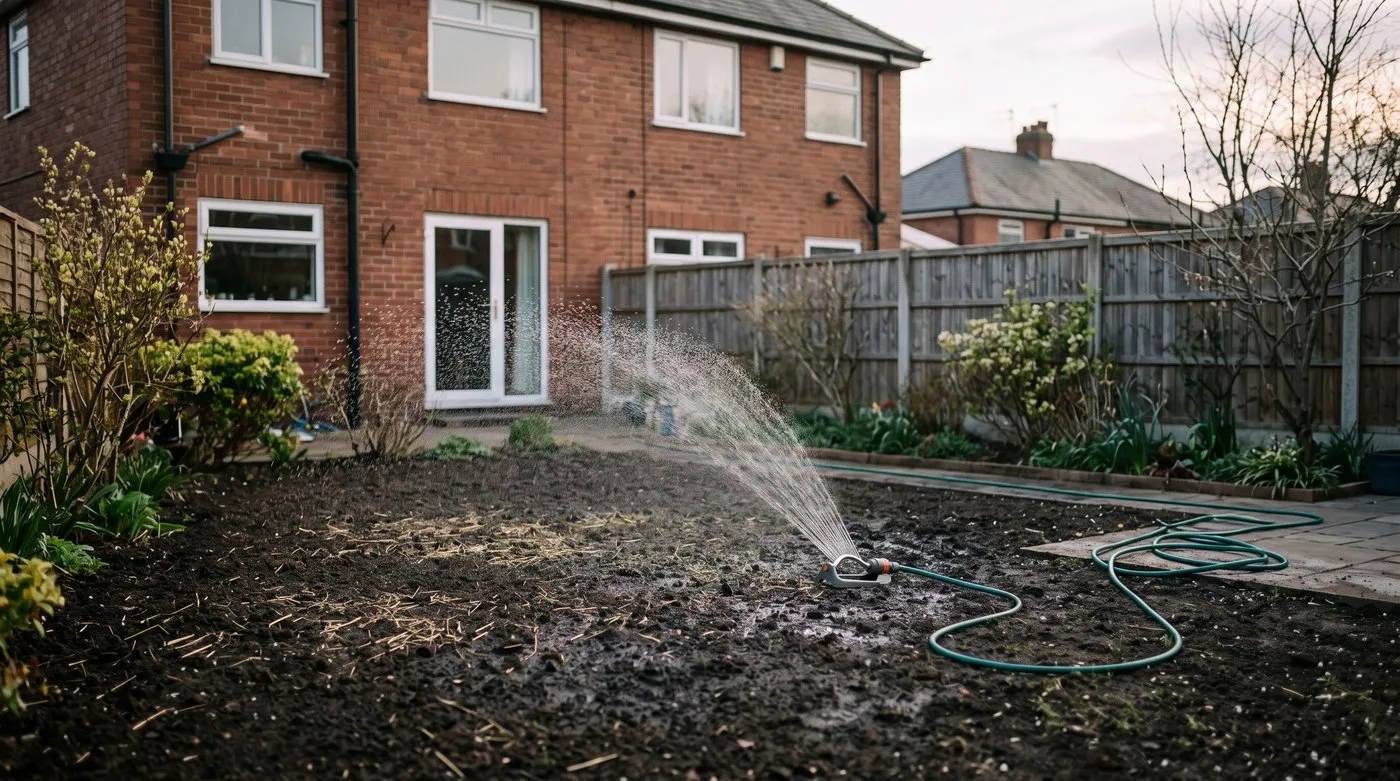
Water lightly, little and often, with a fine spray. A strong jet washes seed into clumps and leaves bare strips.
Once grass reaches 5cm
Cut back to once a day. The roots now reach deeper moisture. Carry on for another two or three weeks.
After the first mow
Switch to a good soak twice a week. Deep, less frequent watering pushes the roots down, which helps the lawn cope with dry spells later.
This is why September sowing is so much easier. The rain does most of the work. A spring lawn in a dry April or May needs daily care for weeks.
How long does grass seed take to germinate?
Grass seed takes about one to three weeks to come up, depending on the type and how warm the soil is.
Perennial ryegrass is fastest, showing in about 5-7 days in warm soil. By two weeks the lawn starts to look green from a distance.
Fine fescues take two to three weeks. They come up as very fine, hair-like blades. The lawn can look bare for a fortnight, so be patient.
Mixed lawns come up unevenly because each grass grows at its own pace. That’s normal.
In cold soil, everything slows right down or stops. That’s why checking the soil temperature matters more than the date on the calendar.
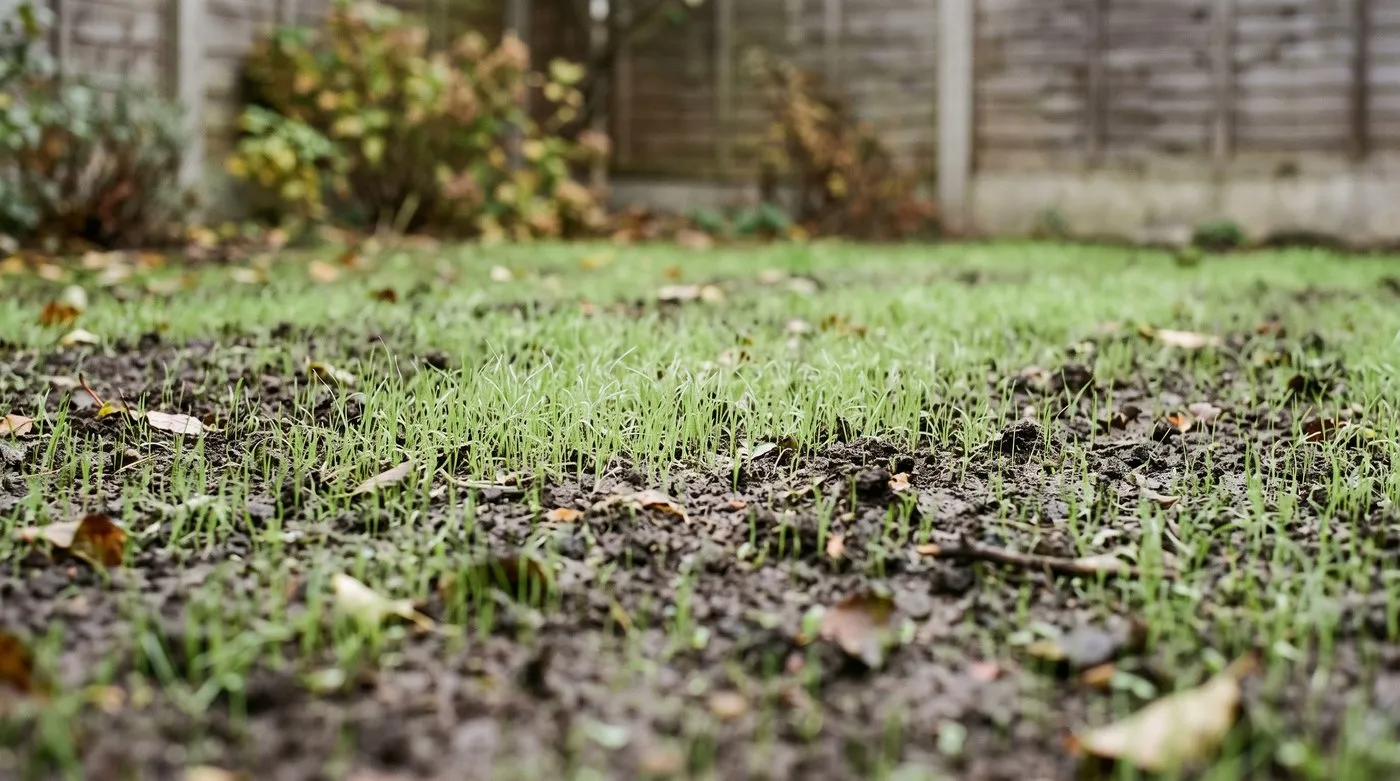
Ryegrass shows in about a week, but fine fescues take longer, so a mixed lawn comes up a bit unevenly. That’s normal.
When should I give the first mow?
Wait until the grass is 7-8cm tall. This usually takes four to six weeks.
Set the mower high, at 5cm or more. Never take off more than a third of the height in one go. A sharp rotary mower is best for the first cut, as a cylinder mower can pull seedlings out of soft soil.
Mow when the surface is dry so you don’t squash the soil or tear the young roots. Collect the clippings for the first few cuts so they don’t smother the grass.
After the third mow, lower the blades a little each time until you reach your normal height: about 25-30mm for a fine lawn or 30-40mm for a family lawn.
When can you walk on new grass seed?
Keep off as much as you can for the first six to eight weeks. Footsteps push seed into dips before it sprouts, and snap or pull out young seedlings afterwards.
Walking on it to mow is fine once the grass is 7-8cm and the surface is dry. If you have to cross it earlier, lay down boards to spread your weight.
Light use, like walking to the washing line, is usually fine after two to three months. Save football and dogs racing about until the lawn has had a full growing season. For an autumn lawn, that means the following late spring.
How to overseed bare patches in an existing lawn
Loosen the surface, add a thin layer of compost and sow at about 25g per square metre. There’s no need to resow the whole lawn.
Can you just throw grass seed on an existing lawn?
You can, but most of it won’t grow. Seed scattered over grass sits on the leaves, not the soil. It dries out, gets eaten or washes away, and any that does sprout is shaded out.
Two things help. First, mow short and rake out the dead grass so you can see soil. Second, after sowing, brush or rake the seed down onto the soil. A thin layer of sieved soil or compost on top holds it in place and keeps it moist.
For a whole tired lawn, hire a scarifier in September, go over the lawn in two directions and then overseed. It works far better than scattering seed alone.
Step-by-step overseeding
- Mow the existing grass shorter than usual so light reaches the soil.
- Rake out dead grass and debris from the bare patch with a spring-tine rake.
- Fork the surface lightly to loosen hard soil.
- Spread a thin layer of compost or topsoil over the patch. A fine mulch or compost about 1cm deep makes a good seedbed.
- Sow about 25g per square metre. Use the same mix as your lawn if you can.
- Firm the seed in with the back of a rake.
- Water daily for three or four weeks until the new grass catches up.
Overseeding works best in September or April. In summer, the existing grass hogs the water.
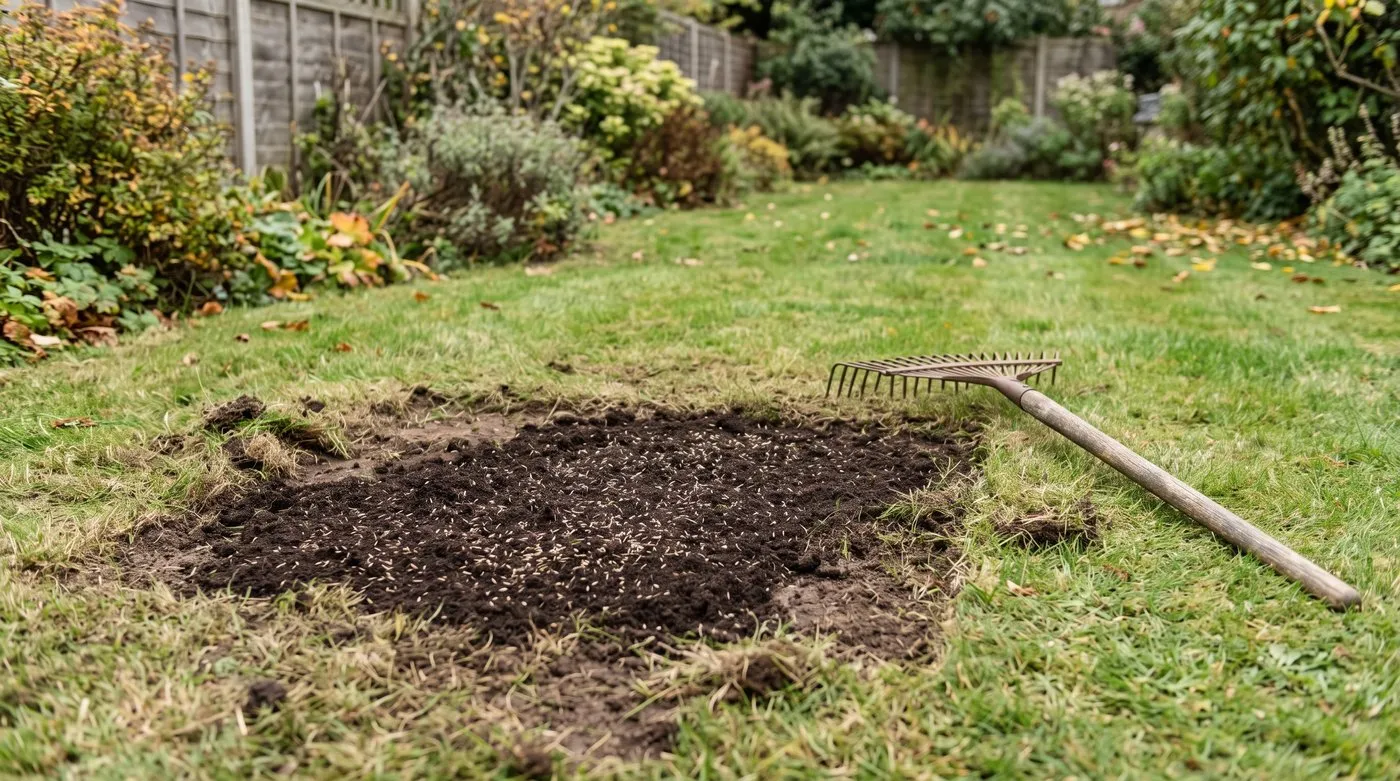
Rake out the dead grass and loosen the soil first. A thin layer of compost gives the seed a moist bed to grow in.
Autumn vs spring sowing: which is better?
Autumn wins in most of the UK. The soil is warmer, the rain is more reliable and fewer weeds come up.
| Autumn (September) | Spring (April-May) | |
|---|---|---|
| Soil warmth | Ideal | Getting there |
| Rain | Reliable | Hit and miss |
| Weeds | Few | Lots |
| Watering | Little | Daily for weeks |
| By next summer | Ready to use | Still settling in |
Autumn lawns grow roots for a couple of months before winter. They come out in spring as a proper lawn, ready for the year.
Spring lawns have to fight dandelions, docks and other weeds from day one. A dry May or June can also catch them before their roots are deep enough. Expect more weeding and watering.
If you miss September, early to mid-October can still work in the south, where the soil stays warm longer. Further north, treat September as the deadline.
Is it better to sow grass seed or lay turf?
Seed is better if you want to save money and can wait. Turf is better if you need a usable lawn quickly. Seed costs much less and lets you pick any mix, including shade or drought-tolerant ones. The downside is a bare, muddy patch for a few weeks and a lawn that isn’t ready for heavy use until next season.
Turf gives you green straight away and can take light use within a few weeks. It needs the same soil preparation as seed and should be laid within a day or so of arriving. It also needs plenty of water in dry weather until it roots in.
Turf can be laid for much of the year but struggles in summer heat. Seed has two shorter windows: September to early October, and mid-April to May. For shady corners, seed is often better, as most turf is grown for sunny spots.
Common mistakes when growing grass from seed
These seven slip-ups cause most seeded lawn failures.
Sowing too early in spring
A sunny March afternoon is tempting, but the soil is still too cold. Wait until mid-April and check with a soil thermometer.
Skipping soil preparation
Seed scattered on hard, bumpy ground gives a patchy lawn. The tread-and-rake routine is what the whole lawn is built on.
Burying seed too deep
Grass seed likes to be at or just below the surface. Deeper than 5mm and it struggles. A light rake is all it needs.
Watering with a heavy jet
A strong blast from the hose washes seed into puddles and leaves bare strips. Use a fine sprinkler or a can with a rose.
Cutting too soon or too short
Mowing before the grass reaches 7cm, or cutting it too low, stresses the seedlings and can pull them out. Set the mower high and be patient.
Using old seed
Seed gets less lively with age. Keep leftovers cool and dry, check the date on the bag, and buy fresh if it’s more than a couple of years old.
Panicking about weeds in the first year
Every new lawn gets some weeds, from seeds already in the soil. Don’t reach for weedkiller. Keep mowing and the grass will crowd most of them out within a few months. Our guide to identifying common lawn weeds helps you spot which need action.
Month-by-month lawn establishment calendar
Here’s how a September-sown lawn settles in over its first year.
| Month | What to do |
|---|---|
| August | Clear the site, deal with deep-rooted weeds and order seed. Start digging and levelling. |
| September | Finish preparing the soil. Sow mid-month. Water if it’s dry. |
| October | Grass comes up. First mow if it reaches 7-8cm. |
| November | A last light mow if the weather allows. Clear fallen leaves. Keep off frosty grass. |
| December to February | No mowing. Keep off when frosty or waterlogged. |
| March | First cut on a high setting. Give a spring feed once the grass is growing. |
| April | Mow weekly. Pull out any big weeds by hand. |
| May | Settle into your normal mowing routine. |
| June onward | Ready for normal family use. Water well in dry spells. |
For spring sowing, shift everything along: prepare in March, sow from mid-April and expect a usable lawn by midsummer.
Feeding a new lawn
Go gently. Rake in a pre-seed fertiliser a few days before sowing, then give a light, balanced feed about six to eight weeks after the grass comes up. Don’t use ordinary strong lawn feed at sowing time, as it can scorch young roots.
Always follow the rate on the packet and never add extra.
From the second year, a simple routine works well:
- Spring: a spring lawn feed to green things up.
- Early summer: another feed to keep it growing.
- Autumn: an autumn lawn feed to toughen it up for winter.
Troubleshooting: patchy germination and thin areas
Patchy growth is usually down to birds, uneven watering, loose soil, shade or waterlogging.
Birds eating seed: Peg fine netting or fleece over the area and take it off once the seedlings are a few centimetres tall. Seed with a bird-deterrent coating also helps.
Uneven watering: Sprinklers often miss edges and corners. Look for paler, dry-looking soil after watering and top those spots up by hand.
Loose soil: Seed sitting on fluffy soil dries out. Tread the patch firm and resow the thin bits.
Shade from buildings or fences: Grass grows slowly in shade. Use a shade mix there and accept the cover will be a bit thinner.
Waterlogged soil: Standing water drowns seed. If puddles hang around for hours after rain, you have a drainage problem. Fork deeply, work in sharp sand, and think about a simple drain for the wettest bits.
Long-term lawn care after establishment
Once it’s established, keep your lawn thick with regular mowing, a few feeds a year and a little autumn care.
Mow weekly from spring to autumn. In a warm, wet June it may need cutting twice a week.
Feed a few times a year as above. A well-fed lawn stays thick and gives weeds fewer gaps.
Scarify in autumn to rake out the layer of dead grass and moss that builds up. Left alone, it stops water reaching the roots. A spring-tine rake or a powered scarifier does the job.
Aerate hard, compacted areas in autumn by pushing a garden fork in at regular spacings. The RHS autumn lawn care guide explains when hollow-tining is worth it on clay or wet soil.
Overseed thin areas each September with a light scatter of seed to keep the lawn dense.
Now you’ve got the hang of growing grass from seed, read our guide on identifying and controlling lawn weeds to keep your new lawn thick and healthy through its first year.
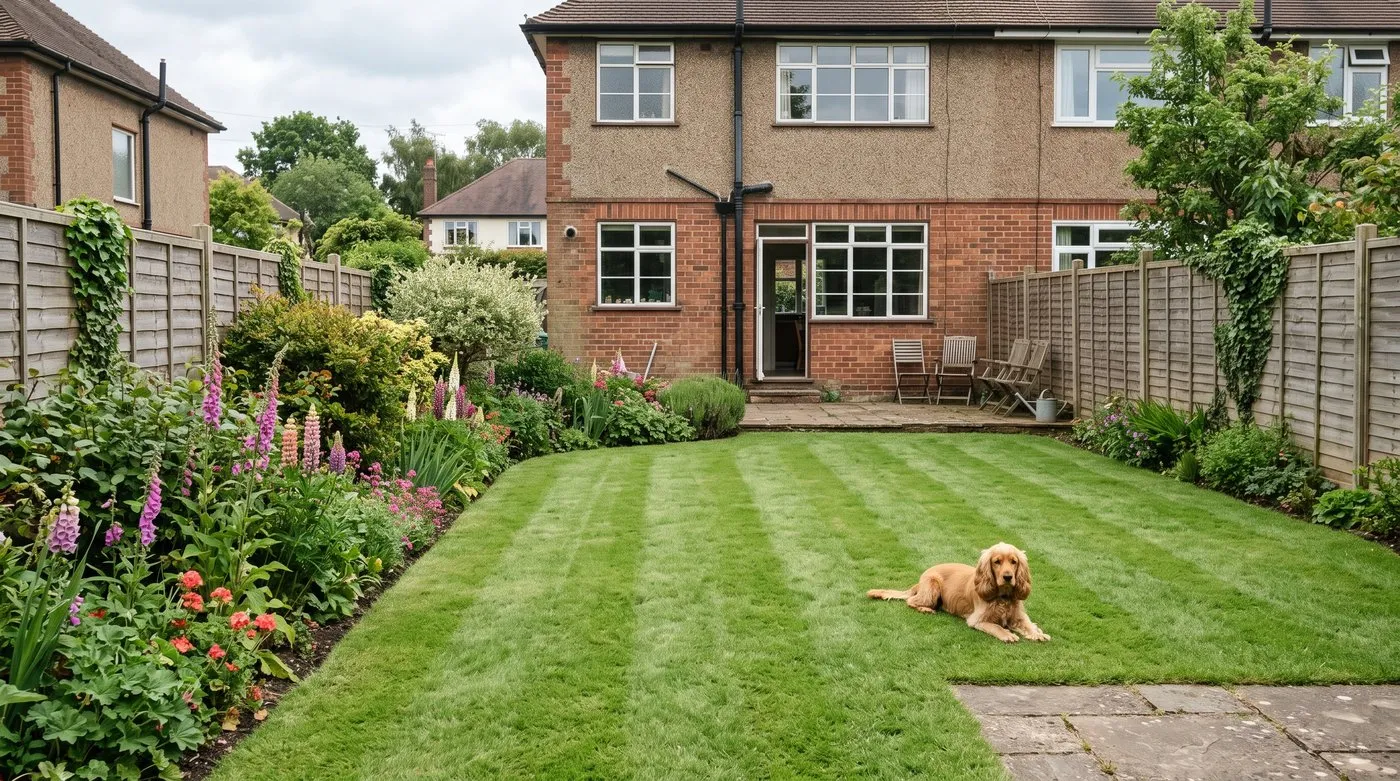
A full growing season later, the lawn is ready for dogs and games. Regular mowing and a few feeds a year keep it thick.
Frequently asked questions
When is the best time to sow grass seed in the UK?
September is the best month to sow. The soil is still warm, autumn rain keeps it moist and fewer weeds come up. Mid-April to May is the next best time, but spring lawns need more watering and weeding.
How long does grass seed take to grow?
Ryegrass comes up in about 5-7 days. Fine fescues take two to three weeks. A new lawn is usually ready for light use after three to four months. Growth stops when the soil is cold, which is why winter sowing doesn’t work.
How much grass seed do I need per square metre?
Use about 35g per square metre for a new lawn. For patching bare spots, 25g per square metre is enough. So a 50 square metre lawn needs about 1.75kg, plus a little extra for the edges.
Can I sow grass seed in March?
March is usually too cold for grass seed. The soil hasn’t warmed up yet in most of the UK. Wait until mid-April, when the ground is warmer. Seed sown in cold soil just sits there and often rots or gets eaten by birds.
Do I need to cover grass seed after sowing?
A light rake over is all it needs. Grass seed likes to be at or just under the surface, so don’t bury it more than 5mm deep. A thin sprinkle of compost or soil can help put birds off, but it isn’t essential.
How often should I water new grass seed?
In dry weather, water lightly twice a day at first. Use a fine sprinkler so the seed doesn’t wash away, and just keep the top couple of centimetres damp. Once the grass reaches 5cm, water once a day. After the first mow, switch to a good soak twice a week.
Why is my grass seed not growing?
Cold soil is the most common reason. Other causes are seed buried too deep, waterlogged ground, seed not pressed firmly onto the soil, or old seed. Seed more than a couple of years old often comes up poorly.
Our team produces practical UK gardening guidance from source research, contributor records and established horticultural practice. Editorial standards are overseen by Matt W.