Key takeaways
- Plant scented climbers within 2 metres of a door, seat or path so you actually smell them
- Most UK scented climbers flower between May and September, peaking in June and July
- Star jasmine and wisteria need a warm south or west wall to flower well
- Honeysuckle and roses like 'Madame Alfred Carriere' cope with cooler north or east aspects
- Fix horizontal support wires 30 to 45cm apart and 5cm off the wall before planting
- Wisteria needs two prunes a year, in July and February, to flower reliably
A scented climber turns a flat wall into something you want to stand beside. Walk through an arch dripping with jasmine on a warm June evening and the perfume stops you in your tracks. The best scented climbers do two jobs at once. They clothe a bare wall, fence, arch or pergola in flower, and they fill the still air around a seat or doorway with fragrance.
How to position a climber for scent
Fragrance only counts if it reaches you. The single biggest mistake gardeners make is planting a scented climber where nobody passes. Site them within 2 metres of a doorway, a path, a window you open, or a seat. Walls and corners trap still air and hold perfume far better than an open fence.
Warmth lifts scent. A sunny, sheltered spot releases far more fragrance than a cold, windy one, because volatile oils evaporate faster in the heat. This is why an enclosed courtyard smells stronger than an exposed garden.
Timing matters too. Many climbers release the most scent in the evening to draw in night-flying moths. Honeysuckle, summer jasmine and star jasmine all peak after dusk. Plant these near a patio or back door where you sit on summer evenings. Day-scented plants like wisteria and most roses belong by a path you walk in daylight. Match the plant’s rhythm to how you use the space.
Star jasmine (Trachelospermum jasminoides)
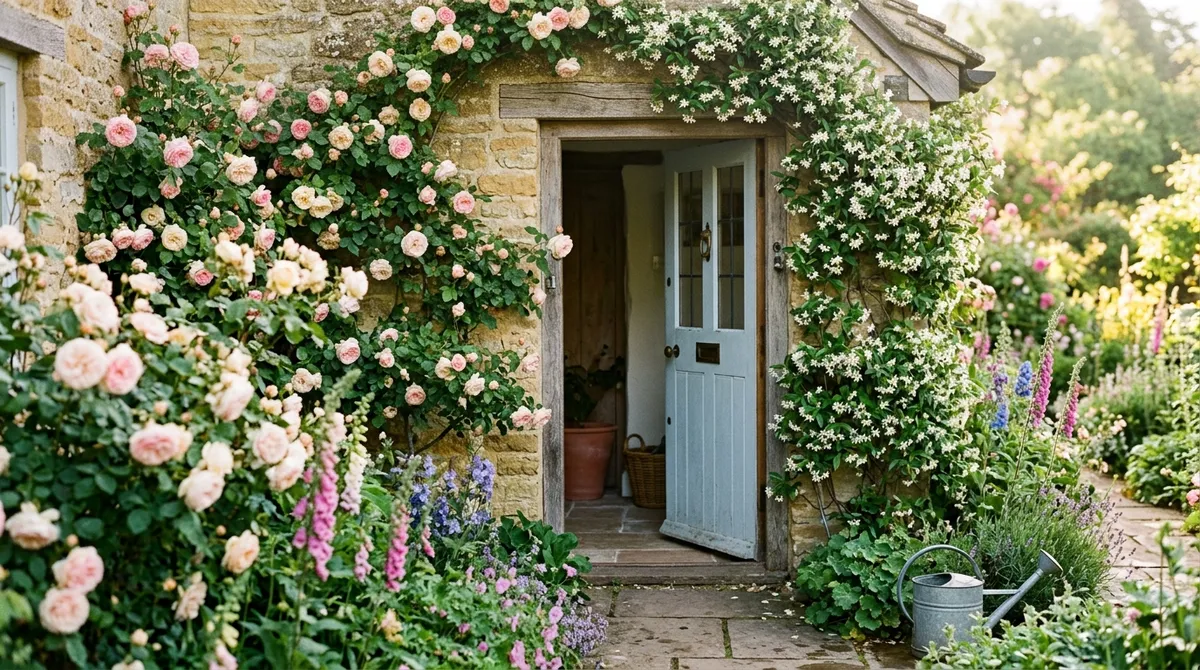
Star jasmine is the finest all-round scented climber for a UK garden. It carries clusters of small white pinwheel flowers from June to September, each one giving off a sweet, true jasmine perfume that hangs in the evening air. The dark, glossy leaves are evergreen, so the plant looks good all year and screens a wall in winter as well as summer.
It needs a warm south or west-facing wall to flower well and ripen its growth. In a cold or exposed garden it can struggle, so give it shelter. Despite the tropical scent, it is hardy to around -10C once established, though young plants appreciate a winter fleece in their first year or two.
Star jasmine is a twining climber that clings with stem tendrils. Give it horizontal wires or a trellis to grip. It is slow and well behaved, reaching 4 to 5 metres over many years, which makes it ideal for a courtyard, a small garden, or beside a door. Prune lightly after flowering to keep it tidy. It is one of the best low-maintenance plants for a sheltered wall.
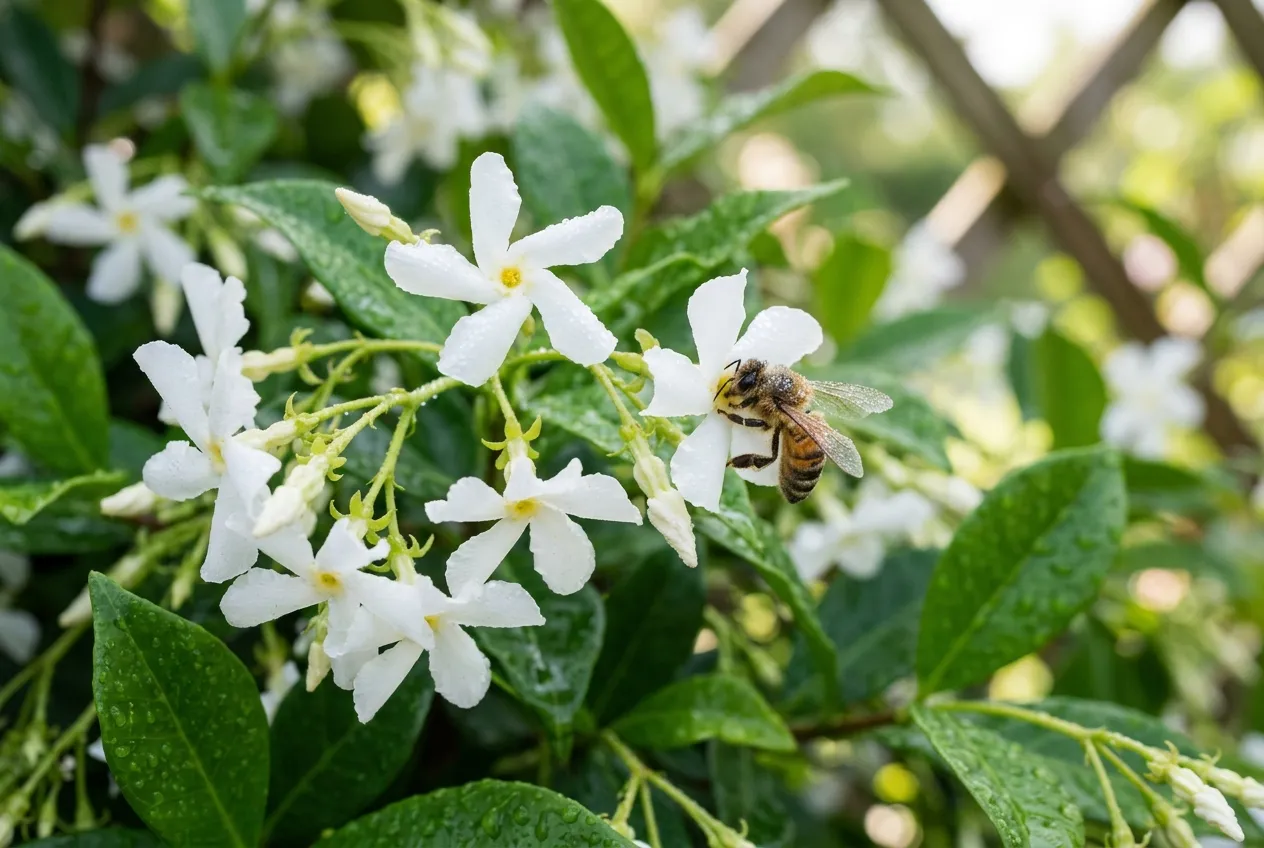 Star jasmine (Trachelospermum jasminoides) flowers from June to September and draws bees and evening moths to its sweet scent.
Honeysuckle (Lonicera periclymenum ‘Serotina’)
Honeysuckle is the climber for evening scent and for a cooler aspect. Our native woodbine, Lonicera periclymenum ‘Serotina’, the late Dutch honeysuckle, bears red-purple and cream tubular flowers from July to October. The perfume is rich and sweet, strongest at dusk, and it pulls in moths, bumblebees and later berries for the birds.
This honeysuckle is happy in part shade and on a north or east-facing wall, which sets it apart from sun-loving jasmine. It likes its roots cool and shaded and its top growth in light. A classic planting is at the foot of a north wall with the stems trained up into the sun above.
It twines strongly and reaches 4 to 7 metres, so give it sturdy wires, a trellis or an arch. Honeysuckle can get bare and congested at the base. Prune after flowering, taking out a third of the oldest stems on mature plants to keep growth fresh from low down. Keep it watered in summer, as drought stress brings on powdery mildew. For more on shady spots, see our guide to the best plants for shade.
Climbing and rambling roses
Scented climbing roses are the heart of the English cottage wall. Three stand out for fragrance and reliability. Rosa ‘Gertrude Jekyll’ is a David Austin climber with rich pink rosettes and a strong, true old-rose scent, often called the best rose perfume of all. It repeat-flowers from June into autumn and reaches around 3 metres.
Rosa ‘New Dawn’ is tougher than almost any other climber. It carries pale shell-pink, sweetly scented blooms from June to autumn, tolerates a north or east wall, and shrugs off poor soil. It grows to 3 to 4 metres. Rosa ‘Madame Alfred Carriere’ is a vigorous noisette with creamy-white, blush-tinted flowers and a warm, fruity fragrance. It flowers from early summer and famously performs even on a cold north-facing wall, climbing to 5 metres or more.
Tie climbing roses onto horizontal wires and bend the main stems sideways. Training shoots near horizontal forces flowering side shoots all along the stem rather than just at the tip. Prune in winter, removing dead and weak growth and shortening side shoots to two or three buds.
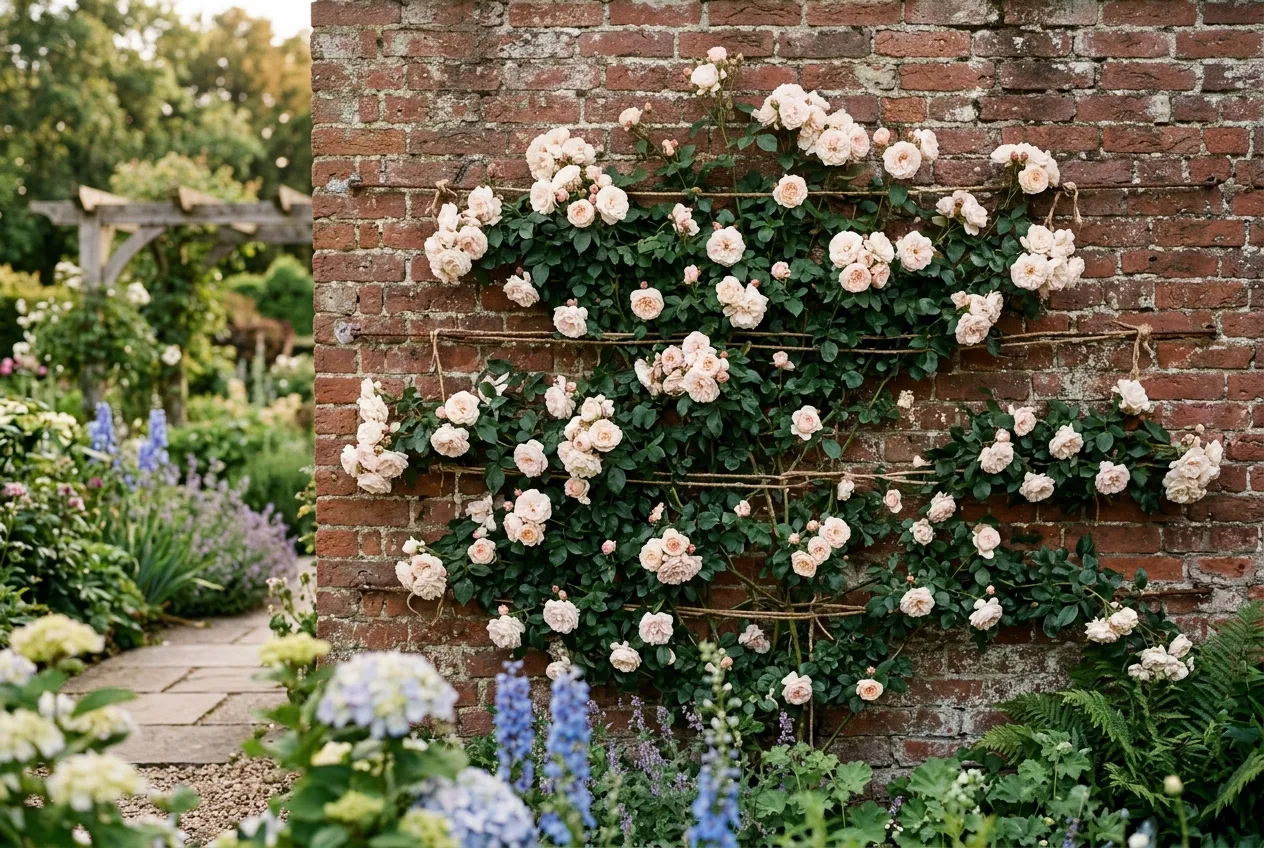 Rosa ‘Madame Alfred Carriere’ flowers even on a cold north wall, with a warm, fruity scent from early summer.
Wisteria (Wisteria sinensis)
Wisteria is the showstopper for a pergola, a house front or a long wall. Wisteria sinensis, Chinese wisteria, drapes long lilac-blue racemes up to 30cm in May, often before the leaves, with a soft sweet-pea scent. A mature plant in full bloom over a timber pergola is one of the great sights of the gardening year.
It demands a warm, sunny south or west aspect to flower and ripen its wood. It is fully hardy but extremely vigorous, reaching 10 metres or more, so it needs a strong structure and yearly control. Buy a grafted, named plant in flower if you can. Seed-raised wisteria can take 20 years to bloom or never flower at all.
Wisteria is the one climber that genuinely needs two prunes a year. In July or August, cut the long whippy summer shoots back to about five or six leaves. In February, shorten those same shoots again to two or three buds. This builds the short flowering spurs that carry next year’s racemes.
Warning: All parts of wisteria are poisonous, especially the seed pods, which children may mistake for peas. Wisteria is also strong enough to crush gutters, lift tiles and block downpipes. Keep it off the house structure and away from where children play, and never let it grow into the roof.
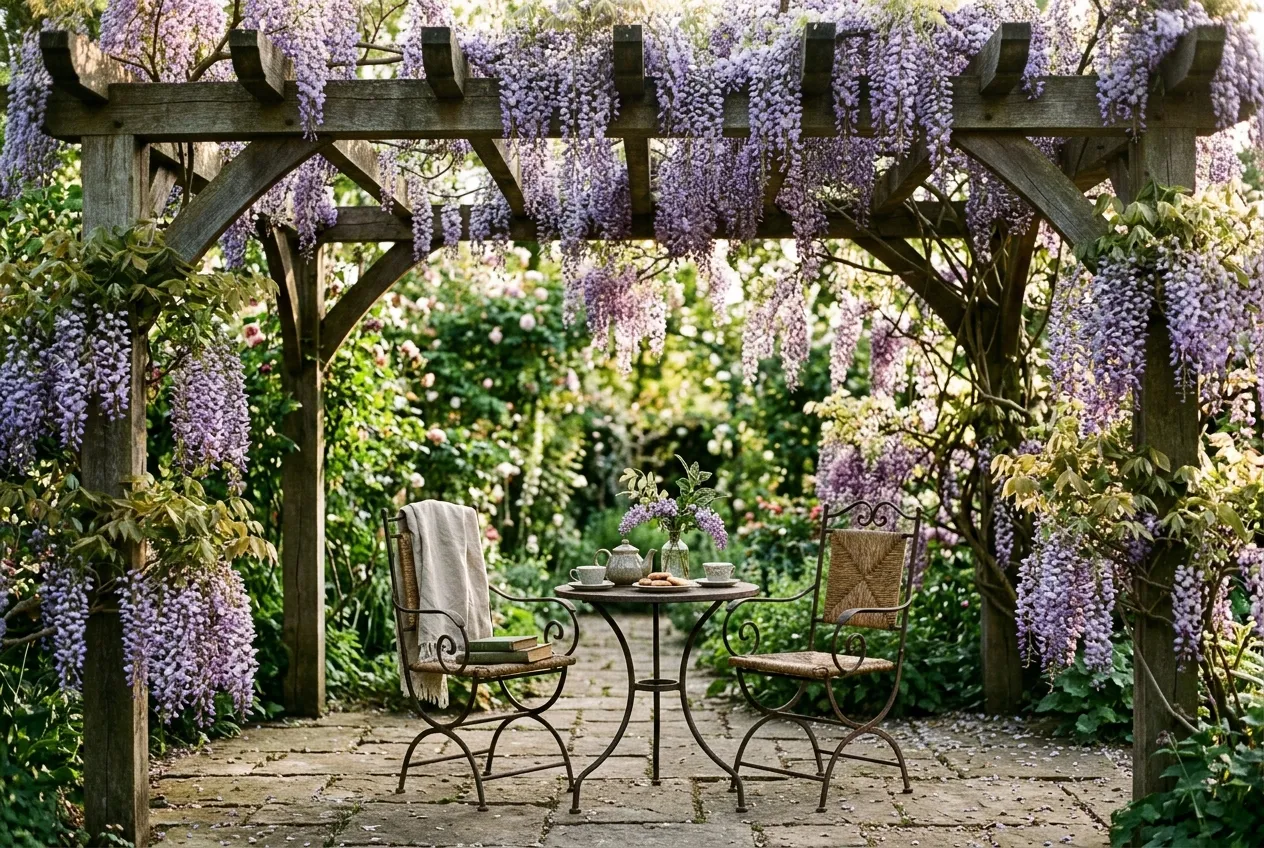 Wisteria sinensis over a pergola in May. It needs a sunny aspect, a strong structure, and two prunes a year to flower well.
Summer jasmine (Jasminum officinale)
Summer jasmine is the classic white jasmine of warm evenings. Jasminum officinale produces clusters of small, pure white star-shaped flowers from June to September, releasing a heady, sweet perfume that is strongest after sunset. It is the scent most people picture when they think of jasmine, and a single plant by an open window will fill a room.
It needs a warm, sheltered south or west wall and free-draining soil. It is hardy in most of the UK, to around -10C, but resents cold winds and heavy wet ground. In colder northern gardens, give it the warmest spot you have or grow it in a large pot that can shelter against a wall.
This jasmine twines and scrambles to 6 to 8 metres, so it needs strong support: wires, a sturdy trellis, or an arch over a path. It can become a tangled thicket if left alone. After flowering, thin out old and crowded stems and tie in the rest. A bench set close by, such as the Rustic Straight Grey Granite Garden Bench, makes the most of the evening scent.
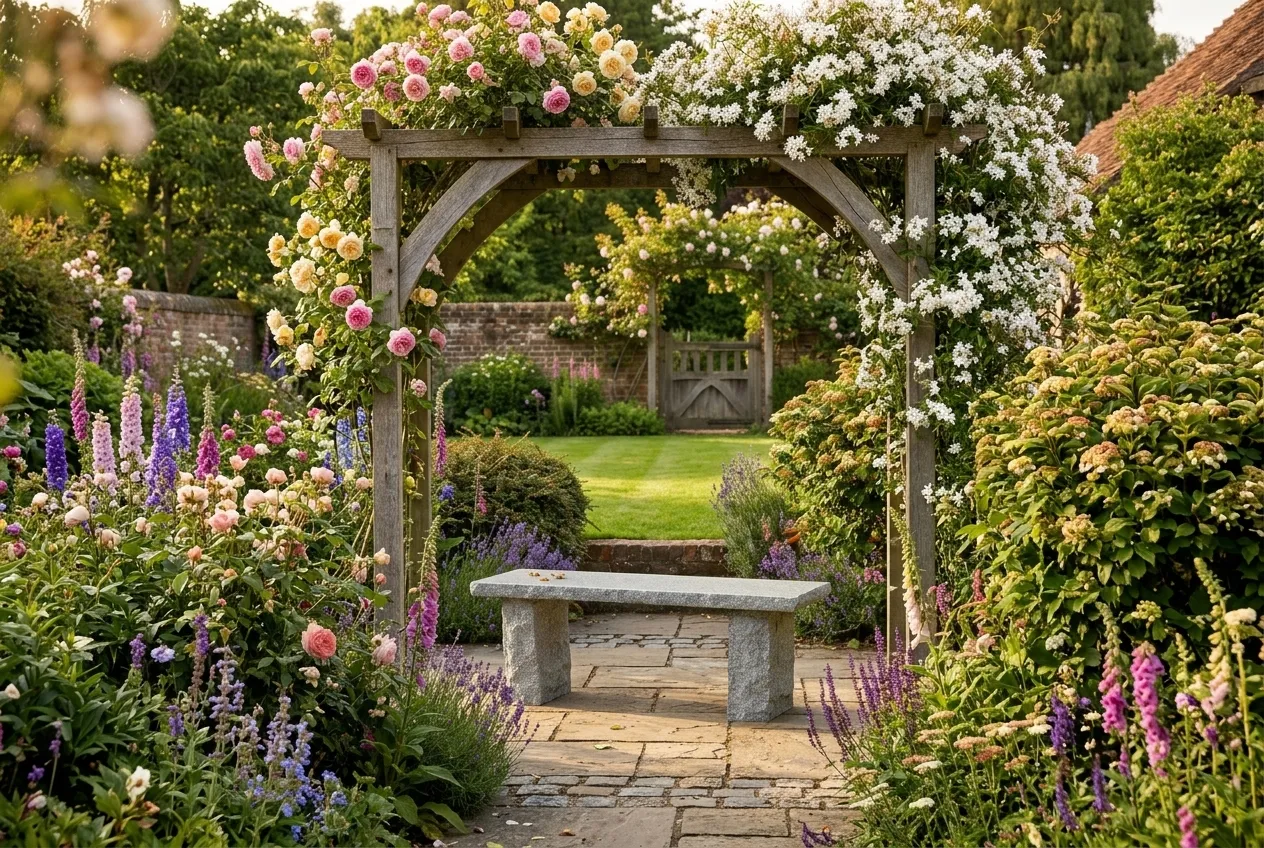 A solid granite bench beneath a climber-clad arch. Site a seat where the evening jasmine scent collects.
Sweet peas (Lathyrus odoratus)
Sweet peas give the strongest scent for the least space and the lowest cost. Lathyrus odoratus is a hardy annual, grown fresh from seed each year, that climbs 1.8 to 2 metres up canes, netting or an obelisk in a single season. The old-fashioned and Spencer varieties carry the best perfume. Look for named scented types like ‘Cupani’, ‘Matucana’ and ‘Painted Lady’ rather than show varieties bred only for flower size.
Sweet peas flower from June to October if you keep picking. The more you cut, the more they bloom, because the plant flowers to set seed. Stop picking, or let pods form, and flowering quickly stops. A jug of sweet peas on the kitchen table is the whole point of growing them.
Sow seed in autumn in a cold frame for the earliest, strongest plants, or in February and March under cover. Plant out after the last frost in a sunny, fertile spot with plenty of moisture. They are hungry and thirsty, so feed and water through summer. As pollinator favourites, they suit a bee-friendly garden as well as a cutting patch.
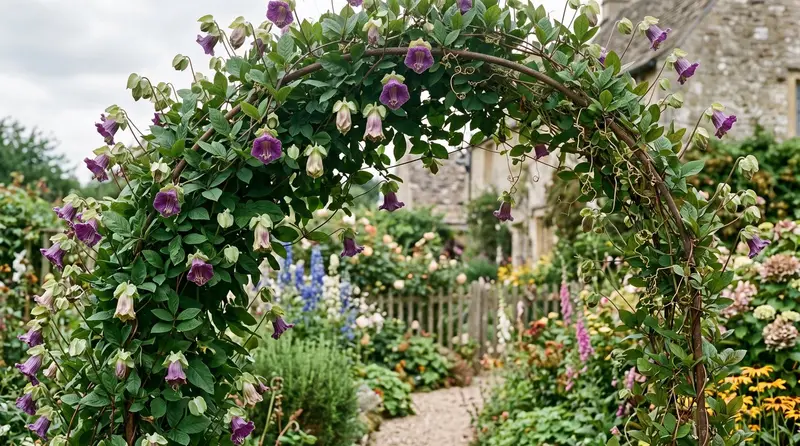
For a second fast annual with an evening perfume, the cup-and-saucer vine (Cobaea scandens) releases a light honey scent at dusk that draws in moths, climbing 3-5m up the same netting or obelisk in one season.
Clematis armandii and montana
Two clematis earn a place among scented climbers, one early and one for spring. Clematis armandii is evergreen, with long leathery leaves and clusters of almond-scented white flowers in March and April, when little else climbs in bloom. It needs a warm, sheltered south or west wall, as cold winds scorch the foliage. It reaches 4 to 5 metres and only needs a light tidy after flowering.
Clematis montana is the vigorous spring favourite. The scented forms, such as Clematis montana var. rubens ‘Elizabeth’, carry masses of soft pink, vanilla-scented flowers in May. It is tough, hardy and happy on almost any aspect including north, but it is fast and large, covering 7 to 10 metres of wall, fence, shed or old tree.
Both belong to clematis pruning group 1, the early-flowering group. Prune only if needed, and only straight after flowering, never in winter. Cutting them hard in spring removes the very growth that carries the flowers. Give montana room, as it quickly outgrows a small trellis and swamps weaker neighbours.
Akebia quinata, the chocolate vine
Akebia quinata, the chocolate vine, is the climber for something different. It bears small, deep maroon-purple flowers in April and May with a soft scent of chocolate and spice, carried best on a warm still day. The pretty five-fingered leaves are semi-evergreen, holding on through mild winters and dropping in hard ones.
It is fully hardy and far less fussy than its exotic looks suggest. It grows happily on sun or part shade and on most aspects, though the scent and any fruit come more freely in sun. After a long hot summer it can set strange sausage-shaped violet pods, though these need two plants for reliable pollination.
Akebia is a twining climber and seriously vigorous, reaching 8 to 10 metres, so give it a large wall, a sturdy pergola or an old tree to scramble through. It can swamp a small structure in a couple of seasons. Prune after flowering to keep it in bounds, cutting back the long whippy stems and thinning congested growth. It is a fine choice where you want quick, fragrant cover over an ugly fence or outbuilding.
Scented climber comparison
| Climber | Scent | Flowering | Aspect | Height | Hardiness |
|---|---|---|---|---|---|
| Star jasmine | Sweet jasmine, evening | Jun-Sep | South/west, sheltered | 4-5m | To -10C |
| Honeysuckle ‘Serotina’ | Rich, sweet, evening | Jul-Oct | Any, incl. north | 4-7m | Fully hardy |
| Rose ‘Madame Alfred Carriere’ | Warm, fruity | Jun-Sep | Any, incl. north | 5m+ | Fully hardy |
| Wisteria sinensis | Soft, sweet-pea | May | South/west, sunny | 10m+ | Fully hardy |
| Summer jasmine | Heady, sweet, evening | Jun-Sep | South/west, sheltered | 6-8m | To -10C |
| Sweet peas | Strong, classic | Jun-Oct | Sunny | 1.8-2m | Hardy annual |
| Clematis montana | Vanilla | May | Any, incl. north | 7-10m | Fully hardy |
| Akebia quinata | Chocolate, spice | Apr-May | Sun/part shade | 8-10m | Fully hardy |
Supports: wires, trellis, arches and pergolas
Get the support right before you plant. Different climbers cling in different ways, and the wrong structure leads to a plant flopping off a wall within a year. Twining climbers such as honeysuckle, jasmine, wisteria and akebia wrap their stems around supports. Tendril climbers like clematis and sweet peas grip with leaf stalks. Roses are scramblers with thorns and must be tied in by hand, as they cannot climb on their own.
For a wall, fix horizontal wires using vine eyes, spacing the wires 30 to 45cm apart and holding them 5cm off the brickwork so air circulates and stems can twine. Use tensioned galvanised or plastic-coated wire. A timber trellis mounted on 5cm battens works for the same plants and looks neater on a small area.
For a path or a doorway, an arch carries a climber overhead so you walk through the scent. A metal arch such as the Gothic Antiqued Metal Garden Arch suits a rose or jasmine over a gravel path. For a seating area, a pergola of stout timber posts and beams carries heavyweight climbers like wisteria, and roofs a patio in fragrant shade.
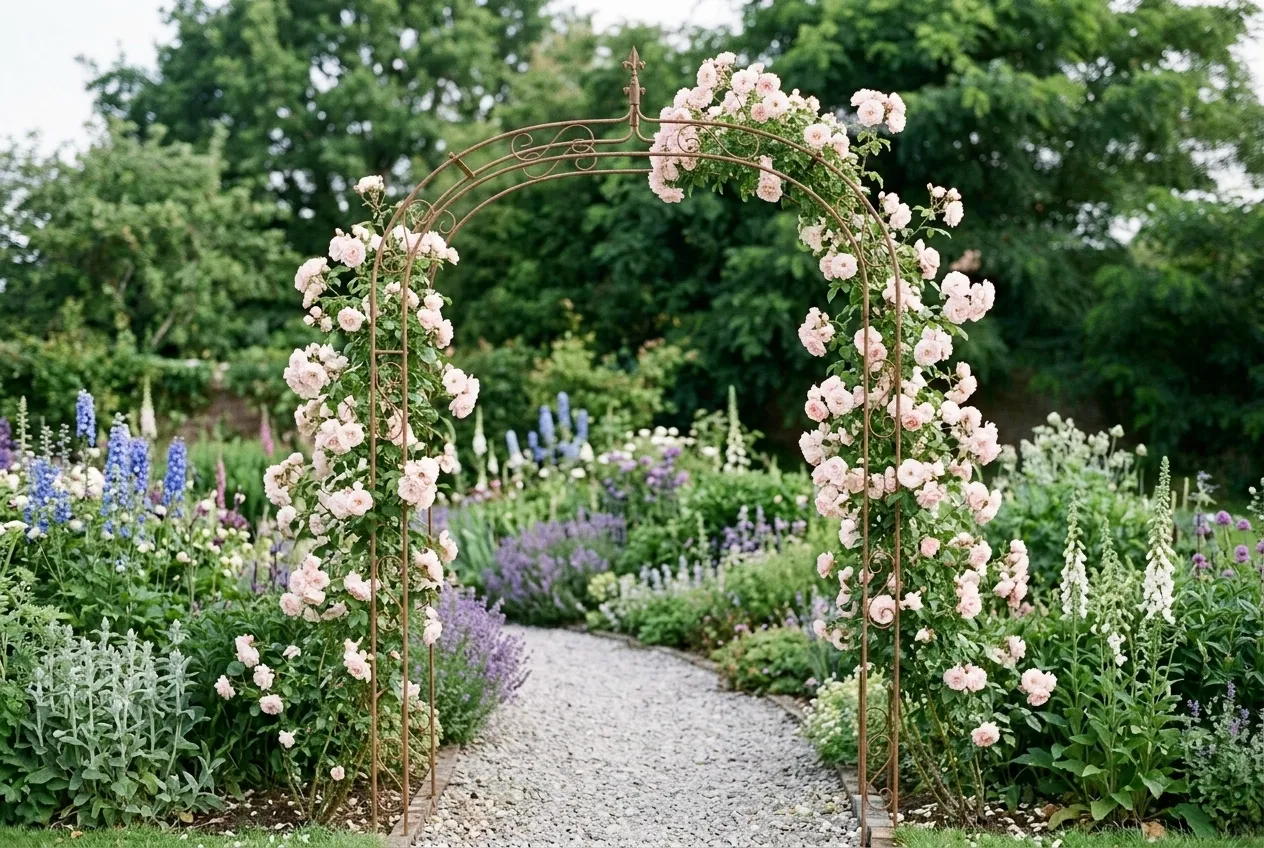 A Gothic metal arch over a path lets you walk through the scent. Train a rose or jasmine over the top and tie in regularly.
Matching the climber to the aspect
Aspect decides which climber will thrive. Check which way your wall faces before you buy, as the difference between a north and a south wall is the difference between failure and a plant smothered in flower. Stand with your back to the wall: if you face south, the wall is south-facing and warm.
A south or west wall is the warmest and suits sun-lovers that need heat to flower and ripen their wood: wisteria, star jasmine, summer jasmine and Clematis armandii. These reward the best spot in the garden with the strongest scent.
A north or east wall is cooler and shadier, but plenty of scented climbers cope. Honeysuckle, Clematis montana and the roses ‘Madame Alfred Carriere’, ‘New Dawn’ and ‘Gertrude Jekyll’ all flower on a cool aspect. East walls catch early sun, which can scorch frosted blooms, so avoid early flowerers there. Whatever the aspect, dig in plenty of compost and keep new climbers watered through their first two summers while the roots establish.
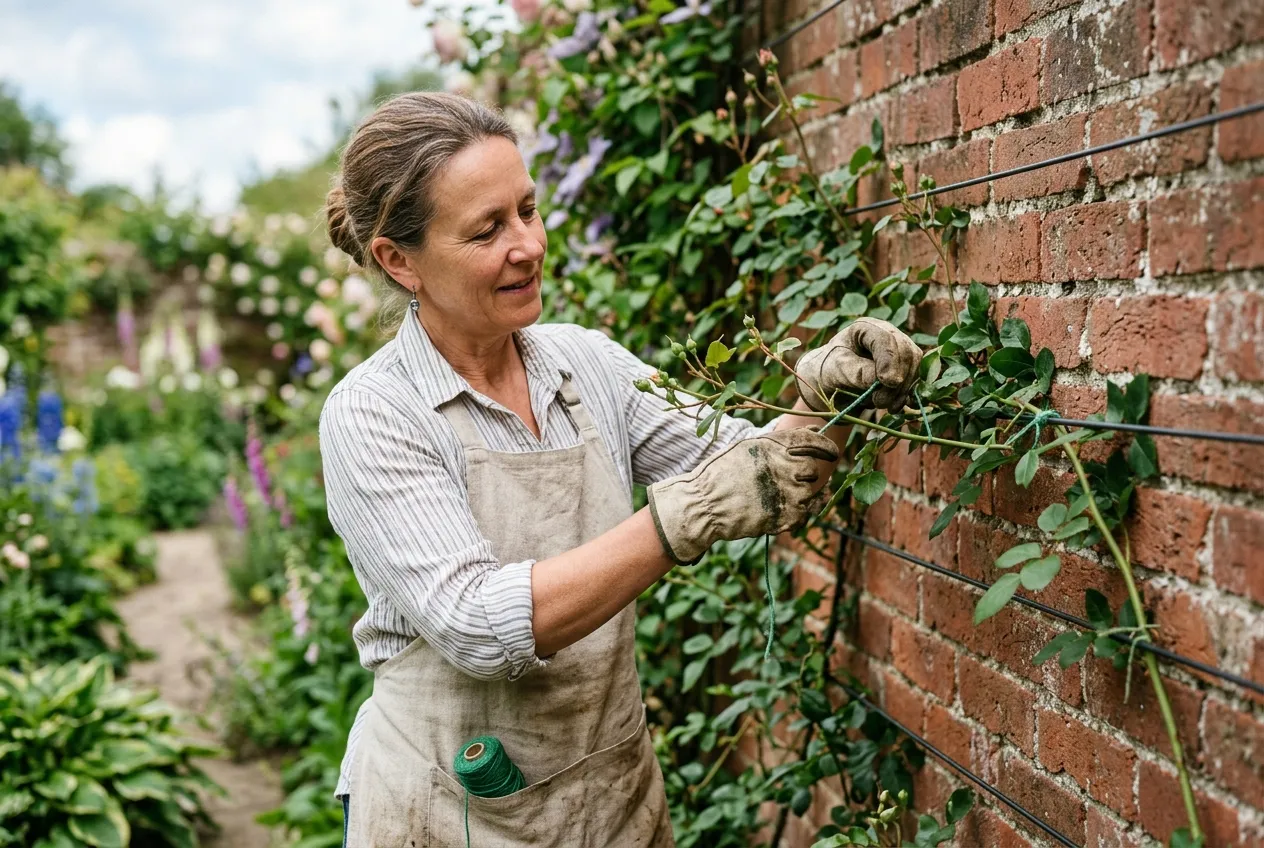 Tie young growth onto the wires with soft twine, spreading stems out like a fan to cover the wall evenly.
Pruning basics for scented climbers
Most climbers flower poorly because they are pruned at the wrong time or not at all. The golden rule is simple. Climbers that flower on the current year’s growth are pruned in late winter or early spring. Climbers that flower on last year’s wood are pruned straight after they finish flowering.
Wisteria is the exception that needs two cuts: long shoots shortened in July, then again in February to build flowering spurs. Honeysuckle, Clematis armandii and Clematis montana are pruned only after flowering, taking out old or crowded stems. Never cut montana or armandii in winter, as you remove the spring flowers.
Climbing roses are pruned in winter when dormant. Remove dead, diseased and crossing wood, then shorten the flowering side shoots to two or three buds and tie in the main stems horizontally. Summer jasmine and star jasmine need only thinning after flowering to stop them tangling. Sweet peas need no pruning, just constant picking. When in doubt, prune lightly and watch where the flowers form, then time next year’s cut to protect that growth.
Month-by-month scented climber calendar
| Month | Task |
|---|---|
| January | Plan and order plants. Fix wall wires and trellis while beds are bare. |
| February | Prune climbing roses. Do the second, hard wisteria prune to two or three buds. |
| March | Plant container-grown climbers. Sow sweet peas under cover. Mulch established plants. |
| April | Clematis armandii and akebia flower. Tie in new growth. Start watering new plants. |
| May | Wisteria and Clematis montana flower. Plant out sweet peas after the last frost. |
| June | Roses, jasmine and star jasmine begin. Tie in and feed. Start picking sweet peas. |
| July | Peak scent. First wisteria prune, cutting long shoots to five or six leaves. |
| August | Continue picking sweet peas. Water in dry spells. Prune early-flowered honeysuckle. |
| September | Star jasmine and late roses still flowering. Take semi-ripe cuttings of jasmine. |
| October | Honeysuckle berries form. Sow autumn sweet peas in a cold frame for early plants. |
| November | Plant bare-root climbing roses. Clear spent sweet pea plants and netting. |
| December | Check ties and supports before winter gales. Firm in any lifted new plants. |
| Year-round | Keep all new climbers well watered through their first two summers. |
Common mistakes
Planting scent where nobody passes
The most common mistake is siting a scented climber on a far fence or boundary. The fragrance drifts away unnoticed. Always plant within 2 metres of a door, path, seat or window you open. Walls and enclosed corners trap still air and concentrate the perfume where you can enjoy it.
Putting a sun-lover on a cold wall
Wisteria, star jasmine and summer jasmine need a warm south or west wall to flower. Plant them on a cold north wall and you get healthy leaves and few or no blooms. Match the plant to the aspect. Save north and east walls for honeysuckle, montana clematis and tough roses.
Pruning at the wrong time
Cutting Clematis montana or armandii in winter or spring removes the very buds that carry the flowers. Both are pruned only after flowering. Likewise, failing to prune wisteria twice a year leaves it all leaf and no bloom. Learn which group your plant belongs to before you reach for the secateurs.
Forgetting the support
Roses cannot climb on their own and must be tied in by hand, yet many gardeners expect them to cling like ivy. Fix wires or trellis before planting. Without support, stems flop, snap in wind, and never flower along their length.
Letting vigour run away
Wisteria, akebia and montana clematis are huge, fast climbers. Plant one against a small fence or a house gutter and it quickly becomes a problem, blocking drains and lifting tiles. Give vigorous climbers a big, strong structure and prune them every year to keep control.
Gardener’s tip: Train the main stems of any climber as near to horizontal as you can. Bending stems sideways rather than letting them shoot straight up triggers far more flowering side shoots, so the whole wall blooms instead of just the top.
Related reading: Ivy earns its place for late nectar rather than scent, covered in our guide to growing and controlling English ivy.
Frequently asked questions
What is the most fragrant climbing plant for UK gardens?
Star jasmine and summer jasmine are the most fragrant climbers for UK gardens. Star jasmine (Trachelospermum jasminoides) scents the air from June to September on a warm wall, while summer jasmine (Jasminum officinale) smells strongest on warm evenings. Both carry a sweet, true jasmine perfume that fills a courtyard or drifts through an open window.
Which scented climber grows in shade or on a north wall?
Honeysuckle is the best scented climber for a north or shady wall. Lonicera periclymenum ‘Serotina’ flowers well in part shade and scents the evening air with rich, sweet perfume. The climbing roses ‘Madame Alfred Carriere’ and ‘New Dawn’ also bloom on a cool north or east aspect, where sun-loving jasmine and wisteria fail to flower.
What is the best scented climber for a pergola or arch?
Wisteria and rambling roses are the classic choices for pergolas and arches. Wisteria drapes scented lilac racemes through timber beams in May. Repeat-flowering roses such as ‘New Dawn’ clothe an arch with fragrant blooms from June into autumn. Both are heavy and vigorous, so build the structure stout enough to carry years of growth.
How do I get climbers to smell stronger in the garden?
Position scented climbers near seating, doorways and paths where you pass. Fragrance is wasted on a far fence. Many climbers, including jasmine and honeysuckle, release the most scent in the evening to attract moths, so plant these by a patio or back door. A warm, sheltered, sunny wall traps still air and lifts the perfume.
Is wisteria poisonous and how vigorous is it?
Yes, all parts of wisteria are poisonous, especially the seeds and pods. The pods resemble pea pods, so keep wisteria away from where children play. It is also extremely vigorous, reaching 10 metres or more and strong enough to lift tiles and crush gutters. Keep it off the house structure and prune it twice a year.
When do scented climbers flower in the UK?
Most scented climbers flower between May and September. Clematis montana and wisteria lead in May. Roses, honeysuckle and jasmine peak in June and July. Star jasmine and repeat-flowering roses carry on into September. Clematis armandii and akebia flower earliest in spring, and sweet peas fill summer from June to October if you keep picking.
Which scented climber is best for a small garden?
Star jasmine is the best scented climber for a small garden. It is evergreen, slow and well behaved, reaching only 4 to 5 metres, so it suits a courtyard wall or trellis without taking over. Sweet peas up an obelisk give strong scent in a tiny space and can be cleared away each autumn, freeing the spot for next year.
Our team produces practical UK gardening guidance from source research, contributor records and established horticultural practice. Editorial standards are overseen by Matt W.