Key takeaways
- Green larvae with black spots can strip gooseberry foliage rapidly if they go undetected
- Three generations per year in the UK: April, June, and August, with the first often missed inside the bush
- Hand picking larvae twice weekly from mid-April is the single most effective organic control
- Ground beetles eat pupating sawfly larvae in the soil and are the main natural predator in UK gardens
- Pyrethrum spray is the only approved organic contact spray but must hit larvae directly to work
- Fine netting in March prevents adult sawflies from reaching bushes to lay eggs
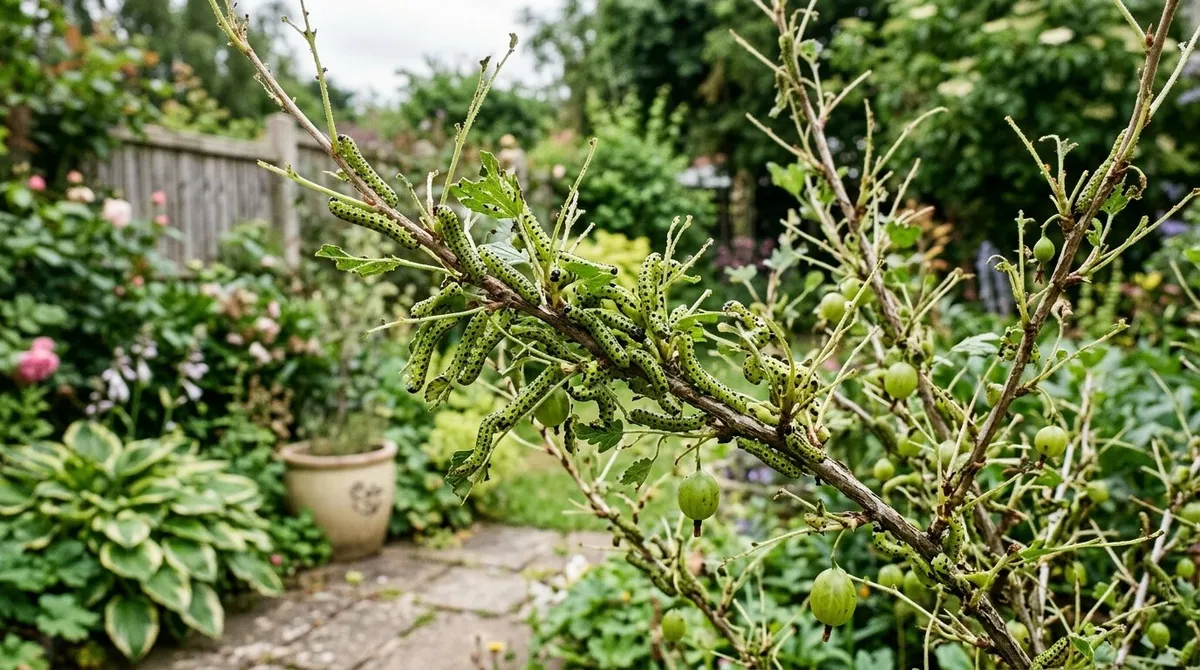
Gooseberry sawfly larvae are pale green and caterpillar-like, with black spots on the common species. They feed in groups and can rapidly consume leaves down to the midrib. The speed of the damage is what catches growers off guard.
The common species is Euura ribesii, a sawfly rather than a moth. Sawfly larvae look like caterpillars but have more abdominal prolegs. The distinction helps identification but does not change the first response: inspect inner leaves and remove larvae promptly. The common species can have three generations per year in the UK.
How do I identify gooseberry sawfly larvae?
Gooseberry sawfly larvae are pale green with obvious black spots across the body and a shiny black head. Fully grown larvae reach 20mm long. They have 7 pairs of fleshy prolegs along the abdomen, distinguishing them from true caterpillars which have 5 pairs.
Young larvae are much smaller, just 3-4mm, and easy to overlook. They are translucent pale green at first, with the black spots developing as they grow. First-instar larvae feed on the lower leaf surface, creating small translucent windows in the leaf. These “windowed” leaves are often the earliest visible damage.
Larvae feed in groups, clustered along leaf margins. When disturbed, they adopt a characteristic S-shaped defensive posture, curling the head and tail upwards while gripping the leaf with their central prolegs. This behaviour is distinctive and confirms identification.
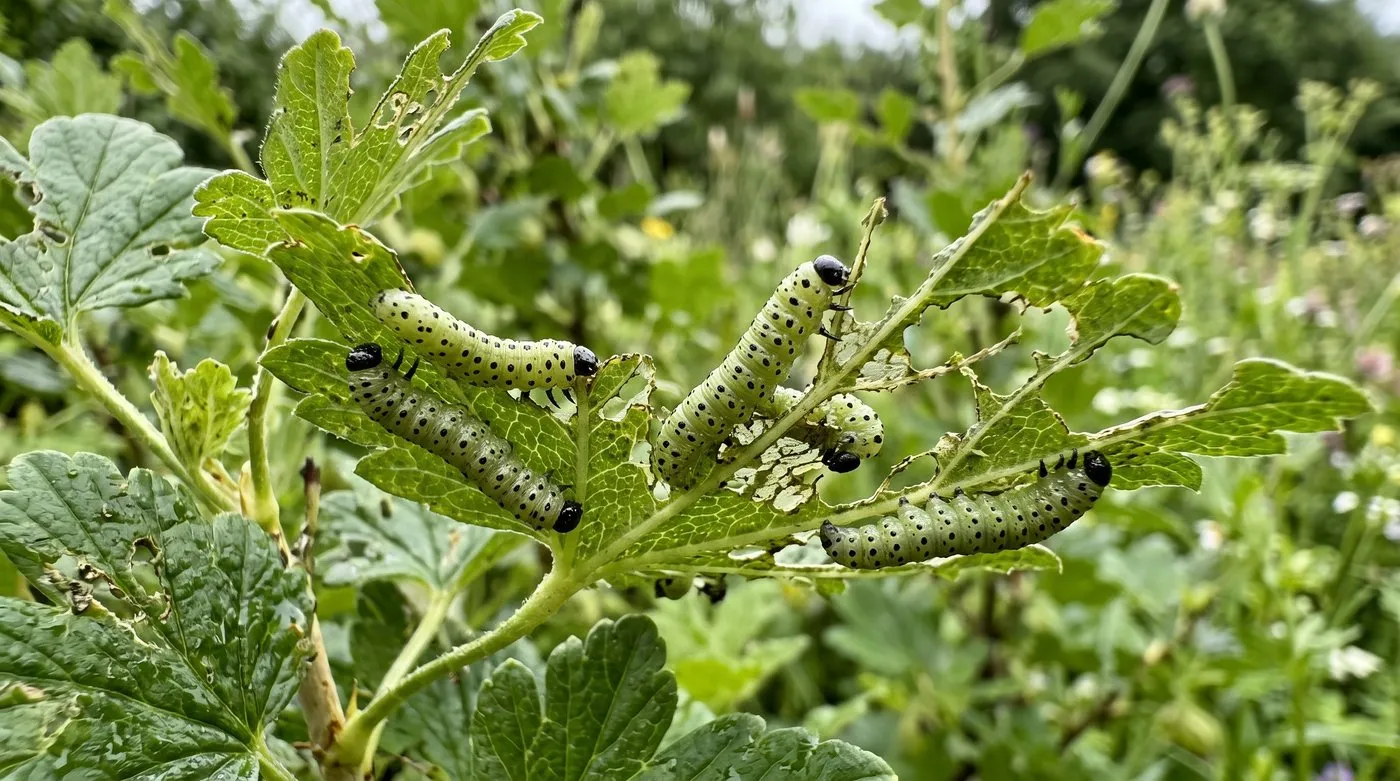 Common gooseberry sawfly larvae are pale green with black spots and a dark head. Look for groups feeding low inside the bush.
The adults are inconspicuous. Female sawflies are 6-8mm long, yellow-bodied with a dark head and wings. Males are smaller and darker. You are unlikely to see adults unless you are specifically looking for them in April.
Comparison: gooseberry sawfly vs common lookalikes
| Feature | Gooseberry sawfly (Euura ribesii) | Magpie moth caterpillar | Winter moth caterpillar |
|---|---|---|---|
| Colour | Pale green with black spots | White with black spots and yellow flank stripe | Green, no spots |
| Size (mature) | Up to 20mm | Up to 40mm | Up to 25mm |
| Prolegs | 7 pairs (sawfly) | 5 pairs (true caterpillar) | 2 pairs (looper) |
| Feeding pattern | Groups on leaf margins | Solitary on leaves | Solitary, looping walk |
| Defensive posture | S-shaped curl | Curls into ball | Drops on silk thread |
| Active period | April-September (3 generations) | May-July (1 generation) | March-May (1 generation) |
| Host plants | Gooseberry, red and white currants | Gooseberry, currants, many others | Most deciduous fruit and trees |
What is the lifecycle of gooseberry sawfly?
Three distinct generations hatch per year in most UK regions, creating repeated waves of damage from April to September. Understanding this cycle is essential because a single round of hand picking in April is not enough. You must check regularly throughout the growing season.
First generation (April-May). Adult sawflies emerge from overwintering pupae in the soil as temperatures rise above 10C. Females lay 50-80 eggs in neat rows along the leaf veins, usually on interior leaves low in the bush canopy. Eggs are pale green, cylindrical, and 1.5mm long. They hatch in 7-14 days depending on temperature. Larvae feed for 3-4 weeks before dropping to the soil to pupate.
Second generation (June-July). Adults from the first generation emerge and lay eggs immediately. This generation often coincides with fruit ripening. Defoliation at this stage reduces sugar accumulation in developing fruit, producing small, sour berries.
Third generation (August-September). The final wave of larvae feeds on late-season foliage. Bushes that were stripped earlier and have regrown are attacked again. Third-generation larvae pupate in the soil and overwinter as pupae, completing the annual cycle.
In northern Scotland and exposed upland sites, only two generations may complete the cycle. In warm southern gardens, a partial fourth generation sometimes appears in October during mild autumns.
Why is the first generation the most dangerous?
First-generation larvae hatch inside the bush centre where they are completely invisible from outside. Adult females deliberately choose interior leaves for egg-laying. By the time damage becomes visible on the exterior canopy, the interior may already be stripped bare.
Do not judge the bush from outside. Part the canopy and inspect the inner leaves, where early feeding can remain hidden until bare branches begin to show.
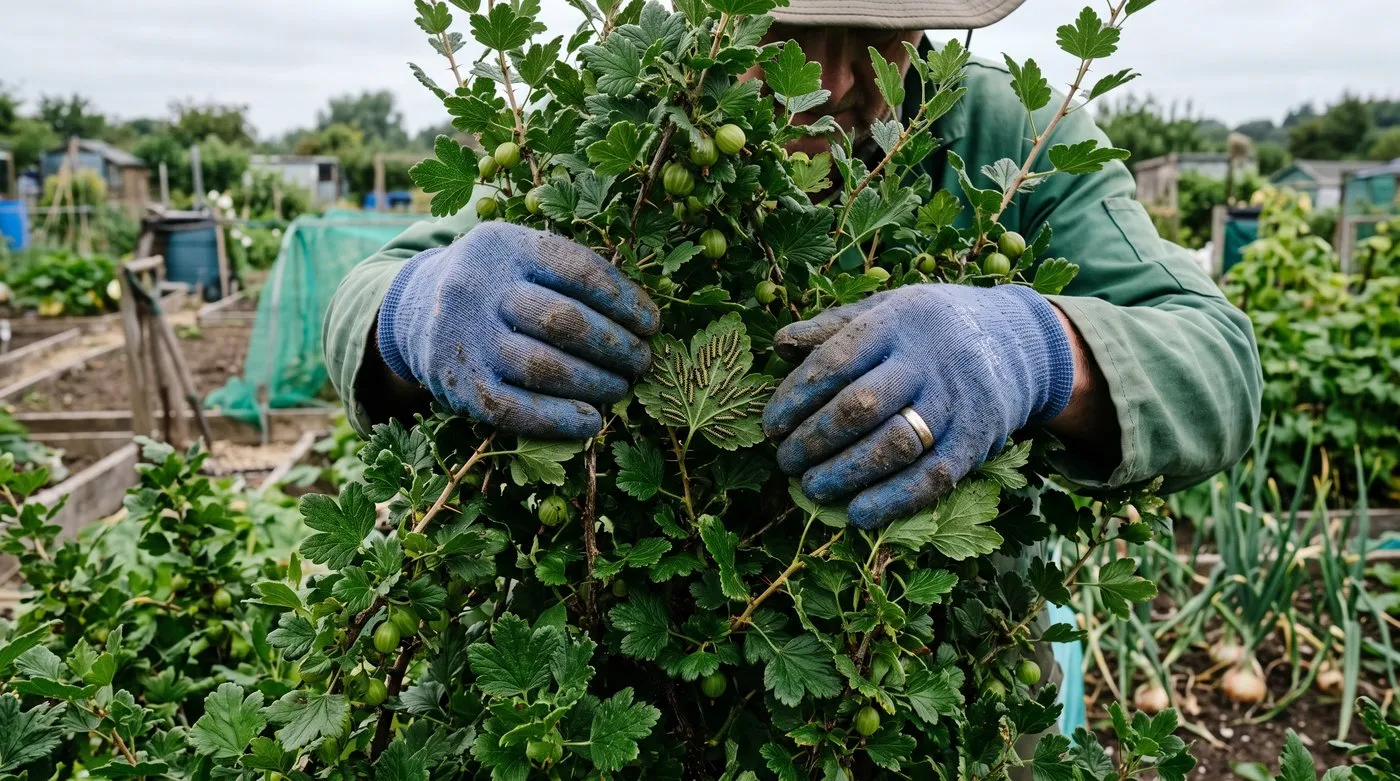 Part the branches and check low inner leaves from April. Eggs and young larvae begin where the outer canopy hides them.
The first generation also causes the most crop damage. April and May foliage drives fruit development. Gooseberry fruit relies on the leaves immediately surrounding it for photosynthate. Strip those leaves and the fruit stops swelling. The berries remain small, hard, and acidic.
From mid-April onwards, make a habit of parting the branches on every gooseberry and currant bush and looking at the interior leaves. The larvae stand out clearly against the leaf surface. Two minutes per bush, once a week, prevents a full-scale defoliation.
A five-minute inspection routine
Start at the bottom centre of the bush rather than the shoot tips. Lift three or four branches, turn over the youngest inner leaves and look for pale eggs, translucent feeding windows or groups of larvae along an edge. Check red and white currants at the same time. Remove larvae into a container, then inspect again a few days later because eggs may continue to hatch. Record the date of the first find so the next generation does not arrive unnoticed.
How do I control gooseberry sawfly by hand picking?
Hand picking larvae into a bucket of soapy water twice weekly from mid-April is the single most effective control method. It is also the simplest. No equipment, no chemicals, no cost. It works because you are removing larvae before they can strip enough foliage to affect the crop.
Start checking in mid-April regardless of whether you see adult sawflies. Eggs take 7-14 days to hatch. By the time you spot larvae, the eggs were laid 1-2 weeks ago. Focus on the interior of the bush first. Part the branches and examine leaves on both surfaces.
Young larvae cluster along the leaf margin. A single leaf may hold 10-15 larvae. Pick the whole group by pinching the leaf edge and dropping them into soapy water. Larger larvae are easier to spot but have already done more damage. Catching them small is better.
Repeat the inspection at least weekly through the main feeding periods. During an outbreak, check every few days because small larvae can strip foliage quickly.
If hand picking feels impractical, lay a light-coloured cloth or sheet under the bush and shake the branches firmly. Larvae drop readily and stand out on a pale background. Pick them up and dispose of them.
Is there a biological control for gooseberry sawfly?
The RHS gooseberry sawfly guide lists a pathogenic-nematode product sold as Fruit and Vegetable Protection. It is watered onto infested foliage during cool, damp weather so the nematodes can infect exposed larvae.
Use biological control only for a confirmed problem and follow the current product directions. Nematodes can affect non-target animals, so they are not a routine preventive treatment. Hand removal remains the most selective response for a small number of bushes.
| Control method | Best use | Timing | Main caution |
|---|---|---|---|
| Hand picking | Small gardens and early colonies | Inspect from April; repeat as needed | Check the hidden centre of the bush |
| Biological nematodes | A confirmed, active infestation | Cool, damp weather | Follow label; avoid unnecessary use |
| Natural enemies | Long-term garden resilience | Year-round habitat support | Will not remove an established colony alone |
How do ground beetles help control gooseberry sawfly?
Ground beetles (Carabidae) are among the natural enemies of gooseberry sawfly. They hunt at night on the soil surface and take larvae or pupae around fruit bushes. Birds and wasps also feed on sawfly larvae in the canopy.
Large ground beetle species, particularly the violet ground beetle (Carabus violaceus, 20-30mm) and the common black ground beetle (Pterostichus madidus, 14-18mm), are the most effective predators. Both are common throughout the UK.
Encourage ground beetles by maintaining undisturbed ground cover near fruit bushes. Log piles, stone heaps, and permanent mulch provide daytime shelter. Avoid digging or rotavating under fruit bushes, which destroys ground beetle habitat and exposes their overwintering sites.
Support ground beetles with undisturbed mulch, log piles and ground-level shelter near fruit bushes. Treat this as supporting habitat rather than a stand-alone control; regular inspections and prompt removal of larvae remain essential.
Birds also help. Blue tits, great tits, wrens, and robins all eat sawfly larvae. A bird feeder near fruit bushes attracts birds that learn to forage on the bushes too. Our bird feeding guide covers seasonal feeding strategies.
Does gooseberry sawfly affect currant bushes?
The common gooseberry sawfly also attacks red and white currants. The RHS lists these as its principal currant hosts, so inspect them whenever nearby gooseberries are affected.
White currants, being closely related to redcurrants, are equally susceptible. If you grow gooseberries and currants together, which many gardeners do for convenient fruit growing, check all Ribes species during your weekly inspection rounds.
The pale spotted gooseberry sawfly, Euura leucotrochus, has pale green larvae and one main generation in May and June. The small gooseberry sawfly, Pristiphora appendiculata, can have up to four generations from late April.
Frequently asked questions
How quickly can gooseberry sawfly strip a bush?
A heavy infestation can strip a gooseberry bush within days. Larvae feed in groups and begin low in the centre of the plant. Check inner leaves from April so you find them before feeding reaches the outer canopy.
How many generations of gooseberry sawfly are there per year?
Three generations occur annually in most UK regions. The first hatches in mid-April, the second in June, and the third in August. Each generation takes roughly 4-6 weeks from egg to adult. The first generation is the most damaging because it strips foliage during the fruit-swelling period. In northern Scotland, only two generations may complete the cycle.
Where do gooseberry sawfly larvae hide?
First-generation larvae feed in the centre of the bush where they are invisible from outside. Adult females deliberately lay eggs on interior leaves, low in the canopy. Damage spreads outward as larvae grow. By the time you notice bare branches on the outside, the interior is already stripped. Part the branches and check inside from mid-April onwards.
What eats gooseberry sawfly in the garden?
Birds, wasps and ground beetles are useful natural enemies. Ground beetles take larvae and pupae at soil level, while birds and wasps forage in the canopy. Keep some undisturbed shelter near fruit bushes and avoid unnecessary broad-spectrum pesticides.
Is there a biological control for gooseberry sawfly?
Yes, a pathogenic-nematode product is sold for gooseberry sawfly larvae. The RHS lists Fruit and Vegetable Protection for use during cool, damp weather. Follow the product directions and use it only where a specific infestation needs treatment.
Does gooseberry sawfly affect currants?
Yes, gooseberry sawflies also feed on red and white currants. These are the currant hosts listed by the RHS. Check nearby bushes when an infestation appears on gooseberry.
Will a defoliated gooseberry bush recover?
Yes, a single defoliation will not kill an established gooseberry bush. The bush regrows leaves from dormant buds within 3-4 weeks. However, fruit on stripped branches will not ripen fully that season. Repeated annual defoliation weakens the root system progressively. After 3-4 years of uncontrolled sawfly, bushes produce smaller crops and shorter growth.
Our team produces practical UK gardening guidance from source research, contributor records and established horticultural practice. Editorial standards are overseen by Matt W.