Prep
30 minutes
Cook
6-10 hours (oven) or 4-6 hours (dehydrator)
Total
7-10 hours
Serves
Makes 1 large sheet (about 20 strips)
Key takeaways
- Spread fruit puree 3mm thick on baking parchment for even drying
- Oven method: 60-80C for 6-10 hours with the door slightly ajar
- Dehydrator method: 60C for 4-6 hours; faster and more reliable
- No added sugar needed; sweetness comes from ripe fruit and apple base
- Acidic fruit only; add 1 tsp lemon juice per 500g if pH is uncertain
- Roll in parchment strips, store airtight for 4-6 weeks at room temperature
From the Garden
Grow these for the recipe: Bramley and dessert apples (orchard or garden tree), Victoria and damson plums, Strawberries (June-bearing or perpetual), Blackberries (hedgerow or cultivated), Blackcurrants (mid-summer harvest).
Ingredients
Base puree (choose one combination)
- • 500g Bramley + 500g blackberry (autumn classic)
- • 500g Victoria plum + 500g eating apple (late summer)
- • 750g strawberry + 250g eating apple (June glut)
- • 750g blackcurrant + 250g apple + 2 tbsp honey (intense)
- • 1kg dessert apple alone (mild, kid-friendly starter)
Optional additions
- • 1 tsp lemon juice per 500g fruit (only for low-acid fruit)
- • 1 to 3 tbsp clear honey or maple syrup (tart fruit only)
- • 1/2 tsp ground cinnamon (apple-based blends)
- • 1/4 tsp vanilla extract (strawberry blends)
Equipment
- Large saucepan (3 litre)
- Stick blender or jug blender
- Fine sieve (for seeded fruit like blackberry, blackcurrant)
- Baking tray (33 x 23cm or similar) lined with baking parchment
- Palette knife or offset spatula
- Fan oven or food dehydrator
- Wooden spoon (to prop oven door)
- Pizza wheel or sharp scissors
- Airtight jar or tin for storage
Method
- 1
Wash and chop the fruit roughly. Apples need cores removed but not peeling. Plums need stoning. Strawberries need hulling. Blackberries and blackcurrants go in whole. Aim for around 1kg of prepared fruit total.
- 2
Place the fruit in a 3 litre saucepan with 3 to 4 tablespoons of water (just enough to stop it catching). Cover and cook over a low heat for 15 to 20 minutes, stirring every 5 minutes, until everything has collapsed into a soft pulp.
- 3
Take off the heat. Blend with a stick blender until completely smooth. For fruit with hard pips (blackberry, blackcurrant, raspberry), press through a fine sieve to remove the seeds. The texture should be like thick custard.
- 4
Taste the puree. If it is sharp (typical for blackcurrant or unripe plum), stir in 1 to 3 tablespoons of honey or maple syrup. If the fruit is low in acid (very ripe strawberry, pear, mango), add 1 teaspoon of lemon juice per 500g. Do not skip this step; the acid stops bacteria growing during the long slow drying.
- 5
Line a baking tray with a single sheet of baking parchment, smoothing out any creases. Do not use greaseproof paper; it sticks. Do not use silicone mats unless they are oven safe to 90C.
- 6
Pour the puree onto the parchment. Use a palette knife to spread it to exactly 3mm thick, slightly thicker at the centre and thinner at the edges to compensate for faster edge drying. Aim for an even rectangle with a sharp line.
- 7
For the oven method: heat the fan oven to 70C (or 80C if your oven cannot go lower). Place the tray on the middle shelf and prop the door open with a wooden spoon by about 2cm. This lets moisture escape. Dry for 6 to 10 hours.
- 8
For the dehydrator method: set to 60C, place the tray (or transfer the puree to the dehydrator's own non-stick sheet) on the middle level. Dry for 4 to 6 hours. Rotate trays once if your machine has hot spots.
- 9
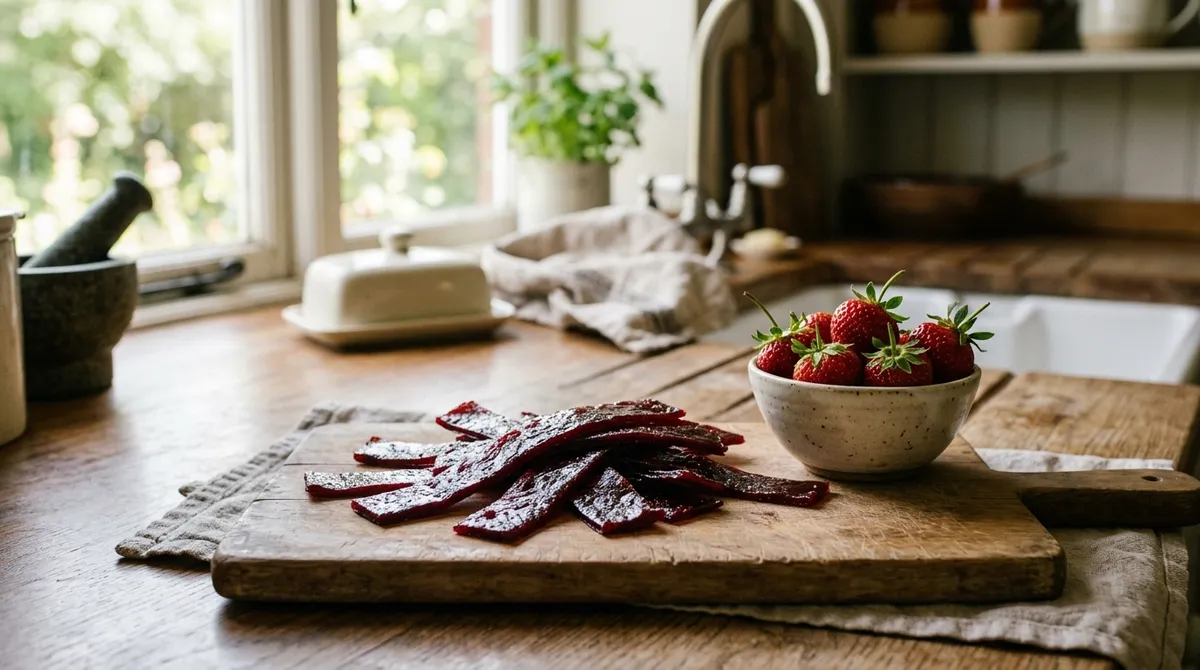
Check after 5 hours (dehydrator) or 7 hours (oven). The leather is ready when the surface is dry to the touch, the centre is no longer tacky, and the sheet peels cleanly away from the parchment in one piece. It should feel like soft chamois leather, not crisp like a crisp.
- 10
Cool flat on the tray for 30 minutes. Cut into strips 3 to 4cm wide using a pizza wheel or sharp kitchen scissors, leaving the parchment underneath. Roll each strip with the parchment still attached. Cut the parchment to length so each roll has its own backing.
- 11
Store the rolls in an airtight jar or tin in a cool dark cupboard. They keep for 4 to 6 weeks at room temperature, 3 months refrigerated, or 6 months frozen in a sealed bag.
Storage
Store rolled strips in an airtight jar or tin at room temperature for 4 to 6 weeks. The cool dark cupboard under the stairs is ideal in a UK kitchen. Refrigerated, the leather keeps 3 months but may pick up fridge smells; double-wrap in cling film inside the jar. Frozen in a sealed bag with the air pressed out, leather keeps 6 months and thaws in 10 minutes at room temperature. If the leather develops sticky patches, return it to the oven at 70C for 30 minutes; if it goes mouldy in storage, the original puree was either too thick (over 4mm) or too low in acid; discard the whole batch.
What Fruit Works Best for UK Fruit Leather
The best fruit for leather has three qualities: enough acid to prevent bacterial growth (pH below 4.5), enough pectin to set the dried sheet, and enough natural sweetness to taste good without added sugar. Apple scores highest on all three. A Bramley or Cox base gives any leather a forgiving texture, and apples are abundant in the UK from August to November.
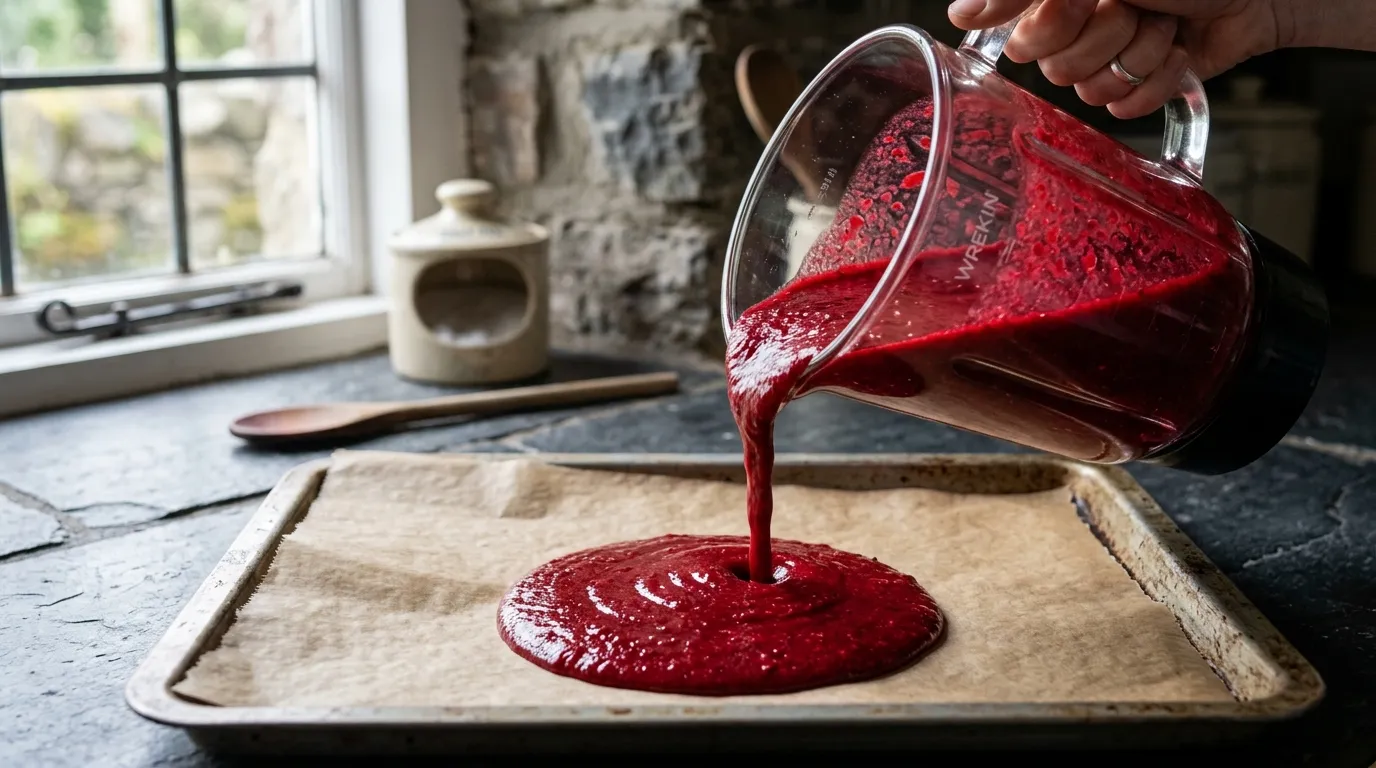 Strawberry and apple puree blended smooth and ready to spread, in a Welsh stone cottage kitchen.
Plum is the second-best leather fruit. Victoria, damson, and Czar all dry into a deep amber sheet with a rich winey flavour. Stone the fruit first; the stones are bitter and cyanogenic.
Strawberry makes a bright pink leather with a strong scent. The fruit is mostly water (91 percent), so a 750g strawberry batch reduces to about 280g of leather. Blend with 250g apple to add pectin and body.
Blackberry is the hedgerow classic and pairs perfectly with apple in the autumn. Sieve the puree to remove the hard pips, which spoil the texture. Blackcurrant has the highest vitamin C of any UK fruit (around 200mg per 100g) and a sharp flavour that needs 2 to 3 tablespoons of honey to balance.
Avoid pear (too low in acid, ferments easily), banana (browns badly), and citrus (the peel turns bitter on drying).
Best UK Fruit Combinations for Leather
Making Fruit Leather in a UK Oven
A standard UK fan oven dries a 3mm sheet of fruit puree in 6 to 10 hours at 70C. Conventional ovens (no fan) need 80C and longer, because there is no airflow to move moisture out of the cavity. Most ovens sold in the UK since 2010 have a fan; check yours before starting.
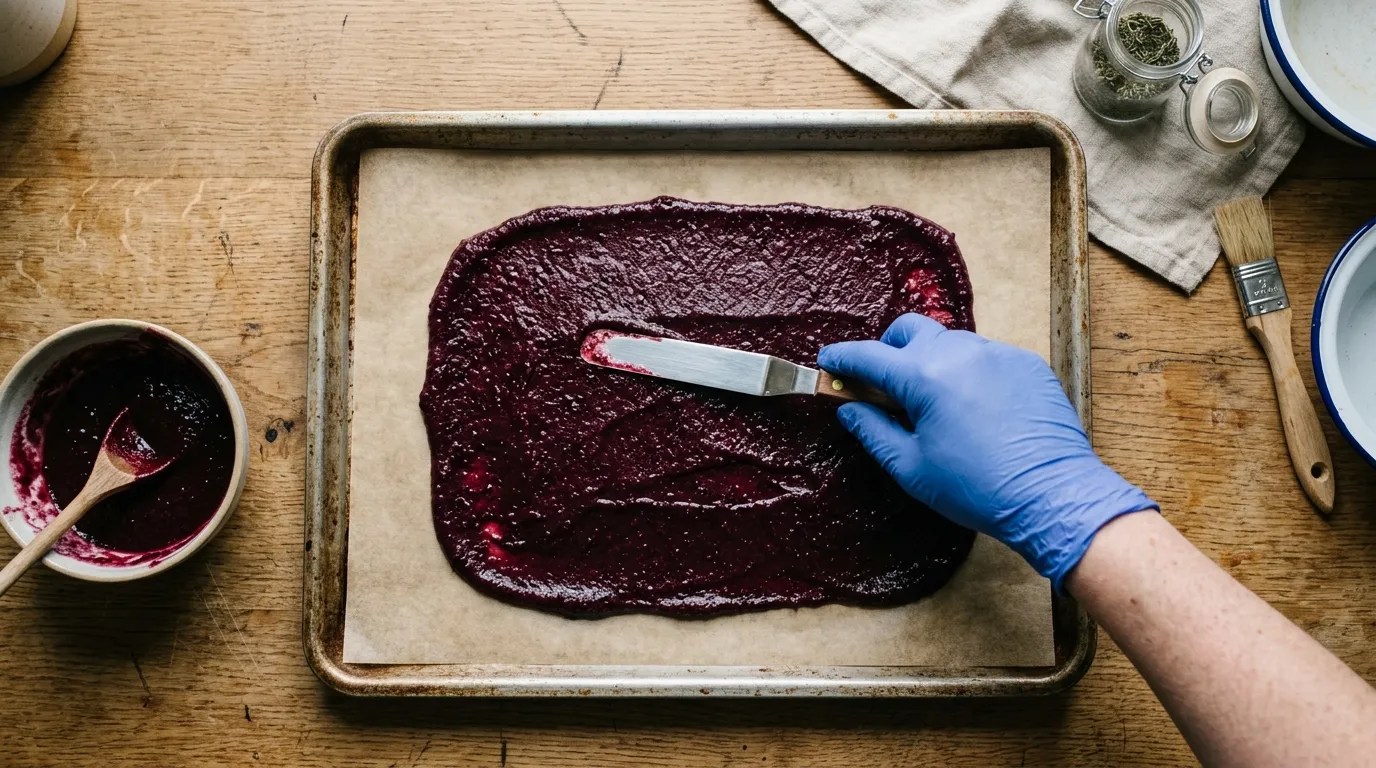 Spreading puree to exactly 3mm thick is the single biggest factor in getting the drying time right.
Prop the door open. This is the step most home cooks skip and the reason most home oven fruit leather fails. Moisture must leave the oven cavity for the puree to dry. A wooden spoon wedged in the door, holding it open by 2cm, lets warm humid air escape and dry hotter air in. Without it the cavity reaches 60 percent humidity within an hour and the puree cooks instead of drying.
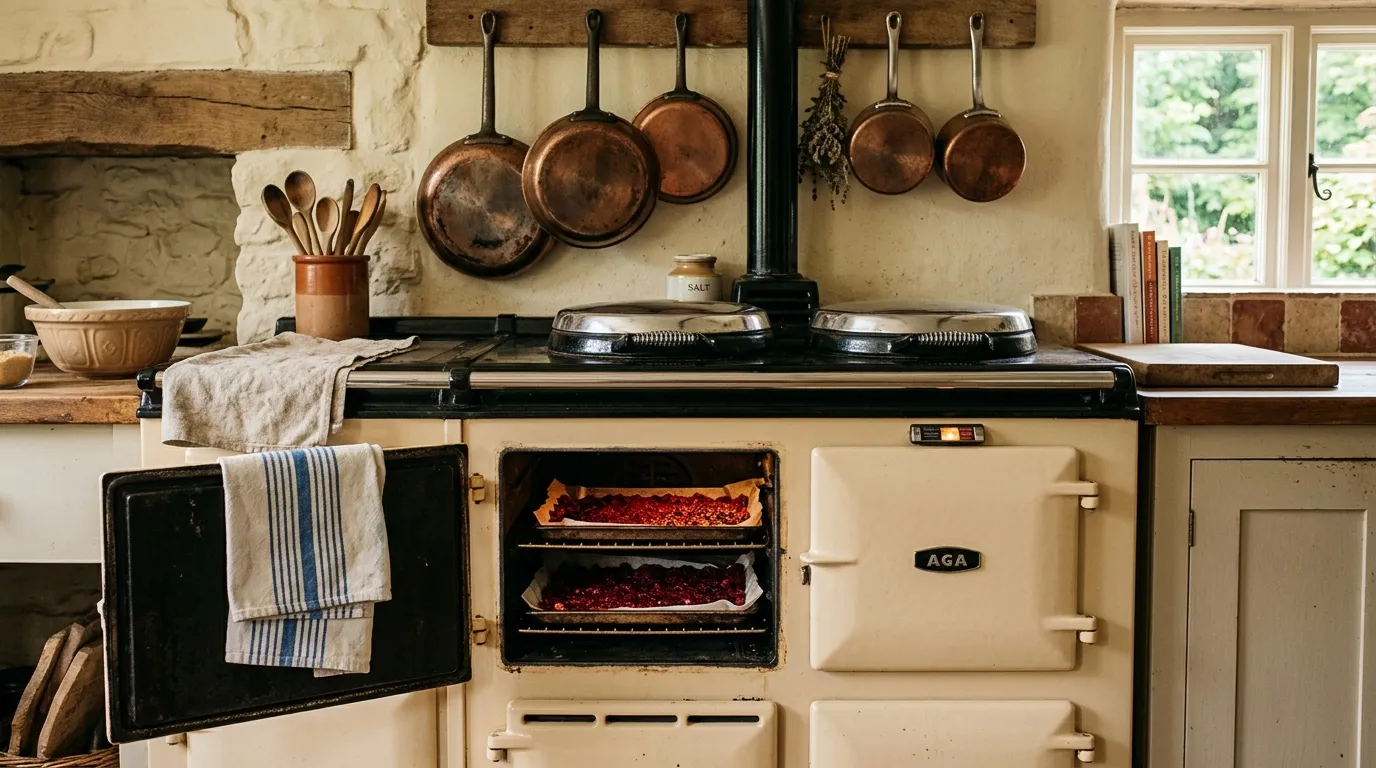 An Aga’s bottom oven runs at 65 to 75C and is excellent for fruit leather; prop the door open by 2cm.
Aga and Esse owners have a head start. The bottom oven of a four-oven Aga sits at 65 to 75C all day and dries leather while you sleep. Stick to a 3mm spread; the table behaviour is the same.
Dehydrator Method for Fruit Leather UK
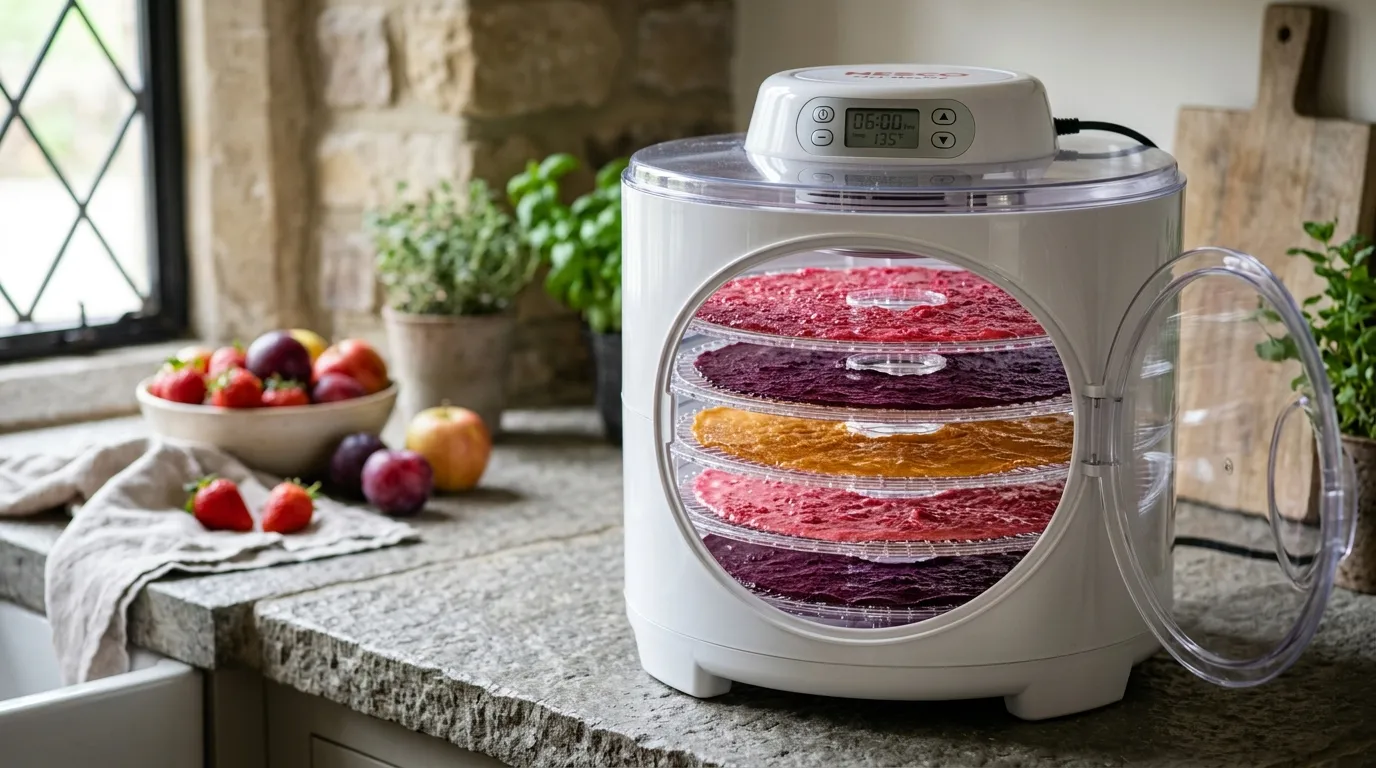 A five-tray dehydrator handles five sheets at once, useful during an orchard glut.
The advantages over an oven are real. Temperature stability: a dehydrator holds 60C within 2C all the way through. A fan oven can swing 10C as the thermostat cycles. Multiple trays: a 5-tray model dries 5 sheets at once, useful when you have a 10kg apple glut to process. Lower running cost: at 350W for 5 hours, a dehydrator uses 1.75 kWh, around 50 pence at current UK rates. A 1.5kW oven on for 7 hours uses 10.5 kWh, around £3.
The disadvantage is the upfront cost. If you preserve once a year, the oven is fine. If you preserve a few weekends a month from June to October, a dehydrator pays for itself in two seasons. We also use ours for drying herbs from the kitchen garden, drying apples and pears, and drying stone fruit.
Fruit Leather Recipe Without Added Sugar
Most commercial fruit roll-ups are 60 percent sugar by weight (Fruit Winders are 56 percent according to Tesco nutrition labels). Homemade fruit leather is 0 percent added sugar when made from ripe sweet fruit. The fructose in the fruit itself concentrates as water evaporates: a 1kg batch of strawberry puree at 6 percent natural sugar becomes a 280g sheet of leather at 21 percent natural sugar, sweet without any added sweetener.
The two tricks for no-sugar leather are: pick the right fruit, and let it fully ripen. Strawberry, plum, blueberry, eating apple, and ripe pear all work unsweetened. Blackcurrant, sour cherry, gooseberry, and unripe plum need 1 to 3 tablespoons of honey per kilo because their natural acidity overwhelms the small natural sugar content.
Honey beats white sugar in two ways. It dissolves into the puree without grit, and it adds its own preservation effect (honey is hygroscopic and pulls water out of the leather as it dries). Maple syrup is a close second. Date paste (50g per kilo) works for sugar-free diets but darkens the leather noticeably.
UK Fruit Availability Calendar for Leather Making
Plan your leather around what is in season. UK supermarket fruit is fine year-round but pricier; garden and pick-your-own fruit is the leather glut driver.
| Month | UK fruit at peak | Best leather combination |
|---|---|---|
| January | Stored apples, frozen berries | Apple + frozen blackberry |
| February | Stored apples, forced rhubarb | Apple + rhubarb + honey |
| March | Stored apples, early rhubarb | Rhubarb + apple + ginger |
| April | Stored apples ending | Pure stored apple |
| May | Early strawberries (south UK) | Strawberry + apple |
| June | Strawberries, gooseberries | Strawberry + apple, gooseberry + apple + honey |
| July | Raspberries, blackcurrants, redcurrants | Raspberry + apple, blackcurrant + apple + honey |
| August | Plums, blackberries starting, early apples | Plum + apple, blackberry + apple |
| September | Apples, blackberries, damsons | Bramley + blackberry (classic), damson + apple |
| October | Late apples, late blackberries, sloes | Apple + cinnamon, blackberry + apple |
| November | Stored apples, frozen berries | Apple + frozen plum from August batch |
| December | Stored apples | Apple + cinnamon + honey |
The peak months for UK fruit leather are August and September, when the orchard glut hits at the same time as hedgerow blackberries. A single weekend in early September can produce six trays of leather and use 8kg of fruit that would otherwise rot.
Common Mistakes When Making UK Fruit Leather
Mistake 1: spreading the puree too thick. Anything over 4mm seals on the outside before the inside dries. The leather stays tacky in the centre for days and grows mould within a week. Use a palette knife and a ruler. The target is 3mm dead centre.
Mistake 2: oven too hot. Anything above 90C cooks the fruit instead of drying it. The surface caramelises and turns leathery in a different sense: brittle, scorched, and bitter. Stay between 60 and 80C in the oven, 60C in a dehydrator. If your oven minimum is 100C, use a dehydrator instead.
Mistake 3: drying in a humid kitchen. A UK kitchen on a wet October day with a steamer pan on the hob and a tumble dryer running can hit 80 percent relative humidity. The drying oven battles to lose its own moisture and the leather takes 14 hours instead of 7. Run the extractor fan or open a window during drying. Dehumidifiers help in unheated outhouses.
Warning: Never use cling film, foil, or greaseproof paper as a drying surface. Cling film melts at 70C, foil sticks impossibly to the leather, and greaseproof releases waxy compounds into the puree. Only food-safe baking parchment or oven-safe silicone mats (rated above 90C) work.
Mistake 4: skipping the acid check. Fruit that has gone slightly past ripe loses acid quickly. Very ripe strawberry, mango, pear, or peach can sit above pH 4.5, the threshold where bacteria and moulds grow during the slow drying process. If you are not certain the fruit is acidic, add 1 teaspoon of lemon juice per 500g. Cost: 5 pence. Insurance against a mouldy batch: priceless.
Storing Homemade Fruit Leather UK
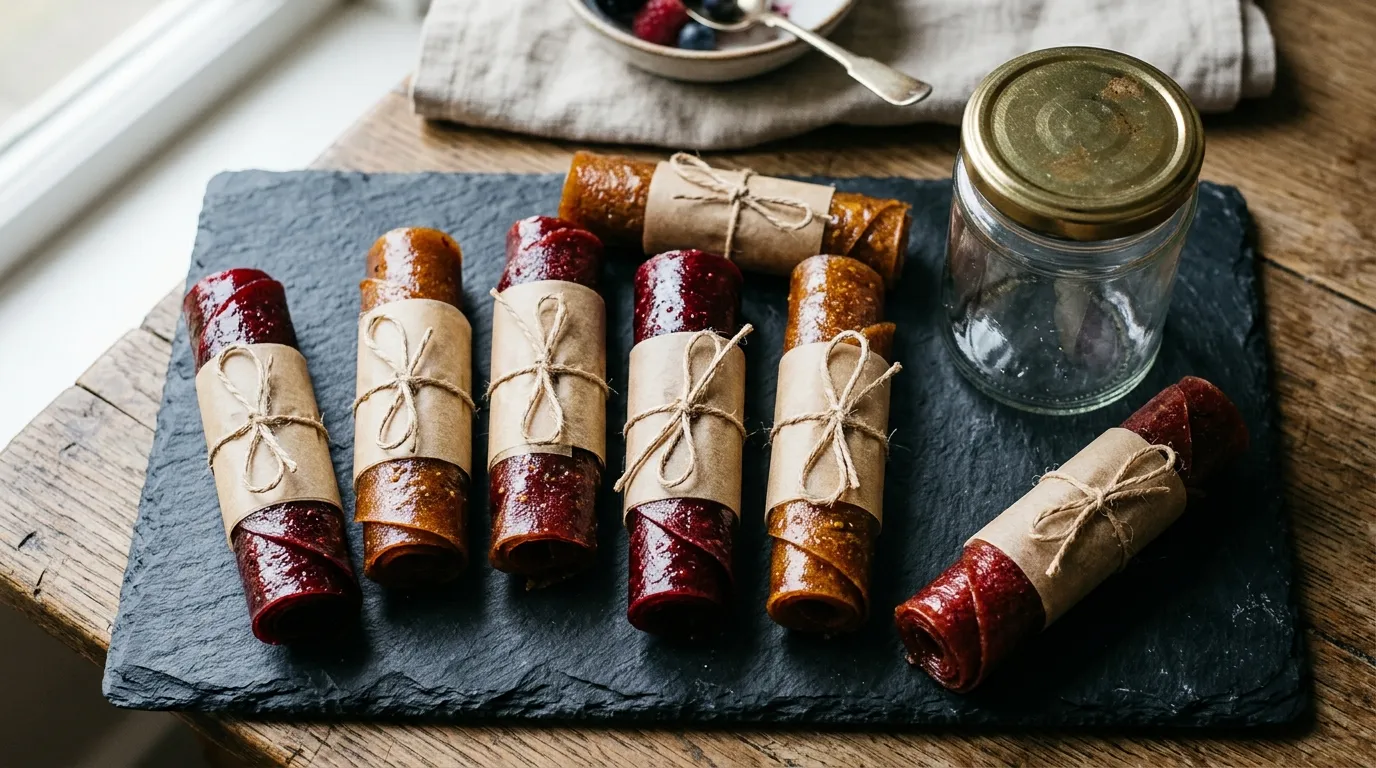 Rolled strips in their parchment, ready for the storage jar.
Cut the cooled leather into strips while still on the parchment. The parchment becomes the food-safe wrapper. Roll each strip tightly with the parchment on the outside; this stops the leather sticking to itself in storage.
Three storage options work in a UK kitchen.
Room temperature, airtight tin or jar: 4 to 6 weeks at 15 to 20C. The under-stairs cupboard is ideal; a kitchen worktop in summer is not. Watch for sticky patches, which mean the leather rehydrated from kitchen humidity and needs a second drying.
Refrigerator, double-wrapped: 3 months at 4C. Wrap each roll in cling film inside the jar to stop it picking up fridge smells. Bring to room temperature for 5 minutes before eating; cold leather is hard to chew.
Always check before eating after long storage. Discard any leather that is fuzzy, smells fermented, or has visible white or green mould. A few sugar bloom crystals (the same harmless white that appears on aged dried fruit) is fine; brush off and eat.
Serving and Using Homemade Fruit Leather
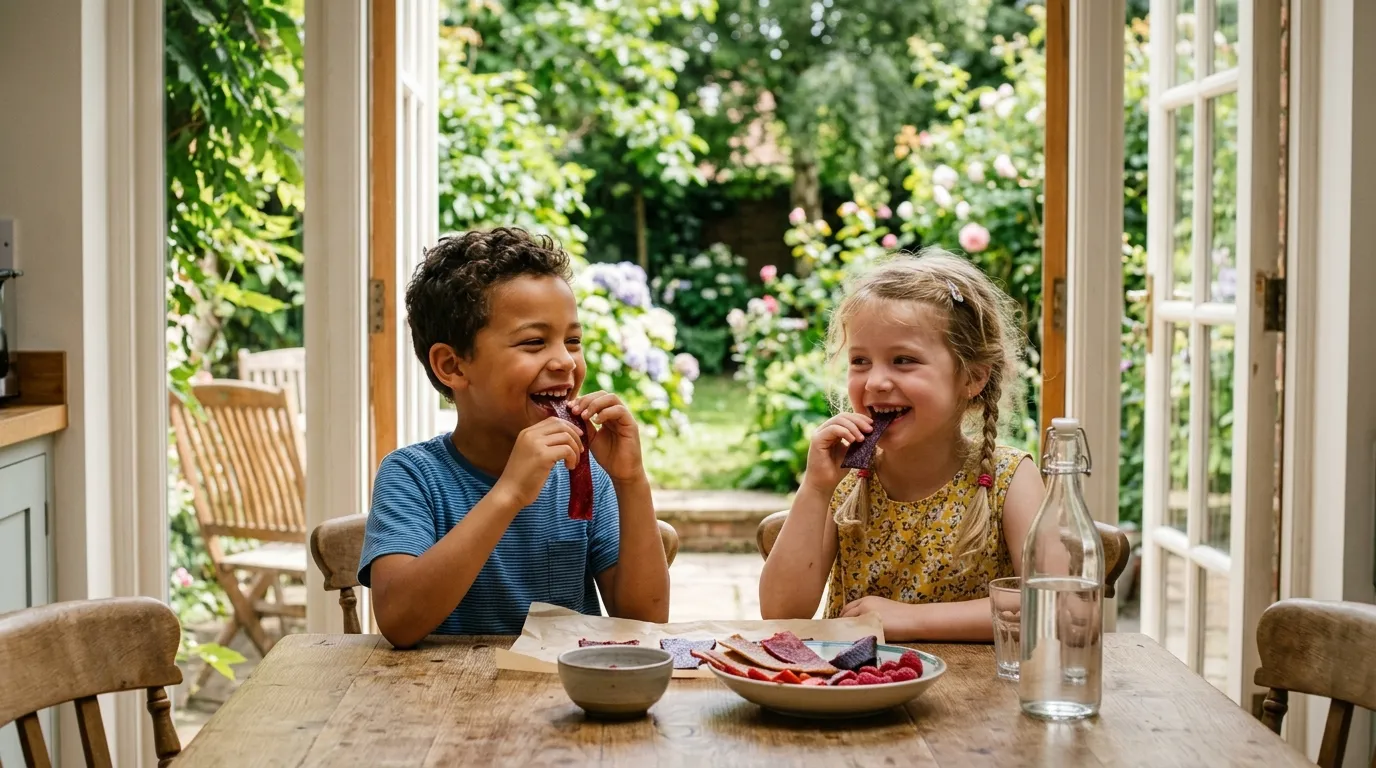 Homemade fruit leather is a popular kids’ snack with no added sugar or artificial colour.
The simplest use is straight from the roll, peeled off the parchment, eaten by hand. Children take to it instantly; adults discover it pairs with cheese.
Lunchbox snack: one strip in a sealed bag travels well and survives a school bag for days.
Hiking food: light, durable, slow-release sugar. A 20g strip gives around 60 calories.
Cheese board: plum or blackcurrant leather with mature cheddar, walnuts, and a glass of dry white wine. The leather behaves like a softer membrillo.
Garnish for desserts: snipped into ribbons over panna cotta, vanilla ice cream, or rice pudding.
Christmas hampers: rolled in waxed paper and tied with twine, fruit leather is one of the best home-made gifts in a year of home preserves and stored apples and pears.
Frequently Asked Questions
For deeper FAQ answers see the structured FAQ list above, which also generates schema markup for AI search engines.
Next Step
Now that you have mastered fruit leather, the next preserving project for an apple glut is our apple chutney recipe, which uses the same fruit base but in a savoury direction. Or move into a sweeter project with our Victoria plum jam recipe, perfect for the August plum harvest.
Frequently asked questions
Do I need to add sugar to homemade fruit leather?
No, fruit leather does not need added sugar. Ripe sweet fruit (strawberry, apple, plum, blueberry) has enough natural sugar to taste sweet after drying, when water evaporates and concentrates the fructose. Tart fruit (blackcurrant, sour cherry, gooseberry) benefits from 1 to 3 tablespoons of honey or maple syrup per kilo to balance, but is not essential.
What temperature should I set my UK oven for fruit leather?
Set a fan oven to 70C with the door propped open by 2cm. Many UK fan ovens have a minimum of 50C; if yours stops at 80C, use that with the door open further. Conventional ovens need 80C with the door ajar because there is no fan to move moist air out. Anything above 90C cooks the fruit instead of drying it and ruins both flavour and texture.
Why is my fruit leather still sticky after 10 hours of drying?
Sticky leather means the puree was spread too thick. If the centre is over 4mm, the moisture cannot escape and the surface seals before the inside dries. Return the tray to the oven for another 2 to 3 hours; if still sticky, slice the leather into thinner strips and re-dry on a wire rack for 1 hour at 70C.
Can I make fruit leather in a UK summer without an oven or dehydrator?
Solar drying works in rare UK heatwaves but rarely succeeds. You need three consecutive days of 28C-plus with low humidity, which the UK typically gets two weeks a year. A south-facing greenhouse at 35C in July can dry a tray in 8 hours if you cover it with muslin to keep insects off. For everyday use, the oven or dehydrator is more reliable.
Is fruit leather safe for young children and toddlers?
Yes, fruit leather is safer than commercial fruit roll-ups, which contain corn syrup, artificial colour, and preservatives. Homemade leather is pure fruit, often unsweetened, and a good source of fibre and vitamins. Cut into thin strips for toddlers over 12 months to reduce choking risk. Brush teeth after eating; concentrated fruit sugar can cling and cause cavities, the same as dried fruit.
What is the best fruit combination for first-time fruit leather?
Pure apple is the easiest first leather. Bramley and dessert apple in equal weights give natural pectin (helps the leather set), mild sweetness, and a forgiving texture. Once you are confident, move to apple-plus-berry blends. Pure berry leathers (blackcurrant, raspberry) are tricky because they lack pectin and stay tacky; always blend with at least 25 percent apple.
Our team produces practical UK gardening guidance from source research, contributor records and established horticultural practice. Editorial standards are overseen by Matt W.