
Key takeaways
- Hoverflies can't sting, even though many look like wasps
- Their larvae eat hundreds of aphids each, so they're great pest control
- Flat, open flowers like yarrow, fennel and poached egg plant attract them best
- Leave a few aphids in spring so hoverflies have a reason to lay eggs
- Skip insecticide sprays, as they kill hoverfly larvae too
Hoverflies are some of the best friends a gardener can have. Their larvae munch through aphids, and the adults pollinate flowers. Despite their wasp-like stripes, they can’t sting. Get to know them and you’ll worry a lot less about greenfly.
When aphids appear, the urge is to reach for a spray. But that also kills the very insects that would sort the problem out for free. Hoverflies need those aphids to breed. Once you see that, managing pests gets much easier.
Why are hoverflies important for gardens?
Hoverflies do two jobs: pollination and pest control. Adults pollinate flowers while they feed on nectar and pollen. The larvae of the commonest garden kinds eat huge numbers of aphids.
They’re great pollinators. Hoverflies visit lots of UK wildflowers and crops such as strawberries, beans and soft fruit. They’re happy flying on cooler, cloudier days than honeybees, which makes them especially useful in the north, where spring warmth arrives late.
Their larvae are aphid eaters. The larvae of kinds like the marmalade hoverfly each eat hundreds of aphids. A female lays her eggs right next to aphid colonies, so the young have dinner waiting. That adds up to far more aphids than you could ever squash yourself.
Some hoverfly larvae live in compost heaps, rotting wood or tree sap, helping break things down. These quieter jobs all help keep wildlife gardens healthy.
How to identify common UK hoverflies
Start with the way it flies. If an insect hangs perfectly still in mid-air, then darts sideways or backwards and hovers again, it’s almost certainly a hoverfly. Bees and wasps don’t hover like that.
The marmalade hoverfly (Episyrphus balteatus) is the one you’ll see most. It’s small, about 1cm long, with orange and black bands that go thick, thin, thick, thin. It’s often the first and last hoverfly of the year, and lots fly in from southern Europe each spring.

A marmalade hoverfly on yarrow. Look for those thick and thin orange and black bands.
The drone fly (Eristalis tenax) is a very convincing honeybee lookalike. It’s one of the bigger hoverflies, dark brown with orange-brown patches. Look for the huge eyes and single pair of wings to tell it from a bee. Its larvae, rat-tailed maggots, live in stagnant water.
The common banded hoverfly (Syrphus ribesii) has bright yellow and black bands and looks more like a wasp than a bee. The bands are neat and even, unlike the marmalade hoverfly’s. You’ll see it from May to October, especially on umbellifers and roses.
The sun fly (Helophilus pendulus) has yellow stripes running lengthways down its back, plus a yellow face and banded tummy. It likes ponds and damp spots.
The batman hoverfly (Myathropa florea) is named after the bat-shaped dark mark on its back. It has a yellow face and an orange-brown body. Its larvae grow in water-filled holes in old trees, so it’s common in gardens with mature trees.
The tapered drone fly (Eristalis pertinax) looks a lot like the drone fly but has pale front feet. It’s easily mistaken for a honeybee, and like the drone fly it’s a useful early spring pollinator.
UK hoverfly species identification table
| Hoverfly | Look for | Where | When | Looks like |
|---|---|---|---|---|
| Marmalade hoverfly | Thick and thin orange-black bands | Gardens, meadows | March to November | Wasp |
| Drone fly | Dark brown, bee-shaped | Gardens, near water | March to November | Honeybee |
| Common banded hoverfly | Even yellow-black bands | Gardens, hedges | May to October | Wasp |
| Sun fly | Yellow stripes down the back | Damp spots, ponds | May to October | Wasp |
| Batman hoverfly | Bat-shaped mark, yellow face | Gardens with old trees | May to October | Bee |
| Tapered drone fly | Like a drone fly, pale front feet | Gardens, hedges | March to November | Honeybee |
| Hornet hoverfly | Very big, yellow-brown bands | Gardens, mostly southern England | June to September | Hornet |
| White-belted hoverfly | One white band across the body | Woodland edges | May to July | Nothing in particular |
| Pellucid fly | Black with a white band | Woodland, shady gardens | May to September | Nothing in particular |
| Long hoverfly | Slim, yellow and black | Grassland, gardens | May to October | Wasp |
The hornet hoverfly (Volucella zonaria) is Britain’s biggest hoverfly and a brilliant hornet lookalike. It’s been spreading north from southern England. Don’t panic if you see one: it’s completely harmless. Its larvae live on scraps in wasp and hornet nests.

A marmalade hoverfly (left) and a drone fly (right). Some hoverflies copy wasps, others copy bees.
What is the hoverfly lifecycle?
Hoverflies go through four stages: egg, larva, pupa and adult. Knowing what each looks like stops you squashing them by mistake.
Eggs are laid next to aphid colonies, one at a time or in small groups. They’re tiny, white and oval, and hatch within a few days in warm weather.
Larvae are the aphid eaters. They look nothing like the adults: small, see-through, pale green or brown, legless and a bit slug-shaped. They mostly feed at night, rearing up to grab aphids.

A hoverfly larva tucking into aphids. It’s easy to mistake for a pest, so leave it be.
Lots of gardeners spot these larvae and think they’re pests. Please don’t spray them. If you see little slug-like creatures crawling among your aphids, leave them alone. They’re doing exactly the job you want done.
Pupae are small brown or green teardrops on leaves, stems or in the soil. Leave them undisturbed.
Adults come out and start feeding on nectar and pollen almost straight away. In a warm summer, several generations can come and go between May and October.
| Stage | Where to find it | What it looks like |
|---|---|---|
| Egg | Next to aphids | Tiny, white, oval |
| Larva | On stems and leaves | See-through, legless, eating aphids |
| Pupa | Leaves, stems, soil | Brown or green teardrop |
| Adult | On flowers, hovering | Striped fly that hovers |
Which plants attract hoverflies to your garden?
Adult hoverflies need nectar they can reach. Their mouthparts are short, so they love flat, open flowers where the nectar sits on top. Deep tube flowers like foxgloves are no good to most of them.

Yarrow, fennel and pot marigolds in a sunny border, all easy food for hoverflies.
Poached egg plant (Limnanthes douglasii) is an easy annual that seeds itself around. Its yellow and white flowers are a hoverfly magnet from May to July. Scatter seed on bare patches in autumn. It’s happy on poor soil.
| Plant | Flowers | Tip |
|---|---|---|
| Fennel | June to September | Let it flower |
| Yarrow | June to September | Flat heads, perfect for hoverflies |
| Poached egg plant | May to July | Seeds itself, very easy |
| Angelica | June to July | Big flower heads, copes with part shade |
| Pot marigold | June to October | Sow straight into the ground |
| Sweet alyssum | June to October | Low edging, flowers for ages |
| Cow parsley | April to June | Native hedgerow wildflower |
| Phacelia | May to September | Also used as a green manure |
| Buckwheat | June to August | Quick to grow from seed |
| Ivy | September to November | Vital late food |
Ivy is a star. It flowers in autumn when little else does, and late hoverflies rely on it to fuel up before winter. Don’t cut ivy back in autumn. If you have a bug hotel near some ivy, hoverflies get shelter and late food in one spot.
How do hoverflies control aphids naturally?
Hoverfly larvae are among the best aphid eaters in any British garden. Together with ladybirds and tiny parasitic wasps, they do most of the natural aphid control for you.
It works like this. Female hoverflies sniff out aphid colonies and lay their eggs right among them. The larvae hatch and start eating straight away, working mostly at night.
The trick is patience. Early aphids are what bring hoverflies in to breed. If you spray in April and May, even with organic pest control products, you kill hoverfly eggs and larvae as well. Then there’s nothing left to stop the next wave of aphids.
How to create a hoverfly-friendly garden
A hoverfly-friendly garden needs food, places to breed, shelter and no sprays. Most of this is the same as bee-friendly gardening and growing plants for butterflies.
Have something in flower from spring to autumn. Early on, try cow parsley and poached egg plant. In midsummer, fennel, yarrow, marigolds and angelica. Late in the year, ivy, sedum and Michaelmas daisies. If there’s a gap with no flowers, the adults move on.
Put up with some aphids in spring. No aphids means no hoverfly eggs. Let a few colonies build up on plants like broad beans, nasturtiums and nettles. A few weeks of patience in April and May pays off all summer.
Leave a little bare soil. Some hoverflies turn into pupae in the soil. Leave a few undisturbed patches in a sunny, sheltered spot.
Give them somewhere to spend the winter. Some hoverflies overwinter as adults. Log piles, thick hedges, leaf litter and insect houses all help. A wildflower area with dead stems left standing over winter gives shelter and early food.
Stop spraying. Insecticides kill hoverflies at every stage, and weedkillers wipe out the flowers they feed on. If aphids really get out of hand, a strong jet of water from the hose knocks them off without harming the good guys.
Add a shallow drink. A saucer with pebbles and a little water, topped up often, gives hoverflies a drink on hot days. Put it near flowers in a sunny spot.
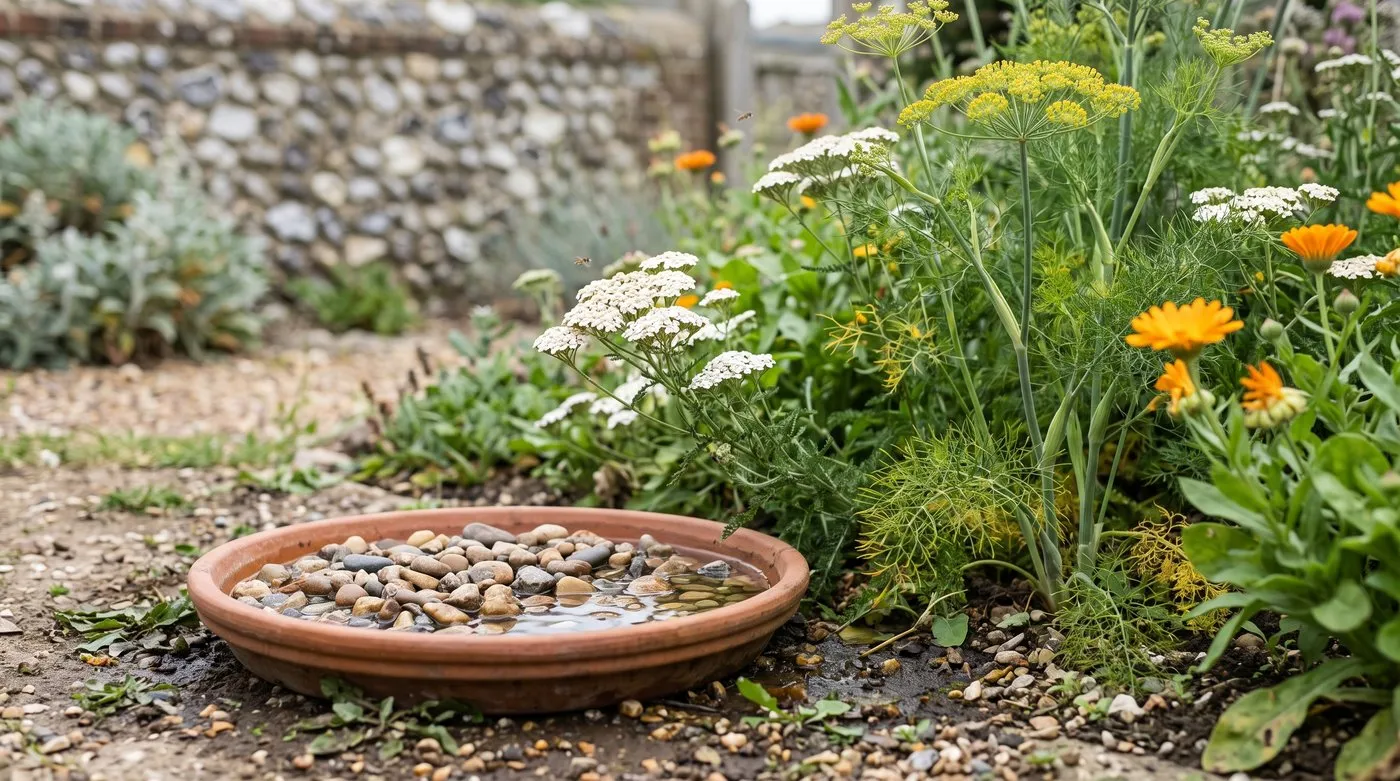
A saucer of pebbles and water gives hoverflies a safe drink on hot days. Put it close to flat, open flowers so they can refuel and sip in one stop.
Hoverfly migration: a UK phenomenon
Lots of people don’t know that hoverflies migrate. Huge numbers of marmalade hoverflies cross the English Channel each spring, mostly in May and June.
They come up from southern Europe, where spring starts earlier, and arrive just as our aphids are building up. In autumn, many head back south. Not all of them go, though. Some stay and spend the winter here.
The Hoverfly Recording Scheme keeps track of UK hoverflies, and you can help. Snap a photo of a hoverfly and send in your sighting through iRecord. It only takes a few minutes. Buglife has more help with identification.
Common mistakes that harm hoverflies
A few well-meant habits make life harder for hoverflies.
Tidying too much in autumn. Cutting every stem to the ground, raking up every leaf and clearing log piles takes away their winter shelter. Leave a good chunk of your borders standing until March.
Pulling out marigolds too early. Companion planting guides suggest marigolds, but many people pull them out in September. Pot marigolds keep flowering until a hard frost and feed hoverflies late in the year.
Thinking organic sprays are harmless. Many organic sprays kill hoverfly larvae just as well as synthetic ones. “Organic” doesn’t mean safe for helpful insects. Never spray plants with hoverfly eggs or larvae on them.
Picking every herb before it flowers. Let some fennel, dill, coriander and parsley flower. Their flat flower heads are perfect for hoverflies. An herb garden that’s always harvested before flowering gives them nothing.
Choosing double flowers. Double marigolds, dahlias and similar flowers have so many petals that hoverflies can’t get to the nectar. Pick single-flowered kinds where you can.
Frequently asked questions
Are hoverflies dangerous or do they sting?
No, hoverflies are harmless and have no sting at all. Their yellow and black stripes copy wasps, which fools birds into leaving them alone. They’re no risk to people, children or pets, and they’re very welcome in the garden as pollinators and aphid eaters.
How do I tell a hoverfly from a wasp or bee?
Watch how it flies first. Hoverflies hang still in mid-air, then dart off. They have one pair of wings, while wasps and bees have two. Their big eyes cover most of the head, the antennae are short, and they don’t have a narrow wasp waist.
What do hoverfly larvae eat?
Most garden hoverfly larvae eat aphids. Each one can eat hundreds before it turns into an adult. They crawl along stems and leaves to find aphids, often feeding at night. Some kinds feed on rotting plant matter instead, and the drone fly’s larva, the rat-tailed maggot, lives in stagnant water.
What flowers attract hoverflies best?
Flat, open flowers where the nectar is easy to reach. Hoverflies have short mouthparts, so deep tube-shaped flowers are no good to them. Try yarrow, fennel, angelica, cow parsley, sweet alyssum, marigolds and poached egg plant. Aim for something in flower from spring to autumn.
When are hoverflies most active in the UK?
From spring to autumn, with most around in summer. Some appear on mild days in early spring and late autumn. The marmalade hoverfly flies in from mainland Europe, sometimes in big numbers. They’re busiest on warm, still, sunny days.
Do hoverflies pollinate plants as well as bees?
They’re important pollinators, though bees still do the most. Hoverflies visit lots of wildflowers and garden plants, and crops such as strawberries. They often fly in cooler, duller weather than many bees, which makes them handy in early spring, late autumn and northern gardens.
How can I encourage hoverflies to lay eggs in my garden?
Leave some aphids in place in spring. Female hoverflies lay their eggs next to aphids so the larvae have food straight away. If you clear every aphid early on, they’ll breed elsewhere. Grow plenty of open flowers for the adults and avoid insecticide sprays.
Our team produces practical UK gardening guidance from source research, contributor records and established horticultural practice. Editorial standards are overseen by Matt W.


