Key takeaways
- A 60cm window box holds about 8-12 plants, depending on their size
- Use the thriller, filler and spiller idea for a box that looks full and balanced
- Plant spring bulbs in October, under the winter plants, for colour in March and April
- Wait until late May or early June to plant tender summer bedding
- Pelargoniums and petunias suit sunny windows; begonias, fuchsias and ivy suit shade
- Make sure the box has drainage holes and is fixed securely to the sill or wall
The best window box plants change with the seasons. Plant pansies and bulbs for spring, pelargoniums and lobelia for summer, then heuchera, cyclamen, skimmia and ivy for autumn and winter. A standard 60cm box holds about 8-12 plants, and choosing for your window’s light is half the battle.
This guide gives a simple plan for each season, picks for sunny and shady windows, and the drainage and watering basics that keep a box looking smart. For pots on a patio or balcony, the guide to plants for pots year-round covers longer-lived choices.
How to plan a window box that looks full
Use the thriller, filler and spiller idea. It is an easy way to make a small box look balanced from the street.
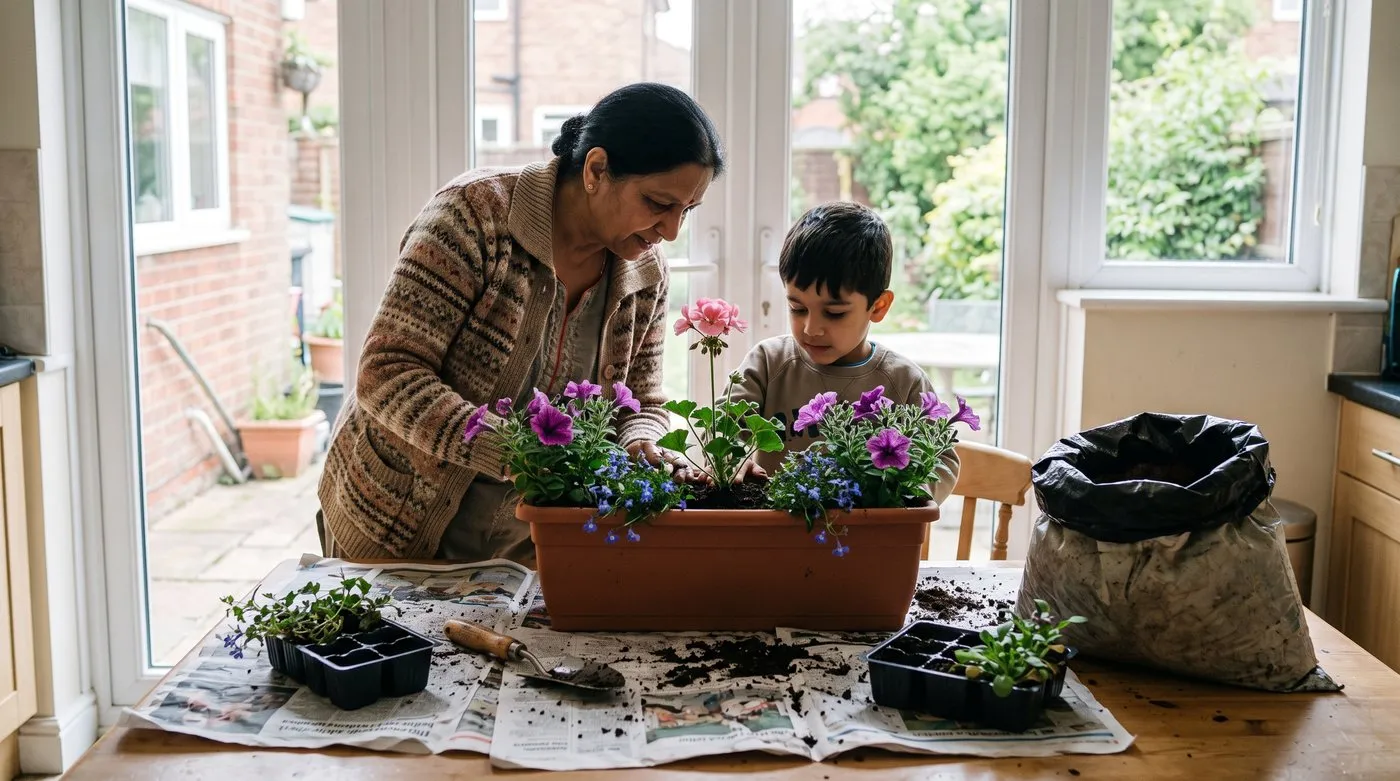
Upright plant at the back, bushy fillers in the middle and trailers along the front. Plant tightly for an instant display.
- Thriller: one upright plant as the focal point, at the back or centre.
- Fillers: three or four bushy, mid-height plants to fill the body of the box.
- Spillers: three to five trailing plants along the front edge to soften it.
A typical 60cm box is about 18-20cm deep and wide. That fits around 8-12 plants, depending on their size. Plant more tightly than you would in a border, as window boxes are short-term displays that need to look full quickly.
Safety tip: On an upper floor, fix the box firmly to the sill or wall with brackets or ties. A full, wet box is heavy, and one that falls could hurt someone below.
Spring window box plants (March to May)
Spring colour starts the previous autumn. Plant bulbs in October, about 10cm deep, under the winter plants. They wake up in March as the winter display fades.
| Role | Good choices |
|---|---|
| Thriller | Dwarf tulips such as ‘Red Riding Hood’, dwarf daffodils such as ‘Tête-à-tête’ |
| Filler | Pansies, violas, primroses, polyanthus |
| Bulbs to tuck between | Muscari (grape hyacinths), crocus, Iris reticulata |
| Spiller | Variegated ivy such as ‘Glacier’ |
Pansies and violas are the workhorses. The trailing Cool Wave pansies spill over the edge and fill out by late spring. The guide to growing pansies and violas covers deadheading to keep them flowering.
Pet note: Tulip and daffodil bulbs are toxic to cats and dogs. Keep spare bulbs out of reach while planting.

Red tulips at the back, white pansies and grape hyacinths in the middle and ivy trailing over the front. A classic spring box.
Summer window box plants (June to September)
Summer is the showpiece. Most summer bedding is tender, so wait until late May in the south, or early June further north, when frosts have passed. Harden off plants for a week or so first. The guide to hardening off bedding plants explains how.
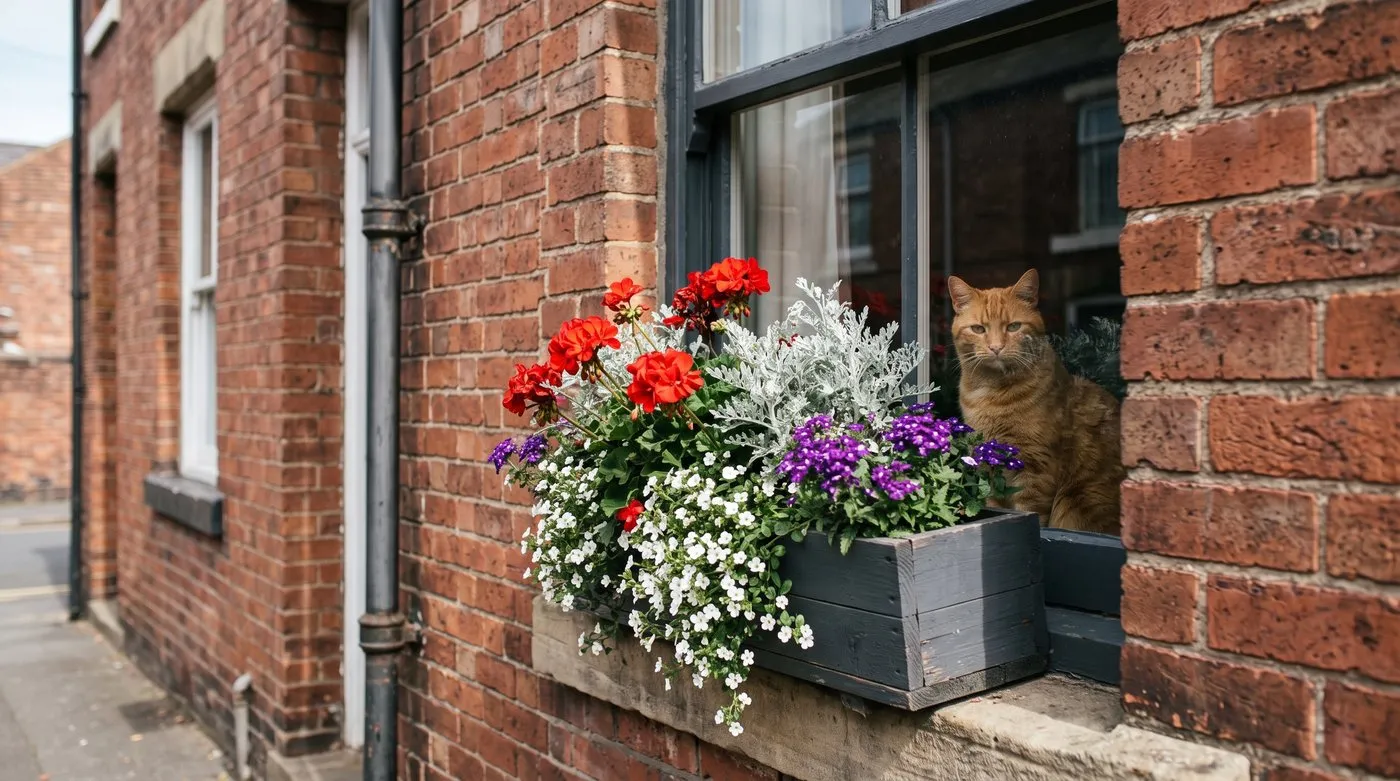
Pelargoniums are the easiest choice for a hot, sunny sill. Deadhead every few days and they flower until autumn.
| Role | Sunny window | Shady window |
|---|---|---|
| Thriller | Upright pelargonium, young cordyline | Upright fuchsia, begonia |
| Filler | Pelargoniums, petunias, verbena | Busy lizzies, begonias, compact lobelia |
| Spiller | Trailing lobelia, helichrysum, bidens, calibrachoa | Trailing lobelia, ivy, trailing fuchsia |
Pelargoniums are the easiest choice for a sunny sill. They cope with drying out better than most bedding.
Plug plants bought in spring and grown on are much cheaper than ready-grown bedding. The guide to plug plants explains how to pot them on so they are ready for planting day.
Deadhead every few days. Removing faded flowers keeps pelargoniums, petunias and violas producing more.
Autumn window box plants (September to November)
By September, summer bedding starts to look tired. Pull out the worst of it, keep anything still going well, and fill the gaps.
| Role | Good choices |
|---|---|
| Thriller | Pot chrysanthemums, a small grass such as Carex |
| Filler | Heuchera, ornamental cabbage, cyclamen |
| Spiller | Ivy, trailing heather, Lysimachia ‘Aurea’ |
Heuchera is a star here. Its leaves come in purple, lime, amber and silver, and it carries on into winter. Ornamental cabbages deepen in colour as nights get colder.
This is also the time to plant your spring bulbs underneath, ready for next year.

Chrysanthemums and ornamental cabbages give a warm autumn look. Ivy carries on from summer and trails over the edge.
Winter window box plants (November to March)
Winter boxes rely on evergreens and a few tough flowers. They need to cope with cold, wet and wind for months.
| Role | Good choices |
|---|---|
| Thriller | Skimmia japonica ‘Rubella’, a dwarf conifer such as Picea glauca ‘Conica’ |
| Filler | Winter-flowering pansies and violas, hardy cyclamen, heuchera |
| Spiller | Variegated ivy, trailing periwinkle |
Skimmia ‘Rubella’ holds red flower buds all winter, then opens to scented white flowers in spring. Move it to a bigger pot or the border in spring and reuse it next winter.
Large-flowered florist’s cyclamen (Cyclamen persicum) look lovely but are not frost hardy. They do best on a sheltered sill in mild areas. Hardy cyclamen such as Cyclamen coum are tougher but smaller.
Pet note: Cyclamen are toxic to cats and dogs, especially the tubers. If you have a cat that likes the windowsill, choose violas or heuchera instead.
For more ideas, see the guide to winter bedding plants that actually flower.

Skimmia, a dwarf conifer and ivy give winter structure. White cyclamen add flowers on a sheltered sill.
Best window box plants for sunny and shady windows
Your window’s aspect matters more than anything else. A plant that thrives facing south will sulk facing north, and the other way round.
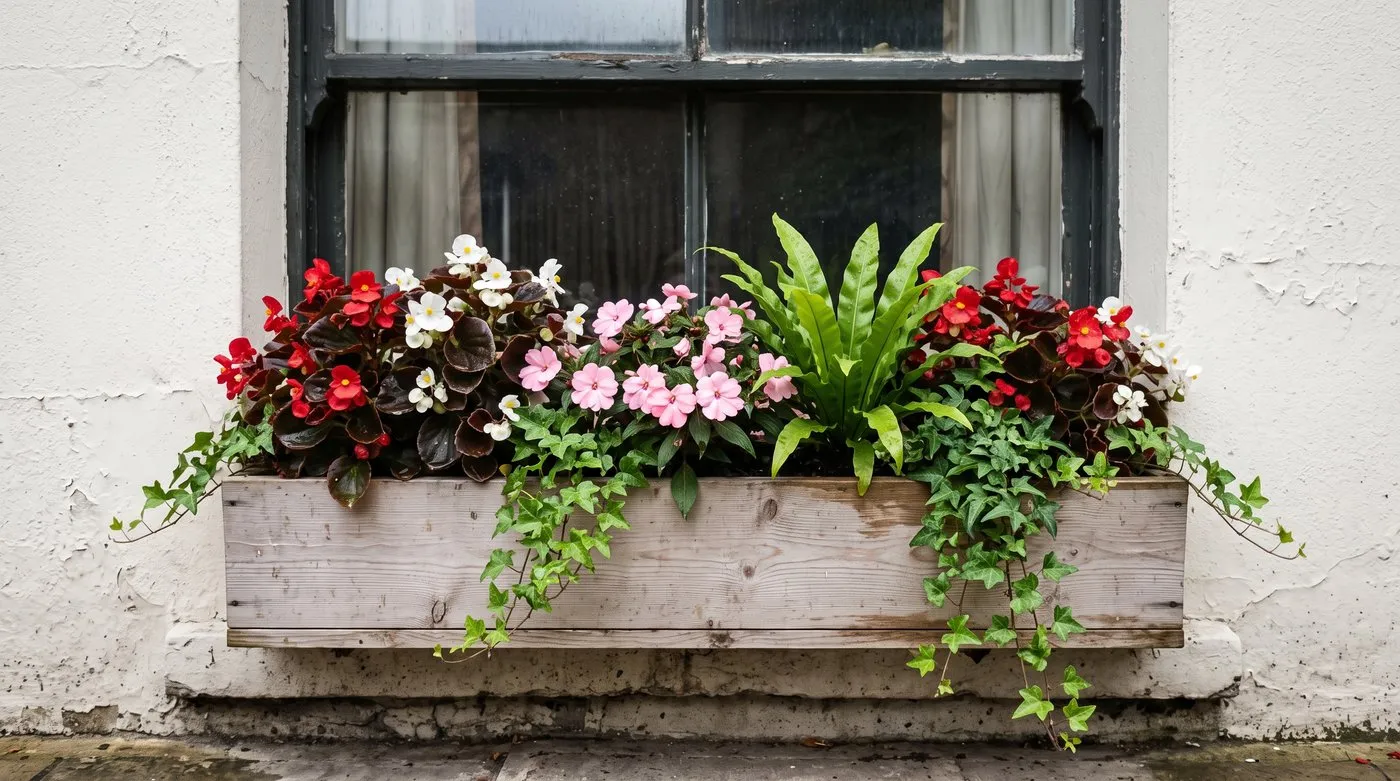
A north-facing window still gives plenty of colour. Begonias, busy lizzies and ferns are happy with little direct sun.
| Window faces | Light | Summer picks |
|---|---|---|
| South | Sun most of the day | Pelargoniums, petunias, verbena, helichrysum, calibrachoa |
| West | Afternoon sun | Pelargoniums, petunias, bidens, trailing lobelia |
| East | Morning sun, afternoon shade | Fuchsias, nemesia, violas, busy lizzies, lobelia |
| North | Little or no direct sun | Begonias, fuchsias, busy lizzies, ferns, ivy |
Sunny boxes dry out fast, so watering is the main job. Shady boxes stay damp longer, so take care not to overwater.
Wind is a problem on corners and high balconies. It shreds long trailers and dries out compost. In exposed spots, use fewer trailers and more compact, bushy fillers.
Drainage and compost for window boxes
Drainage holes are essential. A box with no way out for water turns soggy by winter and roots rot. Drill extra holes if your box has only one or two.
To plant up:
- Cover each hole with a piece of broken pot so compost doesn’t wash out.
- Fill with peat-free multipurpose compost to about 2cm below the rim. That gap stops water spilling over when you water.
- Mix in a slow-release fertiliser at the rate on the pack.
- Plant the thriller first, then fillers, then spillers along the front.
- Water well to settle the compost.
Put a drip tray under the box if water would run down a wall or onto a path. Refresh at least the top layer of compost every year, as it slumps and runs out of food.

A piece of broken pot over each hole lets water out but keeps compost in. Make sure the box has more than one hole.
Watering and feeding a window box
Window boxes dry out much faster than pots on the ground. Sun and wind hit them from all sides, and there isn’t much compost to hold water.
- Summer: water every day in warm weather, and twice a day in a heatwave if the box is in full sun.
- Spring and autumn: every few days, depending on the weather.
- Winter: only when the compost feels dry a couple of centimetres down.
Water early in the morning or in the evening, at the base of the plants rather than over the leaves.
The slow-release fertiliser you mix in at planting lasts a while. From midsummer, add a high-potash liquid feed, such as a tomato feed, every week or two to keep summer bedding flowering into autumn.
Window box calendar month by month
| Month | Jobs |
|---|---|
| January | Check winter boxes for dryness. Remove dead leaves |
| February | Deadhead winter pansies. Order summer plug plants |
| March | Bulbs start flowering. Feed lightly if plants look hungry |
| April | Pot on summer plug plants under cover |
| May | Harden off summer bedding. Clear spring plants late in the month in the south |
| June | Plant summer boxes once frosts have passed. Water daily in warm spells |
| July | Deadhead often. Start weekly high-potash feeds |
| August | Keep watering and feeding. Trim straggly trailers |
| September | Swap tired bedding for heuchera, cyclamen and cabbages |
| October | Plant spring bulbs under the autumn display |
| November | Add skimmia, winter pansies and ivy for winter |
| December | Check fixings are secure ahead of winter storms |
Common window box mistakes
- Choosing plants for the wrong light. Pelargoniums in a north-facing box or begonias in blazing sun both struggle. Match plants to your window.
- Planting summer bedding too early. A late frost can blacken tender plants overnight. Wait until late May or early June.
- Too few drainage holes. Waterlogged compost rots roots, especially over winter.
- Forgetting to water. A packed summer box can dry out in a day. Little and often doesn’t work; water until it runs from the base.
- Skipping autumn bulbs. Without bulbs planted in October, the spring box is late and thin.
Planting a hanging basket too? The summer hanging basket recipes use many of the same plants, and the balcony gardening ideas help if you’re short on space.
Frequently asked questions
How many plants fit in a 60cm window box?
About 8 to 12, depending on the size of the plants. Bigger plants such as pelargoniums need more room, while lobelia and violas pack in closely. Plant fairly tightly, as a window box is meant to look full straight away.
What plants work for a north-facing window box?
Begonias, fuchsias, busy lizzies, ferns, heuchera and ivy all cope with shade. Skip sun-lovers such as pelargoniums and petunias. In winter, use skimmia, ivy and hardy cyclamen.
Do window boxes need drainage holes?
Yes, always. Without holes, water collects and the roots rot, especially in winter. If your box has only one or two holes, drill a few more and raise it slightly so water can escape.
How often should I water a window box?
Every day in warm summer weather, sometimes twice in a heatwave. Water every few days in spring and autumn. In winter, check the compost and water only if it feels dry below the surface.
What is the best compost for a window box?
A good peat-free multipurpose compost suits most window boxes. Mix in a slow-release fertiliser when planting, and add a liquid feed from midsummer. Refresh some or all of the compost each year.
Should I replant a window box every season?
For colour all year, yes, about three or four times. Long-lasting plants such as ivy, heuchera and skimmia can stay put through several seasons. Just swap the bedding around them.
Now your window box is sorted, read the guide to planting and caring for hanging baskets for the next step, or find more ideas in the garden design section.
Our team produces practical UK gardening guidance from source research, contributor records and established horticultural practice. Editorial standards are overseen by Matt W.