
Key takeaways
- A wet green roof is heavy, so check your shed's frame is sound before you start
- Pre-grown sedum mats are the quickest and lightest way to do it
- Lay the layers in order: liner, drainage board, filter fleece, growing mix, plants
- Use special green roof mix, never garden compost or topsoil
- Install in spring or early summer, then just tidy and weed a few times a year
- Most shed green roofs don't need planning permission, but check if you live in a conservation area or a listed home
A green roof turns a plain garden shed into a living, buzzing feature. It soaks up rain, keeps the shed cooler in summer and gives bees somewhere lovely to visit. It’s not a complicated project either. With pre-grown sedum mats, a typical shed roof is a weekend job.
What is a green roof, and why have one?
A green roof is a layered planting on top of a building: a waterproof liner, a drainage layer, a special growing mix and tough, drought-loving plants. On sheds, the usual kind is a shallow, low-care roof planted with sedums and small wildflowers.
Why bother? Here’s what you get:
- Less rainwater rushing off: The plants and growing mix soak up a good share of the rain and release the rest slowly. It works well alongside a rainwater harvesting system.
- A cooler shed: The roof keeps the worst of the summer sun off, and holds a little warmth in winter.
- Wildlife: Bees, hoverflies and beetles move in quickly.
- A longer-lasting liner: The plants shield the waterproof layer from sun and weather.
- A bit of peace: The planting softens noise from outside a little.
Deeper “intensive” green roofs, with lawns and shrubs, are far too heavy for a shed. This guide sticks to the shallow, sedum kind.
 The layers of a shed green roof: roof deck, rubber liner, drainage board, growing mix and sedum.
Can your shed take the weight?
Plenty of sturdy timber sheds can carry a lightweight sedum roof, but a soaking wet roof is heavy, so check before you start.
Which option is lightest?
| Type | Depth of growing mix | Weight when wet | OK for a typical shed? |
|---|---|---|---|
| Pre-grown sedum mat | Thin | Lightest | Usually |
| Modular sedum trays | Medium | Medium | Check the frame |
| DIY layers (sedum) | Medium | Medium to heavy | Check the frame |
| Wildflower blanket | Deep | Heaviest | Often needs strengthening |
How to check your shed
- Look at the rafters. Chunky, closely spaced rafters cope better than thin, widely spaced ones.
- Check for rot. Push a screwdriver into the rafter ends. If it sinks in easily, the wood needs replacing first.
- Check the roof boards. Thin boards may bend under a wet roof. Solid, thicker boards are better.
- Strengthen if needed. Adding an extra rafter between existing ones makes the roof much stronger.
Safety first: Don’t put a green roof on a shed with sagging rafters, split timber or rusty fixings. Fix the frame first. If you’re not sure, ask a builder or joiner to take a look.
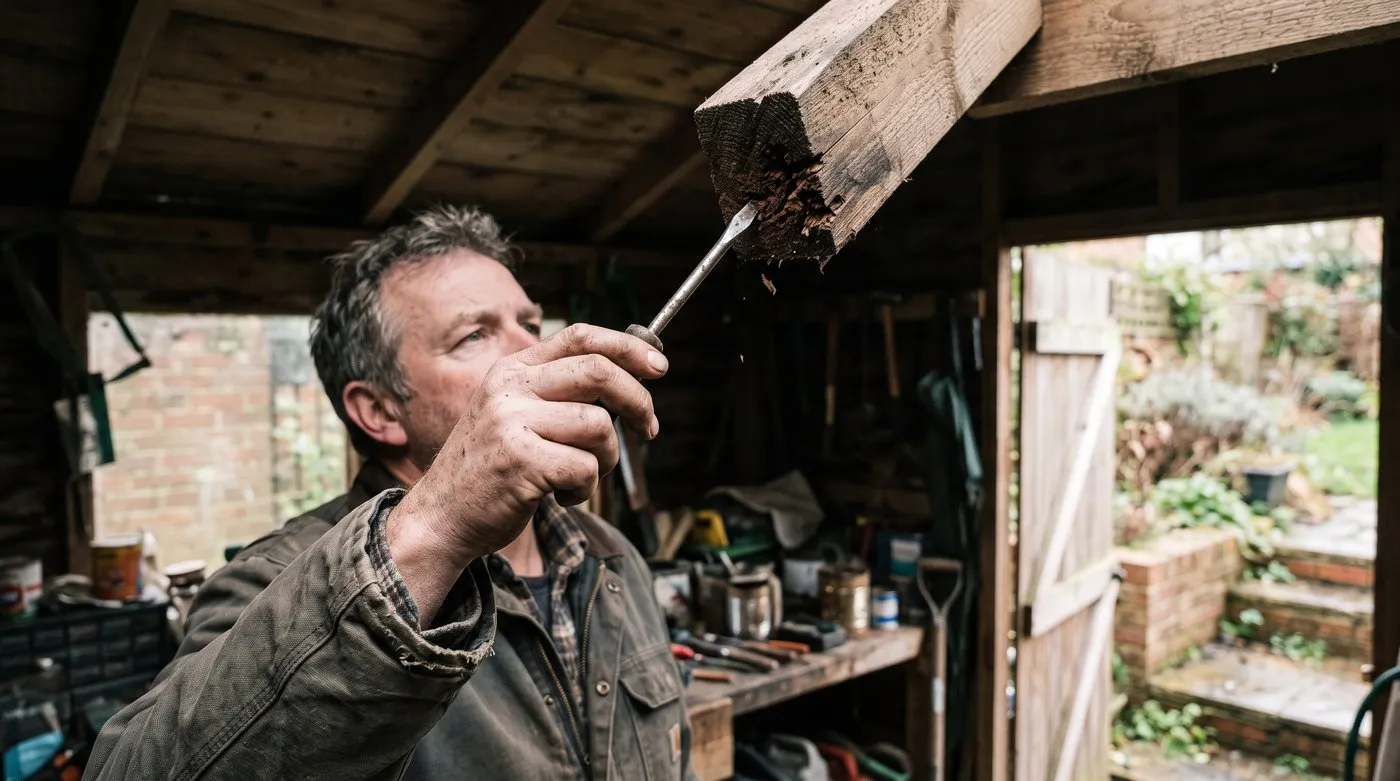
Push a screwdriver into the rafter ends. If it sinks in easily, replace the wood before adding the weight of a wet green roof.
Which green roof system suits your shed?
Pre-grown sedum mats are the easiest choice for most sheds: light, quick to settle and simple to lay. Here’s how the main options compare:
| System | Cost | Weight | How quickly it looks good | Care | Wildlife value |
|---|---|---|---|---|---|
| DIY layers | Low | Medium to heavy | Slowest | Low | High with wildflowers |
| Pre-grown sedum mat | Low to medium | Light | A few weeks | Very low | Good |
| Modular trays | Medium | Medium | Straight away | Very low | Good |
| Wildflower blanket | Highest | Heavy | A few months | Some | Very high |
Go for DIY layers if you’re on a budget or want your own mix. Trays are handy where access is awkward, as you can lift them one by one. Wildflower blankets are brilliant for wildlife but need a roof that can take the extra weight.
How to build a green roof on a shed, step by step
With sedum mats, a typical shed roof takes a weekend. Work through the layers in this order.
Layer 1: Get the roof deck ready
Strip off the old felt. Check for rot and replace any soft wood. Make sure the deck is smooth and dry, with no nails or screws sticking up that could pierce the liner.
Asbestos warning: Old shed roofing can sometimes contain asbestos. If your shed is old and you’re not sure, have it checked by a professional before you remove it.
Layer 2: Root-resistant rubber liner
EPDM rubber is the go-to waterproof liner for green roofs. It’s tough, roots can’t easily get through it, and it usually comes in a sheet big enough for a shed with no joins.
- Lay a protective fleece over the deck.
- Roll the liner out over the top, leaving a generous overhang on every edge.
- Fix the edges with edging strips and stainless screws.
- Fit a metal drip edge along the lower side so water runs into the gutter.
- If you must join pieces, use the proper EPDM primer and seam tape.
Don’t use ordinary roofing felt. It won’t stand up to constant damp and roots.
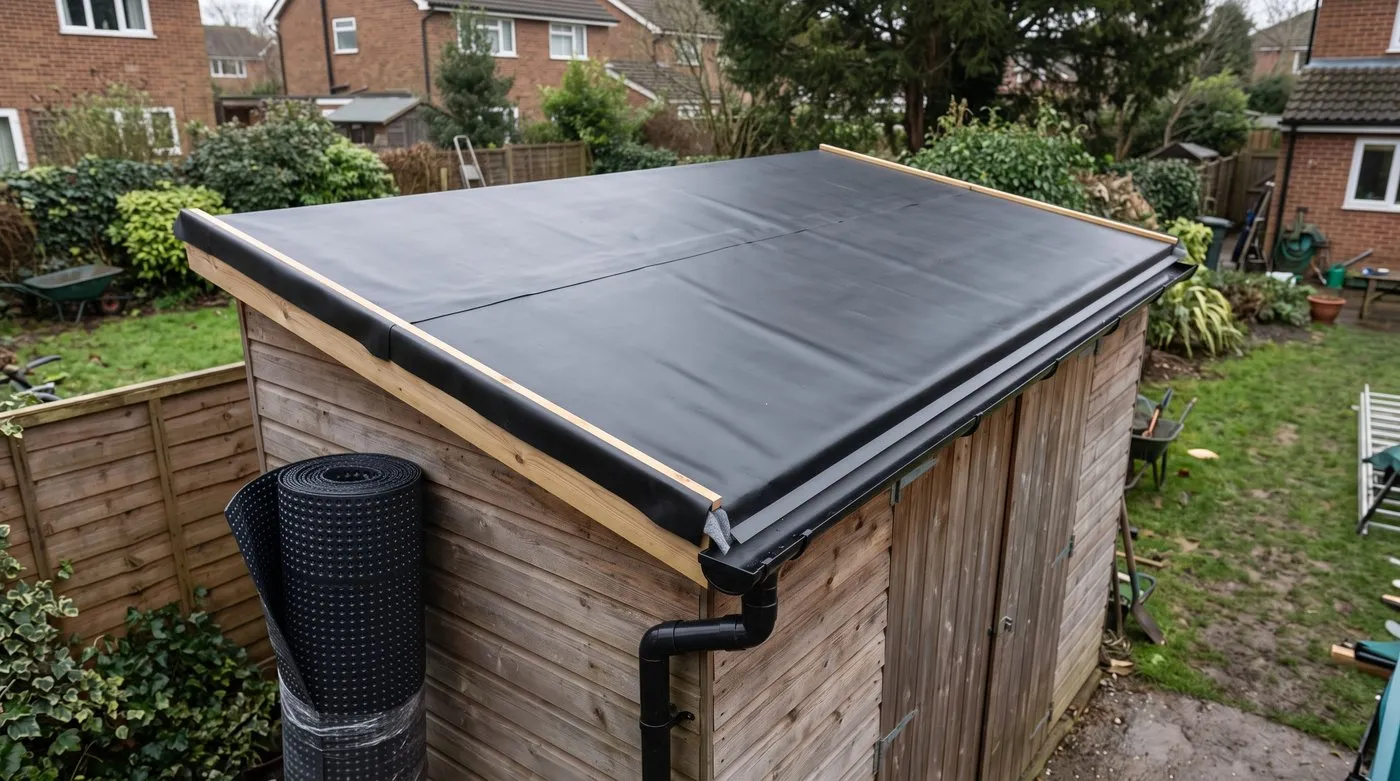
A root-resistant rubber liner in one sheet keeps the shed dry. Fit a drip edge on the low side so water runs into the gutter.
Layer 3: Drainage board
Lay a dimpled plastic drainage board over the liner. It lets extra water run off to the edge so the plants don’t sit in a puddle, and it holds a little water in its dimples for dry spells. Point the channels towards the drip edge.
Layer 4: Filter fleece
Lay a filter fleece over the drainage board, overlapping the pieces. It stops the growing mix washing down and clogging the drainage.
Layer 5: Growing mix
Spread about 8-10cm of green roof growing mix. This isn’t compost or topsoil. It’s a light, gritty mix made mostly of crushed mineral bits with a little organic matter, so it drains well and doesn’t feed weeds.
Rake it level but don’t press it down. It settles a little in the first few months, so add slightly extra.
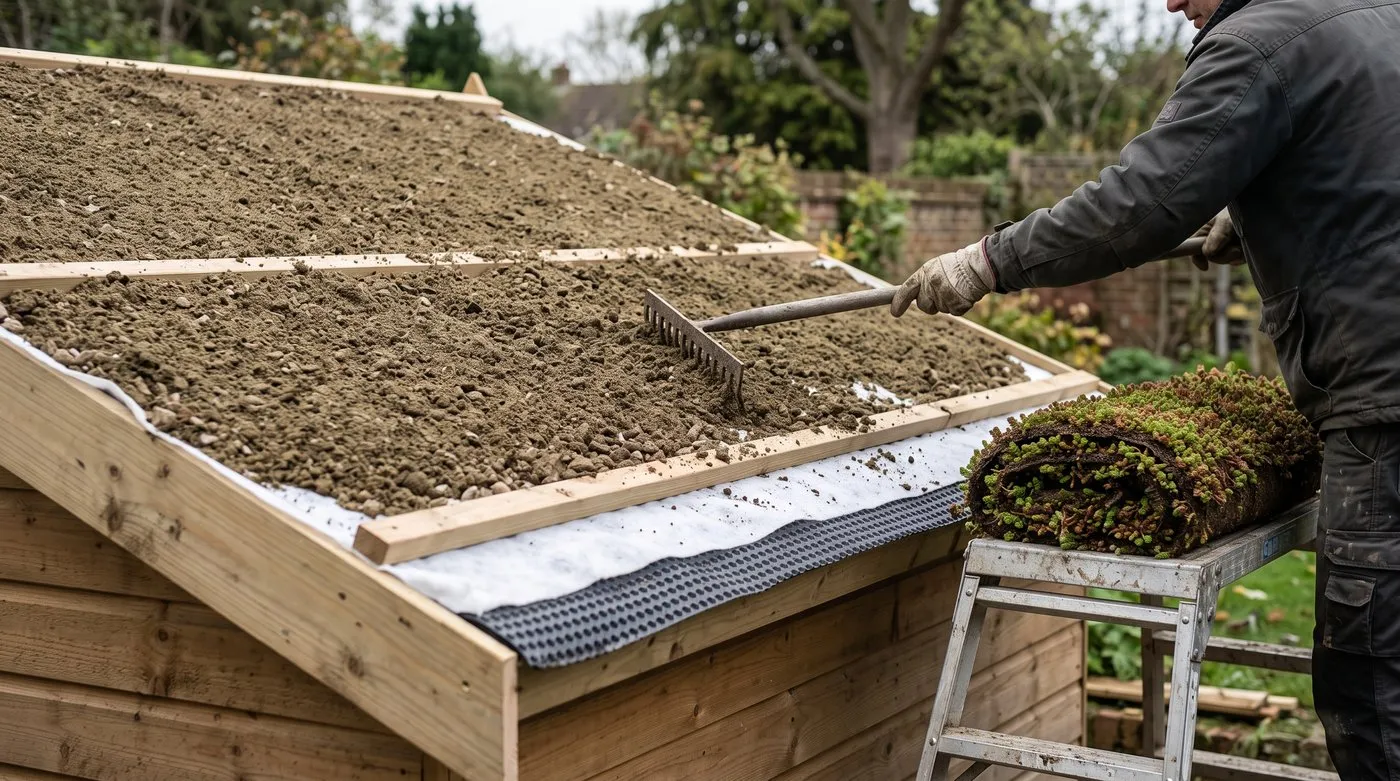
Use proper green roof growing mix, not compost or topsoil. It’s light, drains well and doesn’t feed weeds.
Layer 6: Plants
Roll sedum mats out on top and push the edges snugly together. Water well on the day, then daily for the first couple of weeks. After that, water only in long dry spells during the first summer.
Using plug plants instead? Space them about 20-25cm apart and they’ll knit together within a year or two.
Battens for sloping roofs
On steeper roofs, fix timber battens across the slope to stop the growing mix sliding down. Seal around every screw that goes through the liner.
 Mixed sedums on a mature green roof. The colours and textures get richer over the first few years.
Best plants for a shed green roof
Sedums are the backbone of almost every shed green roof. They cope with drought, frost, full sun and a thin layer of growing mix without watering. Start with these and add more variety later.
Start with sedums
| Plant | Height | Flower colour | Notes |
|---|---|---|---|
| Sedum album | Low | White | UK native, very tough, spreads fast |
| Sedum acre (biting stonecrop) | Very low | Yellow | UK native, copes with very thin mix |
| Sedum rupestre | Low to medium | Yellow | Evergreen, makes a dense mat |
| Sedum spurium | Low | Pink or red | Lovely autumn colour |
| Sedum sexangulare | Very low | Yellow | Tight, neat mat |
Add these in year two
| Plant | Height | Flower colour | Good for |
|---|---|---|---|
| Houseleek (Sempervivum tectorum) | Low | Pink | Striking rosettes |
| Wild thyme (Thymus serpyllum) | Very low | Purple | Bees and butterflies |
| Thrift (Armeria maritima) | Low | Pink | Native, shrugs off wind |
| Maiden pink (Dianthus deltoides) | Low | Pink or red | Butterflies, likes deeper mix |
| Bird’s-foot trefoil (Lotus corniculatus) | Low to medium | Yellow | Native, a favourite with pollinators |
Bird’s-foot trefoil is also the food plant for common blue butterfly caterpillars, and it loves the poor, well-drained conditions up on a roof.
For more of a meadow, go for a deeper layer of mix (if your shed can take it) and add kidney vetch, lady’s bedstraw and common rock-rose. Our guide to creating a wildflower lawn has more ideas.
Plants to avoid
Skip tall grasses. They crowd out sedums, catch the wind and dry out into a tinder-like thatch in summer. A short sheep’s fescue is fine. Avoid anything that needs regular watering, feeding or cutting back. The whole point is a roof that looks after itself.
Depth, drainage and watering
The depth of growing mix decides which plants will thrive, how heavy the roof is and how well it copes with dry spells.
| Depth | Weight | Plants it suits | Copes with drought |
|---|---|---|---|
| Thin (sedum mat only) | Lightest | Sedums only | Struggles in long dry spells |
| Around 5-6cm | Light to medium | Sedums and houseleeks | Fairly well |
| Around 8-10cm | Medium | Sedums, thyme and small wildflowers | Well |
| Deeper | Heavy | A mini wildflower meadow | Very well |
About 8-10cm is the sweet spot for most sheds. It holds enough water to see the plants through a dry fortnight in summer.
Don’t skip the drainage layer
Without a drainage layer, water pools on the liner and the sedum roots sit in the wet and rot. A dimpled drainage board is much lighter than gravel and works better.
Looking after a green roof
A shed green roof needs only a few short visits a year. It really is low-care.
| When | What to do |
|---|---|
| March | Clear leaves and twigs. Check the drip edge and gutter are clear. |
| May to June | Pull out any tree seedlings, like birch, sycamore or buddleja. |
| July | Look for bare patches. In a long drought, give it one good soak. |
| October to November | Clear autumn leaves. Check the liner edges haven’t lifted. Remove anything woody. |
Don’t feed a green roof with compost or fertiliser. It just encourages grass and weeds that smother the sedums. If the sedums start to struggle, the cause is usually poor drainage or too much shade.
No need to cut sedums either. Old growth breaks down by itself.
Tip: Pull tree seedlings as soon as you see them. Woody roots can work their way into the liner if they’re left to grow.
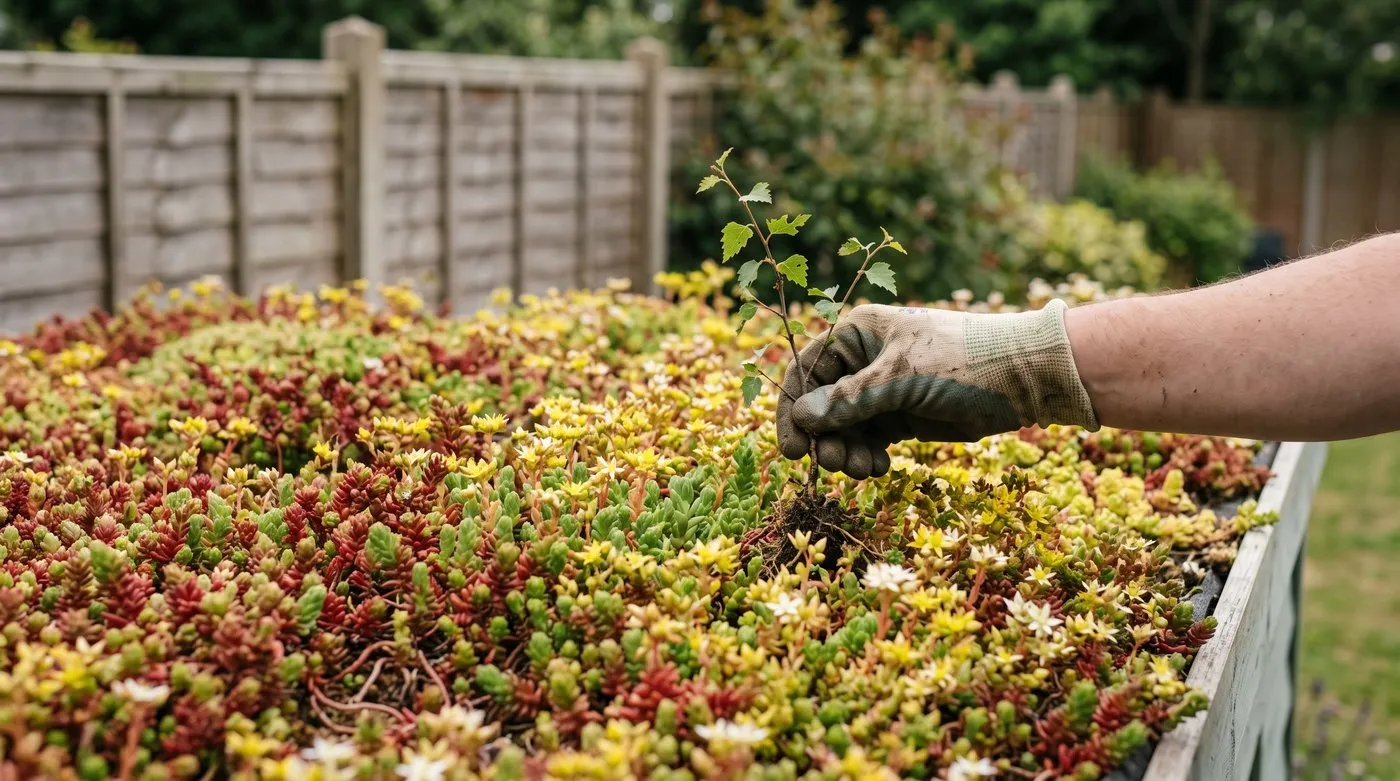
Pull tree seedlings as soon as you spot them. Woody roots can work their way into the liner if they’re left to grow.
Planning permission
Most shed green roofs in England and Wales don’t need planning permission. Garden outbuildings usually come under permitted development.
There are height limits, and they’re lower if the shed is close to a boundary. A green roof adds a bit of height, so measure before you start if your shed is already near the limit.
Rules differ a little in Scotland and Northern Ireland. If you live in a conservation area, a national park, an Area of Outstanding Natural Beauty or a listed home, check with your council first.
Putting a green roof on an existing shed doesn’t normally need building regulations approval. If you’re building a new structure especially for a green roof, it’s sensible to get the roof design checked.
A haven for wildlife
Even a small shed roof soon fills with insects. The same idea scales up to rooftop gardens on flat-roofed extensions, where deeper planting can feed pollinators over a bigger area.
 A mature green roof with wildflowers gives pollinators nectar from spring to early autumn.
Who might move in:
- Solitary bees: Some nest in bare patches between the plants. Leave a few small gaps on purpose.
- Butterflies: Common blues and small coppers visit the flowers.
- Hoverflies: They love sedum flowers, and their larvae eat aphids in the garden below.
- Beetles: Ground beetles and ladybirds shelter in the growing mix.
- Birds: Sparrows and starlings hunt for insects up there.
Pair your green roof with a garden pond and a wildflower area and you’ve built a little wildlife corridor. Water features at ground level give the insects and birds something to drink too.
A cooler, cosier shed
A green roof keeps a shed noticeably cooler on hot days and a little warmer in winter. That makes it nicer to use as a workshop, studio or garden room.
It works in three simple ways:
- The growing mix soaks up heat during the day and lets it go slowly.
- The plants cool the surface as moisture evaporates from their leaves, a bit like sweating.
- The drainage board traps a layer of still air, which adds a little insulation.
It won’t replace proper insulation in the walls and floor, but it helps. Add some clever shed organisation and design and you’ve got a space you’ll want to use all year.
What it will cost
Sedum mats laid on a shed with a sound roof are the cheapest route. A full DIY build with a new liner costs more, and a professional installer costs more again.
Your shopping list:
- EPDM rubber liner
- Protective fleece
- Dimpled drainage board
- Filter fleece
- Green roof growing mix
- Sedum mats or plug plants
- A metal drip edge
- Stainless screws and EPDM adhesive or tape
Extra costs to plan for
- Old roofing: If it might contain asbestos, get it tested. Removal by a licensed contractor costs extra.
- Repairs: Rotten rafters or roof boards may need replacing.
- Guttering: A green roof still sheds some water, so fit a gutter if you don’t have one.
- Watering at the start: New mats need daily watering for a couple of weeks, then regular checks for the next month or two.
Common mistakes to avoid
Mistake 1: Skipping the drainage layer
The most common reason green roofs fail. The growing mix stays soggy at the bottom and the sedum roots rot. A drainage board fixes this.
Mistake 2: Using garden compost
Garden compost, topsoil and multipurpose compost are too heavy, hold too much water and feed weeds. They also pack down fast. Always use proper green roof growing mix.
Mistake 3: Forgetting about wet weight
A roof that feels light on a dry summer day is much heavier after a wet winter week. Always plan for it being soaked.
Mistake 4: The wrong liner
Ordinary felt and some rubber sheets let roots creep through. Once they’re in, water follows and the deck rots. Use a root-resistant EPDM liner or add a separate root barrier.
Mistake 5: Planting too late in the year
Mats and plugs laid after September struggle to root before winter, and loose mats can lift in winter winds. Plant between April and August, ideally in May or June.
Want more? A green roof goes beautifully with a living wall on the side of the same building.
Ready to make the most of the rain your roof catches? Read our guide to rainwater harvesting for UK gardens.
Frequently asked questions
How much weight does a green roof add to a shed?
Quite a lot when it’s soaking wet, so check the frame first. A thin sedum mat is the lightest option. A deeper layer of growing mix weighs more but holds more water for the plants. If your rafters are sagging, rotten or split, fix them before you start, or ask a builder if you’re unsure.
Do you need planning permission for a green roof on a shed?
Usually not for an ordinary garden shed. Most garden buildings are covered by permitted development, but there are height limits, and these are lower near a boundary. A green roof adds a little height, so measure first. If you live in a conservation area or a listed home, check with your council before you start.
What is the best substrate depth for a shed green roof?
About 8-10cm of growing mix suits most shed roofs. That’s enough for a good range of sedums, houseleeks and small wildflowers. Thinner layers suit only the toughest sedums. Deeper layers get heavy for a typical shed.
How long does a green roof last on a shed?
A well-built one should last for many years. The plants keep renewing themselves with very little help. The weak spot is the liner underneath, so take care not to puncture it, and use a root-resistant one.
Can you put a green roof on a flat shed roof?
Yes, flat and gently sloping roofs both work. A flat roof needs a good drainage layer so it doesn’t get waterlogged. A steep roof needs battens to stop the growing mix sliding off. A gentle slope is easiest, and most sheds already have one.
What plants grow best on a green roof in the UK?
Sedums are the most reliable choice. Sedum album, Sedum acre, Sedum rupestre and Sedum spurium all cope with drought, frost and a thin layer of growing mix. Once they’re settled, add houseleeks, wild thyme, thrift and maiden pinks. Bird’s-foot trefoil and kidney vetch do well in deeper mix.
How do you waterproof a shed roof before adding a green roof?
Use a root-resistant EPDM rubber liner. Lay a protective fleece on the roof deck first, then the liner, ideally in one piece with no joins. Fix the edges neatly and fit a drip edge so water runs into the gutter. Don’t rely on ordinary roofing felt, as it won’t last under a green roof.
Our team produces practical UK gardening guidance from source research, contributor records and established horticultural practice. Editorial standards are overseen by Matt W.


