Key takeaways
- Plant from mid September to mid October so roots settle before hard frosts
- Pack plants closer than in summer, as they barely grow in winter
- Winter pansies, violas, Cyclamen coum, winter heather, skimmia and ivy are reliable
- Use fresh peat-free compost with added grit, never last summer's compost
- Water at midday on dry days when the top 2cm is dry, never onto frozen compost
- Hang baskets against a house wall, under an overhang if you can
Winter hanging baskets are an easy way to brighten a front door from October to March. Plant them from mid September to mid October with hardy plants such as winter pansies, violas, cyclamen and trailing ivy. Pack them in tightly, hang them somewhere sheltered and water sparingly.
This guide covers when to plant, which plants last, four simple recipes and how to get your basket through frost. For summer displays, see our hanging basket planting guide.
When to plant a winter hanging basket
Plant between mid September and mid October. Roots then have a few weeks to grow into the compost before the first hard frost. A well-rooted basket copes with cold far better than one planted in November.
In Scotland and northern England, plant in mid to late September. In the mild south west you can carry on into late October.
Buy plants in early autumn while garden centres still have a good choice. Small plug plants are cheaper than 9cm pots. If you miss the window, plant anyway, but expect a slow start.
Gardener’s tip: Soak each plant in a bucket of water for ten minutes before planting. A dry rootball is hard to wet again once it’s in the basket.
What size basket is best for winter?
A 35cm or 40cm basket is best. More compost freezes more slowly and stays evenly moist, which matters in winter.
- 35cm basket: five or six plants. Good for a porch or sheltered wall.
- 40cm basket: seven to nine plants. Good for a main doorway display.
Avoid anything under 30cm across. A small basket can freeze solid in one cold night and dry out on a windy day.
Solid-sided baskets with a water reservoir suit winter well. The solid sides cut wind chill around the roots. Wire baskets work too, if you line them well.
The best plants for winter hanging baskets
Winter pansies flower in any mild spell from autumn to spring, in almost every colour. Violas have smaller flowers but far more of them, and they shrug off rain that turns big pansy flowers to mush. Our guide to growing pansies and violas covers deadheading and the best types.
Cyclamen coum is the hardy winter cyclamen, flowering from about December to March in pink, magenta or white. The big florist cyclamen sold in autumn is less hardy and is best kept somewhere sheltered. Our cyclamen growing guide explains the difference. Winter heather (Erica carnea) flowers from winter into spring and, unlike summer heathers, is happy in ordinary compost.
For evergreen structure, use:
- Trailing ivy, such as variegated ‘Glacier’
- Skimmia japonica ‘Rubella’, for its red winter buds
- Gaultheria procumbens, for red berries (it prefers ericaceous compost)
- Ornamental cabbage or kale, for purple and cream rosettes
- Vinca minor, a trailing evergreen
- Heuchera, for coloured leaves
- Small evergreen ferns such as Polystichum setiferum, for soft arching fronds
| Plant | Job in the basket | Looks good |
|---|---|---|
| Winter pansy | Filler | Flowers in mild spells, autumn to spring |
| Viola | Filler | Flowers in mild spells, autumn to spring |
| Cyclamen coum | Filler | Flowers December to March |
| Winter heather | Filler | Flowers winter into spring |
| Skimmia ‘Rubella’ | Centrepiece | Red buds all winter |
| Ornamental cabbage | Centrepiece | Coloured rosettes through winter |
| Heuchera | Filler | Coloured leaves all year |
| Trailing ivy | Trailer | Evergreen all year |
| Vinca minor | Trailer | Evergreen, blue flowers in spring |
Pets: cyclamen and ivy are toxic to cats and dogs if eaten, and skimmia berries can upset them too. Sweep up anything that falls from the basket.

Skimmia in the middle, violas around it and ivy over the edge: a simple layout that looks good all winter.
How to arrange a winter basket
Use the centrepiece, filler and trailer idea, sometimes called thriller, filler and spiller. It keeps a basket balanced instead of a flat dome of one plant.
The centrepiece gives height in the middle. Use one Skimmia ‘Rubella’, an ornamental cabbage or a small evergreen grass such as carex.
The fillers give most of the colour. Ring three or four pansies, violas, cyclamen or heathers around the centrepiece.
The trailers soften the rim. Tuck two or three ivies or Vinca minor just inside the edge so they hang over the side.
Gardener’s tip: Plant trailers at an angle, almost lying on the compost. They hang over the edge much sooner than trailers planted upright.
Four easy winter basket recipes
Sunny doorway
For a south or west-facing wall. One Skimmia ‘Rubella’ in the centre, four winter pansies around it and two trailing ivies at the edge. The pansies flower best where they catch some low winter sun.
Shady porch
For a north or east-facing spot. One ornamental cabbage in the centre, three Cyclamen coum and two violas around it, and two small ferns at the edge.
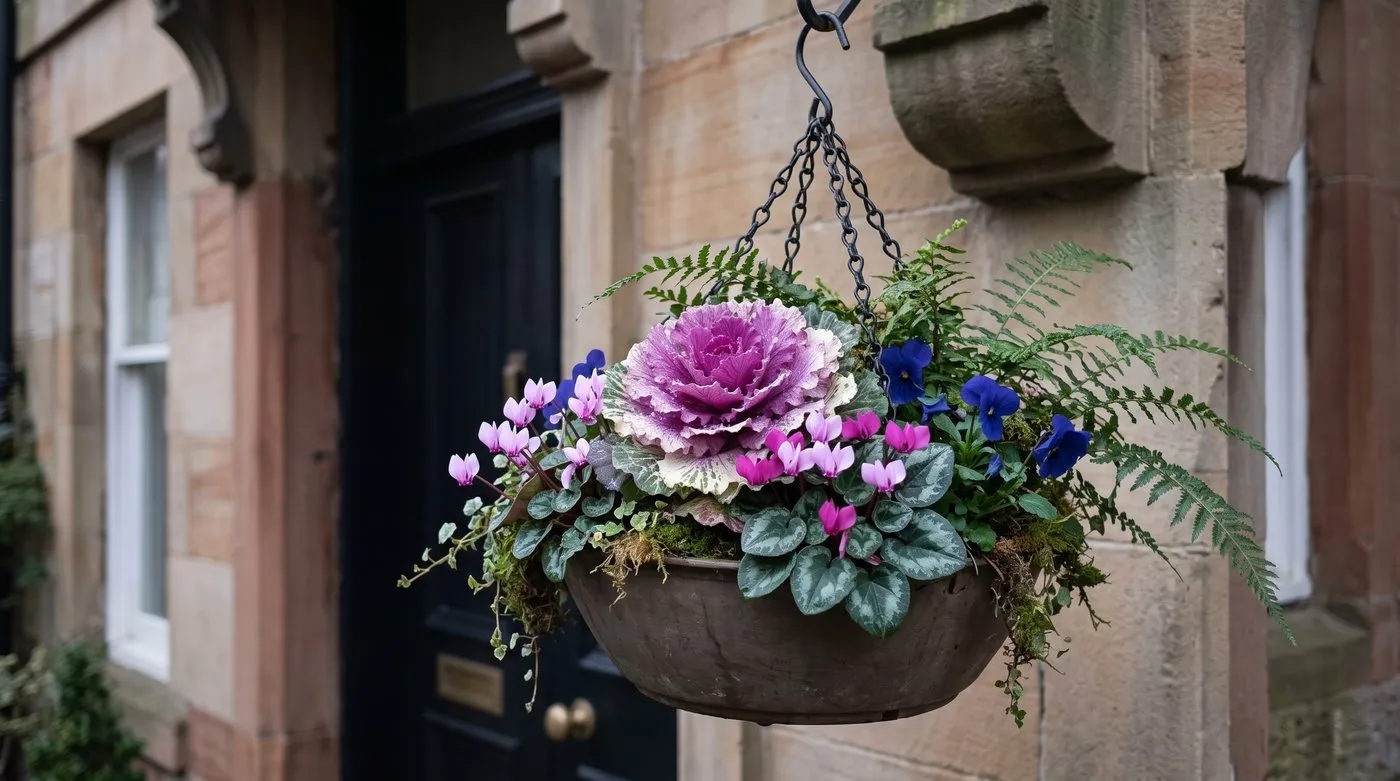
Cyclamen, violas and a fern are happy in a shady porch where pansies would sulk.
All-evergreen
For leaf interest without relying on flowers. One Skimmia ‘Rubella’, two heucheras and two Gaultheria procumbens, with two trailing ivies and one Vinca minor at the edge. Berries, buds and coloured leaves carry it through the dullest weeks.
Winter bee basket
For bumblebees out on mild winter days. Three winter heathers such as Erica carnea ‘Springwood White’ and ‘Myretoun Ruby’, two violas and two trailing ivies. Winter heather is a handy early nectar source.
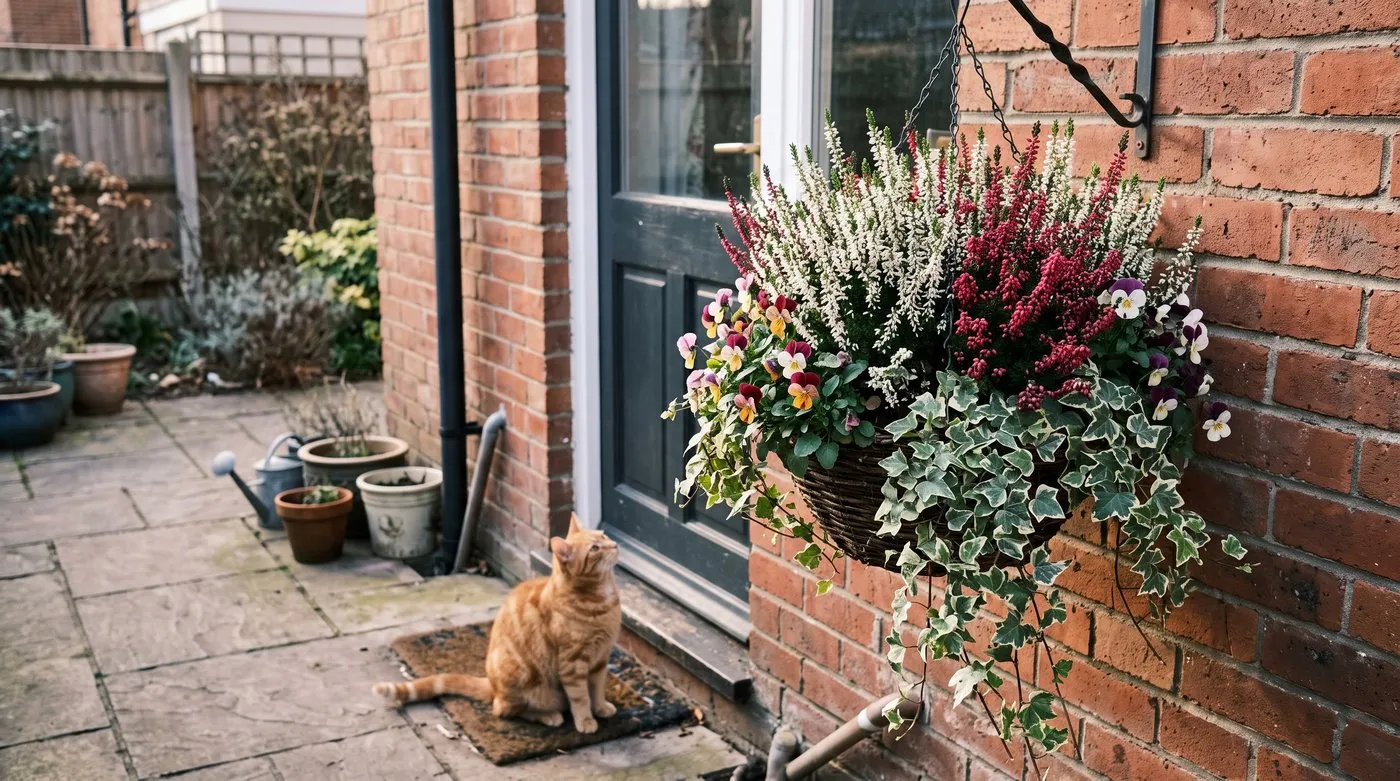
Winter heather gives early bumblebees a welcome snack on mild days in late winter.
Compost, lining and planting
Use fresh peat-free multipurpose compost with a few handfuls of horticultural grit mixed in. The grit helps water drain through instead of sitting cold around the roots.
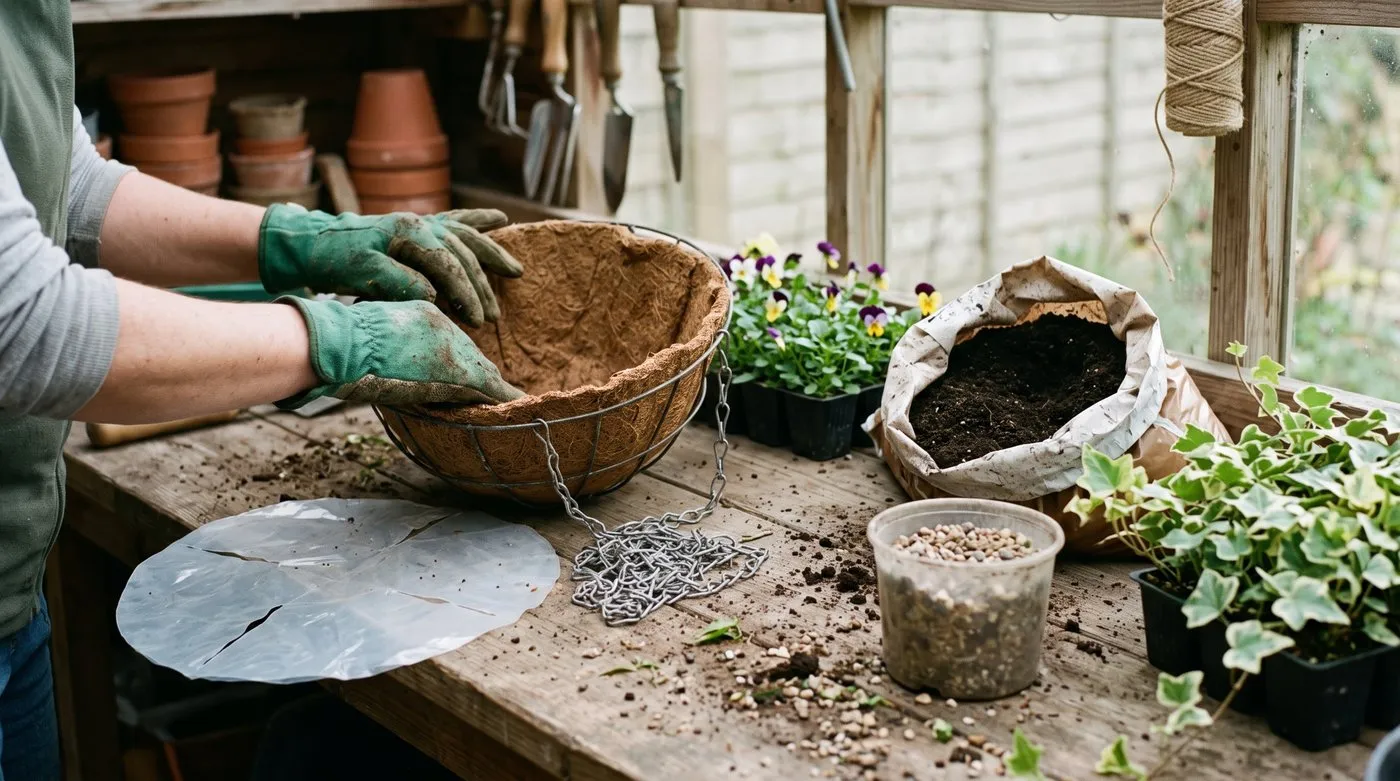
A thick liner and a plastic inner layer keep wind from drying and chilling the roots all winter.
Don’t reuse last summer’s basket compost. By autumn it’s tired, full of old roots and squashed down, so it holds too much water and rots roots. Tip it on the borders and start fresh.
Mix a little slow-release fertiliser into the compost. That’s all the feeding most winter baskets need.
Lining a wire basket: use a thick moulded fibre or wool liner rather than thin moss. Then lay a circle of old compost bag inside, with a few slits in the base, to stop the compost drying out through the sides in wind. Moss liners dry out fast and give little shelter in winter.

A matching pair either side of the door makes a cheerful welcome, and the house wall gives them shelter.
How to water a winter hanging basket
Winter baskets still need water, just far less than in summer. Check weekly and water only when the top 2cm of compost is dry. A basket under a porch gets no rain at all.
Water at midday on a dry day, so the extra drains away before a cold night. Never water frozen compost: wait for a thaw. Too much water and the rot that follows kill more winter baskets than drought.
A quick way to check is to lift the basket from below. A light basket needs water; a heavy one doesn’t.
Feeding is light. Give a high-potash liquid feed in mild spells from late February to boost the spring flush of flowers. Don’t feed from December to late January, when plants are barely growing.

Water around midday on a dry day, so the compost has drained before the temperature drops at dusk.
How to protect a winter basket from frost
Most of the plants above cope with UK frost on their own. The real danger is long, hard freezes and soggy compost.
Position matters most. A basket against a house wall, under an overhang, is warmer and drier than one out in the open. Avoid low, open corners where cold air settles.
When a hard freeze is forecast, wrap the basket loosely in horticultural fleece overnight and take it off in the morning. Don’t use plastic, which traps damp. Our guide to protecting plants from frost covers fleece and other options.

A loose fleece wrap on the coldest nights helps protect the roots. Take it off in the morning so the plants get light.
Month-by-month winter basket calendar
Timings suit central England. Go a couple of weeks earlier in Scotland and the north, and later in the south west.
| Month | Main job |
|---|---|
| September | Buy plants. Plant baskets from mid month, soaking rootballs first |
| October | Finish planting. Hang baskets against a sheltered wall |
| November | Check weekly. Water at midday only when the top is dry |
| December | Fleece on the coldest nights. Pick off faded flowers |
| January | Water very little. No feeding. Clear dead leaves |
| February | First high-potash feed in mild spells. Deadhead pansies |
| March | Feed every two weeks. Plants flush as the light returns |
| April | Plan the summer changeover. Move healthy violas to pots or borders |
Common winter basket mistakes
Reusing old compost. Tired summer compost holds water, freezes hard and rots roots. Always start fresh.
Never watering. Baskets under porches get no rain, and evergreens keep drinking. Check weekly.
Overwatering in cold weather. Water sitting in compost overnight freezes and rots roots. Water at midday, only when dry.
Hanging in an exposed spot. Open corners and dips collect cold air. Hang baskets against the house.
Planting too sparsely. Winter baskets don’t fill out like summer ones, so pack them in from the start.
Frequently asked questions
When should I plant a winter hanging basket in the UK?
Plant between mid September and mid October. That gives roots a few weeks to settle before the first hard frost. Plant later and the plants sit still until spring. In Scotland and northern England, aim for the earlier end.
What plants survive winter in hanging baskets?
Winter pansies, violas, trailing ivy and Cyclamen coum all cope with UK winters. Add Skimmia ‘Rubella’, winter heather (Erica carnea) and Vinca minor for evergreen structure. Summer bedding such as petunias and lobelia won’t survive the first frost.
How many plants go in a winter hanging basket?
Five or six in a 35cm basket, and seven to nine in a 40cm one. Plants barely grow in winter, so pack them more closely than in a summer basket. Leave a small gap between rootballs so water can get down.
Do you water hanging baskets in winter?
Yes, but far less than in summer. Check weekly and water only when the top 2cm of compost is dry. Water at midday on a dry day, and never onto frozen compost. Too much water kills more winter baskets than too little.
How do I protect a winter hanging basket from frost?
Hang it against a house wall, under an overhang if possible. The wall gives shelter and a little warmth. In a hard freeze, wrap the basket loosely in horticultural fleece overnight and take it off in the morning.
Are winter hanging basket plants safe for pets?
Not all of them. Cyclamen and ivy are toxic to cats and dogs if eaten, and skimmia berries can upset them too. Baskets usually hang out of reach, but pick up fallen leaves and tubers, and use pansies and violas in low pots instead.
Now your baskets are planted, carry the same colour down to ground level with our winter container recipes, or find more ideas in our winter bedding plants guide and garden design section.
Our team produces practical UK gardening guidance from source research, contributor records and established horticultural practice. Editorial standards are overseen by Matt W.