Key takeaways
- Minimum useful size: 6x8 foot for one gardener, 8x10 foot if you plan to overwinter plants
- Toughened safety glass is the best long-term glazing choice for permanent greenhouses
- Aluminium frame: lowest maintenance. Wood frame: better looks, needs treatment
- Base must be level, drained, and at least as large as the greenhouse footprint
- Roof vent area should total 20% of the floor area for proper summer cooling
- Budget: £450-£900 entry, £1,200-£2,500 mid-range, £3,000+ for premium wooden
A first greenhouse is one of the larger investments a UK gardener makes. The right choice extends the growing season by 8-10 weeks, allows winter salads, and turns tomato, cucumber and grapevine crops from precarious to reliable, though greenhouse grapes can suffer grape shanking in cool damp summers. The wrong choice rusts, blows over, or sits unused. This guide covers every decision a UK buyer needs to make: size, glazing, frame, base, ventilation, siting, planning rules, and budget.
What Size Greenhouse You Actually Need
The single biggest cause of UK greenhouse buyer regret is buying too small. A 6x4 or 6x6 model fits in any small garden but holds almost no useful crop volume by the second season.
| Greenhouse size | Footprint | Best for | Crop capacity |
|---|---|---|---|
| 6x4 foot | 2.2m² | Seedling raising only | 2 cordon tomatoes max |
| 6x6 foot | 3.3m² | Hobby grower, raised beds elsewhere | 4 cordon tomatoes, 2 cucumbers |
| 6x8 foot | 4.5m² | Minimum useful first greenhouse | 6 tomatoes, 4 cucumbers, propagation bench |
| 6x10 foot | 5.6m² | Serious hobby grower | 8 tomatoes, 4 cucumbers, salad bed, bench |
| 8x10 foot | 7.4m² | Year-round growing | Full overwintering plus summer crops |
| 8x12 foot | 8.9m² | Allotment-grade production | Doubles capacity of 6x10 |
| 10x12+ foot | 11.1m²+ | Show growing, commercial | Specialist crops, propagation business |
Allow space for paths. A 6x8 with a central 600mm path leaves only 1.2m of useful staging on each side. An 8x10 with the same path leaves 1.8m, which fits two rows of plants comfortably.
For UK gardens under 100m², a 6x8 is usually the largest practical size. For 100-300m² gardens, an 8x10 or 8x12 is the sensible choice. Above 300m² there is no upper limit beyond budget and base preparation.
Read our deeper sizing guide for model-by-model comparison across UK supplier ranges.
Glass vs Polycarbonate Glazing
Two main glazing types appear on UK greenhouses: toughened safety glass and twin-wall polycarbonate. A third option, horticultural float glass, still appears on cheap models but is no longer recommended.
| Glazing type | Light transmission | Lifespan | Heat retention | Cost (6x8) | Safety |
|---|---|---|---|---|---|
| Toughened safety glass | 90-92% | 30+ years | Good | £200-£350 panel set | Shatters into pebbles |
| Twin-wall polycarbonate | 75-82% | 8-12 years | Better (insulation) | £150-£280 panel set | Flexible, no shards |
| Horticultural float glass | 90% | 5-15 years | Good | £100-£180 panel set | Breaks into sharp shards |
| Single polycarbonate sheet | 85% | 5-8 years | Poor | £80-£150 panel set | Flexes, no shards |
Toughened safety glass is the standard for any greenhouse meant to last 20+ years. It transmits the highest light (90-92%) and resists scratches, yellowing, and storm damage. Modern UK suppliers use 4mm toughened glass that breaks into small rounded pebbles if shattered, eliminating the cut risk of old greenhouse glass. Budget £200-£350 for a 6x8 panel set, included in mid-range models.
Twin-wall polycarbonate is the practical choice where children play near the greenhouse, in exposed coastal sites, or for buyers on a tight budget. The 6-10mm twin-wall provides genuine insulation that glass cannot match. Drawback: it yellows from UV exposure in 8-12 years, dropping light transmission to 65-70% by year 10. Most UK polycarbonate panels need full replacement at year 10-12, costing £150-£280 for a 6x8 set.
Horticultural float glass (the original Victorian greenhouse glazing) still appears on the cheapest aluminium models. It breaks into sharp shards under wind or hail. Avoid for any greenhouse near children, pets, or public paths. Most reputable UK greenhouse suppliers no longer sell it.
Aluminium vs Wooden Frame
The frame material decides 80% of long-term appearance and maintenance.
Aluminium frames dominate the UK market because they need no treatment, last 30+ years untouched, and cost a third of equivalent wooden frames. Modern UK aluminium greenhouses come in mill (silver), green, anthracite grey, and black powder-coated finishes. The frame thickness varies: budget models use 25x25mm extrusions; mid-range use 30x30mm or thicker. Always check the wind-rating: a quality 6x8 should withstand 78-86mph gusts.
Wooden frames offer better looks, slightly better insulation, and a longer rebuild lifecycle. The two main UK options are cedar (Western Red Cedar, naturally rot-resistant) and thermo wood (kiln-modified Scandinavian softwood, equally rot-resistant). Avoid pressure-treated softwood frames: they last 8-12 years before sections need replacing.
| Frame type | Lifespan | Treatment | Cost premium | Best for |
|---|---|---|---|---|
| Aluminium (mill finish) | 30+ years | None | Baseline | Budget, low maintenance |
| Aluminium (powder-coated) | 30+ years | None | +15-25% | Better look, dark finishes |
| Cedar | 25-30 years | Oil every 3-4 years | +200-300% | Traditional gardens |
| Thermo wood | 25-30 years | None or light oil | +200-300% | Modern traditional gardens |
| Pressure-treated softwood | 8-12 years | Paint every 2 years | +60-100% | Avoid |
For a buyer who wants the long-term value of wood without the maintenance, thermo wood is the better choice over cedar. Several UK suppliers stock thermo wood ranges, including Greenhouse Stores who offer free installation on Swallow thermo wood models.
How to Build the Right Greenhouse Base
A greenhouse is only as stable as its base. A wonky base produces wonky glazing fits, dropped panels, and door alignment problems within the first year.
Three base options work for UK greenhouses:
1. Brick or block plinth. A two-course brick or one-course block plinth, sat on a concrete strip footing, gives the strongest base for any greenhouse over 6x8. Cost: £150-£350 in materials for a 6x10 footprint. Adds 200-300mm of height, which improves headroom and stops splash damage on glazing. Lifespan: 50+ years.
2. Paving slab base. A perimeter of 600x600mm slabs on a 50mm sharp sand bed gives a level, well-drained base for any greenhouse up to 8x12. Cost: £80-£180 for a 6x8 footprint. Lifespan: 25-30 years if the sub-base is properly compacted.
3. Concrete slab. A full 100mm reinforced concrete slab gives the most permanent base. Cost: £180-£300 for a 6x8 footprint. Lifespan: 50+ years. Drawback: no drainage through the floor, so a soakaway must be allowed for at one corner.
Avoid: bare soil, gravel without edging, decking, or grass. Any of these settles over the first 6-18 months and pulls the greenhouse out of square.
The base must be as large as the greenhouse footprint, level to ±5mm across the diagonal, and square to ±10mm across the diagonal of a 6x8. A square check across the diagonals from corner to corner takes 5 minutes and prevents 90% of base problems.
For full step-by-step, our greenhouse base guide shows the brick plinth method for a 6x8 with photos.
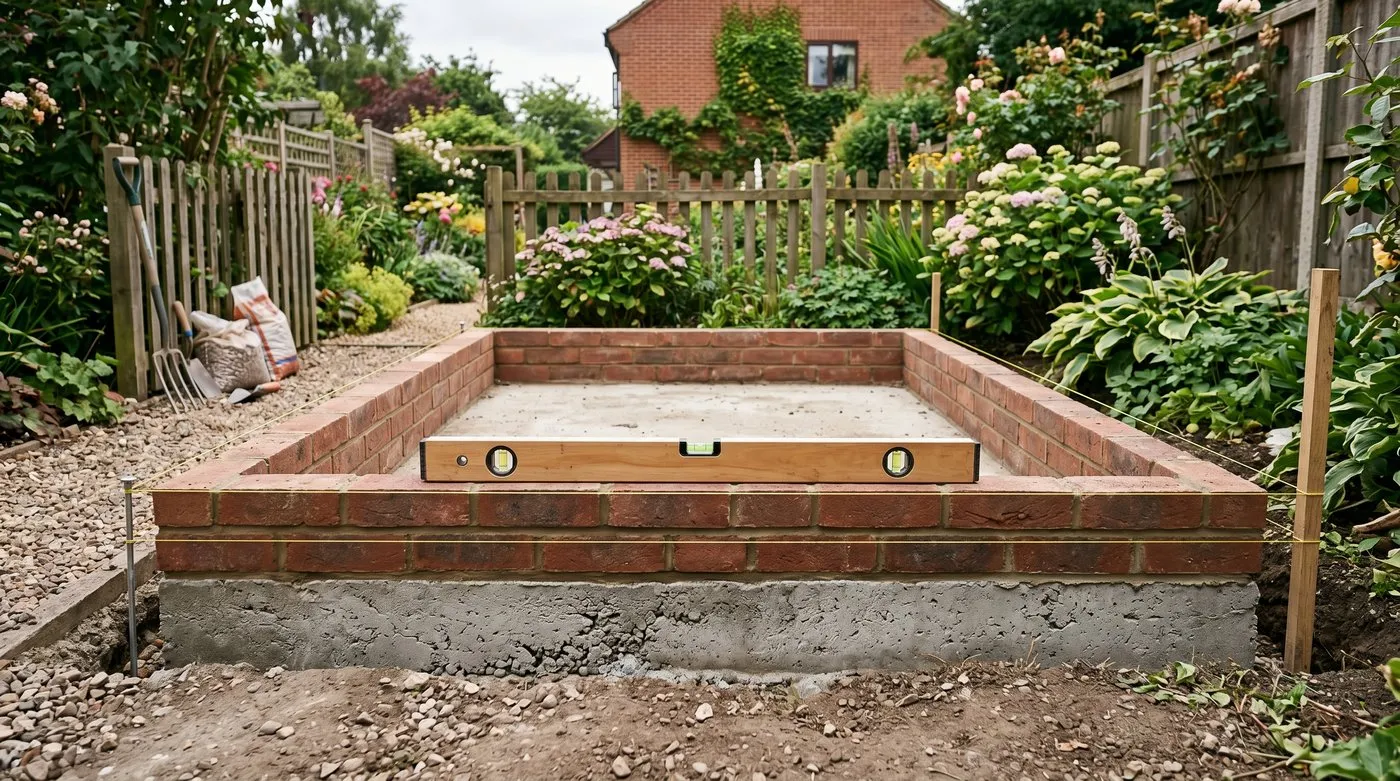 A two-course brick plinth on a concrete strip footing, levelled to ±5mm and squared to ±10mm across the diagonals. This base will outlast the greenhouse on top of it.
Ventilation and Vent Area Rules
Ventilation is the most-skipped detail on cheap UK greenhouses. The rule from the British Greenhouse Manufacturers Association is roof vent area = 20% of floor area minimum. Most budget models supply 8-12%.
A 6x8 greenhouse (4.5m²) needs at least 0.9m² of roof vent area. That is two roof vents of 600x750mm each. Many cheap 6x8 models come with one 600x600mm roof vent (0.36m²), which is less than half the required area.
Roof vents are far more effective than side vents because hot air rises and escapes through the roof. Side vents and louvre vents only work in combination with roof vents and only contribute the lower 20-30% of the total.
| Greenhouse size | Floor area | Required vent area | Vent configuration |
|---|---|---|---|
| 6x4 foot | 2.2m² | 0.44m² | 1 roof vent + 1 louvre |
| 6x8 foot | 4.5m² | 0.9m² | 2 roof vents + 1 louvre |
| 8x10 foot | 7.4m² | 1.48m² | 3 roof vents + 2 louvres |
| 8x12 foot | 8.9m² | 1.78m² | 3 roof vents + 2 louvres |
| 10x12 foot | 11.1m² | 2.22m² | 4 roof vents + 2 louvres |
Most UK greenhouse suppliers sell extra roof vents as a £30-£60 add-on. Order them with the original purchase, not as a retrofit. Retrofitting a roof vent on a built greenhouse costs £80-£150 and risks frame damage.
Automatic vent openers (Bayliss MK7, Vitavia ECO, or similar) cost £25-£45 each and open the vent when the internal temperature exceeds 18-22C. They pay for themselves in saved crops the first July a heatwave hits. Fit one to every roof vent. Read our greenhouse ventilation guide for the auto-vent product comparison.
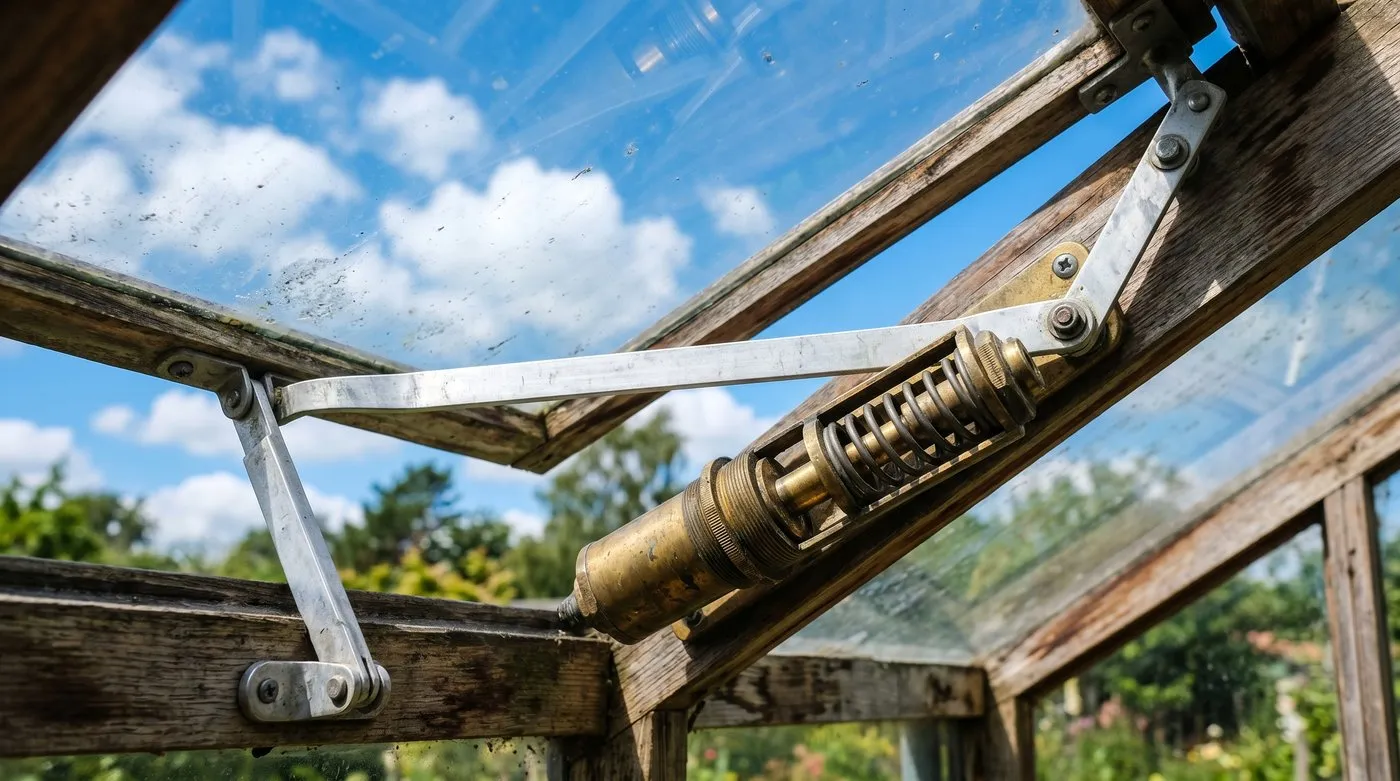 A Bayliss MK7 automatic vent opener fitted to a roof vent. The wax cylinder expands at 17-22C and pushes the vent open. Cost £25-£45 per unit. Essential on every roof vent.
Where to Site a Greenhouse in a UK Garden
Site choice is as important as size and quality. A premium greenhouse in the wrong spot underperforms a budget greenhouse in the right spot.
Aspect. South or south-west facing for maximum winter sun. East-west ridge orientation gives the most even light spread across the day. A north-facing greenhouse loses 30-40% of winter light and is not worth installing for anyone wanting January and February crops.
Shelter. Site behind a wall, fence, hedge or shed on the north and east sides. Prevailing UK wind is south-west, but the cold-damage wind comes from the north and east in winter. A 1.8m fence 2-3m to the north of the greenhouse cuts heat loss by 15-20%.
Tree clearance. Allow at least 3-4m clearance from overhanging deciduous trees and 5-6m from evergreen trees. Falling leaves block roof vents in autumn. Falling branches break glass in winter storms. Tree roots disturb the base over 8-15 years.
Slope. Ground slope under 1 in 20 (50mm over a 1m length) is workable with a level base. Steeper slopes need a retaining wall or a stepped base. Avoid any site with a slope toward the house: water runs the wrong way.
Drainage. Test by digging a 300mm hole and filling with water. If it drains in under 2 hours, drainage is adequate. If water sits for 24+ hours, install a French drain around the base before laying it.
Access. Allow at least 600mm clear path on at least two sides of the greenhouse for cleaning and panel replacement. A 6x8 greenhouse needs a 7x9 cleared area minimum.
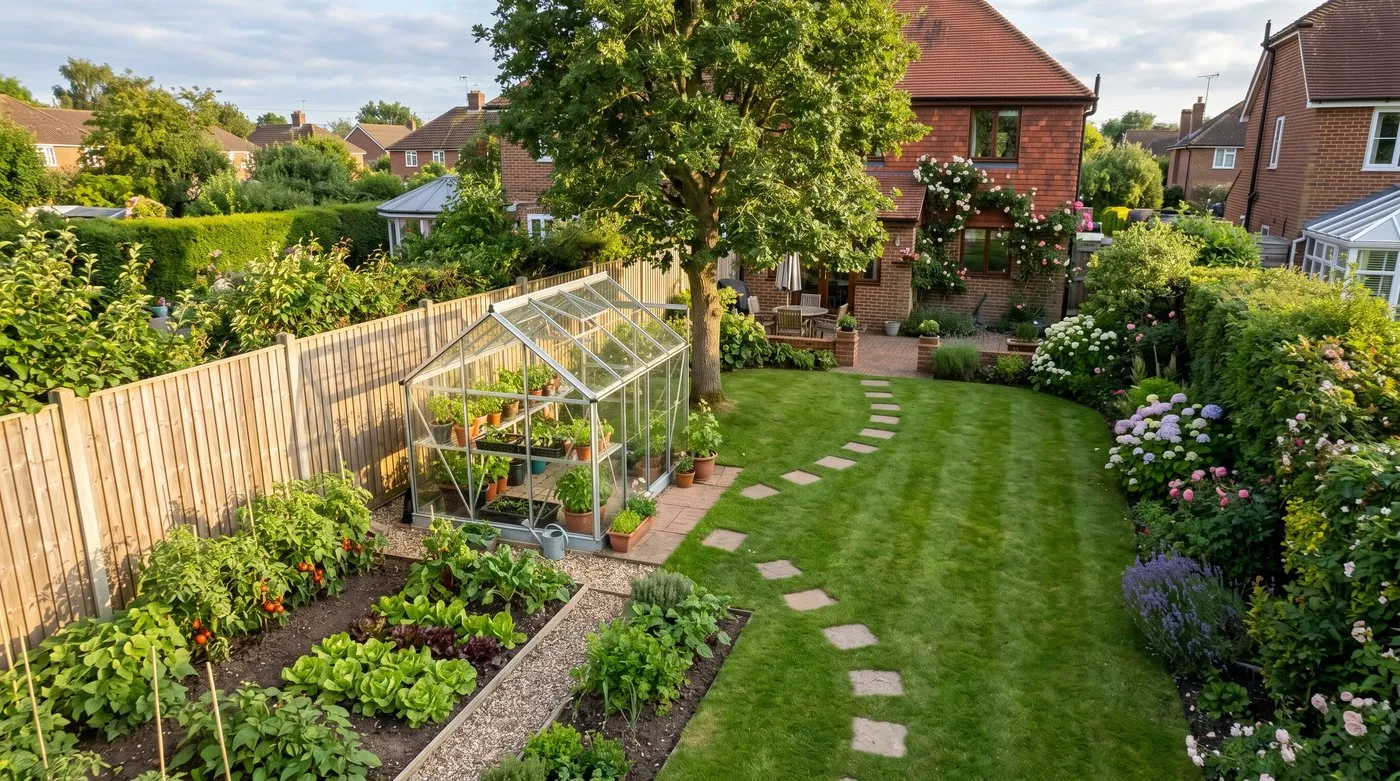 Ideal greenhouse siting in a typical UK back garden: south-facing aspect, north and east shelter from existing fencing, clear of overhanging trees, with room for access paths on at least two sides.
Planning Permission and Permitted Development
Most UK domestic greenhouses fall under Permitted Development Rights and need no planning permission. The rules from the Town and Country Planning Order 2015:
- Maximum height: 2.5m if within 2m of any boundary; 4m otherwise (3m if flat roof)
- Maximum coverage: outbuildings (including greenhouse) cannot cover more than 50% of the garden behind the original house
- Must be behind the front of the house facing the highway
- Must be single storey with eaves under 2.5m
Restrictions apply to:
- Listed buildings: planning permission almost always required, even for small greenhouses
- Conservation areas: greenhouses larger than 10m² often need permission
- Article 4 areas: local authority has removed some permitted development rights
- National parks, AONBs, and the Broads: larger or visible structures need permission
Always check with your local planning office before buying. The cost of a planning application is £258 for a householder application as of 2026, taking 8-10 weeks.
The UK government’s Planning Portal greenhouse guidance covers the full rules with examples.
For full planning, glazing, and brand comparisons, the Greenhouse Stores Buyer’s Guide walks through the UK greenhouse market with installer commentary.
What to Budget for a UK Greenhouse
UK greenhouse prices vary by frame material, glazing, size, and brand. The budget breaks into three tiers.
| Tier | 6x8 price range | 8x10 price range | What you get |
|---|---|---|---|
| Entry | £450-£900 | £700-£1,400 | Aluminium frame, polycarbonate or float glass, single vent, basic door |
| Mid-range | £1,200-£2,500 | £1,800-£3,500 | Toughened glass, 2 roof vents, sliding door, drop-down louvre vent |
| Premium aluminium | £2,500-£4,500 | £3,500-£6,500 | 35-50mm frame, 6mm toughened glass, multiple vents, automatic opener, gutter |
| Wooden (thermo wood) | £3,000-£5,500 | £4,500-£8,000 | Cedar or thermo wood frame, toughened glass, traditional look |
| Premium wooden | £5,500-£12,000+ | £8,000-£18,000+ | Hand-built, bespoke sizes, brass furniture |
Hidden costs to add to any purchase:
- Base preparation: £80-£350 depending on type
- Delivery: £40-£150 in most UK postcodes
- Installation: £200-£600 if buying assembled
- Automatic vent openers: £25-£45 each
- Staging: £80-£250 for a 6x8 set
- Guttering: £50-£120 if not included
- Water butt and downpipe: £30-£80
A realistic total budget for a functioning 6x8 mid-range greenhouse with base, delivery, installation, staging, and auto-vents is £2,000-£3,200. For 8x10, £3,000-£4,800.
Free installation on Swallow thermo wood models is offered by Greenhouse Stores, which saves £400-£600 on the wooden range.
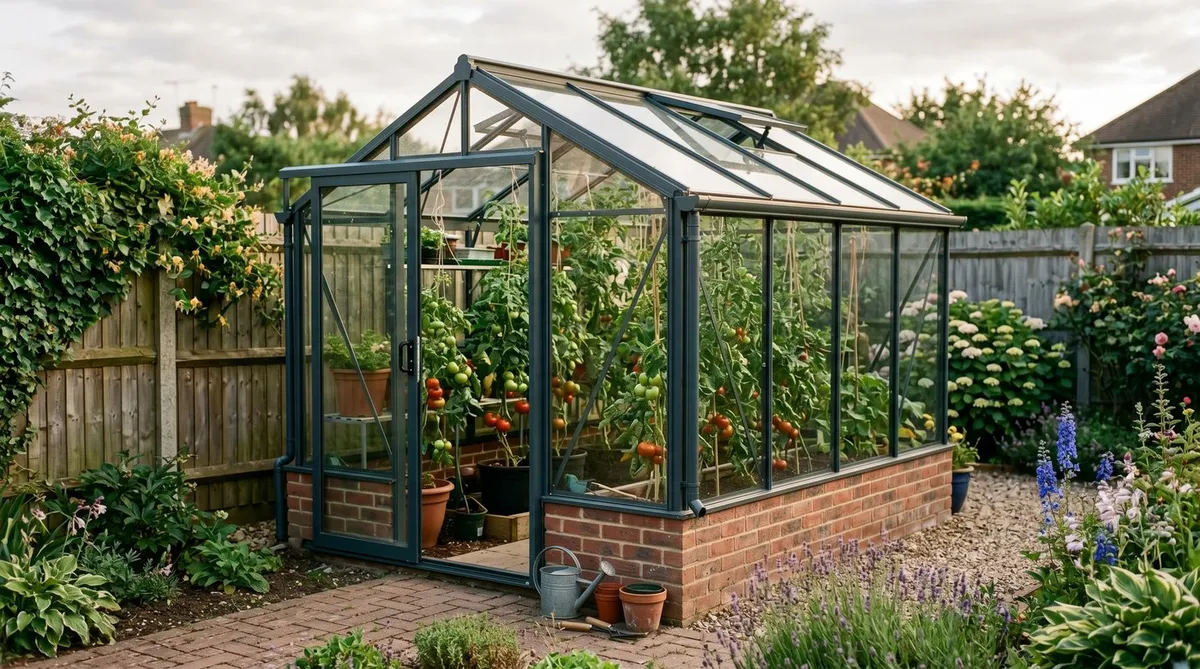
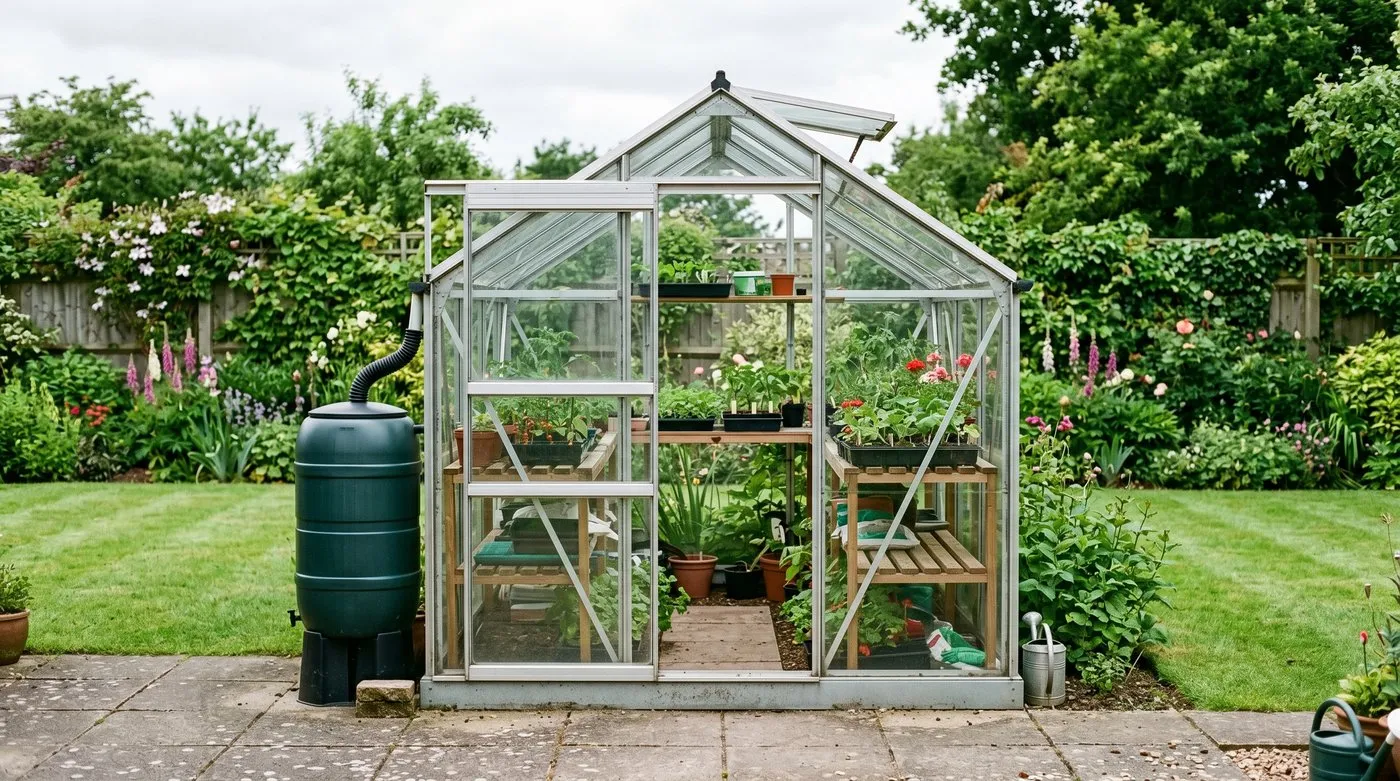 A typical mid-range UK greenhouse setup: 6x8 aluminium frame, toughened safety glass, paving slab base, sliding door, gutter and water butt. Total invested £1,800-£2,400 with installation.
Common Mistakes UK Buyers Make
Mistake 1: buying too small. The 6x6 looks adequate at the garden centre and is half-full by the second spring. A 6x8 or 6x10 will pay back its small price premium in extra crops within two seasons.
Mistake 2: skipping the base. Setting a greenhouse on bare soil or gravel produces alignment problems within 12 months. Always lay a proper base before assembly.
Mistake 3: ignoring vent area. A 6x8 with one small roof vent will reach 40-45C on a UK July day, scorching tomatoes and forcing whitefly outbreaks. Order a second roof vent at purchase, not as a retrofit.
Mistake 4: picking the cheapest model with thin frame extrusions. Budget greenhouses with 25x25mm aluminium extrusions flex in 60mph winds and pop glazing panels. Pay the £150-£300 premium for a 30x30mm or thicker frame.
Mistake 5: ignoring delivery and installation costs. A £600 greenhouse with £150 delivery and £400 installation costs the same as a £950 model with free delivery and DIY install. Compare the total cost.
For premium UK ranges, the Vitavia, Elite, Janssens, Halls and Swallow brand comparisons on Greenhouse Stores cover the model differences in detail. For polytunnels as an alternative, our polytunnel vs greenhouse guide covers the trade-offs.
Greenhouse Buying Calendar UK Month-by-Month
| Month | Buying or planning task |
|---|---|
| January | Plan the site, measure available space |
| February | Order greenhouse for spring delivery (8-12 week lead times common) |
| March | Lay the base on a dry weekend |
| April | Take delivery, assemble before peak season |
| May | Move overwintered plants and start summer crops |
| June | Add auto vent openers if not fitted |
| July | Monitor temperature, add shading if peaking above 32C |
| August | Order spare glazing clips and door seals for winter |
| September | Plan winter crops, install heater if growing through |
| October | Clean glazing, check seals, fit insulation if needed |
| November | Final winter prep, secure roof vents against gales |
| December | Plan next year’s expansion or upgrade |
For storm and wind protection, our how to secure a greenhouse against wind covers the storm-proofing detail. For winter use, the winter insulation guide covers heaters, bubble-wrap and double-glazing options.
Frequently asked questions
What size greenhouse do I need for a UK garden?
6x8 foot is the minimum useful size. 6x10 or 8x10 if you plan to overwinter plants. A 6x8 holds 6 cordon tomatoes, 4 cucumber plants, and a propagation bench. Always buy one size larger than your first estimate.
Is glass or polycarbonate better for a UK greenhouse?
Toughened safety glass is better for permanent greenhouses. It lasts 30+ years, holds heat, transmits 90% of light, and looks right. Polycarbonate is cheaper, lighter, and safer near children, but yellows in 8-12 years and transmits 80% light at best.
Aluminium vs wooden greenhouse: which should I choose?
Aluminium for low maintenance and budget. Wood for looks and insulation. Aluminium frames last 30+ years with no treatment. Wooden frames need oil or paint every 2-3 years and last 15-25 years on a good base. Budget difference is 3-5x in favour of aluminium.
Do I need planning permission for a greenhouse in the UK?
Most UK gardens do not need planning permission for a greenhouse under 2.5m ridge height, behind the front of the house, and covering under 50% of the garden. Listed buildings, conservation areas, and Article 4 areas have stricter rules. Always check with your local planning office.
Where in the garden should I site my greenhouse?
South or south-west aspect, sheltered from north and east winds. Avoid overhanging trees within 3-4 metres. Level ground or a base levelled with concrete or paving slabs. Clear of dense shade for 6+ hours a day in summer.
Now plan the rest of the build
Choosing the model is the first step. Now you’ve decided the size, glazing and frame, read our greenhouse base guide for the brick plinth method that lasts decades. To get the ventilation right from day one, our greenhouse ventilation guide covers vent sizing, auto openers and humidity control. For year-round use, the winter insulation guide shows the bubble-wrap and heater setups that hold a frost-free greenhouse through January. And for storm prep, our secure your greenhouse against wind shows the anchor and clip checks that prevent insurance claims.
Our team produces practical UK gardening guidance from source research, contributor records and established horticultural practice. Editorial standards are overseen by Matt W.