Key takeaways
- Greenhouses are light, so a strong gust can lift one that isn't fixed down
- Bolting it to a proper base is the single most important thing you can do
- Toughened glass is much stronger than horticultural glass and breaks into blunt pieces
- Polycarbonate barely breaks at all and is the best pick for exposed gardens
- A hedge filters the wind and gives shelter well beyond its own height
- Before a storm, shut every vent, door and louvre so the wind can't get inside
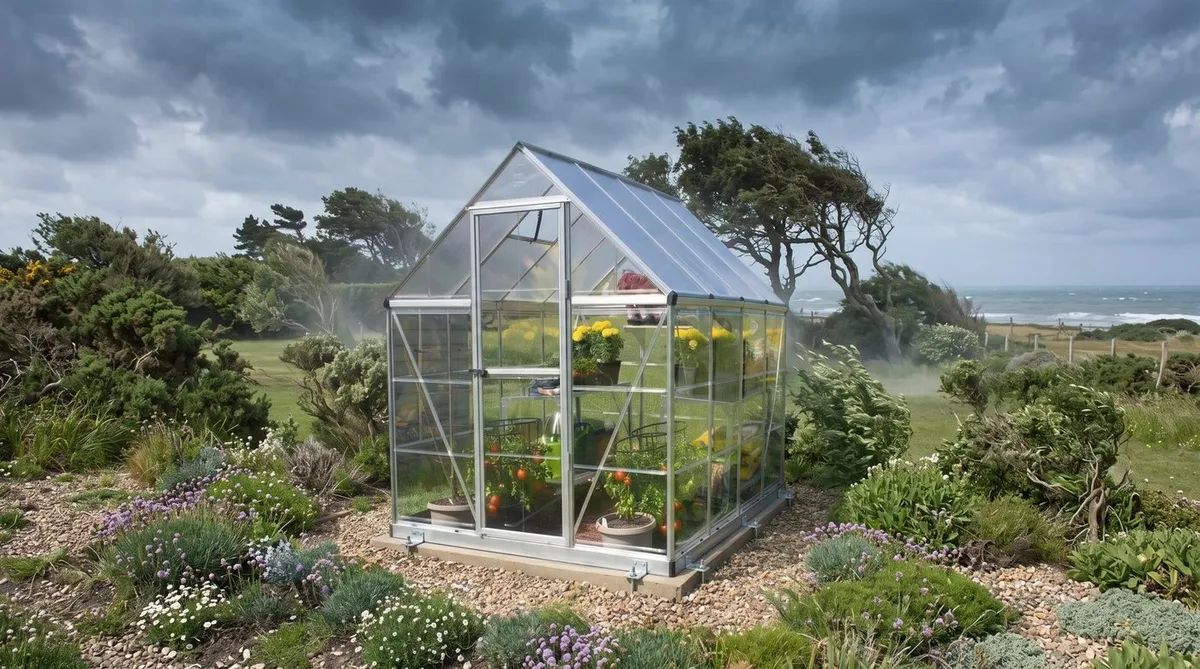
A greenhouse is one of the lightest things in the garden, yet its flat panes catch the wind like a sail. That mix makes it easy prey in a storm, especially in coastal, hilltop and open country gardens.
The good news is that most wind damage can be prevented. It starts with how and where the greenhouse is put up, long before the first gale arrives.
Why greenhouses are vulnerable to wind
Wind doesn’t have to be extreme to cause trouble. As wind rushes over the roof, it tries to lift it, a bit like an aeroplane wing. If it also gets inside through an open vent, a gap in the glass or a loose door, it pushes outwards from within. Together those forces can lift a greenhouse right off its base.
Aluminium frames are light by design. Without proper fixing, the greenhouse relies on its own weight and whatever’s inside to stay put. In a British winter, that often isn’t enough.
Older greenhouses are more at risk, because glazing clips loosen, glass slips in its grooves and door catches wear out. Keeping things in good order matters just as much as putting it up properly.
How to anchor a greenhouse properly
Fixing the greenhouse to a solid base is the single most useful thing you can do. Everything else comes second.
Steel base on concrete
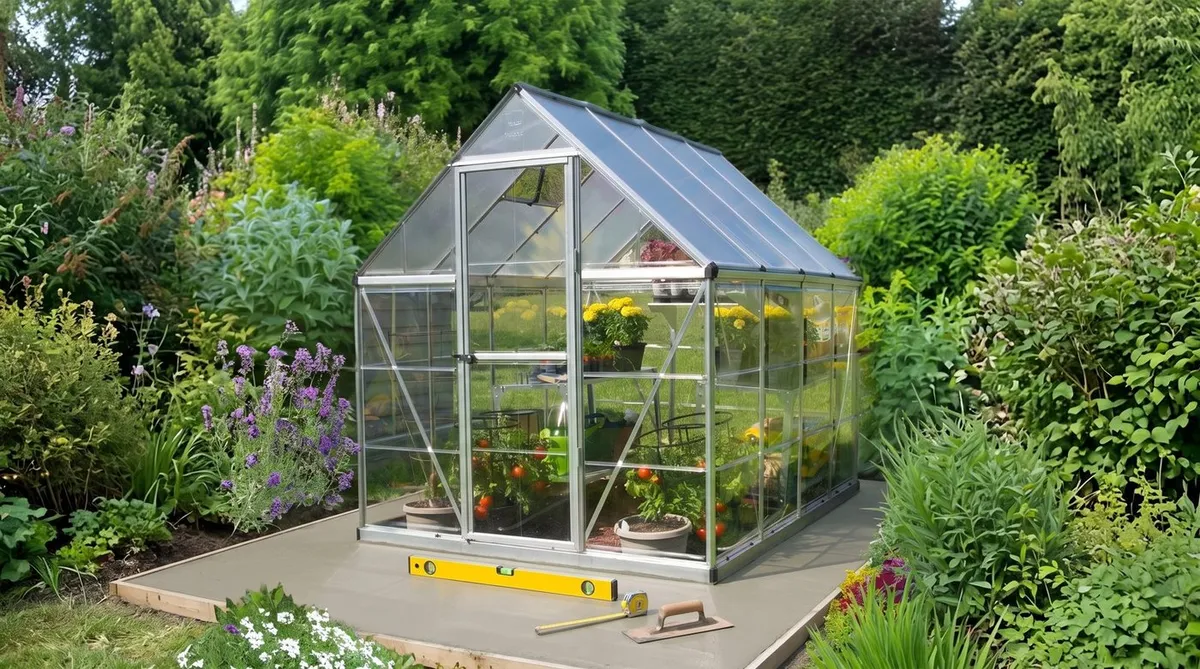
A steel base bolted to a concrete strip foundation is the most secure option. The concrete runs all the way round the edge, the steel base bolts to the concrete, and the greenhouse bolts to the base. The wind then has to pull up the ground to move it.
Vitavia greenhouse bases are made to fit specific frame sizes. Always match the base to your greenhouse model rather than making do with odd bits of steel.
Ground anchor kits
On soil, gravel or anywhere without concrete, a ground anchor kit holds the greenhouse down without permanent foundations. The Palram Canopia Greenhouse Anchor Kit has steel stakes that screw about 300mm into the ground, with straps that fix to each corner of the frame.
Ground anchors are ideal for allotments, rented homes and anywhere a concrete base isn’t an option.
Bolting to paving slabs
You can also fix a greenhouse to paving slabs, drilling through and bolting at each upright post with masonry bolts and stainless steel washers. The slabs need to be bedded on compacted hardcore and mortar, not loose sand, which shifts in a strong wind.

An anchor kit holds a greenhouse down on soft ground and allotment sites.
Shop the Palram Anchor Kit at Greenhouse Stores →
Choosing glazing for a windy garden
For a windy site, go for toughened glass or polycarbonate. Horticultural glass is usually the first thing to go in a gale.
Horticultural glass
Horticultural glass is the cheapest and lets in lovely light. The downside is it’s fragile. It cracks easily, breaks into sharp shards and is the first part to fail in a storm. On an exposed site, replacing panes after every gale soon gets expensive.
Toughened safety glass
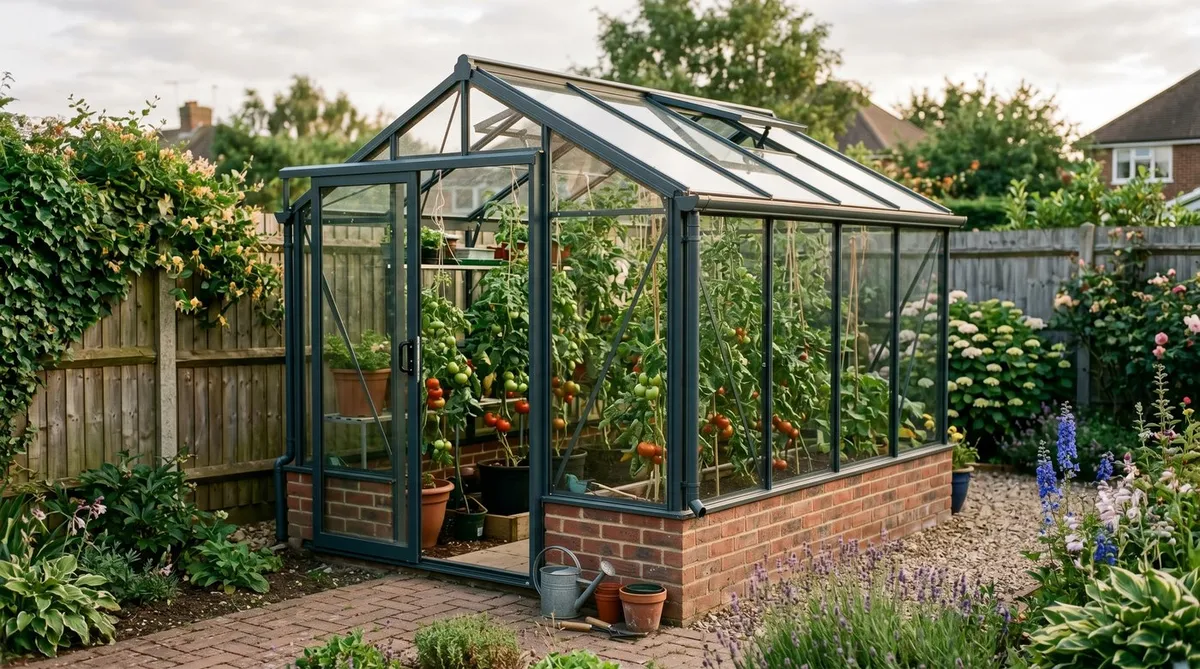
Toughened glass is much stronger than horticultural glass. If it does break, it crumbles into small, blunt pieces rather than sharp shards, which is far safer around children and pets. It costs more to start with but you’ll replace far fewer panes. For most UK gardens it’s the best mix of strength, clarity and safety.
Polycarbonate panels
Polycarbonate hardly ever breaks. It bends when something hits it rather than shattering, and twin-wall sheets keep the heat in better than single glass.
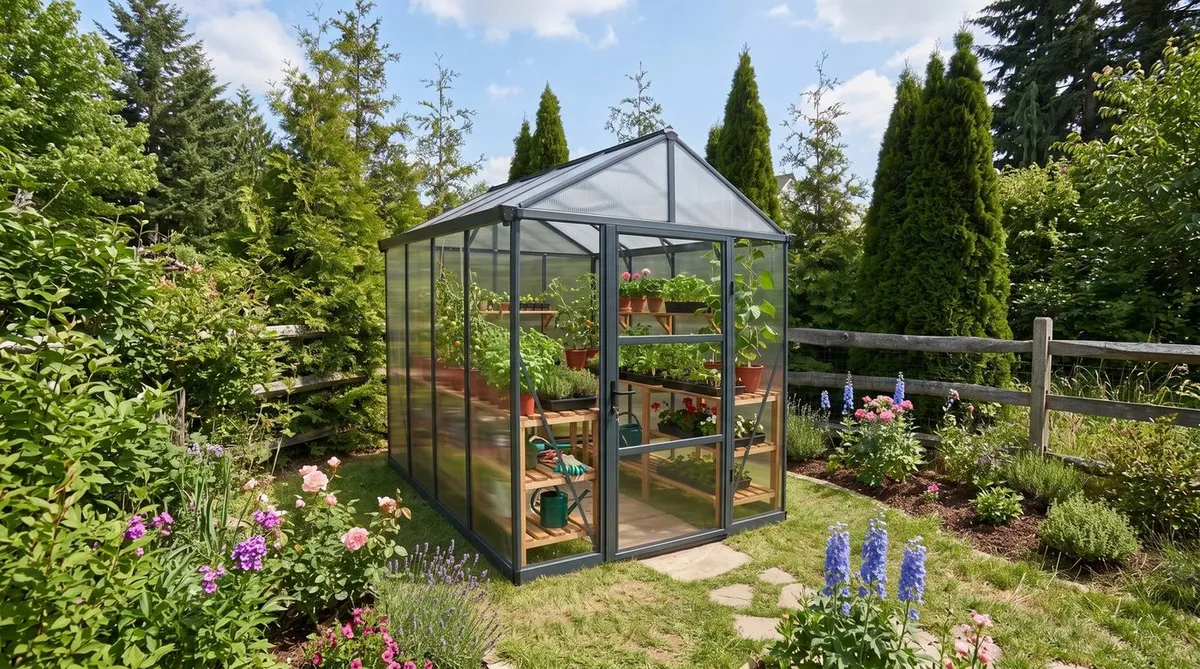
The Palram Hybrid greenhouse range pairs a polycarbonate roof with clear side panels. That puts the strength where hail and falling branches land, while you can still see in easily at eye level. For coastal, hilltop or other exposed gardens, a fully polycarbonate greenhouse is the safest bet.
The trade-off is looks. Polycarbonate slowly yellows over the years and never looks quite as crisp as glass. If toughness matters more to you than looks, it wins. Our guide to polycarbonate vs glass greenhouses compares light, warmth and cost.
| Glazing | Strength | Clarity | Keeps heat in | Best for |
|---|---|---|---|---|
| Horticultural glass | Low | Excellent | Poor | Sheltered gardens |
| Toughened glass | High | Excellent | Poor | Most UK gardens |
| Twin-wall polycarbonate | Very high | Good | Good | Exposed and coastal gardens |
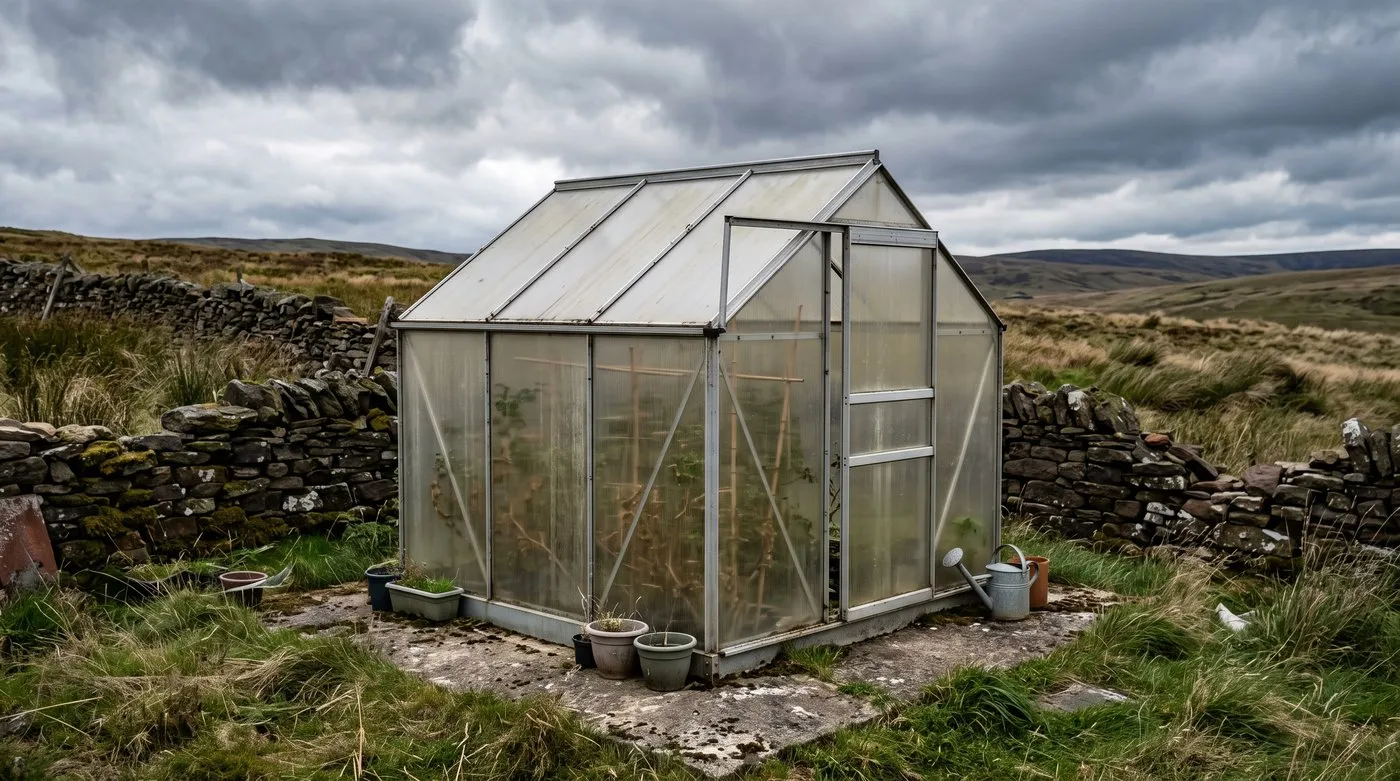
Polycarbonate bends rather than shatters, which makes it the safest choice for hilltop, coastal and open gardens.
How do you stop a plastic greenhouse blowing away?
Weigh it down and tie it to something solid. Plastic-covered walk-in and mini greenhouses weigh very little, so they take off in much lighter winds than aluminium ones.
Stand the feet on paving slabs or bricks and hold them down with sandbags or bags of gravel. Strap the frame to a wall, fence post or sturdy trellis with ratchet straps, or use guy ropes pegged into the ground. A mini greenhouse is safest against a south-facing wall, which shelters one side.
Keep the zipped cover fully closed in wind, as a flapping cover acts like a sail. If a bad storm is forecast, it’s often safest to take the cover off and lay the frame flat until it passes. Move any trays of plants into a shed or porch first.
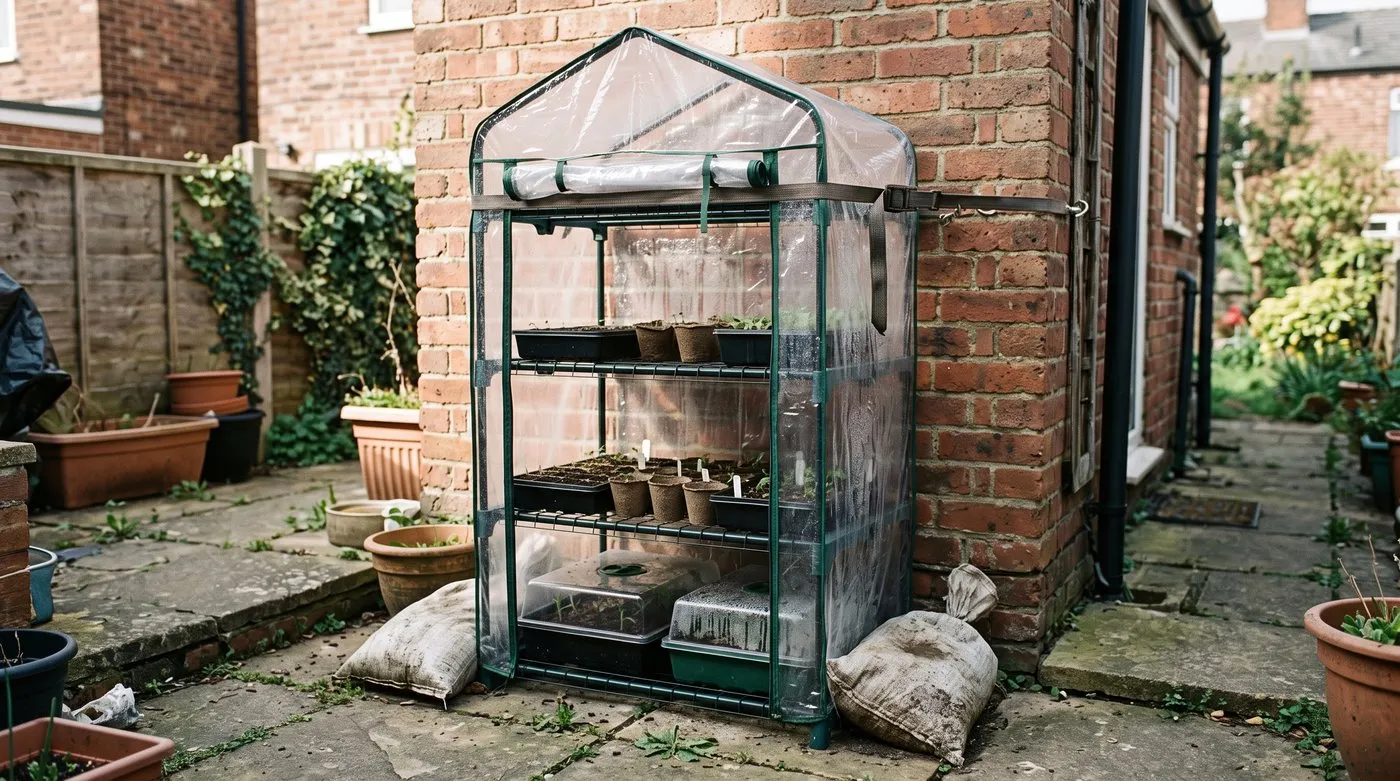
Weigh the feet down and strap the frame to something solid. In a really bad storm, take the cover off and lay the frame flat.
Where to put a greenhouse for shelter
Picking the right spot is the cheapest wind protection there is. A greenhouse tucked behind a house, wall or mature hedge is far safer than one in the middle of an open garden. Before you build a base, think about where the wind comes from. Across most of the UK, the strongest winds blow from the south-west and west.
Put the greenhouse where a building, fence or hedge breaks the wind first. Don’t put it right up against a solid barrier, though, as the wind swirls around just behind it. If your garden has little shelter, look at garden fence ideas or plant a hedge before you put the greenhouse up.
Avoid hilltops, ridges and gaps between buildings, which squeeze and speed up the wind. Even a slight dip in the ground gives useful shelter.
Tip: Where you can, have a narrow end of the greenhouse rather than a long side facing the usual wind direction, so there’s less for the wind to push against.
Planting a windbreak hedge
A windbreak hedge is the best long-term shelter for any garden building. A thick hedge slows the wind a lot, and the RHS explains that the shelter reaches well beyond the hedge’s own height.
Solid walls and close-board fences make the wind tumble and swirl on the far side. A hedge lets some air through, slowing the wind gently instead. That’s why a hedge is better than a solid fence for sheltering a greenhouse. Our hedge planting guide covers choosing and planting one.
Good windbreak hedges for UK gardens:
- Hawthorn: quick, dense and happy in exposed spots
- Hornbeam: holds on to its dead leaves through winter for year-round shelter
- Beech: keeps its bronze leaves from autumn to spring
- Holly: evergreen, very dense and copes with seaside spray
- Escallonia: evergreen, flowering and great for coastal gardens
Plant the hedge at least 3-4 metres from the greenhouse, so it doesn’t shade it and fallen leaves stay out of the gutters.
Storm checklist
A few minutes before a forecast storm can save hours of repairs afterwards.
Shut everything
Close every vent, door and louvre before a storm. An open roof vent lets the wind inside, where it pushes out on every pane while the wind over the roof tries to lift it. That’s how greenhouses get torn off their bases. If you have automatic vent openers, lock the vents shut by hand.

Every vent and door shut tight before a storm arrives.
Check the clips
Walk round and press each pane gently. If one rattles or moves, its clip is loose. Tighten or replace glazing clips before the storm, as spare packs are cheap. Elite Lining Hooks are handy for holding an inside lining firmly in place too.
Secure the door
The door is the weak spot. If the latch is worn, screw a batten across to brace it shut, or fit a heavy-duty bolt. A door that blows open will bang until the hinges break or the glass smashes.
Clear loose things away
Move garden furniture, pots, tools and anything else loose away from the greenhouse. A flying pot can smash a pane in seconds. Put cold frames, cloches and light staging inside or weigh them down.
Replace broken panes straight away
Don’t leave a cracked or missing pane over winter. The gap lets the wind straight in and puts extra strain on every other pane.
What should you do after a storm damages a greenhouse?
Wait until the wind has dropped, then make it weatherproof before doing proper repairs. Loose glass in a gale is dangerous, so do nothing while it’s still gusting.
Wear gloves and eye protection. Pick up broken glass first, including bits that have landed in pots and borders. Cover any gaps with clear polythene, a tarpaulin or plywood, taped or battened in place, to stop the wind loosening more panes.
Check every glazing clip, as they often slip loose without the glass falling out. Glazing repair tape will hold a cracked pane for a short while, but replace it before the next storm. Local glaziers usually stock standard horticultural panes, while toughened glass and odd sizes of polycarbonate may need ordering.
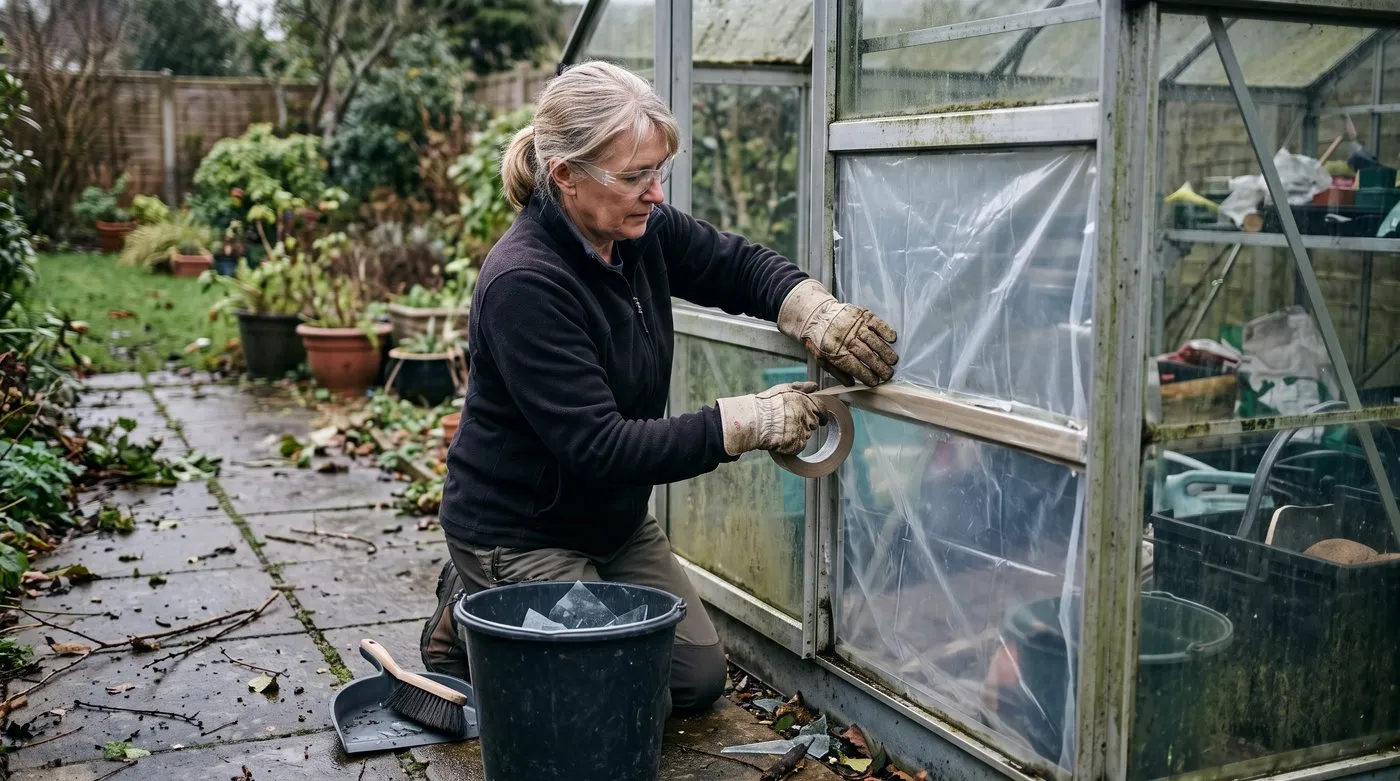
Wait until the wind drops, then cover gaps with polythene or board so the wind can’t loosen more panes. Gloves and eye protection first.
Does home insurance cover greenhouse storm damage?
Some policies do and some don’t, so check yours. Greenhouses are often counted as outbuildings, but some insurers leave them out or set low limits for garden structures.
Insurers usually want proof there was a storm on the day, and often turn down claims caused by wear and tear, such as loose clips, rotten timber or a rusty base. Photograph the damage before you clear up, keep receipts, and talk to your insurer before replacing the whole thing.
Keeping an older greenhouse wind-proof
Even a well-built greenhouse needs a check now and then. Aluminium frames grow and shrink with the temperature, which slowly loosens bolts. Hedges and fences that used to shelter it may have gone or been cut back.
Check the base fixings every autumn. Tighten any loose bolts and swap rusty ones for stainless steel. If the fences around it have been knocked about too, our fence repair guide covers fixing posts and panels before winter.
On clay soil, check the base hasn’t shifted. Clay swells when wet and shrinks when dry, which can crack a concrete base and tilt the frame.
Safety: Never try to fix a greenhouse in a strong wind. Wait for calm weather and wear gloves and eye protection when handling glass.

An Elite Thyme greenhouse sheltered from the wind by hedging and fencing.
If you’re after a toughened glass greenhouse, the Elite Thyme 6x8 at Greenhouse Stores is one to look at.
Common mistakes that lead to wind damage
No base. Standing a greenhouse straight on soil or gravel with no base is the most common reason for losing one in a storm. Our guide on how to build a greenhouse base walks you through slabs, concrete and steel base kits.
Vents left open. Automatic vent openers respond to warmth, not wind. They’ll happily hold a vent open in a gale on a mild day. Lock them shut before a storm.
Loose clips. One missing clip lets a pane lift. The wind gets in and loosens the next one, and so on. Check clips at least twice a year.
A spot in a wind tunnel. Gaps between buildings, fences with gaps underneath and narrow passages all speed the wind up. A hedge or a well-kept fence gives better shelter.
Horticultural glass on an exposed site. It’s fine in a sheltered town garden. On a hilltop, by the sea or in open country, it’ll keep breaking. Toughened glass or polycarbonate saves money and hassle in the long run.
Plants that help shelter a greenhouse
As well as hedges, planting around a greenhouse softens the wind at ground level. Tough climate-resilient plants that cope with exposed spots make good informal windbreaks.
Evergreen shrubs like holly, Portuguese laurel and pyracantha give shelter all year. Drought-tolerant plants like rosemary and lavender in gravel around the base make a low buffer against draughts. Ornamental grasses filter the wind gently and look lovely too.
Once your greenhouse is safe and sound, growing in it gets easier, as it stays warmer with no broken panes or draughts. Tomatoes and container vegetables will thank you. Next, have a look at our guide on how to build a greenhouse base.
Frequently asked questions
Can wind blow over a greenhouse?
Yes, a greenhouse that isn’t fixed down can lift and tip over. A typical small aluminium greenhouse is surprisingly light for its size. Bolting the frame to a base on concrete or slabs stops this. A ground anchor kit adds extra hold on exposed sites.
How do I anchor a greenhouse to the ground?
Bolt it to a steel base fixed to concrete or paving slabs. On softer ground, use a ground anchor kit, with steel stakes that screw about 300mm into the soil and strap to the frame. Choose a kit made for your size of greenhouse.
Is polycarbonate or glass better for a windy site?
Polycarbonate is the better pick for windy, exposed gardens. It’s far tougher than glass and bends rather than shattering. Twin-wall polycarbonate also keeps the heat in better. Glass looks crisper and stays clearer for longer, but it’s more likely to break in a storm.
What wind speed will damage a greenhouse?
There’s no single number, as it depends on the greenhouse. A loose, unanchored greenhouse with horticultural glass can be damaged in an ordinary winter gale. One bolted to a good base, with tight clips and toughened glass or polycarbonate, copes with far stronger winds.
Do I need a base for a greenhouse?
Yes, it’s well worth having one. A base lifts the frame off damp ground, keeps it level and gives you solid fixing points. A steel base on concrete is the most wind-proof option. Without one, the frame sits on the soil and moves far more easily in a storm.
How do I protect my greenhouse before a storm?
Shut every vent, door and louvre. Check that all the glazing clips and bars are tight. Clear away anything loose nearby that could get blown into the glass. Brace the door shut if the catch is worn, and replace any cracked or missing panes first.
Our team produces practical UK gardening guidance from source research, contributor records and established horticultural practice. Editorial standards are overseen by Matt W.