Key takeaways
- Store at 4-8C in dark, dry, airy conditions
- Hessian sacks are the simple UK standard
- Paper-lined wooden boxes give best long-term protection
- Traditional clamps work where no indoor space exists
- Target 85-95% humidity to prevent shrivelling
- Inspect every 4 weeks; remove any sprouting or rotting tubers
A successful UK potato year ends not in October at harvest but in April when the last sack still has firm tubers. Storage decides everything. This guide covers the three UK storage methods (hessian sacks, paper-lined boxes, traditional clamps), the temperature and humidity targets that prevent shrivelling and rot, and the monthly inspection routine that protects a 200kg harvest through to spring.
After 12 winters of storing 200kg+ of maincrop in the Staffordshire garage, the patterns are clear. Temperature and humidity decide storage life more than variety choice. Monthly inspection decides whether the second half of the harvest reaches the kitchen at all. Method matters less than most guides suggest; all three work if temperature and humidity are right.
Temperature and Humidity Targets
The optimal UK storage conditions for potatoes:
| Variable | Target | Effect of going too high | Effect of going too low |
|---|---|---|---|
| Temperature | 4-8C | Sprouting, moisture loss | Starch-to-sugar (sweetening) |
| Humidity (RH) | 85-95% | Mould, soft rot | Shrivelling, rubbery texture |
| Light | Total darkness | Greening, solanine | No effect |
| Ventilation | Gentle airflow | Drying, shrivelling | Mould, condensation |
Temperature 4-8C is the sweet spot. Most UK garages, stone outbuildings, and brick-built sheds sit naturally at this range through winter without heating. Cellars and basements often hold closer to 8-10C, which works for shorter storage but accelerates sprouting in February-March.
Humidity 85-95% RH is critical and often overlooked. UK garages in winter typically sit at 60-75% RH, drying tubers out. Place a shallow tray of water in the storage area, or drape damp hessian sacks over the storage sacks, to lift humidity 10-20%.
Total darkness prevents greening. Light hitting potato skin triggers chlorophyll production and solanine accumulation. Even one daily exposure to light during inspection greens tubers within 2-3 weeks. Store in opaque sacks, in closed boxes, or in a windowless space.
Gentle airflow removes excess moisture and any ethylene gas from sprouting. A single small vent at the top of the storage space, or an opened door for 30 minutes weekly, is enough.
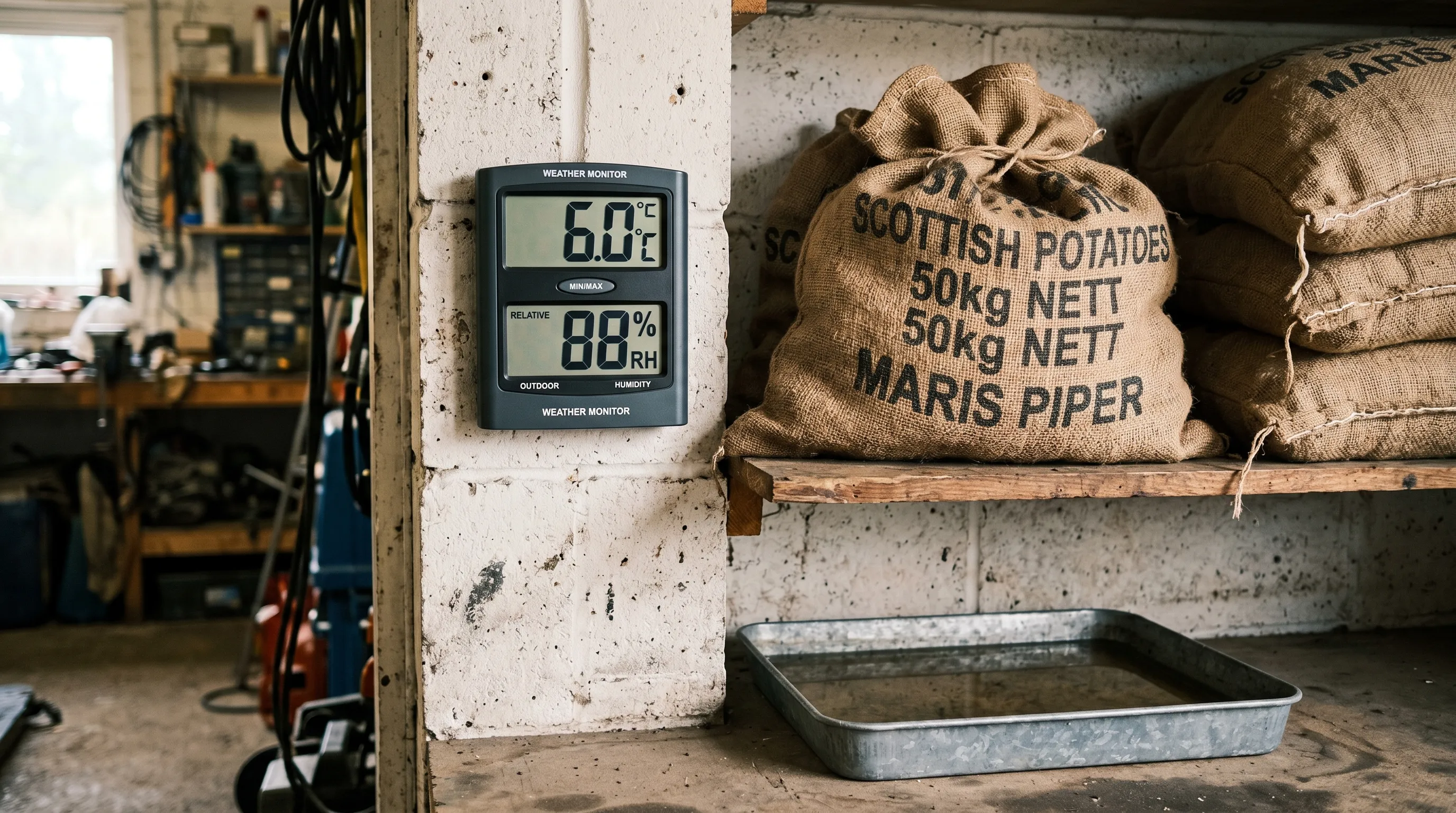 The Staffordshire garage hits 6C and 88% RH in late January with a shallow water tray boosting humidity. Temperature holds without intervention; humidity needs the tray to stay above 85%.
Hessian Sacks: The UK Standard
Hessian sacks (also called burlap or jute sacks) are the standard UK potato storage container.
Why hessian works:
- Breathes naturally, regulating humidity inside the sack
- Blocks light completely
- Holds 25-35kg per standard sack
- Lasts 5-8 storage seasons before fraying
- Cheap: £3-£6 per sack from UK ironmongers, agricultural suppliers, or online
How to fill hessian sacks:
- Place a single layer of dry newspaper at the base of the sack to absorb any moisture
- Add cured, brushed tubers in single batches of 5-8kg
- Gently shake the sack between batches to settle tubers
- Fill to 25-30kg maximum (any more and bottom tubers crush)
- Fold the top of the sack closed (do not tie too tight; needs to breathe)
Stacking:
Always stack hessian sacks single-layer on a wooden pallet or slatted floor. Never stack two or three deep. Bottom sacks compress, lose airflow, and rot first.
For a typical UK home gardener storing 100-150kg of maincrop, plan 4-6 hessian sacks at 25kg each plus a small reserve sack for damaged tubers eaten first.
The hessian-sack method delivers 4-5 months of reliable storage for Maris Piper and King Edward, 5-7 months for Cara and Desiree, 6-8 months for Sarpo Mira and Sarpo Axona.
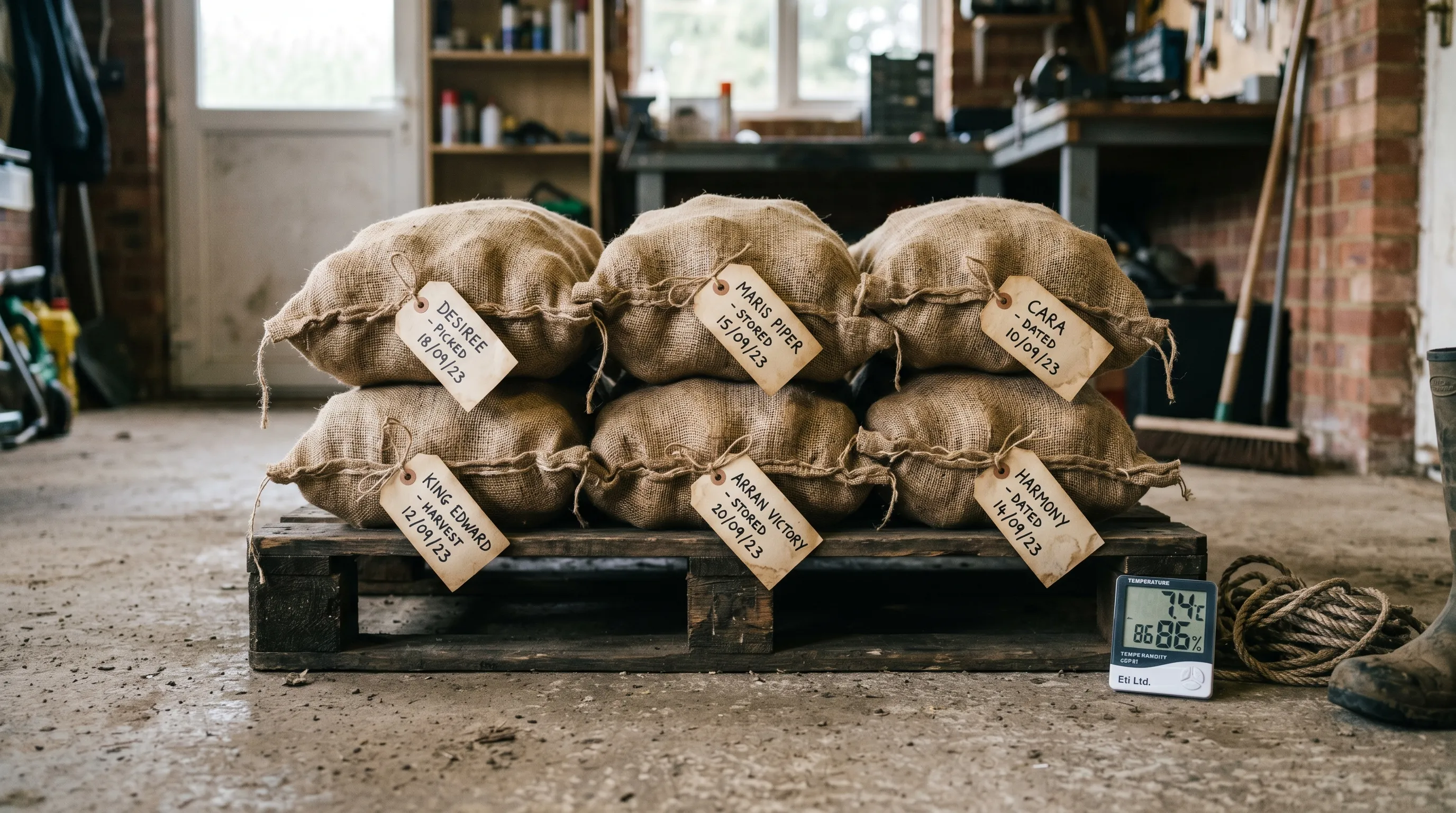 The standard UK potato storage setup. Six hessian sacks of Maris Piper, King Edward and Cara on a slatted pallet, single-layer for airflow. Each sack labelled with variety and lift date for easy monthly inspection.
Paper-Lined Wooden Boxes
Wooden apple crates or trade boxes lined with paper give the best long-term protection. Slightly more setup; significantly less rot loss.
Box specification:
- Wooden box 600x400x200mm (standard UK apple crate size)
- Slatted base or perforated for airflow
- Capacity: 15-20kg of tubers
- Cost: £8-£15 each new, £2-£5 second-hand from UK farm shops
Lining and filling:
- Line the box with two layers of brown paper (sugar paper or unbleached craft paper)
- Add 50mm of dry newspaper shred or wood shavings as cushioning at the base
- Place cured tubers in a single layer, not touching each other
- Cover with brown paper
- Add a second single layer of tubers
- Cover with brown paper
- Maximum two layers of tubers per box
The double-paper layering between tuber layers prevents one rotting potato from spreading to neighbours. Storage loss in boxed storage typically runs at 2-4% versus 5-10% in sacked storage.
Boxes stack 3-4 deep on a pallet without compressing tubers. Each box still needs the monthly sort but can be lifted off the stack easily.
Best for:
- Long-storage varieties (Maris Piper, Cara, Sarpo Mira)
- Gardens with a clean dry storage space
- Larger harvests (100kg+) where the loss reduction pays back the cost
Avoid for:
- Short-storage second earlies
- Small harvests under 50kg (sacks are easier)
- Damp storage spaces (paper wicks moisture)
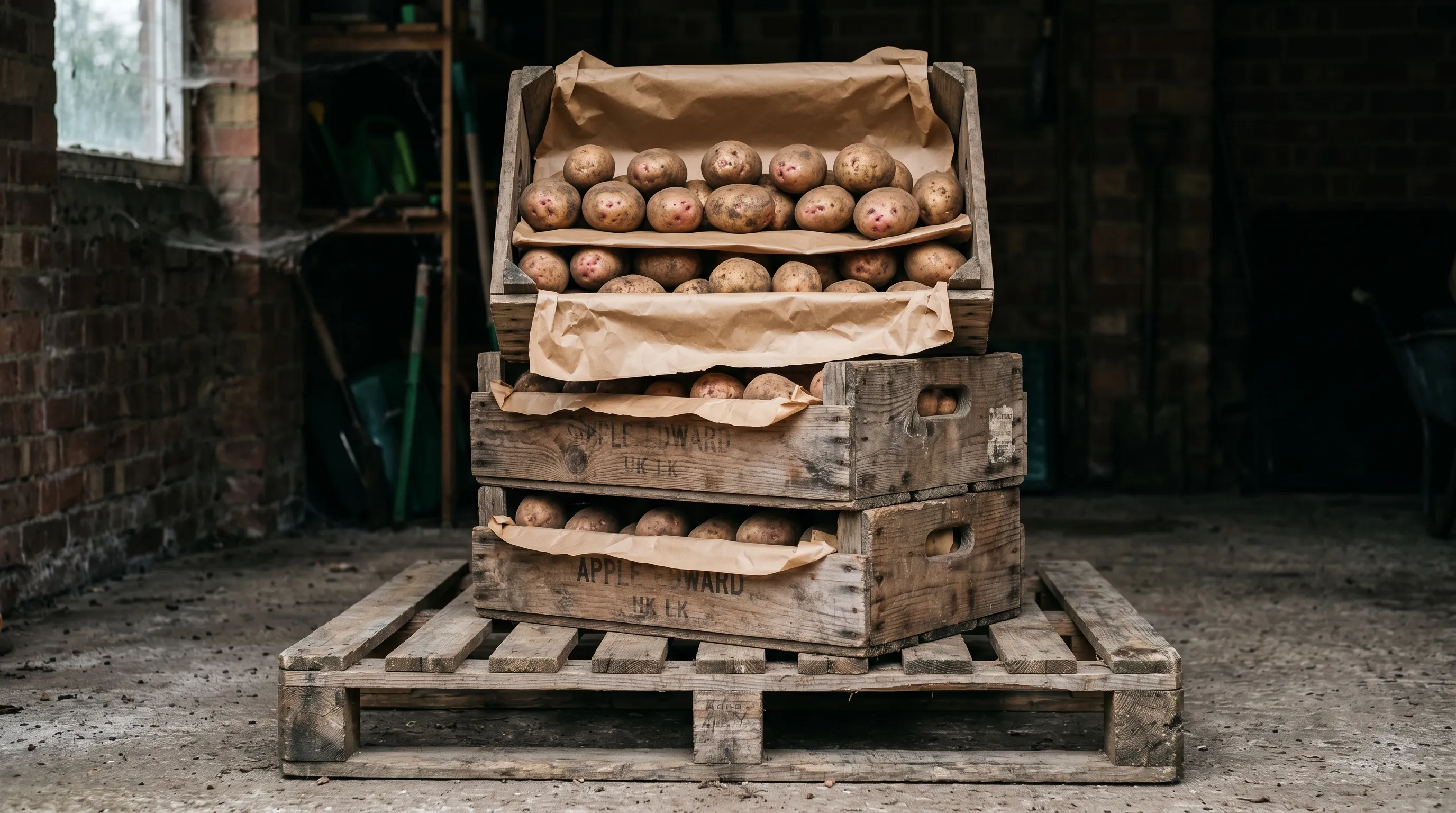 Paper-lined wooden boxes hold King Edward maincrop in a Staffordshire garage. Two single layers per box, brown paper between, stacked three deep on a slatted pallet. The setup costs more but reduces loss to 2-4% across the winter.
Traditional Potato Clamp: The Outdoor Option
Where no indoor storage exists, a traditional outdoor clamp keeps tubers through the winter. Used by UK farmers and gardeners for centuries.
How to build a clamp:
- Choose a site: well-drained level ground, sheltered from prevailing wind, easy to access in mud
- Mark out: 1-2m wide by 1.5-3m long depending on harvest size
- Lay straw base: 100mm of clean dry straw across the marked area
- Pile tubers: stack cured potatoes in a low pyramid, 600-900mm high at the centre
- Straw cover: cover the whole pile with 100mm of more straw
- Soil cover: apply 100-150mm of soil (well-firmed but not compressed) across the straw
- Chimney: leave a 100mm wisp of straw protruding through the soil at the top centre as a ventilation chimney
- Drainage: dig a shallow drainage trench around the base to take rain off
The clamp protects tubers from frost (insulation by straw and soil) and from light (total darkness). The chimney releases moisture and ethylene gas. The whole structure is biodegradable and clears in March-April by simply lifting off the soil.
Opening the clamp:
In a UK clamp, always open from the side, not the top. Each opening removes a wedge of tubers. After taking what you need, refill the wedge with straw and soil. This minimises moisture loss from the remaining stored crop.
A well-built clamp holds maincrop tubers 4-6 months at typical UK winter outdoor temperatures of 0-8C. Loss rates run 5-15%, higher than indoor storage but acceptable where no indoor option exists.
Best for:
- Allotment plots without indoor storage
- Large harvests (200kg+) overflow that does not fit indoor space
- Older traditional gardens with the right outdoor space
Avoid where:
- The site is in a frost pocket
- Foxes or badgers are likely to dig (UK rural plots)
- Water table sits within 600mm of the surface in winter
The Monthly Inspection Routine
The monthly inspection is the single most important storage habit. Five minutes per sack saves the bulk of the harvest.
Monthly routine:
- Lift each sack or box onto a tarpaulin in the garage or shed
- Tip the contents out gently
- Inspect each tuber by hand
- Discard immediately any tuber with: soft spots, dark sunken patches, white fluffy mould, sweet sweet smell (early rot), sprouts longer than 5mm
- Eat soon (within 7-10 days) any tuber with: small green patches (trim before cooking), surface bruising, light skin damage
- Return to storage clean firm tubers showing only intact skin and unblemished surface
- Refill the sack or box
- Note inspection date and any losses on the label
Common reasons for losses during winter storage:
| Cause | Sign | Action |
|---|---|---|
| Bacterial soft rot | Soft sweet-smelling patches | Discard immediately. Sterilise sack |
| Late blight (carried from field) | Brown sunken patches with internal rot | Discard. Treat as biohazard |
| Dry rot (Fusarium) | Shrunken concentric rings | Discard. Sterilise storage area |
| Sprouting | Long white shoots from eyes | Trim and use soon; sprouted tubers store no longer |
| Greening (light exposure) | Green patches on skin | Trim deep before eating; greens contain solanine |
| Shrivelling | Soft wrinkled skin | Humidity too low; raise to 90% RH |
| Pink rot | Pink-tinged decay inside | Discard. Often field-acquired |
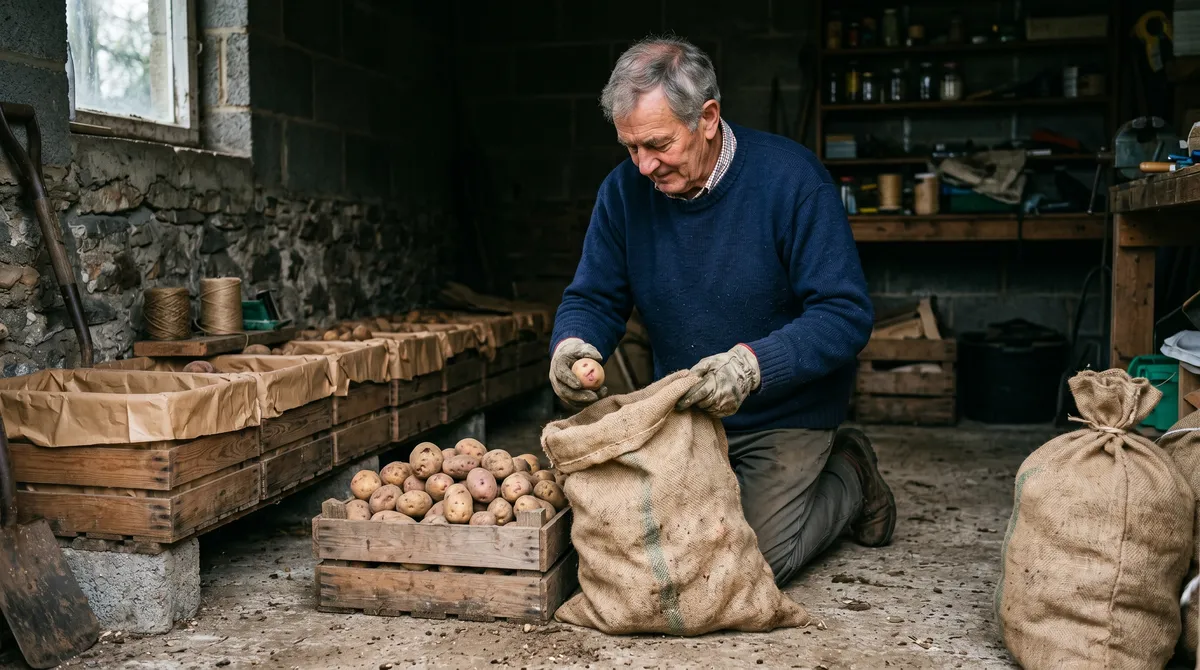
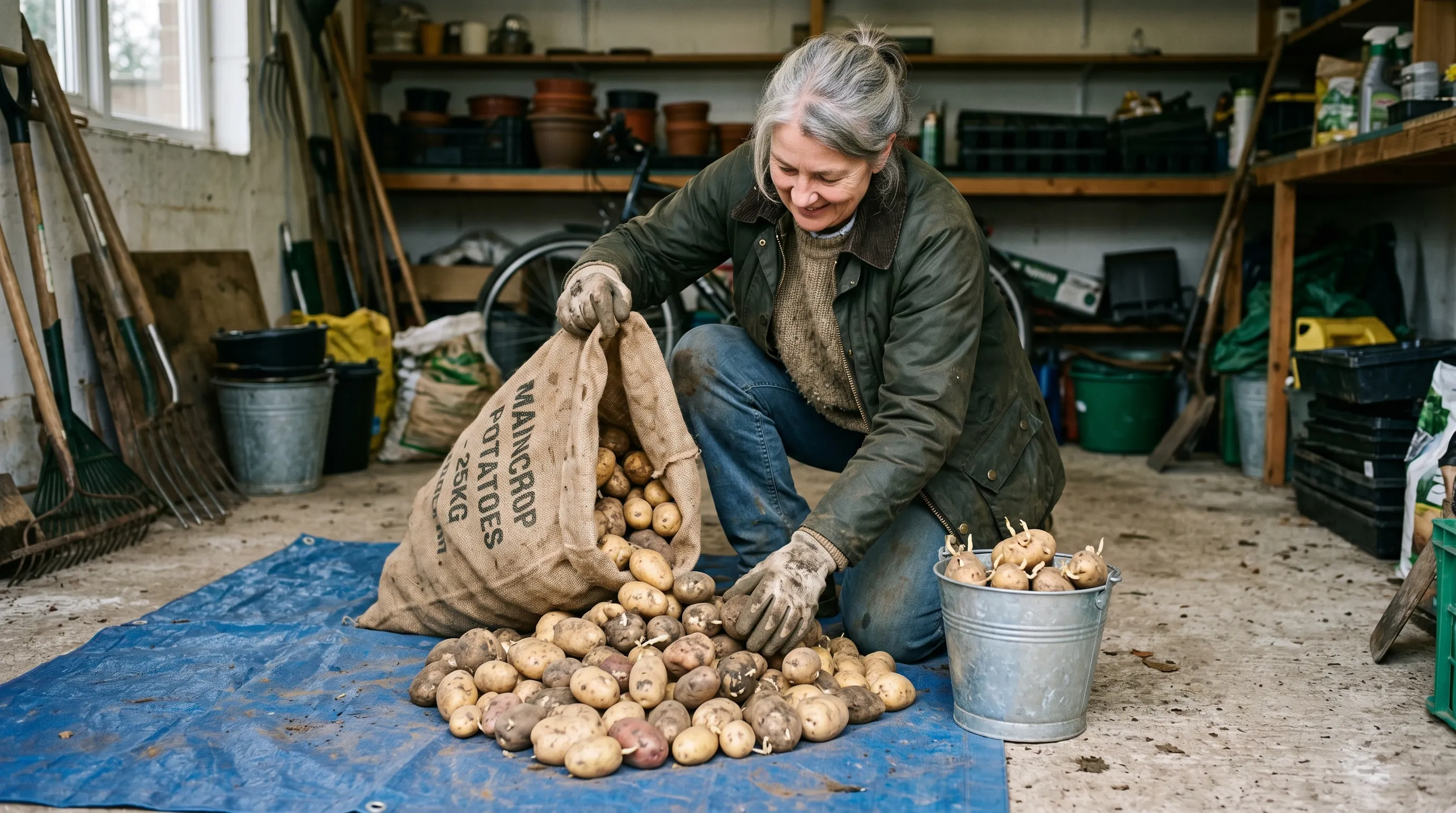 The monthly inspection routine: tip each sack onto a tarpaulin, sort by hand, reject any sprouted, soft or dark-patched tubers into the bucket on the left. Five minutes per sack saves the bulk of the harvest.
Sprouting Control
Even at 4-8C, potatoes start sprouting in February-March as natural dormancy breaks. Three approaches.
1. Rub off sprouts at each inspection. Manual removal works for under 100kg of storage. Run a thumb across each tuber to break off sprouts. Sprouts under 5mm leave no damage. Sprouts over 25mm signal the tuber needs eating within 2-3 weeks.
2. Drop temperature to 3-4C. Below 4C, sprouting slows but starch converts to sugar making tubers taste sweet. Useful in March if storage life needs another month. Bring tubers back up to 8-10C for 7-10 days before eating to convert sugars back to starch.
3. Use a sprout inhibitor. Carvone (spearmint oil-based) and chlorpropham (CIPC) inhibitors exist commercially. Not typically used by UK home gardeners; reserved for commercial-scale storage.
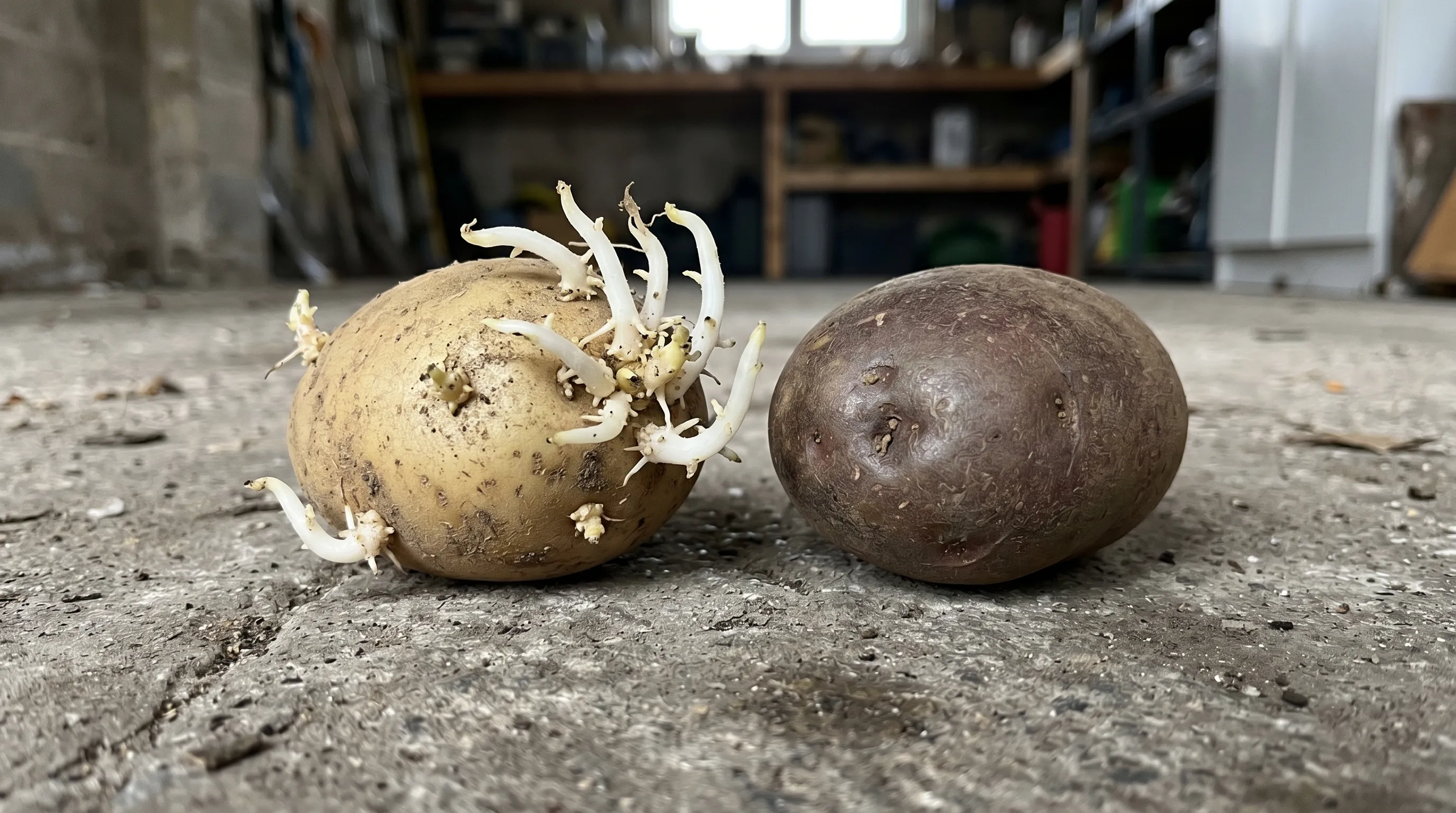 Side-by-side dormancy comparison in mid-February. Maris Piper (left) sprouting at 25mm; Sarpo Mira (right) still dormant. Same lift date, same storage conditions. Variety choice is the easiest long-term sprouting management.
Varieties That Store Best
For UK home gardeners who want one variety to store the longest, Sarpo Mira is the choice. For best flavour combined with reliable storage, King Edward. For balance of yield, storage and culinary use, Maris Piper remains the safe default.
Common Mistakes With Potato Storage
Mistake 1: stacking sacks deep. Bottom sacks compress, lose airflow, and rot first. Always store sacks single-layer on a pallet.
Mistake 2: skipping the curing step. Direct-from-field tubers store 4-8 weeks. Cured tubers store 4-6 months. The 7-14 day cure is the single best storage investment.
Mistake 3: storing in plastic sacks. Plastic traps moisture and accelerates rot. Hessian breathes; plastic suffocates.
Mistake 4: storing in a warm space. Cellars at 12-15C sprout potatoes within 6-8 weeks. Use a cool space at 4-8C; UK garages and stone outbuildings usually suffice.
Mistake 5: skipping monthly inspections. One rotten tuber spreads to a dozen within 2-3 weeks. Five minutes per sack monthly saves the rest.
For next year’s planting, our when to plant potatoes UK guide covers chitting and planting dates.
Potato Storage Calendar UK Month-by-Month
| Month | Storage task |
|---|---|
| September | Prepare storage space: clean, ventilate, set up pallets |
| October | Cure lifted tubers 7-14 days, then sack and store |
| November | First monthly inspection. Sort and remove damaged tubers |
| December | Second monthly inspection. Watch for early sprouting |
| January | Third monthly inspection. Check humidity rising as outdoor temp drops |
| February | Fourth inspection. Sprouting begins on Maris Piper and King Edward |
| March | Fifth inspection. Use up Maris Piper. Sarpo varieties still firm |
| April | Final inspection. Eat last Cara and Sarpo. Clean and store sacks |
| May | Wash and dry sacks. Store for next season |
| June | First earlies eaten fresh; storage space empty |
| July | Plan storage for upcoming maincrop harvest |
| August | Repair pallets, ventilate space, check for rodent activity |
Frequently asked questions
What temperature should I store potatoes at in the UK?
4-8C is the sweet spot. Below 4C the starches convert to sugars and the tubers go sweet. Above 10C they sprout fast and lose moisture. Most UK garages and stone outbuildings sit at 4-8C through winter without heating.
Are hessian sacks better than plastic for potato storage?
Yes. Hessian breathes, letting moisture escape and air circulate. Plastic sacks trap moisture and accelerate rot. Hessian sacks at UK ironmongers cost £3-£6 each and last 5-8 storage seasons. Each sack holds 25kg of tubers.
What is a potato clamp and how do you build one?
A potato clamp is a traditional outdoor storage mound. Lay 100mm of straw on free-draining soil. Pile cured potatoes on top in a low pyramid. Cover with 100mm more straw, then 100-150mm of soil. Leave a small chimney of straw at the top for ventilation. Lasts to April.
Why are my stored potatoes shrivelling?
Low humidity. Storage air should be 85-95% relative humidity. Below 70% RH causes tubers to lose moisture, shrivel, and become rubbery. Place a shallow tray of water in the storage area or use damp hessian over the sacks.
How often should I check stored potatoes?
Every 4 weeks. Sort each sack onto a tarpaulin, remove any sprouting tubers, soft tubers, or tubers with dark patches. One rotting potato spreads to a dozen within 2-3 weeks. The 5-minute monthly inspection saves the bulk of the harvest.
Now plan the wider winter storage
Our team produces practical UK gardening guidance from source research, contributor records and established horticultural practice. Editorial standards are overseen by Matt W.