
Key takeaways
- Nandina is hardy in most UK gardens and isn't a real bamboo, so it won't run
- Firepower is the go-to compact variety for pots and the front of a border
- Plant in sun for the best red winter leaves. Deep shade keeps it green
- Barely any pruning needed. Snip out dead stems in spring and never hedge-trim it
- The berries are mildly poisonous, so pick a non-fruiting variety if children or pets graze
Nandina is one of the easiest ways to get colour in a winter garden. While most plants look grey and tired from November to March, nandina’s leaves go rich crimson, scarlet or burnt orange, and they stay on all winter.
Don’t let the name heavenly bamboo put you off. It isn’t a bamboo and won’t run around the garden. It’s actually related to berberis and mahonia. It needs very little pruning and copes with cold winters. Here’s how to choose one, plant it and get the best red colour.
What is nandina and why grow it?
Nandina domestica is a neat evergreen shrub from eastern Asia, grown in British gardens for around 200 years. You grow it for the leaves. From autumn they turn from green to red, purple and orange, and the colour deepens as the weather gets colder. It holds until fresh green growth arrives in spring.
In early summer it has sprays of small white flowers. After a warm summer these can turn into bunches of red berries that last through winter. Berries are hit and miss in cooler northern gardens, but the leaf colour works everywhere.
Nandina leaves turn from green to crimson as the nights get colder.
Which nandina varieties suit UK gardens?
For most gardens, pick Firepower. It stays small, about knee-high, and goes a brilliant red. For a bigger space, the plain species or Richmond grow to around 2m.
| Variety | Size | Winter colour | Good for |
|---|---|---|---|
| Firepower | Small, about 45-60cm | Bright red-orange | Pots and front of borders |
| Gulf Stream | Small to medium | Orange to bronze | Low, bushy mounds |
| Obsessed | Small to medium | Deep crimson | The darkest red |
| Richmond | Tall, up to 2m | Red-purple | Berries, back of the border |
| Twilight | Medium | Pink, cream and green | Colourful leaves all year |
Firepower
The one you’ll see most in garden centres. It makes a tight little dome of fine leaves and turns a traffic-light red from November. It rarely flowers or fruits, so the berries aren’t a worry. Lovely in pots, raised beds and at the front of a border.
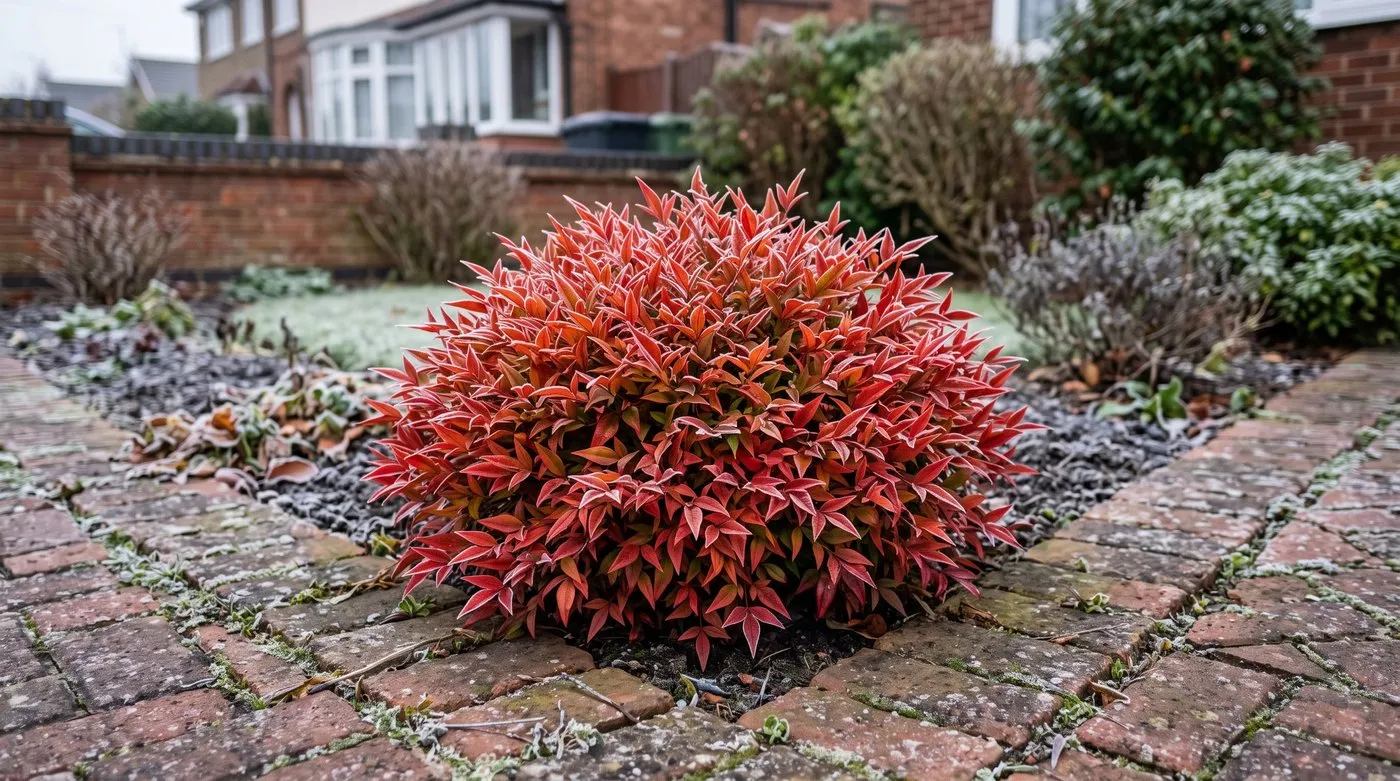
Firepower stays about knee-high and goes a brilliant red. It rarely fruits, so the berries aren’t a worry.
Gulf Stream
A little bigger than Firepower, with a naturally dense, rounded shape that needs no clipping. Winter colour is more orange-bronze than red. Good in the middle of a border or as a low, informal hedge.
Obsessed
The deepest red of the lot. It has upright stems, and the new spring growth comes through bright red too before going green for summer. You may need to hunt a little harder to find it.
Richmond
The one to choose if you want berries, as it fruits well on its own. It’s tall, so put it at the back of a mixed border. Winter leaves are red-purple rather than true crimson.
Twilight
This one is grown for its pink, cream and green leaves, which look good all year rather than just in winter. It’s a bit less hardy than the green-leaved types, so give it shelter from cold winds.
How to plant nandina
Plant nandina in soil that drains well and doesn’t sit wet in winter. It’s happiest in neutral to slightly acid soil but copes with a bit of lime.
Getting the soil ready
Dig a hole twice as wide as the pot and the same depth. Plant at the same level it sat in its pot, not deeper. On heavy clay, mix plenty of horticultural grit into the soil you put back. This stops the roots rotting in a wet winter.
On sandy or chalky soil, dig in a bucket of garden compost to help it hold moisture. Nandina will grow on chalky soil, but it does better with that extra organic matter.
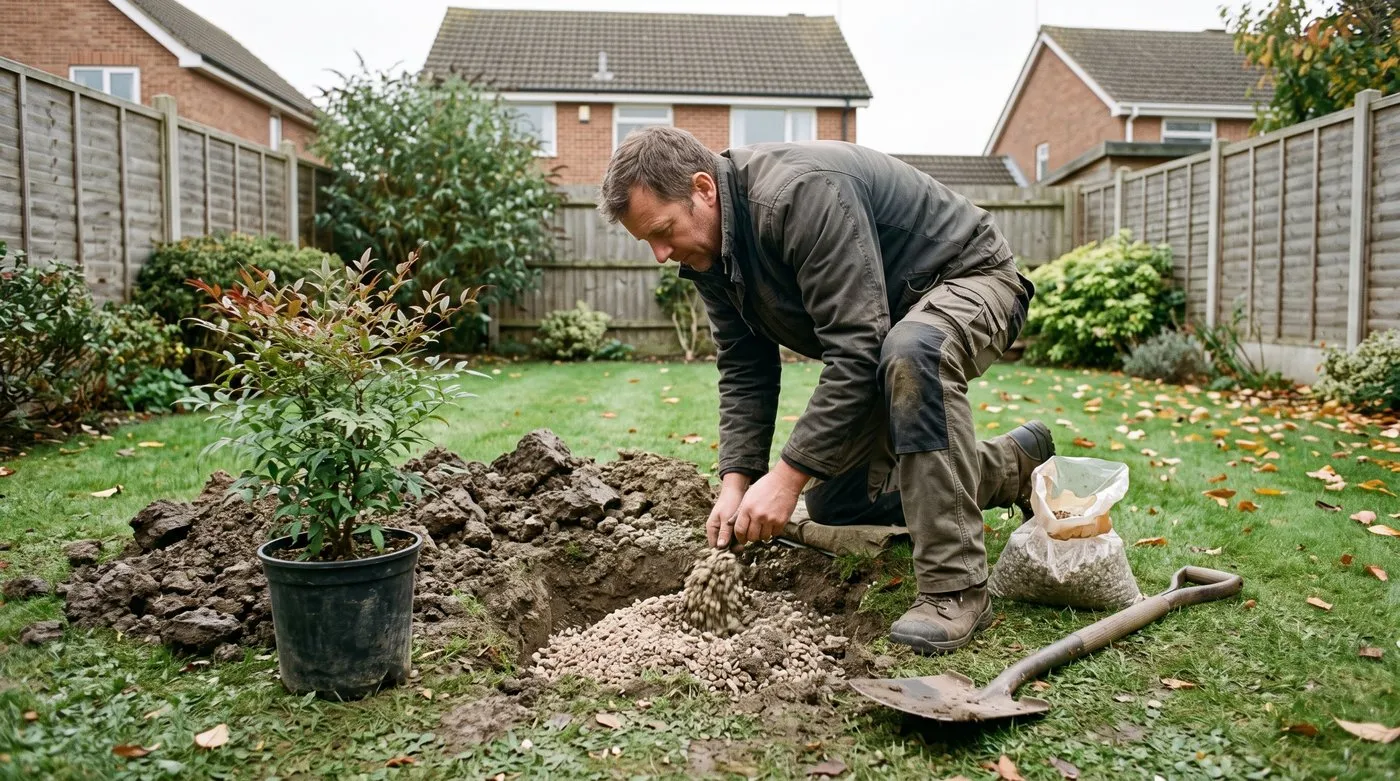
On heavy clay, mix plenty of grit into the soil you put back. It stops the roots rotting in a wet winter.
Sun or shade?
It grows in sun, part shade or light dappled shade. For the best red leaves, give it at least four hours of direct sun a day. In deep shade it stays green all winter, which rather misses the point.
Red nandina leaves really stand out against dark green neighbours in a mixed border.
Spacing
Space tall varieties about 80-100cm apart and compact ones about 40-50cm apart. Nandina looks best in groups of three or five. Put the small ones at the front of a border, where you can see the winter colour from the path or the window. Taller ones work at the back or against a fence.
Growing nandina in pots
Compact nandinas are some of the best evergreen shrubs for pots, looking good all year with very little fuss. Firepower and Gulf Stream are the top picks, and they fit nicely into year-round container planting on a patio or by the front door.
Choosing a pot and compost
Use a pot at least 30cm wide and deep, with a drainage hole. Terracotta or frost-proof glazed pots are ideal. Put a few crocks over the hole so it doesn’t clog. Fill with peat-free multipurpose compost mixed with some perlite or grit, so it drains freely but still holds a little water.
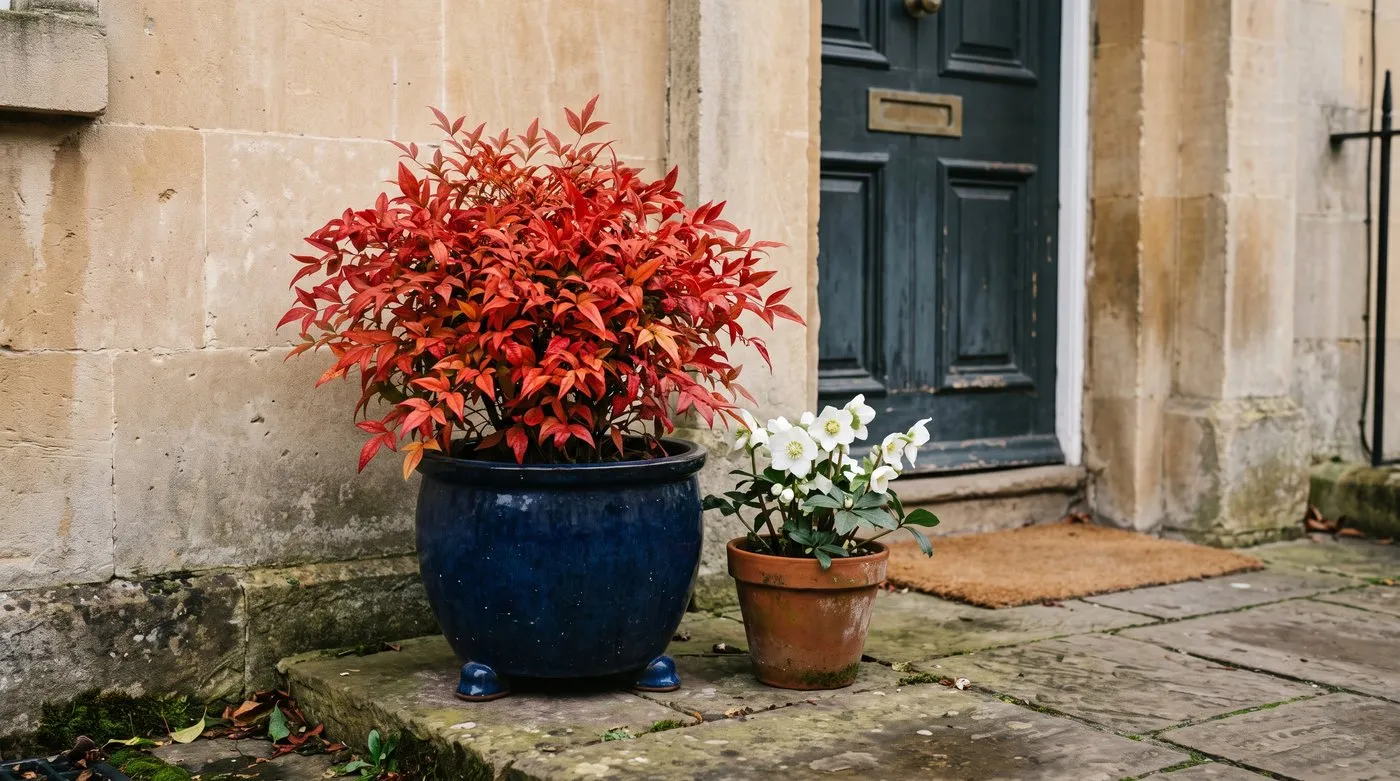
A 30cm pot of free-draining compost suits compact nandinas for years. Too much water is a bigger risk than too little.
Watering and feeding
Water when the top 3cm of compost feels dry. In a hot summer that might be every two or three days. In winter, once a week or less is usually enough. Too much water is a bigger problem than too little. Yellow lower leaves are often a sign of soggy roots.
Feed once a month from April to August with a general liquid feed. Stop in September. Late feeding makes soft growth that frost can damage, and it dulls the winter colour.
Repotting
Every three or four years, in spring, move it into a pot a little bigger. If it’s already in a big pot, lift it out, tease away some old compost, trim the outer roots lightly and put it back with fresh compost. Each March, scrape off the top layer of compost and replace it with fresh.
When and how to prune nandina
Nandina needs hardly any pruning. Just cut out dead or damaged stems at the base in April. Never clip it into a ball or a box. Its loose, airy shape is the whole charm, and hard clipping spoils it for years.
Freshening up an older plant
After many years a nandina can get leggy and bare at the bottom. Each March, cut about a third of the oldest stems down to 15cm above the ground. Do this for three years in a row. New shoots come up from the base while the rest of the plant keeps its shape. Our spring pruning guide explains this kind of renewal pruning.
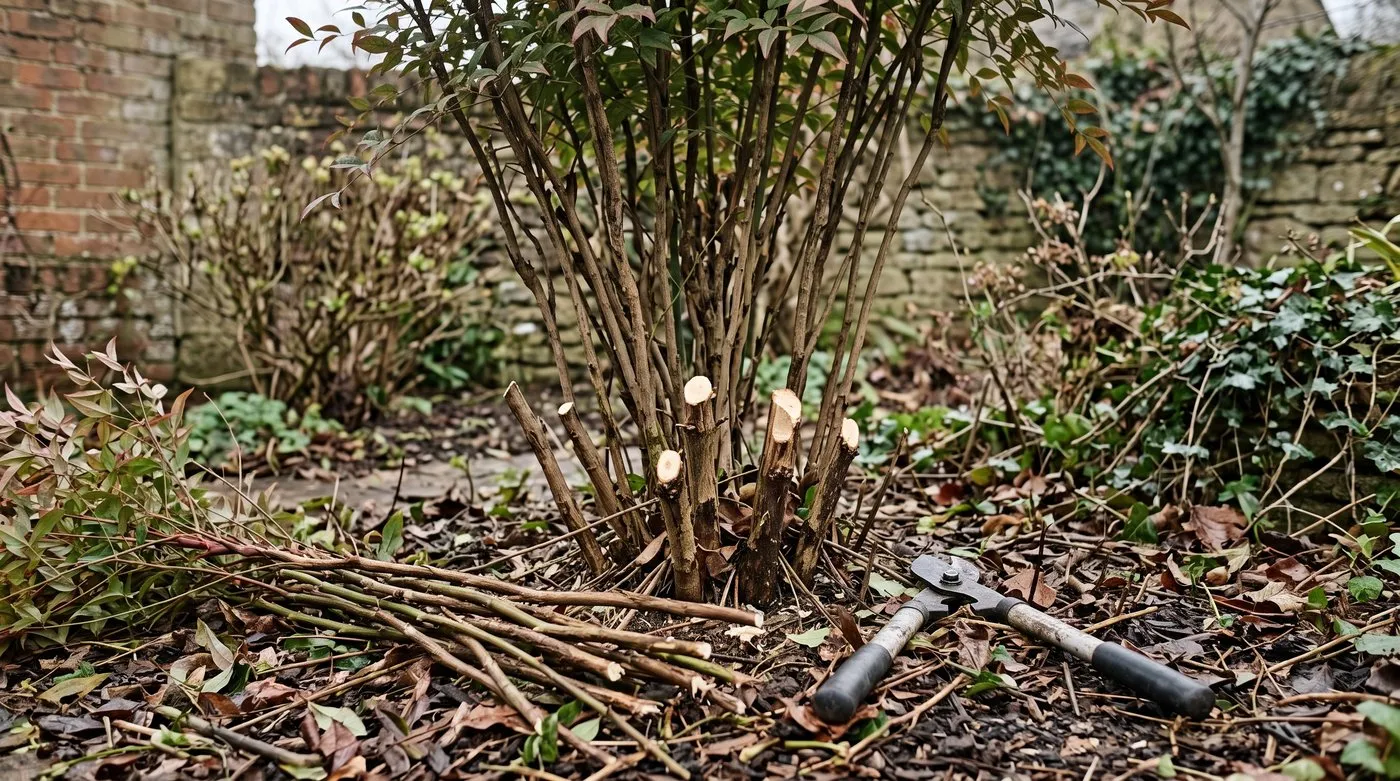
Cut a third of the oldest stems to 15cm each March for three years. New shoots fill in from the base while the plant keeps its shape.
Suckers
Now and then nandina sends up a sucker, a new shoot from the roots, especially in damp soil. These aren’t like bamboo runners. Just cut them off at soil level, or dig one up with a bit of root to make a new plant.
Getting the best red winter colour
Sun and cold are what turn nandina red. It works the same way as autumn colour in acers and other trees.
Three things make the difference:
- Sun: Four or more hours of direct sun gives the strongest reds. Shady plants go bronze or stay green.
- Cold: Chilly nights bring out the brightest colour. A mild winter gives a softer show.
- Variety: Obsessed and Firepower go the deepest red. Gulf Stream leans orange-bronze whatever you do.
Colour usually starts to show from mid to late autumn and lasts until new green shoots come through in spring.
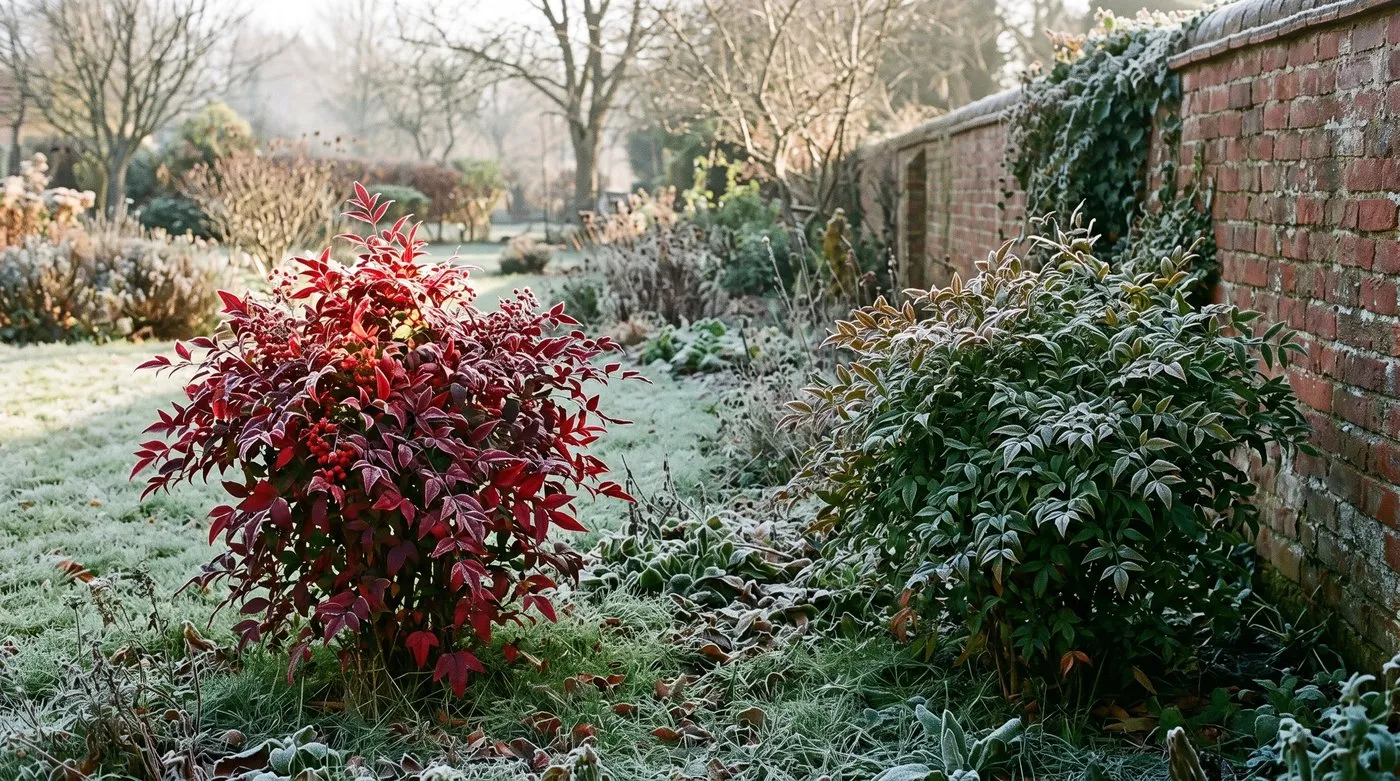
Sun and cold nights bring out the reds. In deep shade, a nandina can stay green all winter.
Are nandina berries safe?
The berries are mildly poisonous to people, cats, dogs and birds. Eating them usually causes sickness and stomach ache rather than anything serious. Berries are unreliable in the UK anyway: you get more after a hot summer and often none after a cool, wet one.
If young children or pets tend to eat things in the garden, choose a variety that rarely fruits, like Firepower, or plant it out of reach. The RHS nandina page has more on the plant.
How to propagate nandina
Semi-ripe cuttings in July or August are the easiest way to get more plants. You can also divide clumps or grow from seed, but cuttings give you copies of the parent quickest.
Semi-ripe cuttings
- Pick a stem from this year that’s firm at the bottom but still bendy at the tip.
- Cut a 10-15cm piece just below a leaf joint. Take off the lower leaves, leaving a few at the top.
- Dip the end in hormone rooting powder.
- Push it into a small pot of half perlite, half peat-free compost.
- Cover with a clear plastic bag or pop it in a propagator.
- Keep the compost just moist. Roots take a couple of months to form.
- Once rooted, move it into its own pot and grow it on for a year before planting out.
Division
In March, lift a big clump and split it into pieces, each with a few stems and good roots. Replant straight away at the same depth, water well and mulch. They may look thin for a season but soon fill out.
Seed
Growing from seed is slow and a bit of a lottery. Seeds need a cold spell first, so keep them in damp sand in the fridge for a couple of months, then sow in spring somewhere warm. They come up unevenly, take several years to flower and may not look like the parent.
Compact nandinas like Firepower are happy in a pot for years.
What to plant with nandina
Nandina’s red winter leaves look best next to plants with different shapes and colours. Its fine leaves sit nicely beside broad, glossy evergreens and grasses. For more ideas, see our plant combinations for UK borders.
Winter partners
- Sarcococca (Christmas box): Its dark glossy leaves make the red glow, and it adds winter scent.
- Dogwood ‘Midwinter Fire’: Orange and red stems behind red nandina make a warm winter picture from the window.
- Christmas rose (Helleborus niger): White flowers at the foot of a red nandina make a classic winter pot.
A border for all year
Put compact nandinas at the front of a border with flowering shrubs and evergreen trees. Add snowdrops and crocuses underneath for late winter, and lime or purple heuchera for colour at ground level.
Common nandina problems
Nandina is a pretty trouble-free shrub. Most problems come down to where it’s planted rather than pests or disease.
| Problem | Likely cause | What to do |
|---|---|---|
| Yellow lower leaves | Too much water or poor drainage | Water less, add grit |
| No red winter colour | Too shady or a mild winter | Move it somewhere sunnier |
| Slow growth | Heavy or packed-down soil | Mulch every year, add grit when planting |
| Brown new leaves in spring | Late frost | Avoid exposed spots, or cover with fleece on frosty nights |
| Bare lower stems | Age | Cut out a third of old stems each March |
| Rotting roots | Soggy soil in winter | Improve drainage or use a raised bed |
Deer, rabbits, slugs and snails usually leave it alone. Greenfly sometimes turn up on soft spring shoots but rarely do much harm. A blast from the hose knocks them off.
Frequently asked questions
Is nandina hardy in the UK?
Yes, it copes with winter in most UK gardens. Established plants rarely need any protection. In a cold, exposed garden, give young plants a sheltered spot and a thick mulch around the base for their first winter. Variegated Twilight is a little more tender, so keep it out of cold winds.
Is nandina actually a bamboo?
No, it isn’t a bamboo at all. The name comes from its upright, cane-like stems. It’s actually a cousin of berberis and mahonia. Unlike real bamboo, it grows as a tidy clump and doesn’t send out runners.
Are nandina berries poisonous?
Yes, they are mildly poisonous to people and pets. Eating them usually means an upset stomach rather than anything serious. If young children or berry-munching pets use the garden, choose a variety that rarely fruits, such as Firepower.
Can I grow nandina in a pot?
Yes, compact Firepower and Gulf Stream are great in pots. Use a pot at least 30cm wide and deep with drainage holes. Fill it with peat-free compost mixed with some perlite or grit. Water when the top few centimetres feel dry, feed monthly from April to August, and move it up a pot size every few years.
Why is my nandina not turning red?
It usually needs more sun and a proper chilly spell. Plants in deep shade stay green. Move pots somewhere sunnier in autumn. Some varieties, like Gulf Stream, go more orange-bronze than red. Too much feeding late in the year also keeps the leaves green, so stop feeding in September.
Does nandina spread or become invasive?
No, it stays put in UK gardens. It grows slowly as a clump and has no running roots. It can be a problem plant in some warm parts of the USA, but it doesn’t behave that way here.
When is the best time to plant nandina?
Plant between March and May or in September and October. Spring planting gives the roots a whole season to settle before winter. Autumn planting is fine if you water in dry spells. Avoid frozen or waterlogged ground. Pot-grown plants can go in at other times as long as you keep them watered.
Our team produces practical UK gardening guidance from source research, contributor records and established horticultural practice. Editorial standards are overseen by Matt W.


