Key takeaways
- Every tulip belongs to one of 15 official divisions, based on flower shape and parentage
- Kaufmanniana, Fosteriana, Greigii and Species tulips (Divisions 12 to 15) come back most reliably
- Darwin Hybrids (Division 4) are the best big tulips for flowering again year after year
- Parrot and Double Late tulips are best treated as one-year displays
- Mix early, mid and late divisions for tulips from March right through to May
Tulip types make much more sense once you know about the 15 official divisions. Every tulip you can buy belongs to one of them. The division tells you its flower shape, rough height, when it flowers and whether it is likely to come back.
This guide explains all 15 in plain words, with example varieties and the best job for each. If you just want tulips that return every year, the guide to tulips that come back year after year has a shortlist. For planting and care, see how to grow tulips.
What are tulip divisions?
Tulip divisions are the official groups every named tulip is registered in. They are based on flower shape, parentage and flowering time. You’ll often see the division on the packet or in a catalogue, sometimes as a number.
The divisions fall into two halves:
- Divisions 1 to 11 are garden hybrids. They have been bred for big flowers and bright colours. They put on a great show, but many fade after a year or two.
- Divisions 12 to 15 are closer to wild tulips. They have smaller flowers and shorter stems, but they come back far more reliably.
Multiflowering tulips, which carry several flowers on one stem, are not a separate division. They are registered under whichever division their flower shape fits.

Flower shape is what the divisions are built on. Once you know the shapes, you can spot most of them at a glance.
The 15 tulip divisions at a glance
Heights and flowering times are typical for most of England. Expect things a little later further north.
| Division | Name | Flower shape | Height | Flowers | Comes back? |
|---|---|---|---|---|---|
| 1 | Single Early | Cup-shaped | 25-40cm | Early to mid April | Fairly well |
| 2 | Double Early | Full, double | 25-40cm | Early to mid April | Poorly |
| 3 | Triumph | Classic cup | 35-50cm | Mid to late April | Poorly |
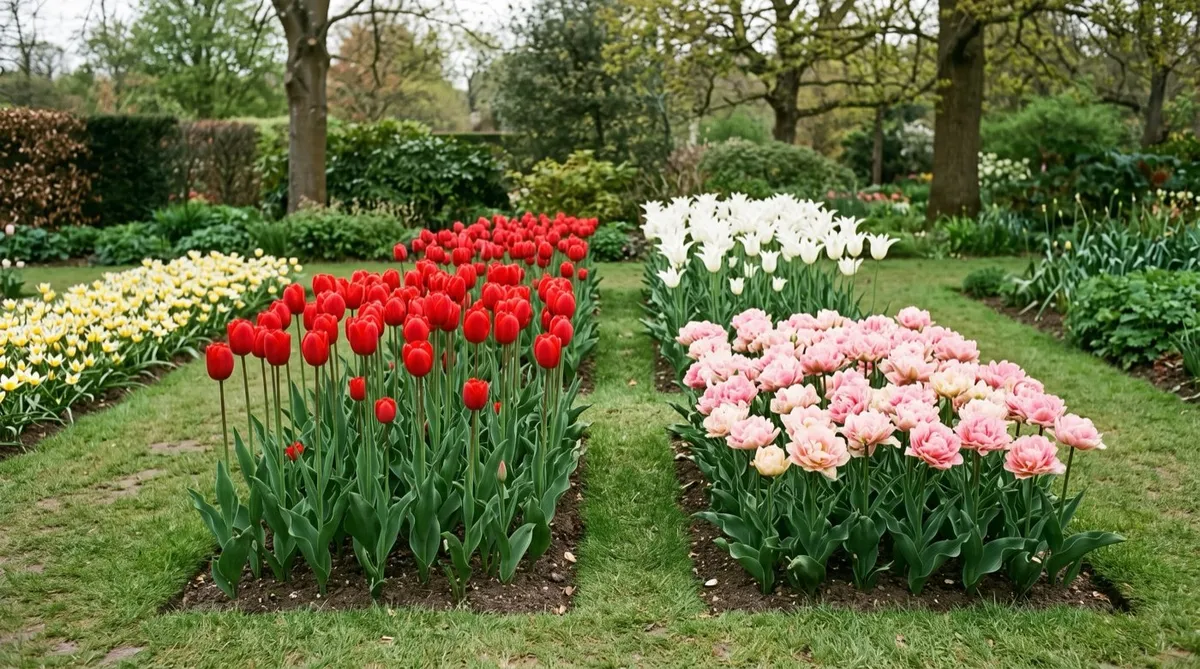
| 4 | Darwin Hybrid | Very large cup | 50-65cm | Mid to late April | Well |
| 5 | Single Late | Tall, egg-shaped | 55-75cm | Late April to May | Fairly well |
| 6 | Lily-flowered | Pointed, curved-out petals | 45-60cm | Late April to May | Poorly |
| 7 | Fringed | Frilly petal edges | 45-60cm | Late April to May | Poorly |
| 8 | Viridiflora | Green streaks on petals | 40-55cm | May | Fairly well |
| 9 | Rembrandt | Virus-streaked (historic only) | n/a | n/a | Not sold |
| 10 | Parrot | Twisted, feathered petals | 40-55cm | May | Poorly |
| 11 | Double Late | Big, peony-like | 40-55cm | May | Poorly |
| 12 | Kaufmanniana | Opens flat like a waterlily | 15-25cm | March to early April | Well |
| 13 | Fosteriana | Large, long-petalled cup | 30-45cm | Early to mid April | Well |
| 14 | Greigii | Cup, with striped leaves | 20-35cm | April | Well |
| 15 | Species | Small, often starry | 10-30cm | March to May | Very well |
“Comes back” assumes a sunny, well-drained spot and leaves left to die down naturally.
Divisions 1 to 3: early singles, doubles and Triumphs
Single Early tulips (Division 1) have neat, cup-shaped flowers on short, sturdy stems. They suit windy gardens and pots. ‘Apricot Beauty’ is a popular one.

Short, sturdy Single Early tulips stand up well to wind, which makes them a good pick for balconies and window boxes.
Double Early tulips (Division 2) have full, bowl-shaped flowers. They look lovely in pots, but the heavy heads can flop after rain. ‘Monte Carlo’ is a bright yellow example.
Triumph tulips (Division 3) are the biggest group and the classic bedding tulip. They come in almost every colour on 35-50cm stems. Most flower brilliantly in their first year, then dwindle. Treat them as a one-year show, or plant fresh bulbs each autumn.
Division 4: Darwin Hybrids, the big tulips that return
Darwin Hybrids are the exception among the big garden tulips. They were bred by crossing old Darwin tulips with the wild Tulipa fosteriana. That wild parent gives them huge flowers and a better habit of coming back.
They grow about 50-65cm tall, mostly in reds, oranges, yellows and pinks. ‘Pink Impression’ is a softer choice. Left in a sunny border, they often flower again for several years.
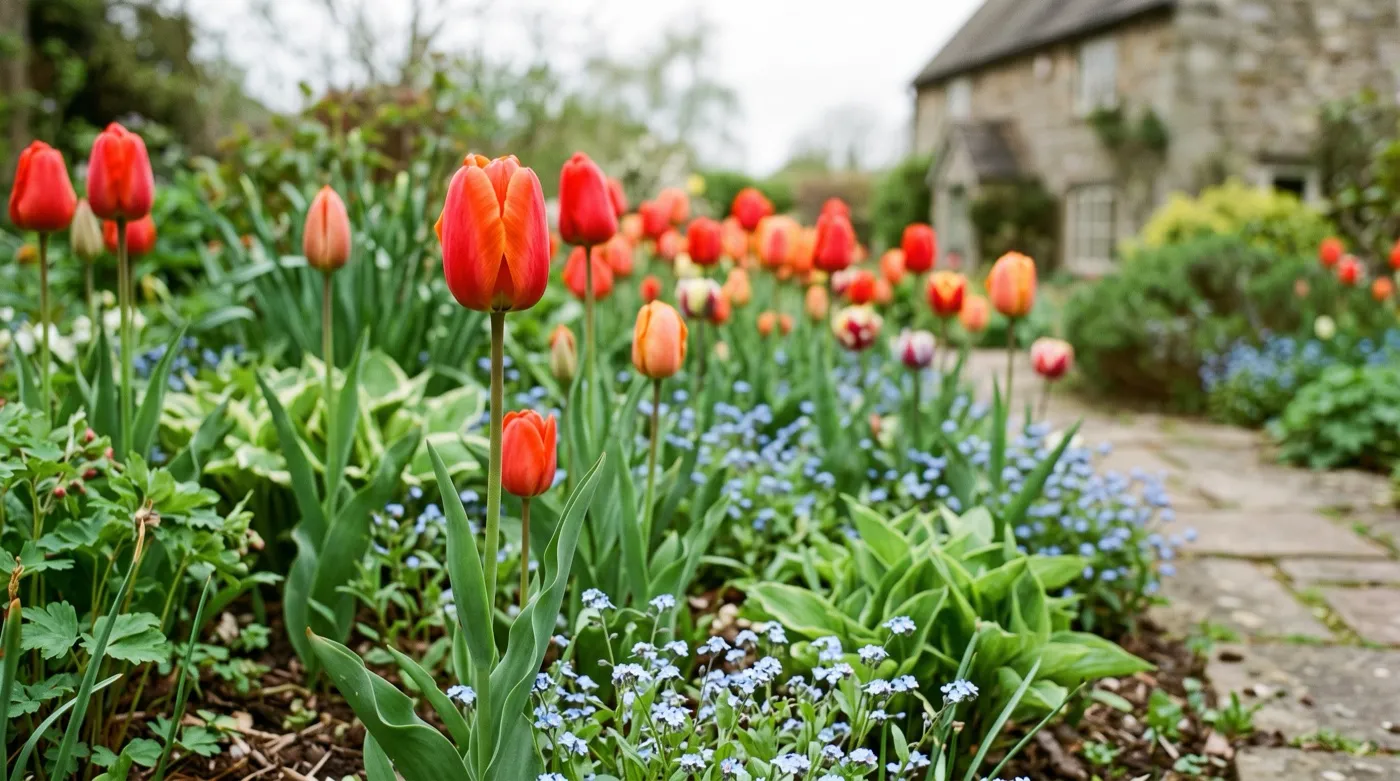
Darwin Hybrids give you big, bold flowers that often come back. Forget-me-nots make a pretty carpet underneath.
Divisions 5 to 8: tall late tulips, lily shapes, fringes and greens
Single Late tulips (Division 5) are the tallest, at 55-75cm. They flower from late April into May. The near-black ‘Queen of Night’ is the famous one. Their long stems make them the best tulips for cutting.
Lily-flowered tulips (Division 6) have narrow waists and pointed petals that curve outwards. ‘White Triumphator’ is an elegant white.
Fringed tulips (Division 7) have frilly, crystal-like edges to their petals. The look is natural, not caused by a virus.
Viridiflora tulips (Division 8) have green streaks running up each petal. They flower late and last well in a vase. ‘Spring Green’ is the classic, with white and green petals.

Tall Single Late tulips give you stems long enough for a proper vase. Cut them when the buds are coloured but still closed.
Divisions 9 to 11: Rembrandts, Parrots and Double Lates
Rembrandt tulips (Division 9) are a historic group that you can’t really buy. Their famous flamed petals were caused by tulip breaking virus, spread by aphids, which slowly weakens the bulbs. Modern streaked tulips such as ‘Rem’s Favourite’ are healthy varieties with the pattern bred in.
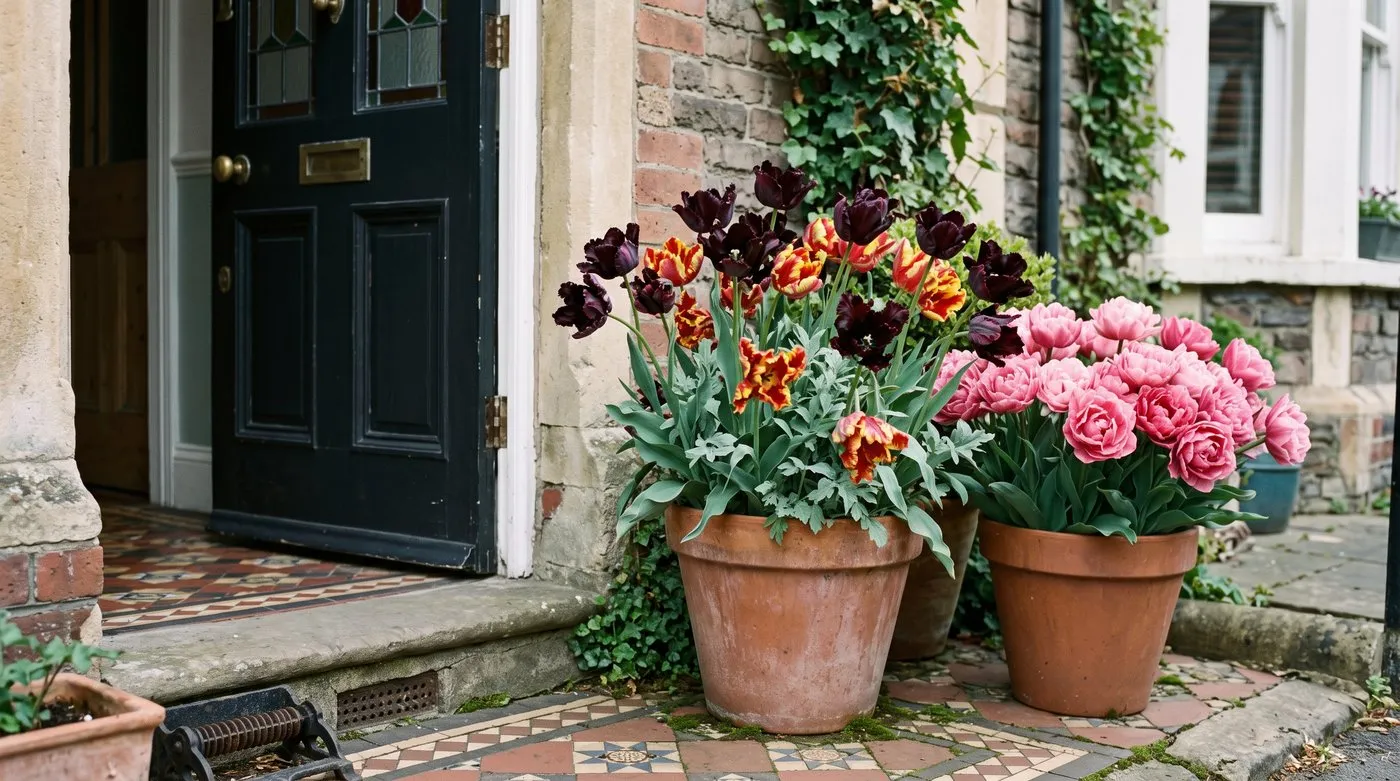
Parrot and Double Late tulips make a fabulous one-year show in pots. Enjoy them, then plant fresh bulbs next autumn.
Warning: Don’t buy streaked “broken” tulips sold as genuine virused Rembrandts. The virus can spread to your other tulips and lilies.
Parrot tulips (Division 10) have ruffled, twisted, feathered petals in dramatic colours. Many began as natural sports of other tulips. ‘Black Parrot’, for example, is a sport of ‘Queen of Night’. They rarely come back well and often need staking.
Double Late tulips (Division 11), also called peony-flowered, have big, many-petalled heads in May. ‘Angelique’ is a soft pink favourite. The heads hold rain and can snap their stems, so give them a sheltered spot or a pot.
Divisions 12 to 15: the wild tulips that come back
These four divisions are the answer if you want tulips that return. They are close to wild tulips from the mountains of Central Asia, so they like sun and sharp drainage.
Kaufmanniana tulips (Division 12) flower first, often from mid-March. They are only 15-25cm tall and open flat in the sun, which is why they’re called waterlily tulips. Many have striped or mottled leaves.
Fosteriana tulips (Division 13) have large, long-petalled flowers on 30-45cm stems in early to mid April. ‘Purissima’, a creamy white, is a reliable favourite.
Greigii tulips (Division 14) have purple-striped leaves that look good before the flowers even open. ‘Red Riding Hood’ is the classic, a short scarlet tulip for pots and the front of borders.
Species tulips (Division 15) are the wild tulips themselves. Flowers are small and plants reach just 10-30cm. In a hot, well-drained spot they often spread. Tulipa sylvestris is yellow and scented, T. turkestanica has clusters of small white stars, and T. sprengeri is usually the last tulip of the year.
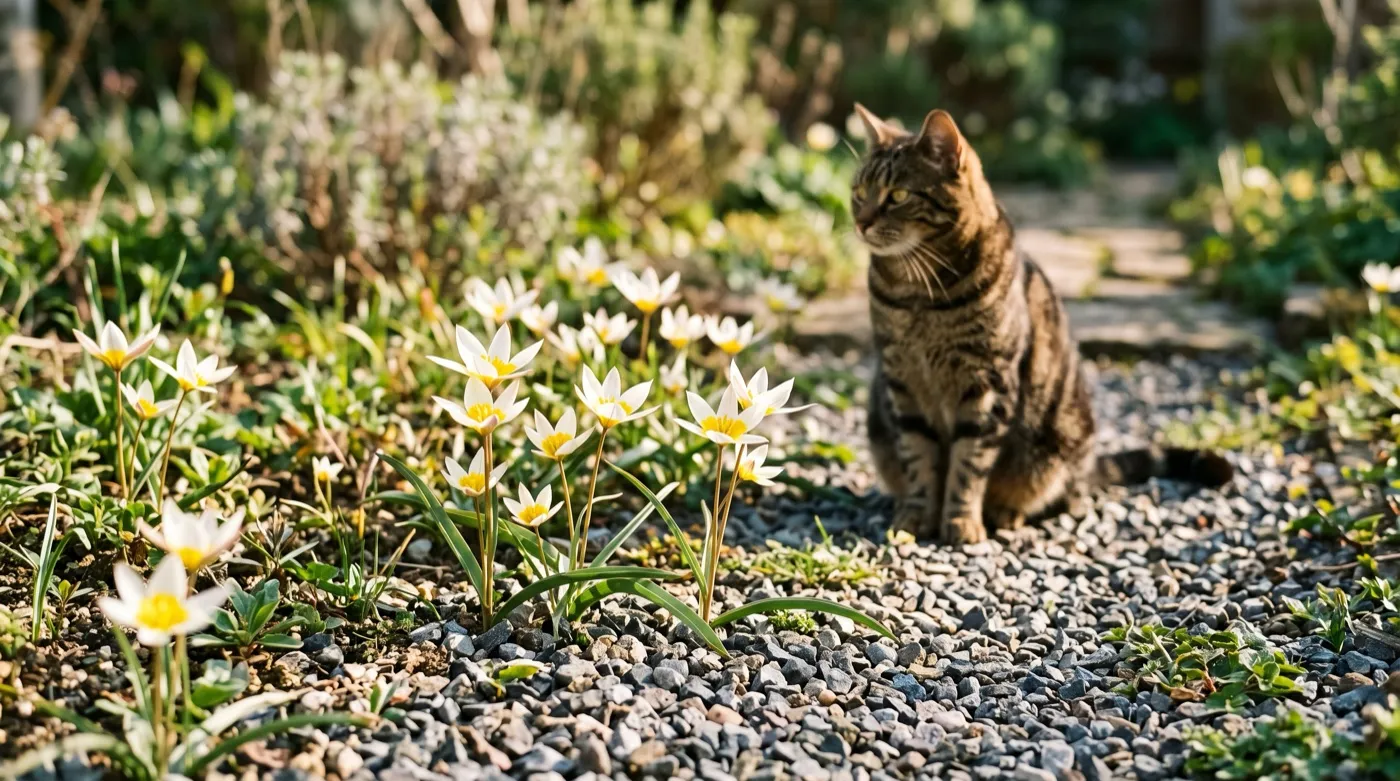
Species tulips love a sunny gravel bed and often spread over the years. Tulip bulbs are poisonous to cats and dogs, so plant them where pets won’t dig.
Why some tulip types come back and others don’t
Most garden hybrid tulips fade because of bulb splitting. Each summer the old bulb is replaced by new ones. In wild tulips, one good-sized new bulb usually forms. In many hybrids, the bulb splits into several small ones that are too small to flower.
That is why a bed of Triumphs can turn into lots of leaves and few flowers by the third spring. Feeding won’t fix it. Choosing a division that returns, planting deeply and leaving the leaves to die down all help.
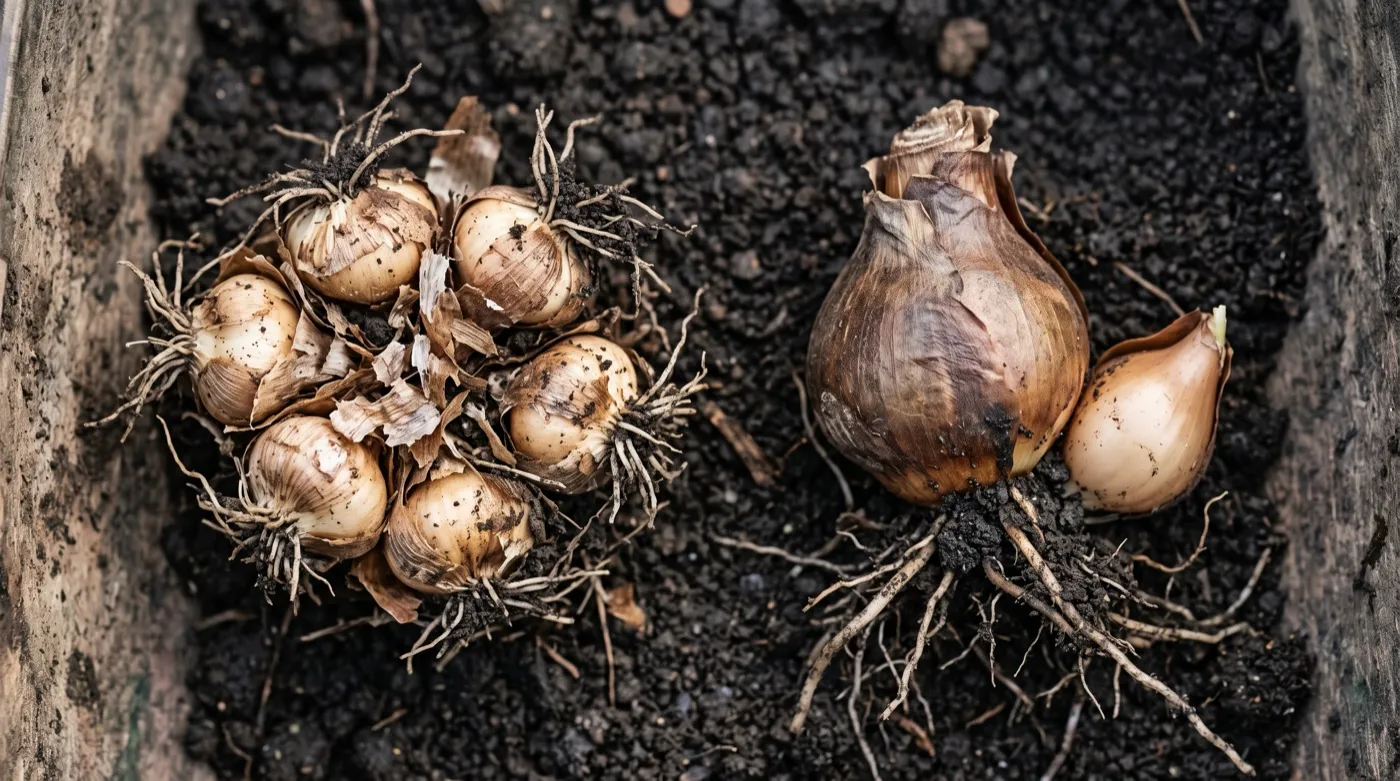
On the left, a hybrid bulb that has split into small offsets. On the right, a large single replacement bulb, which is much more likely to flower.
Tulip fire, a fungal disease, is the other common reason tulips fail. Planting in November rather than early autumn helps avoid it. The guide to tulip fire explains the signs.
Which tulip type to choose for each job
- Permanent planting in borders and gravel: Divisions 12 to 15. Give them sun and good drainage.
- A big, bold show that may return: Darwin Hybrids (Division 4).
- Pots and one-year displays: Triumphs, Double Earlies, Parrots and Double Lates. Enjoy them for one spring.
- Cutting for the house: Single Lates for long stems, and Viridifloras for vase life.
- Growing in grass: Only Tulipa sylvestris has much chance. Daffodils are a better choice, and the guide to naturalising bulbs in grass explains why.
For pots, you can layer tulips with other bulbs for a longer show. The bulb lasagne guide shows how.
Tulip flowering and planting calendar
| Month | What to do |
|---|---|
| March | Kaufmanniana and early species tulips flower |
| April | Single Early, Fosteriana, Greigii, then Triumph and Darwin Hybrid tulips flower |
| May | Single Late, Lily-flowered, Viridiflora, Parrot and Double Late tulips flower |
| June | Deadhead, but leave the leaves until they turn yellow |
| July | Lift bulbs you want to store once the leaves have died down |
| August | Store lifted bulbs somewhere cool, dry and airy. Order new bulbs |
| September to October | Prepare beds. Add grit on heavy clay |
| November | The main tulip planting month |
| December | You can still plant tulips if the ground isn’t frozen |
The guide to when to plant tulip bulbs explains why later planting works best.
Common mistakes when choosing tulip types
- Buying by picture alone. The photo shows the first spring. The division tells you how it will do after that.
- Expecting all tulips to flower together. The season runs from March to May. Pick divisions that overlap, or spread them out on purpose.
- Mixing very short and very tall types. A 15cm species tulip disappears behind a 70cm Single Late.
- Feeding hard to make them come back. Feeding won’t stop bulbs splitting. The right division, deep planting and good drainage matter more.
- Cutting the leaves off after flowering. The leaves feed next year’s bulb. Leave them until they turn yellow.
Now you can read a tulip packet and know what you’re buying, try the guide to daffodil types for the other half of your spring bulb order. There are more bulbs and flowers on the plants hub.
Frequently asked questions
How many types of tulip are there?
There are 15 official tulip divisions, covering thousands of named varieties. They are set by the international register of tulip names, held in the Netherlands. Multiflowering tulips, with several flowers per stem, are not a division of their own. They belong to whichever division their flower shape fits.
Which tulip division comes back every year?
Divisions 12, 13, 14 and 15 come back most reliably. These are Kaufmanniana, Fosteriana, Greigii and Species tulips, which are close to wild tulips. Darwin Hybrids are the best of the big showy tulips. Parrots and Double Lates rarely flower well after the first year.
What is the difference between Triumph and Darwin Hybrid tulips?
Triumphs are shorter; Darwin Hybrids are taller with bigger flowers. Triumphs grow about 35-50cm tall and flower in mid to late April. Darwin Hybrids reach about 50-65cm and have huge flowers. They are also much more likely to flower again the next spring.
Which tulips flower first in the UK?
Kaufmanniana tulips usually flower first, from about mid-March. They are short, at around 15-25cm, and open flat in the sun, which is why they are called waterlily tulips. Some species tulips flower early too. Double Lates and Tulipa sprengeri finish the season in May.
Are Rembrandt tulips still sold?
Not the original ones, as their streaks came from a virus. Tulip breaking virus caused the famous flamed petals and slowly weakened the bulbs. Modern streaked tulips such as ‘Rem’s Favourite’ are healthy varieties with the pattern bred in, sold in other divisions.
How deep should I plant tulip bulbs?
Plant tulips about 15cm deep, measured to the base of the bulb. That is roughly three times the bulb’s height. On light, free-draining soil you can go to 20cm, which helps tulips you want to leave in the ground.
Are species tulips worth growing?
Yes, they are the most reliable tulips of all. Flowers are smaller and plants reach only 10-30cm. In a sunny, well-drained spot they often spread over the years. Try Tulipa sylvestris, T. turkestanica or T. sprengeri.
Our team produces practical UK gardening guidance from source research, contributor records and established horticultural practice. Editorial standards are overseen by Matt W.