Key takeaways
- Flagging is the first sign, with yellow, wilting branches in a green crown from June to August
- Cut a wilting twig straight across and look for a ring of brown dots just under the bark
- Elm bark beetles carry the fungus, and it also spreads through joined roots between nearby elms
- Nothing cures an infected elm, so the aim is to stop it spreading to others
- Fell infected trees in winter and strip or burn the bark before beetles emerge in spring
- Resistant varieties such as 'Lutece', 'New Horizon' and 'Sapporo Autumn Gold' are the way to plant elm again
Dutch elm disease is why few people under fifty have seen a full-grown English elm. It swept through Britain from the late 1960s and killed most of the big hedgerow elms. It is still here today.
This guide helps you work out whether your elm has it. It covers the signs in the order you will see them, the simple twig test that confirms it, and what to do next. There is no spray or feed that saves an infected elm. What you can do is spot it early, stop it spreading and plant a resistant elm in its place.
What causes Dutch elm disease?
Dutch elm disease is caused by a fungus that lives in the tree’s water-carrying vessels. The tree tries to block the fungus by plugging those vessels, which cuts off its own water. That is why branches wilt.
There were two waves in Britain. A milder form arrived in the 1920s and killed some elms, but many survived. A far more aggressive form, Ophiostoma novo-ulmi, arrived in the late 1960s, thought to have come in on imported logs. It kills most elms it infects, often within a season or two.
The name comes from the Dutch scientists who studied the disease in the 1920s, not from where the trees grew.
Flagging: the first sign in summer
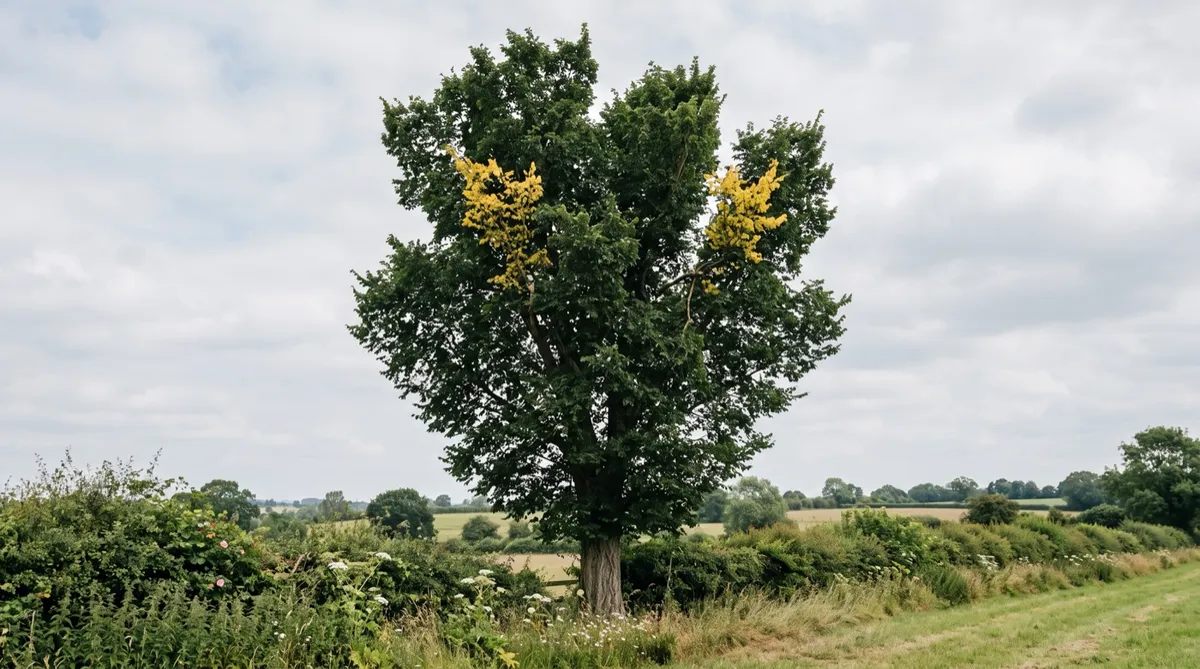
Flagging is the first thing most people notice. One branch, or a small group, turns yellow while the rest of the tree stays green. From a distance it looks like a yellow flag hung in the crown.
It usually shows from June to August. Yellowing in April or May is more likely to be frost, drought or a root problem.
Watch what the leaves do next. They curl, turn brown and often stay on the twig for weeks rather than falling. More branches follow through the summer. By the next year, much of the crown may be dead.
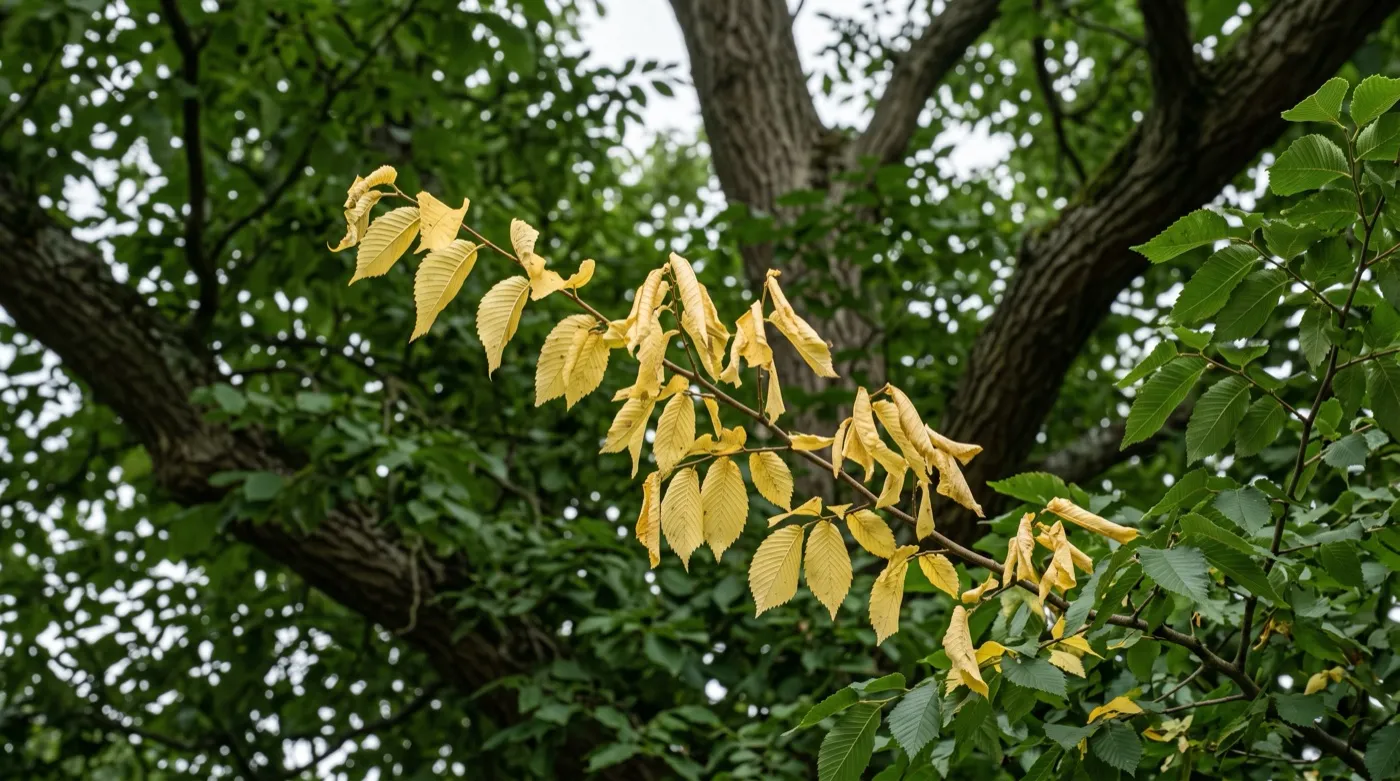
Flagging is the first sign: one branch yellows and wilts while the rest of the crown stays green.
The twig test that confirms Dutch elm disease
This is the most useful check you can do. It takes a few minutes and costs nothing.
- Choose a branch that is actively wilting.
- With clean secateurs, cut a twig about as thick as a pencil or a little thicker.
- Cut it straight across and look at the fresh cut end, with a hand lens if you have one.
- Cut a twig from a healthy green branch too, so you can compare them.
In a healthy elm, the cut face is pale cream all over. In an infected one, you’ll see brown staining in the outer wood, just under the bark. It often shows as a broken ring of brown dots rather than a solid circle. Peeling back the bark on a wilting twig can also reveal brown streaks running along the wood.
Cut three or four twigs, because the staining can be patchy. Wipe your secateurs with a little methylated spirit before you move to another tree.
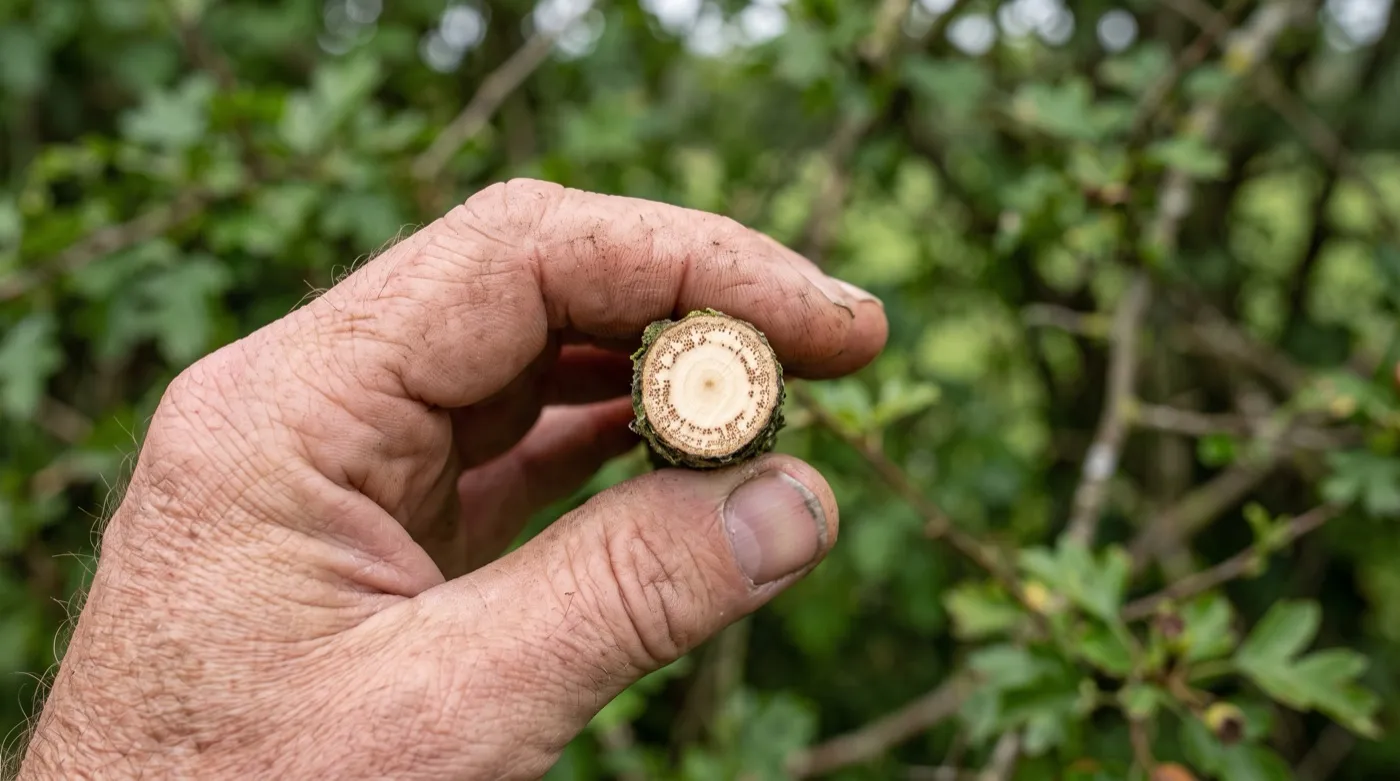
A ring of brown dots just under the bark is the sign to look for. A clean, pale cut suggests another cause.
Other Dutch elm disease symptoms to look for
Two more clues help you build the picture. Neither proves it on its own.
Shepherd’s crooks are shoot tips that wilt and curl over into a tight hook. Several on the same yellowing branch is a strong hint.
Small round exit holes in the bark of dead branches are where bark beetles have flown out. Peel away loose bark and you may find their tunnels underneath.
Some things look similar but are not Dutch elm disease:
- Zigzag trails eaten into elm leaves are the work of the elm zigzag sawfly, a leaf-eating insect.
- The whole crown thinning at once points more to drought or root damage.
- Sudden death of a different tree has many possible causes. The sudden tree death diagnostic guide works through them.
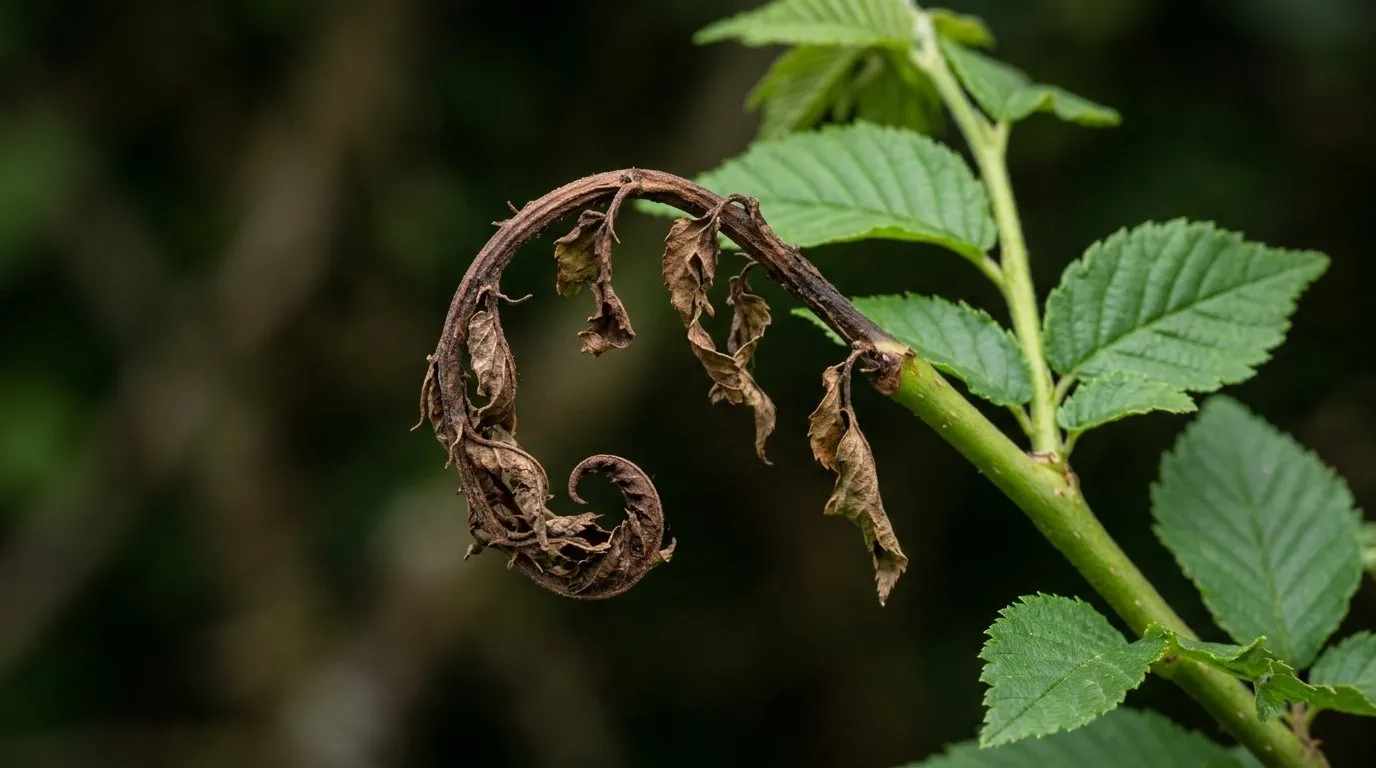
A shepherd’s crook: the soft shoot tip loses water and curls over into a hook.
How Dutch elm disease spreads
The fungus can’t travel by itself. It moves in two ways.
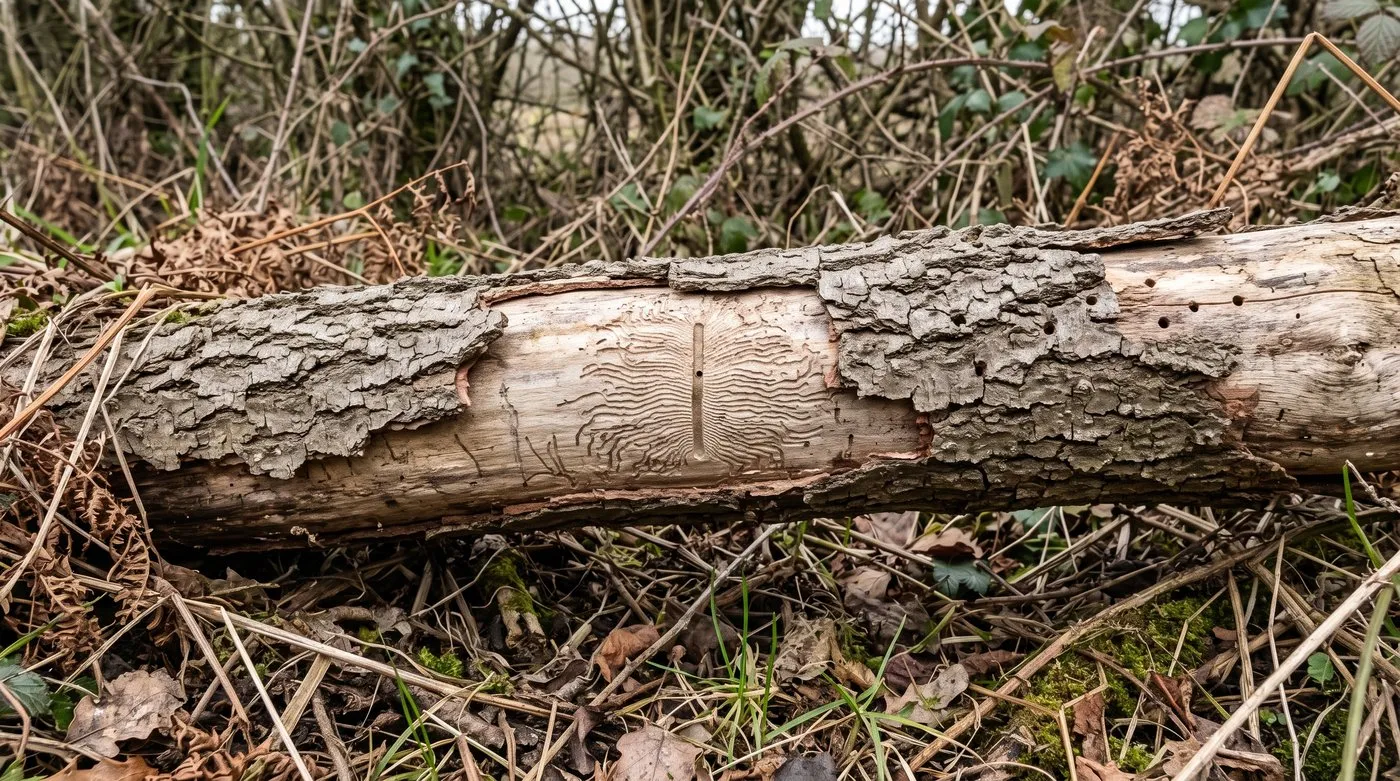
Peel back the bark of a dead elm branch and you may find these beetle tunnels. This is where the next generation picks up the fungus.
Elm bark beetles carry it. There are two main species, the large one up to about 6mm long and the small one about half that. They breed under the bark of dying or freshly dead elms. When the young beetles fly out in late spring and summer, they carry fungal spores. They feed on twigs of healthy elms, and the spores get into the tree through the feeding wounds. The beetles then fly to a weak or dying elm to breed, and the cycle starts again.
Joined roots are the second route. Elms growing close together, in hedgerows or avenues, often have roots that have grown together. The fungus can pass straight through these from one tree to the next, without any beetle. This is why elms in a row often die one after another.
So felling an infected tree may not save an elm growing close by if their roots are already joined. A tree surgeon can advise whether cutting the roots between them is worth trying.
Warning: Never stack elm logs with the bark still on. Beetles breed under the bark and fly out the next spring carrying the fungus to healthy elms. Strip the bark, burn it or chip it. Elm isn’t suitable for a wildlife log pile, whatever else you use.
Why hedgerow elms keep dying back
Elm hasn’t vanished from Britain. You will see it in hedgerows everywhere, just not as big trees.
English elm rarely grows from seed here. It spreads by root suckers, new shoots from the roots. When the tree above ground dies, the roots usually survive and sucker again.
Those suckers grow into young trees over many years. Once the stems are thick enough for bark beetles to breed in, the disease finds them and they die back. Then the roots sucker again. That cycle keeps elm alive as a hedgerow shrub and keeps the beetles fed, which is why the disease never burns out.
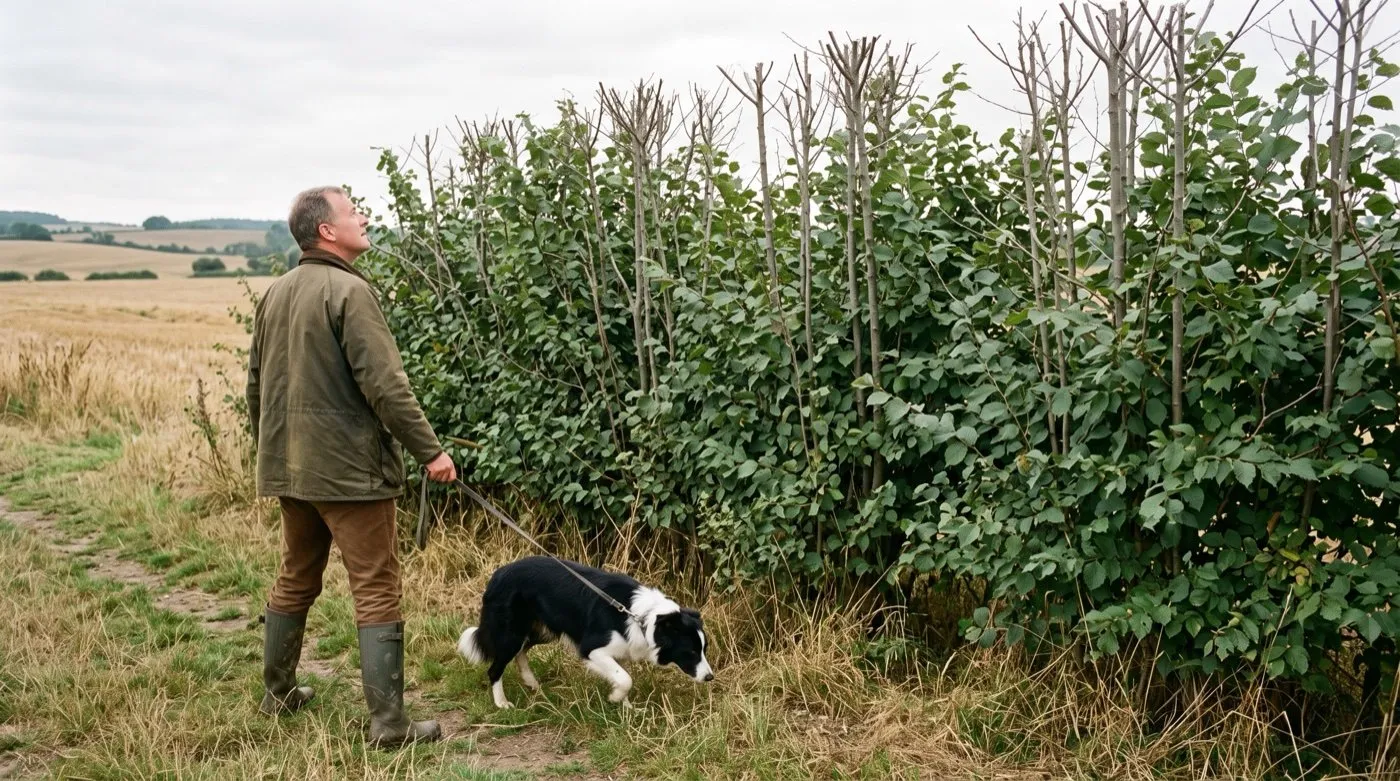
Hedgerow elm grows back from the roots, reaches a few metres, then often dies back again as the disease returns.
The loss hit wildlife too. The white-letter hairstreak butterfly lays its eggs on elm and declined with it. The guide to rare woodland butterflies covers how to help it.
What to do if your elm has Dutch elm disease
There is no cure, so the aim is to protect other elms and plant a replacement.
- Confirm it with the twig test in summer.
- Plan to fell it over winter, between November and March. Beetles start flying in spring, so this stops the tree becoming a breeding site.
- Use a qualified tree surgeon for anything bigger than a small tree.
- Strip or burn the bark of all the wood on site. Don’t move bark-on elm wood elsewhere.
- Replant with a resistant elm or a different tree.
Before felling, check whether the tree has a Tree Preservation Order or is in a conservation area. The guide to tree preservation orders explains what to check. Winter felling also avoids the bird nesting season.
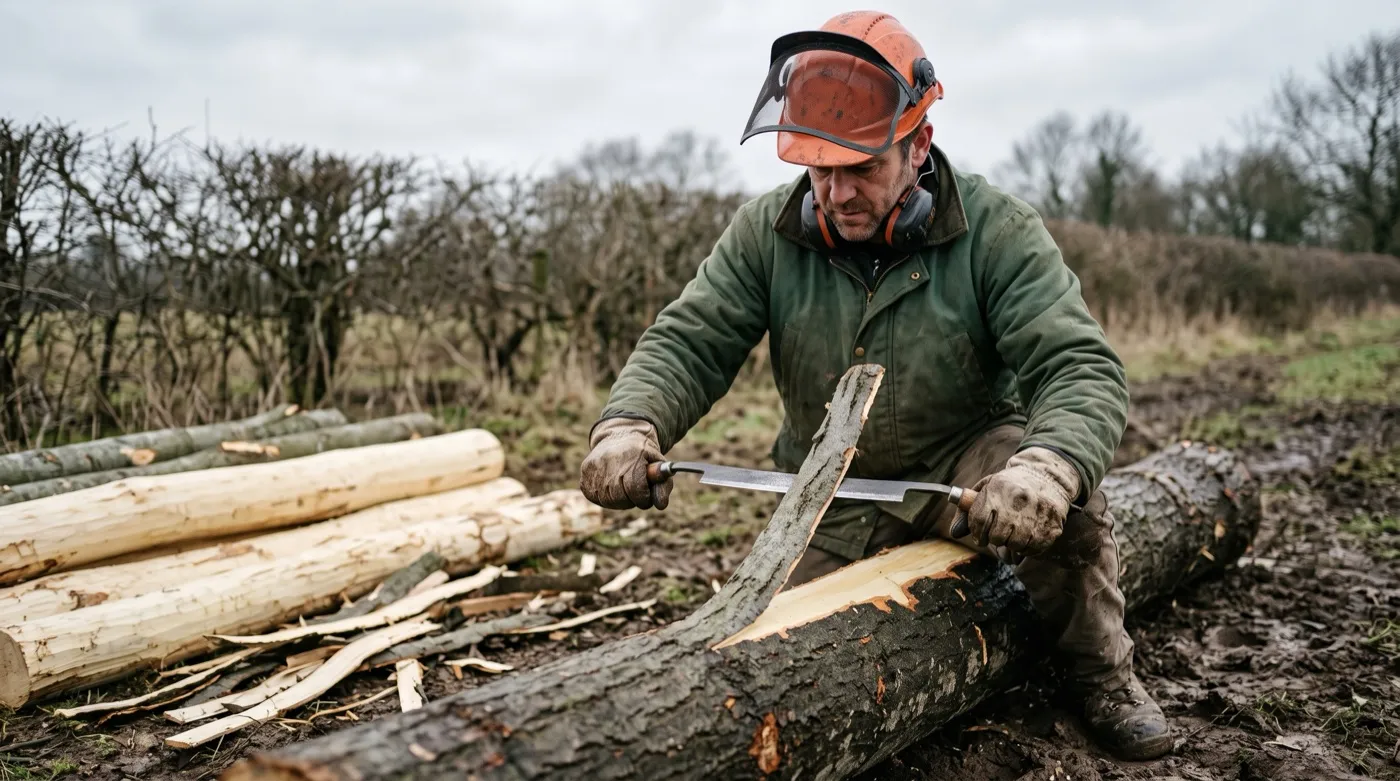
Stripping the bark on site removes the layer where beetles breed, so the wood can’t spread the disease.
Most of Britain has no legal duty to report the disease. A few areas, notably Brighton and Hove, run control programmes to protect their elms. Check with the council there before felling or moving elm wood. You can log sightings on Forest Research’s TreeAlert.
Resistant elms worth planting
The best way to bring elm back is to plant a resistant variety. These are hybrids that include Asian elm species, which cope with the fungus far better than English elm.
Varieties to look for include ‘Lutece’, ‘New Horizon’ and ‘Sapporo Autumn Gold’. They grow narrower and more upright than the old English elm, but they give you an elm that should last.
Brighton and Hove shows what careful control can do. Its downs-and-sea setting and years of quick felling have kept a large population of mature elms going. Even so, one of the famous Preston Twins elms in Preston Park was lost to the disease in 2019.
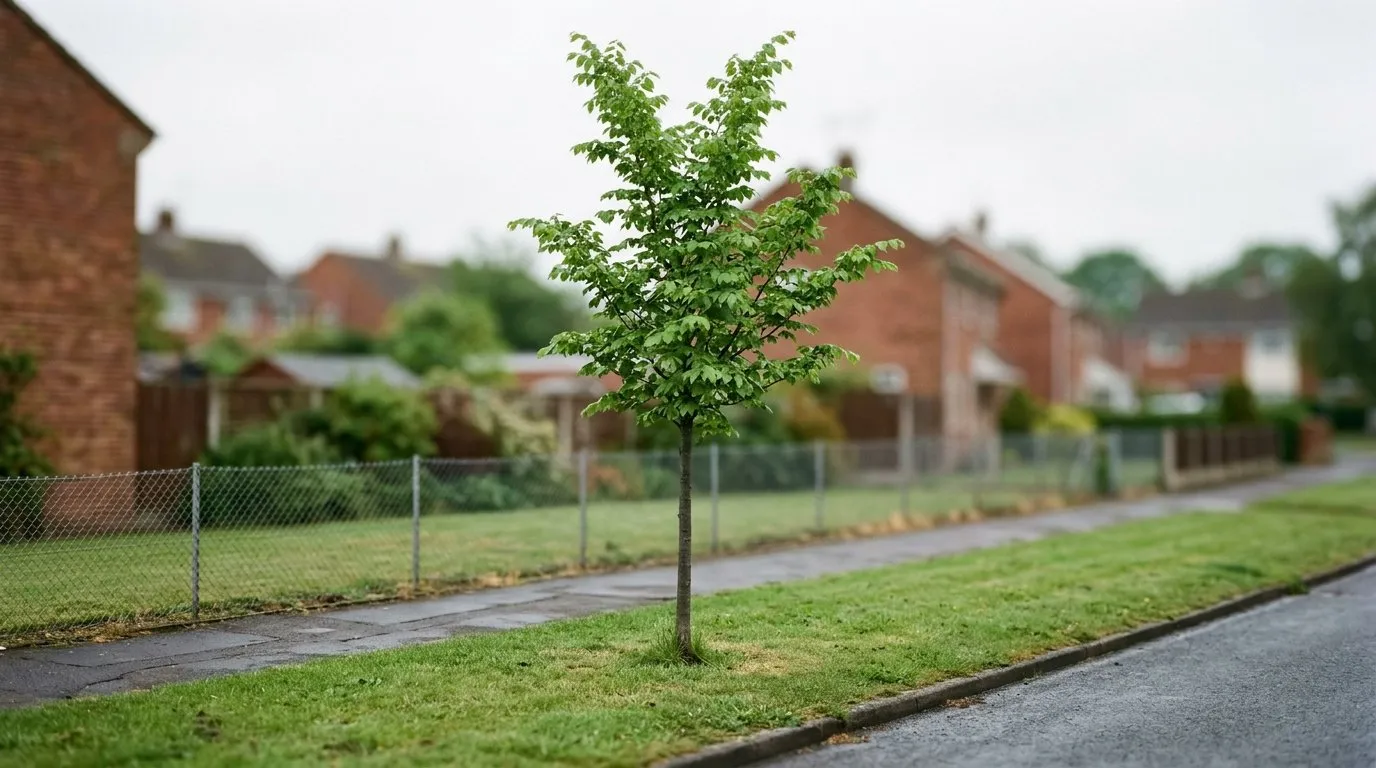
Resistant elms grow narrower and more upright than English elm, but they give you an elm that should last.
Prefer a different tree? The best small native trees for UK gardens are a good place to start. Buying UK-grown trees also helps keep new pests and diseases out.
Elm watch calendar month by month
Elm jobs follow the beetle’s year. Checking happens in summer, while the crown shows symptoms. Felling and clearing happen in winter, before beetles fly.
| Month | What to do |
|---|---|
| January | Fell confirmed cases. Strip or burn the bark from all elm wood |
| February | Finish clearing infected wood. Plant bare-root resistant elms |
| March | Deal with any elm wood still lying around before spring |
| April | Check for forgotten bark-on elm logs |
| May | Beetles start flying. Avoid felling unless the wood is burnt straight away |
| June | Flagging starts. Check any elm you value every week or two |
| July | Peak flagging. Run the twig test on anything suspicious |
| August | More branches may flag. Note every affected tree |
| September | Confirm your diagnosis and book winter felling |
| October | Leaf fall hides symptoms. Mark affected trees while you can still tell |
| November | Felling season starts. Prioritise trees close to healthy elms |
| December | Fell, strip the bark and burn. Order resistant trees for spring planting |
Common mistakes with a suspect elm
- Testing only one twig. Staining is patchy. Cut several from wilting branches, plus one from a healthy branch to compare.
- Waiting to see if it recovers. It won’t, and the tree becomes a beetle breeding site. Fell it the following winter.
- Keeping the logs. Bark-on elm by the shed breeds beetles. Strip it or burn it.
- Forgetting the neighbours. Elms close by may share roots. Ask a tree surgeon about the risk.
- Replanting English elm. It will go the same way. Plant a resistant variety or a different tree.
Now you can tell a flagging elm from a stressed one, read the ash dieback identification guide for the disease now affecting ash. More tree and plant troubles are in the garden problems guides.
Frequently asked questions
How do I know if my elm has Dutch elm disease?
Cut a wilting twig across and look for a brown ring under the bark. Other signs are branches yellowing in summer, leaves browning but hanging on, and shoot tips curled into a hook. A clean, pale cut suggests the wilt has another cause.
Can Dutch elm disease be cured?
No, there is no cure once a branch is wilting. Specialist trunk injections can help protect some healthy, valuable elms, but they are a job for a tree surgeon and need repeating. For most gardens, the answer is to fell the tree and replant.
Why do elms still grow in UK hedgerows if the disease killed them all?
The roots survive and send up new shoots called suckers. These grow into young trees for many years. Once the stems are thick enough for bark beetles to breed in, the disease finds them and they die back, and the roots sucker again.
Do I have to report Dutch elm disease?
Usually not, as it is widespread across most of Britain. A few areas, notably Brighton and Hove, run their own control programmes, so check with the council there before felling or moving elm wood. Logging a sighting on TreeAlert is still helpful.
Are there elm trees resistant to Dutch elm disease?
Yes, varieties such as ‘Lutece’, ‘New Horizon’ and ‘Sapporo Autumn Gold’. They are hybrids that include Asian elm species, which cope with the fungus far better. They grow narrower and more upright than the old English elm.
Can I burn or move logs from an elm that died of the disease?
Burn them or strip the bark first, and never store bark-on elm logs. Bark beetles breed under the bark and fly out in spring carrying the fungus. Elm with the bark removed is safe to season and burn.
What is the difference between Dutch elm disease and elm zigzag sawfly damage?
Dutch elm disease wilts whole branches; zigzag sawfly chews zigzag trails in leaves. Sawfly leaves stay green around the feeding marks. Leaves on a diseased branch yellow and wilt together, with no chewing at all.
Our team produces practical UK gardening guidance from source research, contributor records and established horticultural practice. Editorial standards are overseen by Matt W.


