
Key takeaways
- Mix at least five native shrubs for picking from May elderflowers to November sloes
- Plant bare-root whips 30-45cm apart between November and March
- Water weekly from April to September in the first year
- Trim lightly in January or February, never in the nesting season
- Pick wild fruit for your own use, but never dig up wild plants
- Only eat berries you can name for certain, and always cook elderberries
An edible hedgerow is a boundary you can eat from. Instead of a fence, you get elderflowers in June, wild cherries in July, blackberries in August, and sloes, rosehips and hazelnuts in autumn. It feeds you, feeds the birds, and looks better every year.
Below you’ll find eight native shrubs to choose from, how to plant them, when to pick each one, three easy recipes, and the simple rules for foraging. It works whether you’re starting a new boundary or planting along an old fence.
What is an edible hedgerow and why plant one?
It’s a mixed, informal hedge of native shrubs that give you fruit, nuts or flowers to eat. Unlike a neat beech or yew hedge, it’s allowed to grow a bit loose, so it can flower and fruit freely.
You get months of picking, plus a busy home for insects, nesting birds and hedgehogs. A hedge also filters the wind far better than a solid fence. And bare-root plants are cheap, so a good length of hedge costs very little to plant.
Hawthorn is the star for wildlife, feeding more insects than almost any other native shrub. Add blackthorn, elder and dog rose and you’ve got a real wildlife haven.
For more on planting technique, see our hedge planting guide.

Bare-root whips go in between November and March, and cost far less than pot-grown plants.
Choosing the right species for your edible hedgerow
Variety is the secret. Pick at least five of these eight and you’ll have something to gather for most of the year.
- Hawthorn (Crataegus monogyna): the backbone of any native hedge. White blossom in May, red haws in autumn. Happy on any soil.
- Blackthorn (Prunus spinosa): white blossom on bare stems in March, then blue-black sloes in October for sloe gin.
- Elder (Sambucus nigra): elderflowers in June, elderberries in September. Fast growing. See our elderberry growing guide.
- Dog rose (Rosa canina): pink flowers in June, then bright orange-red hips from September.
- Hazel (Corylus avellana): catkins in February, hazelnuts in September. Great for coppicing too.
- Crab apple (Malus sylvestris): pink-white blossom in April, small sharp apples from September for jelly. Our crab apple growing guide has the best varieties.
- Damson: white blossom in April, purple fruit in September. Brilliant for jam and damson gin.
- Wild cherry (Prunus avium): white blossom in April, small sweet-sharp cherries in July. Grows taller than the rest.
Plant them in loose groups of three to five. A strict one-of-each pattern looks odd and makes a weaker hedge.
Edible hedgerow species comparison table
| Shrub | What you eat | When to pick | Good for | Soil |
|---|---|---|---|---|
| Hawthorn | Haws, young leaves | Leaves Apr-May, haws Oct-Nov | Jelly, ketchup | Any, including clay |
| Blackthorn | Sloes | Oct-Nov | Sloe gin, jam | Any, including chalk |
| Elder | Flowers, berries | Flowers Jun, berries Sep | Cordial, syrup | Any, including wet clay |
| Dog rose | Hips | Sep-Nov | Syrup, jelly | Any well-drained |
| Hazel | Nuts | Sep-Oct | Eating, baking | Any but waterlogged |
| Crab apple | Fruit | Sep-Oct | Jelly | Any, including clay |
| Damson | Fruit | Sep-Oct | Jam, gin, chutney | Any, including clay |
| Wild cherry | Fruit | Jul-Aug | Eating, jam | Well-drained |
A simple mix for a 10m hedge: five hawthorn, five blackthorn, three elder, three dog rose, three hazel, two crab apple, two damson and two wild cherry. That’s 25 plants at about 40cm apart.
How to plant a bare-root edible hedgerow
Plant between November and March while the plants are dormant. Earlier is better, as roots get longer to settle before spring.
What you need
- Bare-root whips, about 40-60cm tall
- String and pegs to mark a straight line
- A spade and a fork
- Mulch, such as bark chips, straw or cardboard
- Spiral rabbit guards if rabbits visit
Step-by-step planting method
1. Mark the line. Run a string along where the hedge will go. Allow a strip about 60cm wide for one row, or 90cm for a double row.
2. Dig a trench. Make it about 30cm deep and 30cm wide. Fork over the bottom, especially on clay, so roots can get through.
3. Soak the roots. Stand the plants in a bucket of water for an hour or two. Dry roots are the main reason new hedges fail.
4. Plant. Space plants 30-45cm apart. For a thicker hedge, plant a zigzag double row, 30cm between rows and 40cm between plants. Spread the roots, backfill and firm with your boot. The old soil mark on the stem should sit at ground level.
5. Cut back by a third. Trim all stems by about a third straight after planting. It feels harsh, but it makes the hedge bushy from the base.
6. Mulch. Spread a thick layer of bark, or overlapping cardboard, along both sides to keep weeds down and moisture in. Keep it a few centimetres back from the stems.
7. Add rabbit guards. Rabbits love to strip bark from young hawthorn and blackthorn in winter, which can kill them.
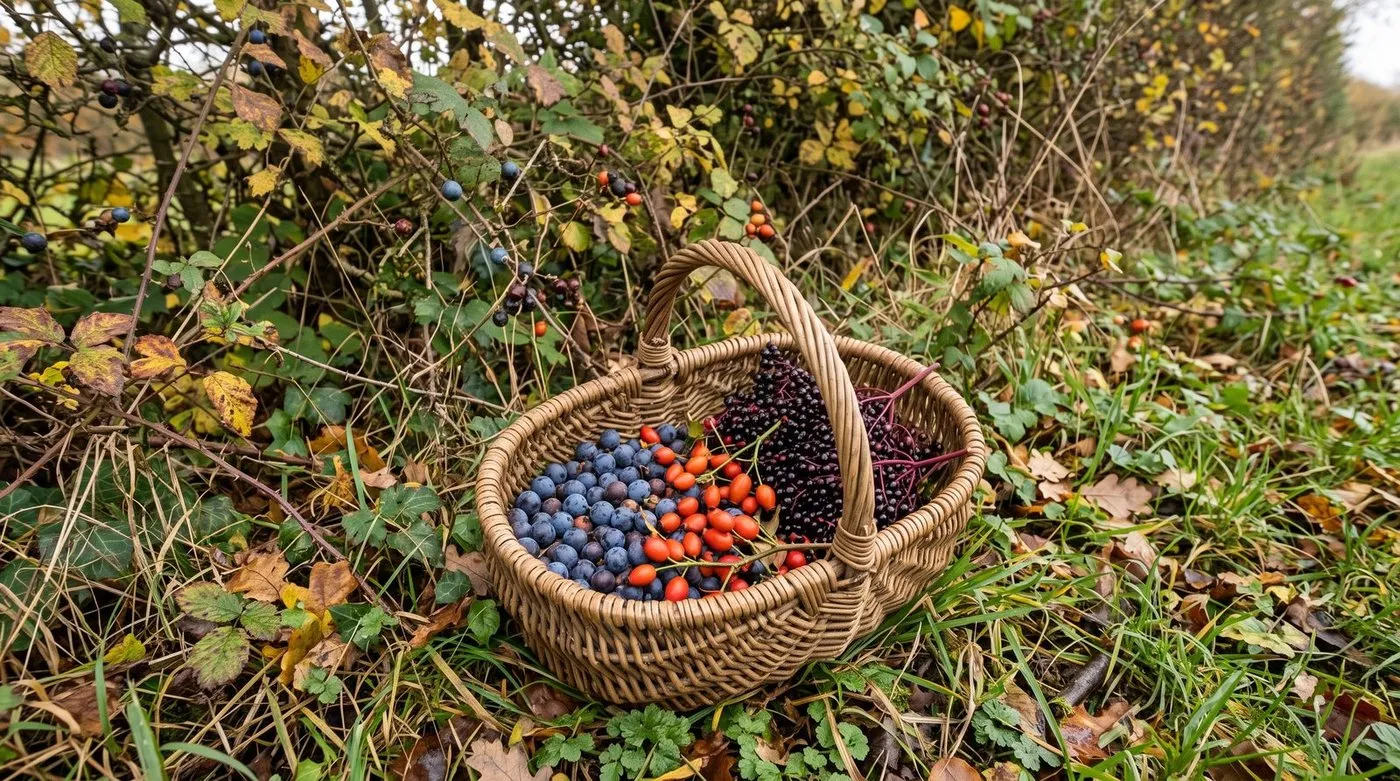
Sloes, rosehips and elderberries all ripen between September and November.
Establishment and first-year care
Get the first two years right and the hedge will mostly look after itself.
Water. Give every plant a good drink each week from April to September in the first year. A leaky hose along the base makes this easy.
Weed. Keep a strip about 30cm wide on each side clear of grass and weeds for two years. Mulch does most of the work.
Don’t prune in year one. Let everything grow so the plants build strong roots. Just snip out anything dead or damaged.
Trim in year two. In the second winter (January or February), cut all the new growth back by about half. This makes the hedge branch again and fill out at the bottom.
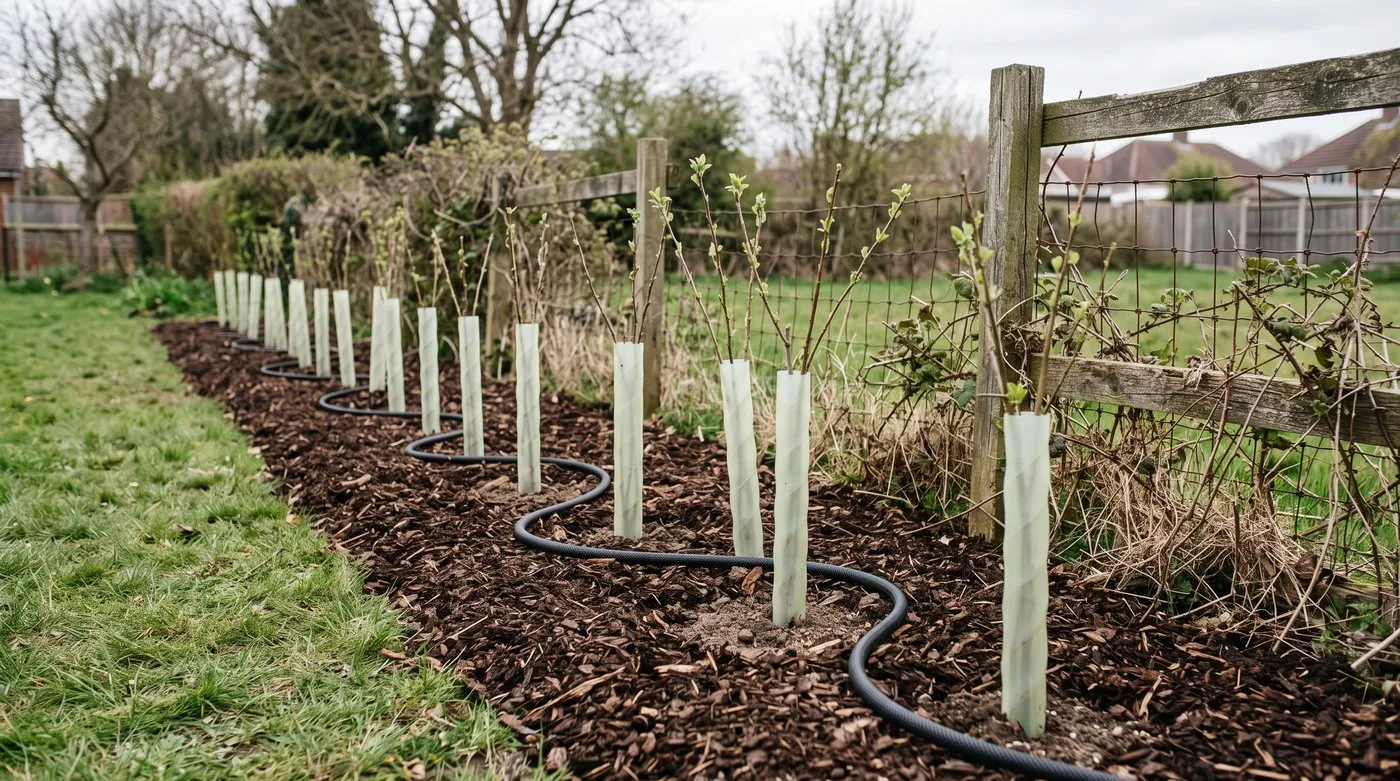
Keep a weed-free strip on each side for the first two years and water weekly through the first summer. A leaky hose along the base makes that easy.
Maintenance and pruning for fruit production
Once it’s settled, an edible hedgerow needs very little. Aim to keep its shape without cutting off next year’s fruit.
Trim once a year in late January or early February. The birds have finished the berries by then, and nesting hasn’t started. The Wildlife Trusts suggest the same timing for wildlife hedges.
What to cut. Take out crossing branches, lower the top if it’s got too tall, and trim the sides so the hedge is wider at the bottom than the top. That shape lets light reach the base and keeps it thick.
What to leave. Don’t cut off elderflowers or hips before you’ve picked them. Leave hawthorn and blackthorn alone from June to November if you want a good crop. It’s nice to leave a few stretches uncut each year for wildlife.
Coppicing hazel. Every seven to ten years, cut hazel down to about 15cm in winter. It shoots back strongly from the stump.
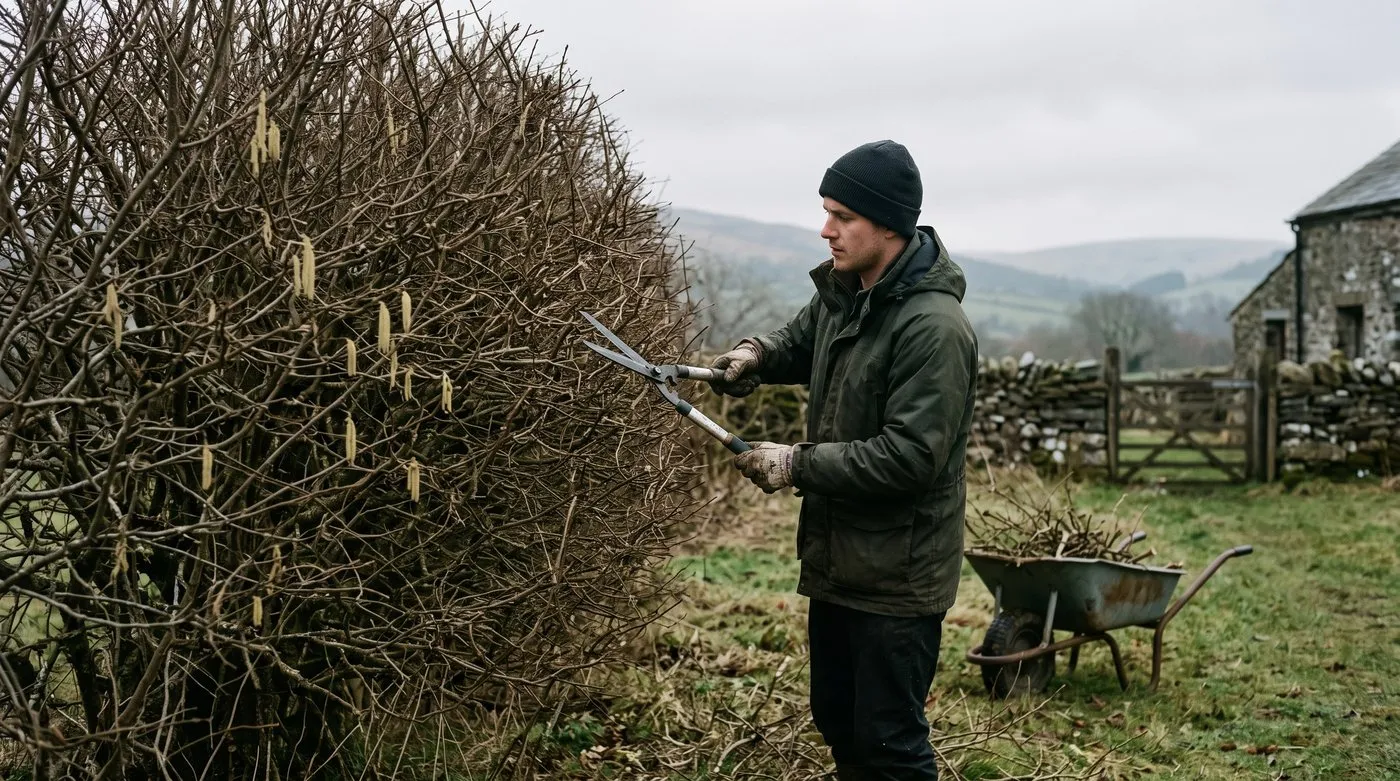
Trim lightly in late January or early February, after the birds have finished the berries and before nesting starts. Keep the hedge wider at the bottom so light reaches the base.
The edible hedgerow foraging calendar
Here’s roughly when everything is ready in central England. Scotland may be a week or two later, and the mild south a little earlier.
| Month | What to pick | How to tell it’s ready |
|---|---|---|
| April-May | Young hawthorn leaves and flower buds | Leaves bright green and soft |
| May-June | Elderflowers | Flowers fully open, creamy and sweetly scented |
| June-July | Dog rose petals, wild cherries | Petals open; cherries dark red and soft |
| August-September | Blackberries (if bramble has crept in), elderberries | Deep purple-black, clusters drooping |
| September-October | Hazelnuts, crab apples, damsons | Nuts brown in their husks; fruit gives a little when pressed |
| October-November | Sloes, rosehips, haws | Sloes blue-black with a dusty bloom; hips deep orange-red |
Three classic hedgerow recipes
Three easy favourites, all using fruit from the shrubs above. No special kit needed.
Sloe gin
Sloes are far too sour to eat raw, but they turn gin into something rich, deep purple and lovely.
Ingredients: 450g sloes, 225g caster sugar, 700ml gin.
Method: Prick each sloe with a pin, or simply freeze them overnight to split the skins. Put the sloes and sugar in a 1-litre jar, pour in the gin, seal and shake. Keep it somewhere cool and dark. Shake daily for a week, then weekly for three months. Strain through muslin into clean bottles. It keeps getting better for up to a year.
Elderflower cordial
Pick elderflowers on a dry, sunny morning in June, when they smell their best. Twenty big heads make about 1.5 litres.
Ingredients: 20 elderflower heads, 1.5kg granulated sugar, 1.5 litres boiling water, zest and juice of 2 unwaxed lemons, 50g citric acid.
Method: Shake the flowers gently to get rid of insects, but don’t wash them. Dissolve the sugar in the boiling water, then add the lemon zest, juice and citric acid. Drop in the flowers, cover and leave for 24 hours, stirring twice. Strain through muslin into sterilised bottles. Keeps in the fridge for up to three months. Mix one part cordial with five parts fizzy water.
Rosehip syrup
A wartime favourite, and still the best way to use rosehips. They’re packed with vitamin C.
Ingredients: 1kg rosehips, 500g granulated sugar, 1.5 litres water.
Method: Wear gloves, as the hairs inside the hips are itchy. Roughly chop the hips in a food processor. Bring 1 litre of water to the boil, add the hips, bring back to the boil, then take off the heat and leave for 15 minutes. Strain through a jelly bag. Put the pulp back in the pan with the other 500ml of water, boil, steep and strain again. Combine the liquids, boil down to about 750ml, stir in the sugar until it dissolves, and boil for five minutes. Pour into sterilised bottles and seal. Keep it in the fridge.

Hawthorn blossom and elderflowers bring the first pickings of the year in May and June.
Legal rules for foraging from hedgerows in the UK
The rules are simple. Picking wild fruit, nuts, flowers and leaves for your own use is generally fine. That covers public rights of way, common land and hedges where you have the owner’s permission.
What’s not allowed: digging up any wild plant without the landowner’s permission, picking protected species, or picking to sell without permission.
Be a good forager, too. Take no more than a third of the fruit from any bush and spread your picking along the hedge. Birds rely on hedgerow berries all winter, including the fieldfares and redwings that fly in from Scandinavia.
Wildlife value of edible hedgerows
An edible hedgerow is one of the best things you can add for wildlife.
Insects. Hawthorn and blackthorn feed a huge range of insects. Ladybirds, hoverflies and lacewings shelter at the base over winter, then help with pests on your veg and borders.
Birds. Wrens, robins, blackbirds, song thrushes, chaffinches and long-tailed tits all nest in hedges. Thorny blackthorn and hawthorn keep nests safe from cats. The berries feed thrushes all winter.
Mammals. Hedgehogs travel along the bottom of hedges and hibernate in the leaf litter. Dormice feast on hazelnuts. Bats hunt along the sheltered side at dusk.
You can also train blackberries along the sunny side of the hedge, where they won’t smother slower shrubs.
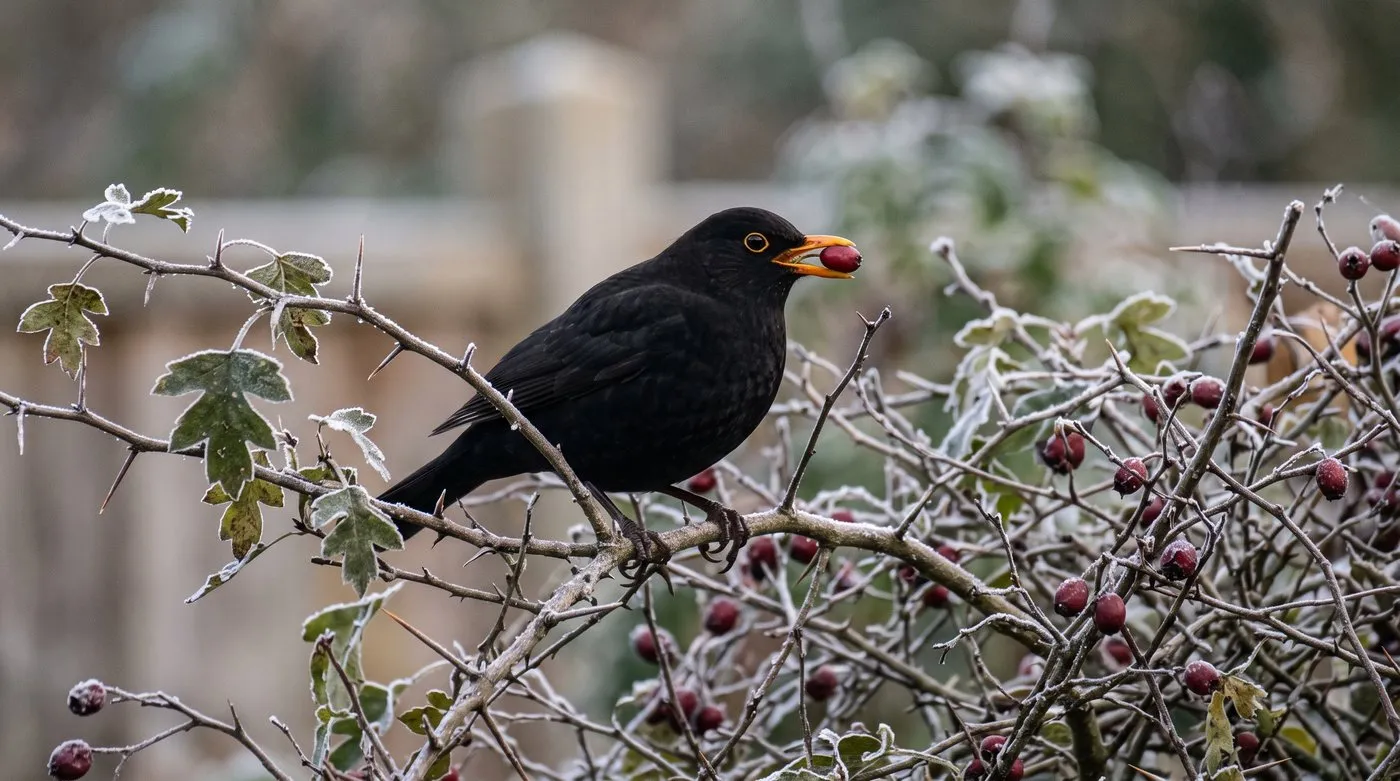
Thrushes and blackbirds rely on hedgerow berries all winter. Leave plenty on the bush when you pick, and spread your picking along the hedge.
Common mistakes when planting edible hedgerows
A few easy slips that hold new hedges back, and how to avoid them.
Planting right on the boundary. Plant at least 50cm in from the line. The hedge will spread to 1-1.5m wide, and you’re responsible for trimming anything that hangs over next door.
Forgetting to water. Bare-root whips have no soil around their roots to fall back on. Weekly watering through the first summer really matters.
Cutting too hard, too soon. Leave it alone in the first growing season. The trim at planting is plenty for year one.
Putting elder in the middle. Elder grows faster and taller than everything else and will shade out its neighbours. Plant it at the ends where you can keep it in check.
Ignoring rabbits. Rabbits chew bark in winter, and you often don’t notice until spring. Spiral guards are cheap and save a lot of heartache.
Clipping it like a formal hedge. A flat-topped box cuts off the fruiting wood. Trim lightly for shape, not neatness.
Frequently asked questions
What is the best time to plant an edible hedgerow?
Between November and March, while the plants are dormant. Earlier in winter gives roots longer to settle before spring. Bare-root whips are only sold at this time and are much cheaper than pot-grown plants. Don’t plant into frozen or waterlogged ground. Pot-grown plants can go in at other times if you keep them watered.
How far apart should you plant hedgerow species?
About 30-45cm apart in a single row. For a thicker hedge, plant a zigzag double row with about 40cm between plants and 30cm between rows. Plant in small groups of three to five of each shrub rather than one of each in turn. It looks more natural and fills out better.
Is it legal to forage from hedgerows in the UK?
Yes, picking wild fruit for your own use is generally legal. That covers fruit, nuts, flowers and leaves from wild plants, as long as you’re not picking to sell. Digging up any wild plant without the landowner’s permission is against the law, and some plants are fully protected. Stick to public paths and take only what you need.
How long before an edible hedgerow produces fruit?
Most shrubs start fruiting within three to five years. Elder and dog rose often give a small crop within a couple of years. Hawthorn and blackthorn usually take a little longer. Hazel, crab apple and damson can take four to six years to give a decent harvest.
Which hedgerow berries are poisonous in the UK?
Several common hedgerow berries are poisonous, so learn them first. Watch out for lords-and-ladies (spikes of orange-red berries), black bryony (shiny red berries), woody nightshade (berries ripening from green to red) and spindle (pink and orange fruit). Yew seeds are very poisonous. Raw elderberries can make you sick, so always cook them. Never eat a berry you can’t name for certain.
Can you grow an edible hedgerow in clay soil?
Yes, most native hedgerow shrubs are happy on heavy clay. Hawthorn, blackthorn, elder and dog rose all grow wild on clay, and hazel and damson cope well too. Wild cherry likes better drainage, so give it the driest stretch. Fork over the bottom of the trench to help the roots get going.
Do edible hedgerows need pruning?
Yes, but only lightly, once a year in late winter. Trim in January or February, after the birds have eaten the berries and before nesting starts. Avoid cutting from March to August, as harming an active nest is against the law. Light trimming keeps the fruiting wood, while hard cutting means less fruit next year. Apart from the trims after planting and in the second winter, let young hedges grow freely.
Further reading
- How to grow hawthorn in the UK, including haw jelly
- How to grow elderberry in the UK, with pruning and cordial tips
- How to grow crab apple trees UK, best varieties and jelly making
- How to grow blackberries in the UK, thornless varieties and training
- Foraging in your garden: edible plants, wild food that may already be growing in your garden
Our team produces practical UK gardening guidance from source research, contributor records and established horticultural practice. Editorial standards are overseen by Matt W.


