Key takeaways
- Hawthorn is one of the best plants for garden wildlife, from bees to nesting birds
- Plant bare-root whips from November to March, three per metre for a hedge
- Cut new whips back by a third to a half after planting for a thick base
- Trim hedges in autumn or winter, and never disturb an active bird's nest
- 'Paul's Scarlet' is a lovely small tree, but it gives few berries for birds
Hawthorn is the backbone of the British countryside, and it’s brilliant in gardens too. It’s cheap, quick to thicken up and packed with life. Spring blossom, autumn berries, nesting spots and masses of insects all come from one plant. If you plant one thing for wildlife, make it hawthorn.
Hawthorn species and cultivars
Two hawthorns are native to the UK, plus some pretty garden varieties bred from Midland hawthorn. Choose by what you want: a hedge, a tree or a show of flowers.
Which hawthorn should you choose?
| Hawthorn | Size | Flowers | Berries | Best for |
|---|---|---|---|---|
| C. monogyna (common hawthorn) | Large tree or any hedge height | White, May | Plenty | Hedging, wildlife |
| C. laevigata (Midland hawthorn) | Medium tree | White, late April to May | Plenty | Woodland edge, heavy soil |
| ’Paul’s Scarlet’ | Small tree | Double crimson, May | Few | Small gardens |
| ’Plena’ | Small tree | Double white, May | Few | Formal spots |
| ’Rosea Flore Pleno’ | Small tree | Double pink, May | Few | Colour in a small garden |
| C. persimilis ‘Prunifolia’ | Medium tree | White, late spring | Long-lasting red | Autumn colour, winter birds |
Crataegus monogyna, the hedging standard
Common hawthorn is the one for hedges, wildlife and boundaries. It’s the most common plant in our native hedgerows. Its thick, thorny growth keeps out animals within a few years. In April and May it’s covered in white blossom, which is why it’s called the May tree. Red haws follow from September and often hang on into winter.
It grows in almost any soil, from chalk to clay, and copes with exposed, windy and coastal spots. This is the one sold cheaply as bare-root whips for hedging.
C. laevigata, Midland hawthorn
Midland hawthorn flowers a little earlier and copes with more shade. It’s at home on woodland edges and under bigger trees. The two kinds often cross in the wild.
It works just as well for hedging but is less often used. In gardens, it’s best known as the parent of the ornamental varieties.
Ornamental cultivars for smaller gardens
‘Paul’s Scarlet’ is the most popular ornamental hawthorn. In May it’s smothered in double crimson flowers, and it holds the RHS Award of Garden Merit. The double flowers give few berries, so it’s less useful for wildlife. As a small garden tree, it grows into a neat rounded shape and needs very little care.
‘Rosea Flore Pleno’ has soft pink double flowers on a slightly smaller tree. ‘Plena’ has double white flowers and suits more formal gardens. All three are grafted, and sold as young trees rather than hedging whips.
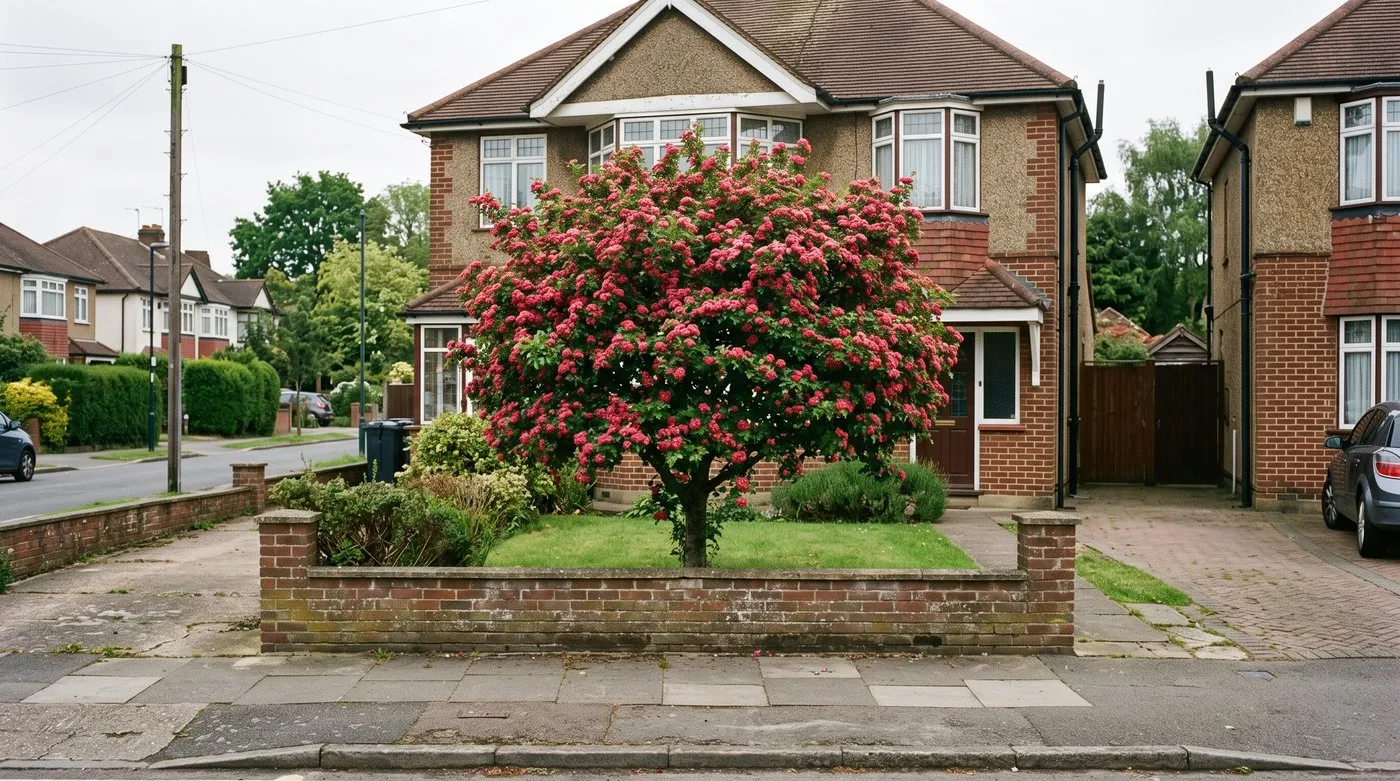
‘Paul’s Scarlet’ makes a neat, rounded small tree with very little care. Its double flowers give few berries, so it’s one for looks more than wildlife.
Seasonal interest calendar
| Month | What’s happening |
|---|---|
| January | Bare branches. Leftover haws feed fieldfares and redwings. |
| February | Last haws eaten by thrushes and blackbirds. |
| March | Buds break. Early bees about. |
| April | Fresh green leaves. Midland hawthorn starts flowering. |
| May | Common hawthorn in full blossom. Bees everywhere. |
| June | Blossom fades. Green haws form. Birds nesting. |
| July | Leaves full of insects. |
| August | Haws start to colour. |
| September | Red haws ripen. Birds start feasting. |
| October | Autumn colour and the most haws. Winter thrushes arrive. |
| November | Leaves fall. A good time to trim and to plant. |
| December | Bare branches. Birds pick at the last haws. |
How to plant a hawthorn hedge
When to plant
Plant bare-root whips from November to March, while they’re dormant. Early winter is best, as the soil is still workable and rain settles the roots. Bare-root whips cost much less than potted plants and do just as well. Our guide to planting bare-root trees has the full method.
How many plants per metre
For a single-row hedge, plant three whips per metre, about 33cm apart. For a double-row hedge, the thickest and best for wildlife, plant five per metre in a zigzag, with rows 30-40cm apart. A 20m double-row hedge needs about 100 whips.
Mixing in other natives such as blackthorn, field maple, dog rose and elder makes the hedge even better for wildlife. Keep hawthorn as the main plant.
Planting method
- Mark the hedge line with pegs and string
- Dig a trench about 30-40cm wide and a spade deep along the line
- On poor soil, mix in some garden compost or well-rotted manure
- Soak the whips in water for half an hour to an hour. Never let the roots dry out
- Plant each one at the same depth as before. Look for the darker soil mark on the stem
- Firm the soil around the roots with your heel
- Mulch along the row with bark or compost, keeping it just clear of the stems
- Water in the first spring if it’s dry
Small whips don’t need staking. Taller ones can have a short cane for support. Our hedge planting guide walks through it step by step.
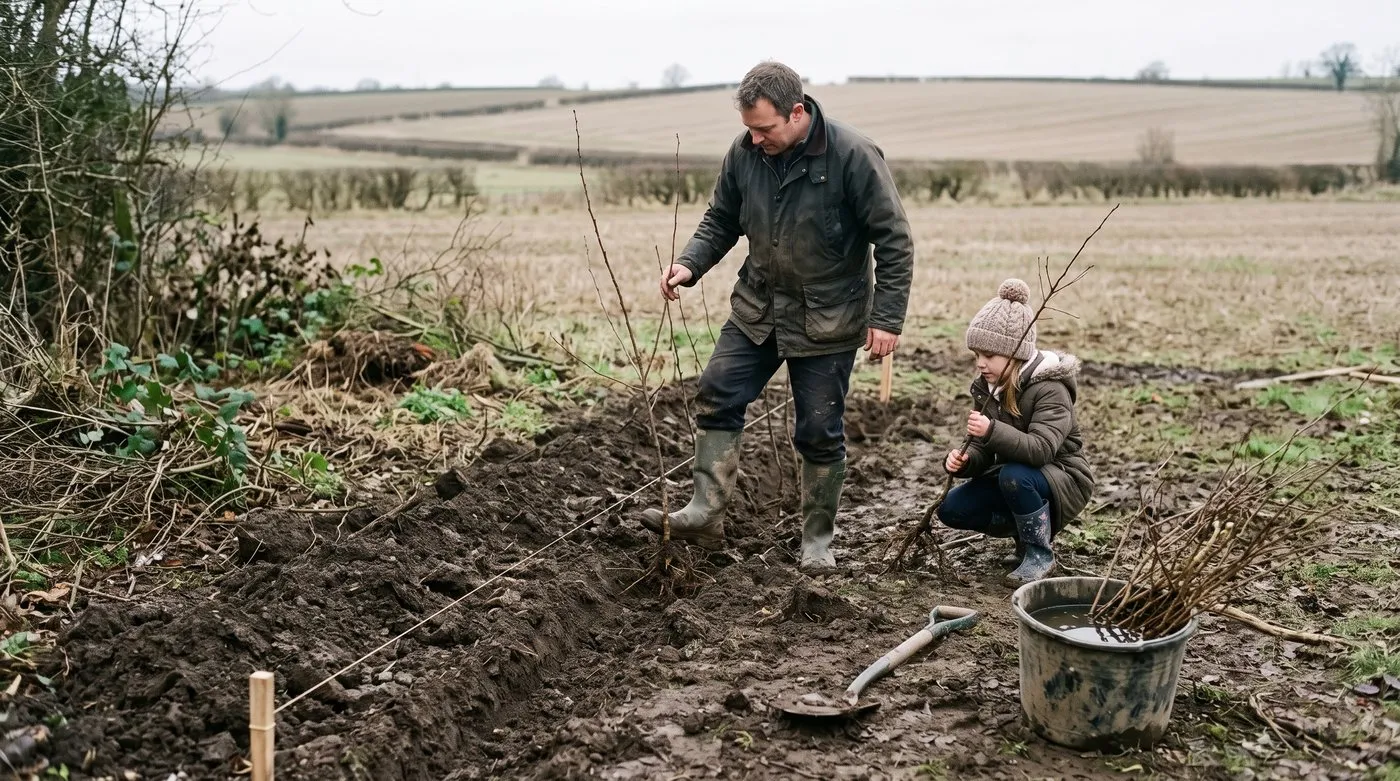
Plant five whips per metre in a zigzag for the thickest, most wildlife-friendly hedge. Keep the roots in water until the moment they go in.
First-year care
Cut the whips back by a third to a half straight after planting. It makes them branch low down, which gives a thick base. It’s the step most people skip, and the main reason hedges end up bare at the bottom.
Water in the first summer during any long dry spell. From the second year, hawthorn rarely needs watering.

Hawthorn blossom in May. These white flower clusters are a feast for bees and other early insects.
How to prune hawthorn
When to cut, and the law on nesting birds
Trim hawthorn in autumn or winter. From March to August, birds are likely to be nesting in your hedge. It’s against the law to damage or destroy an active nest, so leave hedges alone in the nesting season. Our guide to hedge cutting dates in the UK explains the rules in more detail.
The kindest time of all is late autumn to winter, once the birds have eaten most of the haws.
Trimming an established hedge
Once the hedge is a few years old, trim it once a year in autumn or winter. Use a hedge trimmer for the sides and top, and loppers or a pruning saw for thick stems. A garden boundary hedge is usually kept at about 1.5-2m tall.
For wildlife, don’t worry about a perfectly flat finish. A slightly shaggy hedge gives more nesting spots. Trimming different sides in different years also leaves more berries.
Hard renovation
An overgrown hawthorn hedge can be cut back hard in winter and will grow back well. Few hedging plants take such a hard cut. If needed, cut the main stems to 30-50cm from the ground. New shoots will grow from the base in spring, and within a few years you’ll have a hedge again.
For a very tall hedge, do it in two goes: one side this winter and the other side next winter.
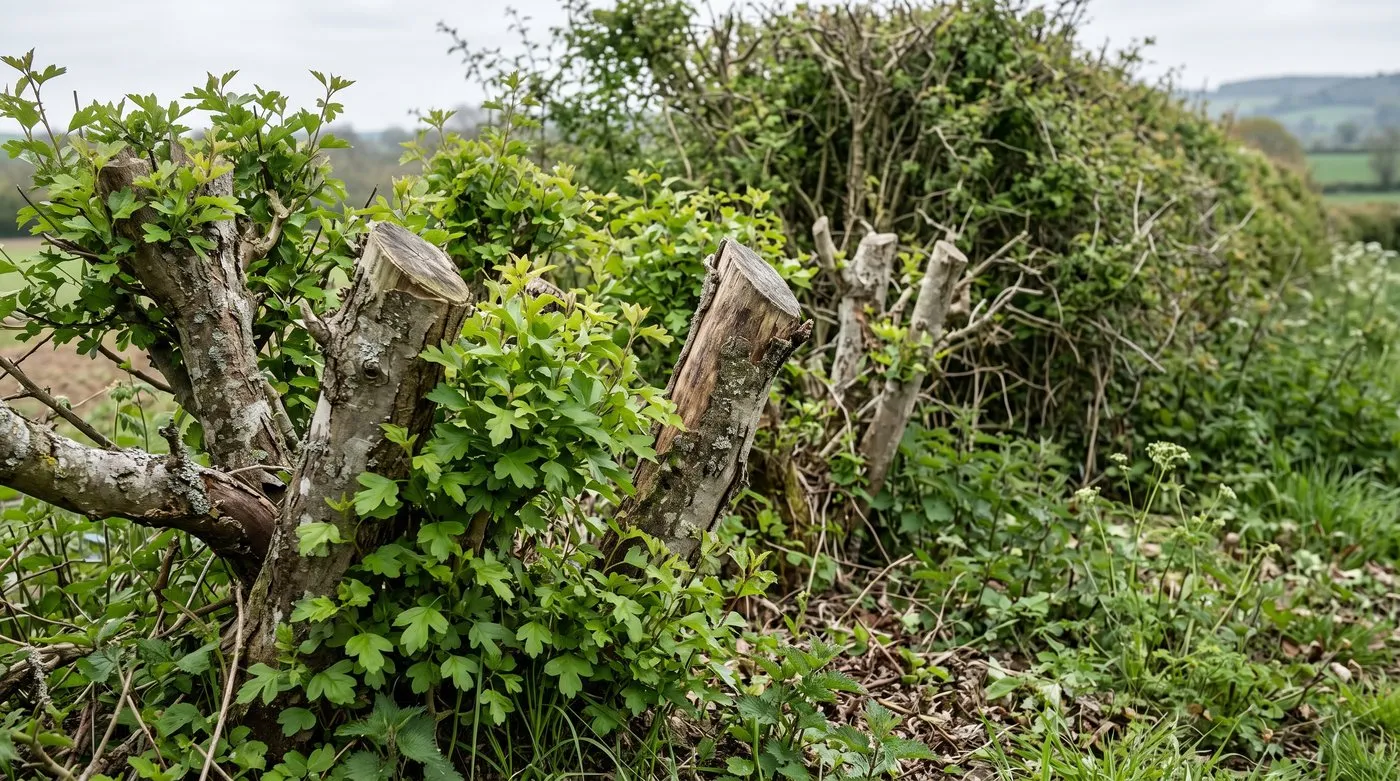
Few hedging plants take a hard cut like hawthorn. Cut the main stems low in winter and new shoots soon fill the gap.
Specimen tree pruning
A hawthorn tree needs very little pruning. In late winter, take out dead, diseased or crossing branches. Avoid big cuts on a mature tree, as large wounds can let in disease. A little shaping in the first few years is much better than heavy pruning later.
Growing hawthorn as a specimen tree
Hawthorn makes a lovely garden tree. Over the years it grows gnarled and full of character, and it looks great in winter. In spring, few native trees beat its blossom. In autumn, the red haws bring birds right into view.
Choosing a site
It grows almost anywhere. Full sun gives the most blossom and berries, but part shade is fine. It’s happy in acid or chalky soil, and in clay or sand. On waterlogged ground, plant on a slight mound.
Ornamental types like ‘Paul’s Scarlet’ flower best in a sheltered spot, as wind spoils the delicate double flowers sooner.
How big does it get?
Left to grow, common hawthorn slowly becomes a tree of about 8-10m tall and fairly wide. In a smaller garden, think about the shade it will cast. On a boundary or at the edge of a wildlife area, its size is a plus. For less space, ‘Paul’s Scarlet’ or ‘Rosea Flore Pleno’ stay smaller. Our guide to the best trees for small gardens has more compact ideas.
Planting a standard tree
For a tree, buy a half-standard or standard (a young tree with a clear stem) rather than a hedging whip. Plant from November to March:
- Dig a hole twice as wide as the roots and the same depth as before
- Knock in a short stake at an angle, leaning away from the wind
- Keep the graft union (the bulge where the variety joins the rootstock) above the soil
- Fill in, firm with your heel and water well
- Mulch in a circle around the tree, keeping it clear of the trunk
Keep it staked for two or three years and loosen the ties each autumn.

Red haws in October. Fieldfares and redwings arriving from Scandinavia love them.
Hawthorn and wildlife
Few garden plants do as much for wildlife as hawthorn, and it helps all year round.
Insects
Hawthorn leaves, bark and flowers feed a huge range of insects, from moths and beetles to sawflies. Only oak comes close among our native trees. Those insects then feed birds, bats and hedgehogs.
Blossom and pollinators
The blossom is a big early meal for pollinators. It opens for a few weeks in April and May, just as fruit tree blossom finishes. Bumblebees, honeybees, hoverflies and moths all visit.
You’ll smell a hedge in full flower before you see it, especially on a warm day. That heavy scent draws insects in from all around.
Nesting birds
Fences and walls give birds nowhere to nest. Even a short run of hawthorn hedge changes what can live in your garden. For more ways to help garden birds, see our bird feeding seasonal guide.
Haws and winter birds
Red haws are a vital winter food for thrushes. Fieldfares and redwings arrive from Scandinavia in autumn and rely on them. In a hard winter, when other berries are gone, a hedge full of haws really matters.
Blackbirds and song thrushes feast on them too. A berried hedge you can see from the window makes great birdwatching.

A hawthorn hedge makes a thick, thorny garden boundary that birds love to nest in.
Pests and diseases
Hawthorn leaf miner (Phyllonorycter species)
Tiny moth caterpillars tunnel inside the leaves, leaving pale blotches. It looks odd but does no real harm, so there’s nothing you need to do.
Fire blight (Erwinia amylovora)
Fire blight makes shoots turn black and wilt, as if scorched. It mostly hits apples and pears but can affect hawthorn in warm, damp springs. Cut out affected shoots well below the damage and clean your tools between cuts. Bin or bag the prunings rather than composting them.
On hedges it rarely affects more than the odd shoot. It’s no reason not to plant hawthorn.
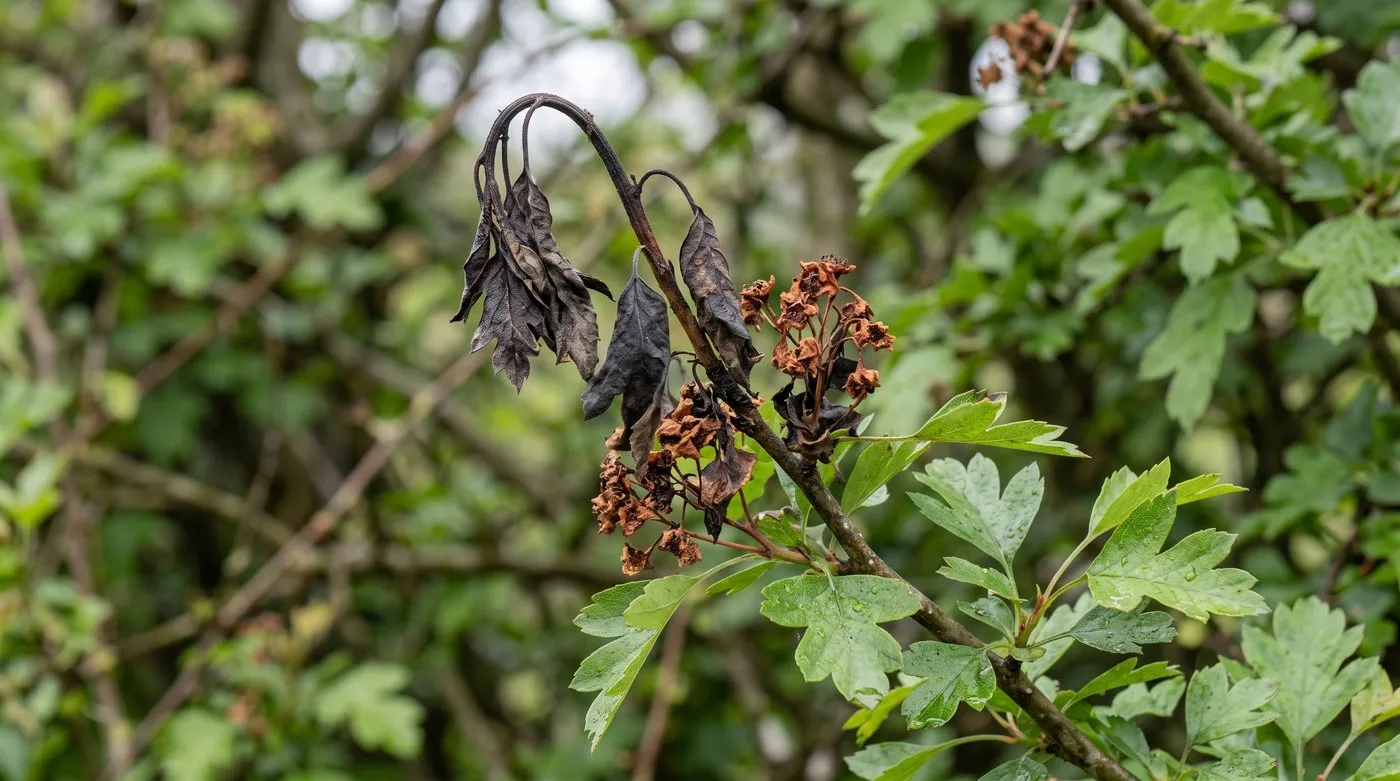
Blackened, scorched-looking shoots point to fire blight. Cut well below the damage and clean your tools between cuts.
Silver leaf (Chondrostereum purpureum)
Silver leaf gets in through big pruning wounds and gives leaves a silvery sheen before branches die back. The best defence is to avoid large cuts on trees. Hedges trimmed with a hedge trimmer are rarely troubled.
Aphids
A few kinds of aphid like hawthorn and can curl and redden young leaves in spring. Ladybirds, blue tits and hoverfly larvae usually clear them by summer. You rarely need to do anything.
Common hawthorn in hedgerow history
Hawthorn is so much part of the countryside partly because of the enclosure era. When fields were enclosed in the 18th and 19th centuries, huge lengths of hedge were planted, mostly hawthorn. It was quick, thick, thorny and grew anywhere. That’s where the patchwork of hedged fields we know today came from.
Those old hedgerows are now some of our richest wildlife habitats. Plant hawthorn in your garden and you’re adding a little piece to the same network. The Woodland Trust’s hawthorn guide is a lovely read if you want to know more.
Common growing mistakes
Not cutting back hard at planting
Skipping the first hard cut is the most common reason a new hedge stays thin at the bottom. Cutting new whips back by a third to a half feels brutal, but it’s the best thing you can do. Without it, whips grow tall and leggy and the base never fills in.
Planting too late into spring
Potted hawthorn planted in April or May will probably survive, but it’s already growing, so it roots more slowly and is more likely to struggle in a dry summer. Plant bare-root whips in early winter for the best start.
Cutting in the bird nesting season
Lots of people trim hedges in spring or summer to tidy up, without checking for nests. Damaging an active nest is against the law, so do your hedge cutting in autumn and winter. If you’re not sure whether a nest is in use, leave it alone.
Choosing ‘Paul’s Scarlet’ for wildlife value
‘Paul’s Scarlet’ is gorgeous, but its double flowers offer little to insects and it gives few berries. If wildlife is your main aim, plant common hawthorn. If you want a beautiful small tree, ‘Paul’s Scarlet’ is perfect, just know the trade-off.
For another native-style tree that’s great for wildlife, see our guide to growing crab apple trees in the UK.
Frequently asked questions
When should I plant hawthorn?
Plant bare-root whips from November to March, while they’re dormant. Early winter is ideal, as the rain settles the roots before spring. Bare-root whips are much cheaper than potted plants and do just as well. Avoid frozen or waterlogged ground. Potted hawthorn can go in any time, but winter is still best.
How fast does hawthorn grow?
Hawthorn grows at a steady, moderate pace in most UK gardens. It grows fastest in good, moist soil and slower on thin chalk or dry sand. A hedge from bare-root whips is usually thick and stock-proof within a few years. Left to grow as a tree, it slowly reaches 8-10m.
Can I cut hawthorn hedge in summer?
It’s best not to. From March to August, birds are likely to be nesting, and it’s against the law to damage or destroy an active nest. Trim in autumn or winter instead. Waiting until after the birds have had their pick of the berries is kindest of all.
What is the difference between C. monogyna and C. laevigata?
Common hawthorn (C. monogyna) is the native used for hedging. It has single white flowers and berries with one seed. Midland hawthorn (C. laevigata) is also native but less common, likes woodland edges and heavier soil, and flowers a little earlier. Ornamental types like ‘Paul’s Scarlet’ and ‘Plena’ come from Midland hawthorn.
Are hawthorn berries safe to eat?
Yes, the flesh of the haws is edible. It’s mealy and mildly sweet, and people use it in jellies, sauces and hedgerow wines. Don’t eat the seeds, though. Haws taste best after the first frost, but birds eat plenty, so pick early if you want a lot.
How many hawthorn plants per metre for a hedge?
Plant three bare-root whips per metre for a single-row hedge. That’s about 33cm apart. For a thicker double row, plant five per metre in a zigzag, with the rows 30-40cm apart. A double-row hedge 20m long needs about 100 whips.
Is hawthorn good for wildlife?
Yes, it’s one of the best hedging plants for wildlife. Its leaves feed a huge range of insects, and its thorny branches make safe nesting spots for birds like blackbirds and dunnocks. The May blossom feeds bees, and the autumn haws feed thrushes, fieldfares and redwings.
Related reading
- Native Trees for UK Gardens: field maple, dog rose, blackthorn and other wildlife-friendly natives
- How to Plant a Hedge in the UK: spacing, preparation and first-year care for any hedge
- Legal Hedge Cutting Dates UK: when to cut and how to protect nesting birds
- How to Grow Crab Apple Trees in the UK: another pretty tree that birds and bees love
- Creating a Wildlife Garden in the UK: simple ways to bring more wildlife into your garden
Our team produces practical UK gardening guidance from source research, contributor records and established horticultural practice. Editorial standards are overseen by Matt W.