Key takeaways
- Annual Iberis umbellata gives quick summer colour; evergreen Iberis sempervirens gives a white spring carpet
- Sow the annual direct in 1cm drills from March to May and thin to 15-20cm
- Trim the perennial by a third after flowering so it stays tight and green
- Both need full sun and sharp drainage, and do well on poor, chalky soil
- The flat flower heads feed bees, butterflies and aphid-eating hoverflies
Candytuft is one of the easiest flowers you can grow, as long as you know which one you’re buying. The name covers two plants. One is a quick hardy annual you sow each spring for summer colour. The other is an evergreen perennial that spills white flowers over walls and edges every spring for years. This guide covers both.
Annual or perennial: which candytuft should you grow?
Grow the annual for quick summer colour and little posies. Grow the perennial for permanent white cover on walls, edges and rockeries. Plenty of gardens have room for both.
Annual candytuft is mainly Iberis umbellata, with domed heads in white, pink, lilac and carmine on plants 20-30cm tall. Iberis amara gives scented white spikes. Both are sown direct, flower in summer, set seed and die.
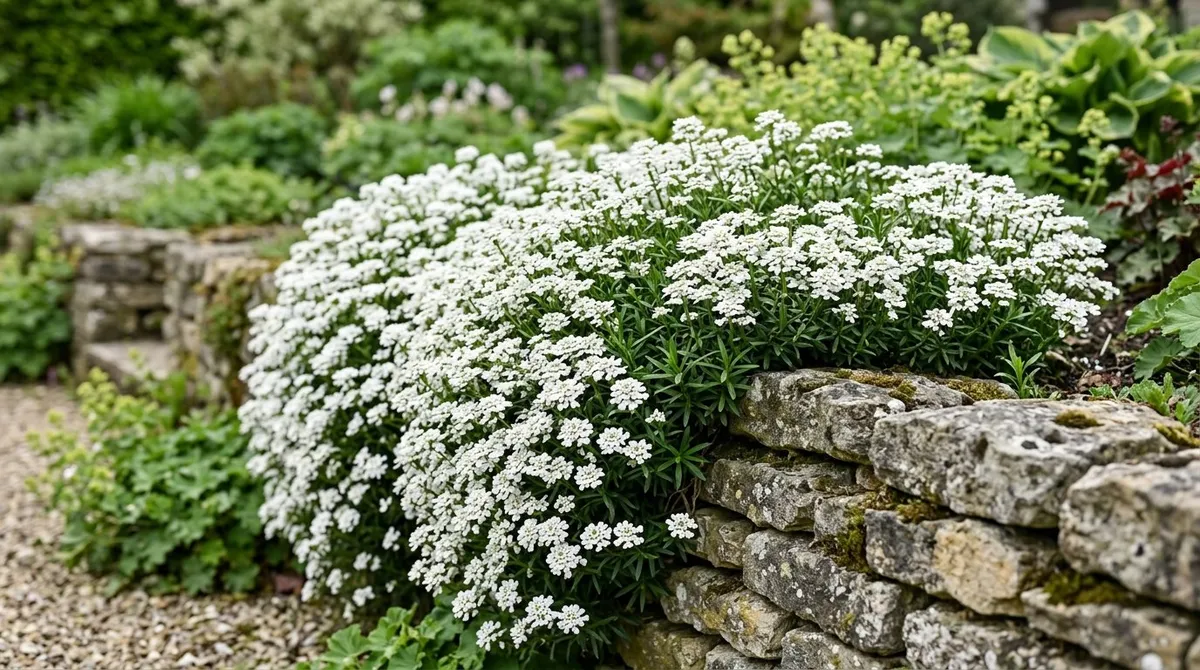
Perennial candytuft is Iberis sempervirens. It’s an evergreen mound of narrow dark green leaves, about 20-30cm tall and wider than it is high. It’s smothered in pure white flowers in April and May.
| Feature | Annual (Iberis umbellata) | Perennial (Iberis sempervirens) |
|---|---|---|
| Life cycle | One season | Evergreen, lasts for years |
| Flower colour | White, pink, lilac, carmine | White (a few pink forms) |
| Main flowering | June to September | April to May |
| How you get it | Sow seed direct | Buy plants or take cuttings |
| Best use | Edging, posies, gap filling | Walls, raised beds, rockeries |
| Self-seeds | Yes, freely | Rarely |
Good perennial varieties include ‘Snowflake’, a classic white carpet, ‘Absolutely Amazing’, a compact free-flowering white, and ‘Pink Ice’, which opens pale pink.
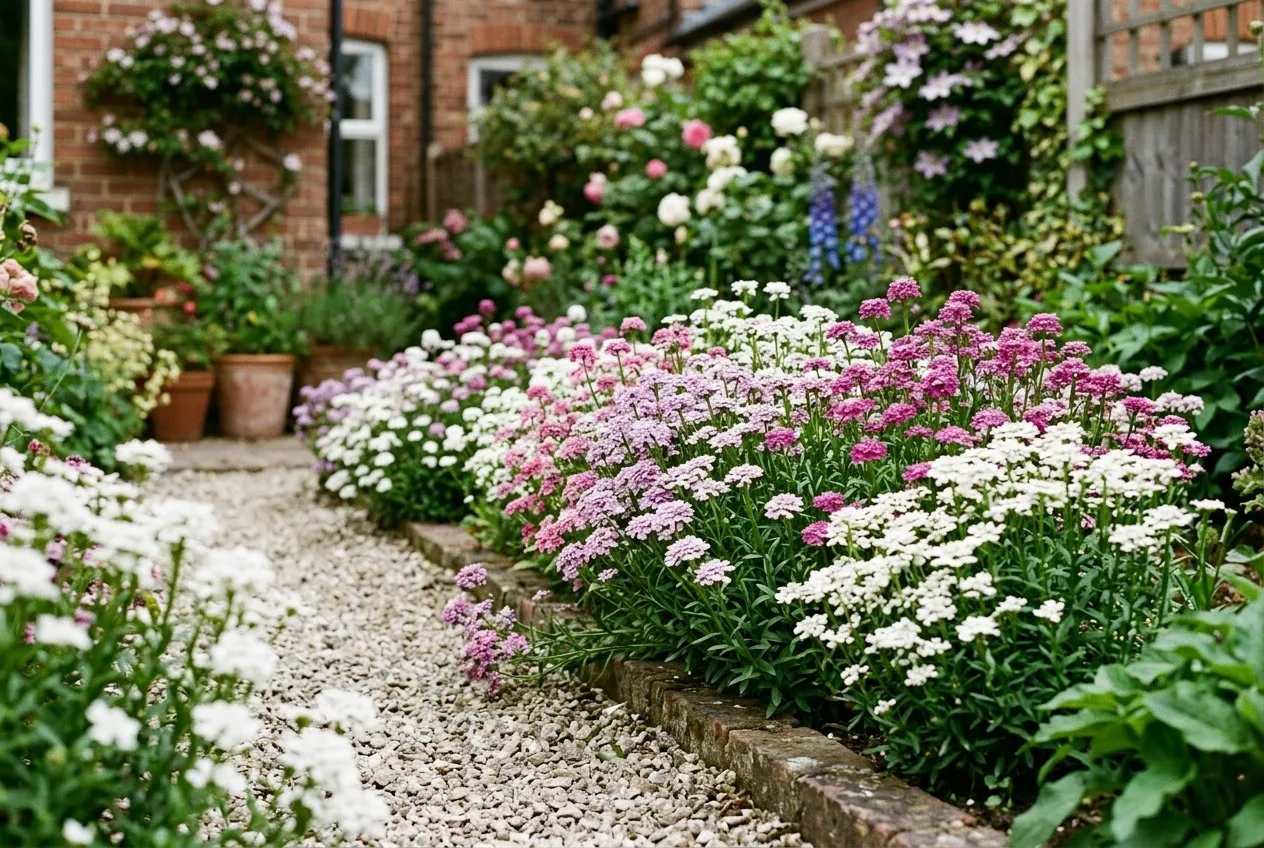
Annual candytuft makes a cheerful mixed edge all summer. Sow it fresh each spring or let it self-seed.
If you want another low white edger, alyssum is a sweetly scented alternative for the front of a border.
How to sow annual candytuft
Sow annual candytuft straight into the ground from March to May, right where you want it to flower. It doesn’t like being moved, so skip the seed trays.
- Rake the soil to a fine, crumbly surface
- Draw a drill about 1cm deep
- Sow the seed thinly and cover it over
- Water with a fine rose if the soil is dry

A shallow drill and a thin sprinkle is all it takes. Sow where it will flower, as candytuft dislikes being moved.
Seedlings usually appear in two or three weeks. When they’re big enough to handle, thin them to 15-20cm apart so each one can bush out. Flowers follow about two months after sowing.
For flowers all summer, sow a short row every three or four weeks until early June. The guide to sowing hardy annuals direct walks through the routine for lots of easy flowers.

Thin to 15-20cm while the seedlings are small. Each plant then has room to fill out into a full dome.
How to grow perennial candytuft on walls and edges
Buy perennial candytuft as plants and set them out in spring or early autumn. Plant it at the front of a border, along the edge of a raised bed, or in the top of a wall, and let it tumble.
- Space plants 30-45cm apart, with the crown level with the soil
- Add grit to the planting hole on heavy soil
- On a wall or in a rockery, tuck the roots into a pocket of gritty soil between stones
- Water until it settles in
The one job it needs is a trim. When the flowers fade in late May, shear the whole plant back by about a third. This stops it going woody and bare in the middle. Skip it for a few years and the mound splits open and looks tired.
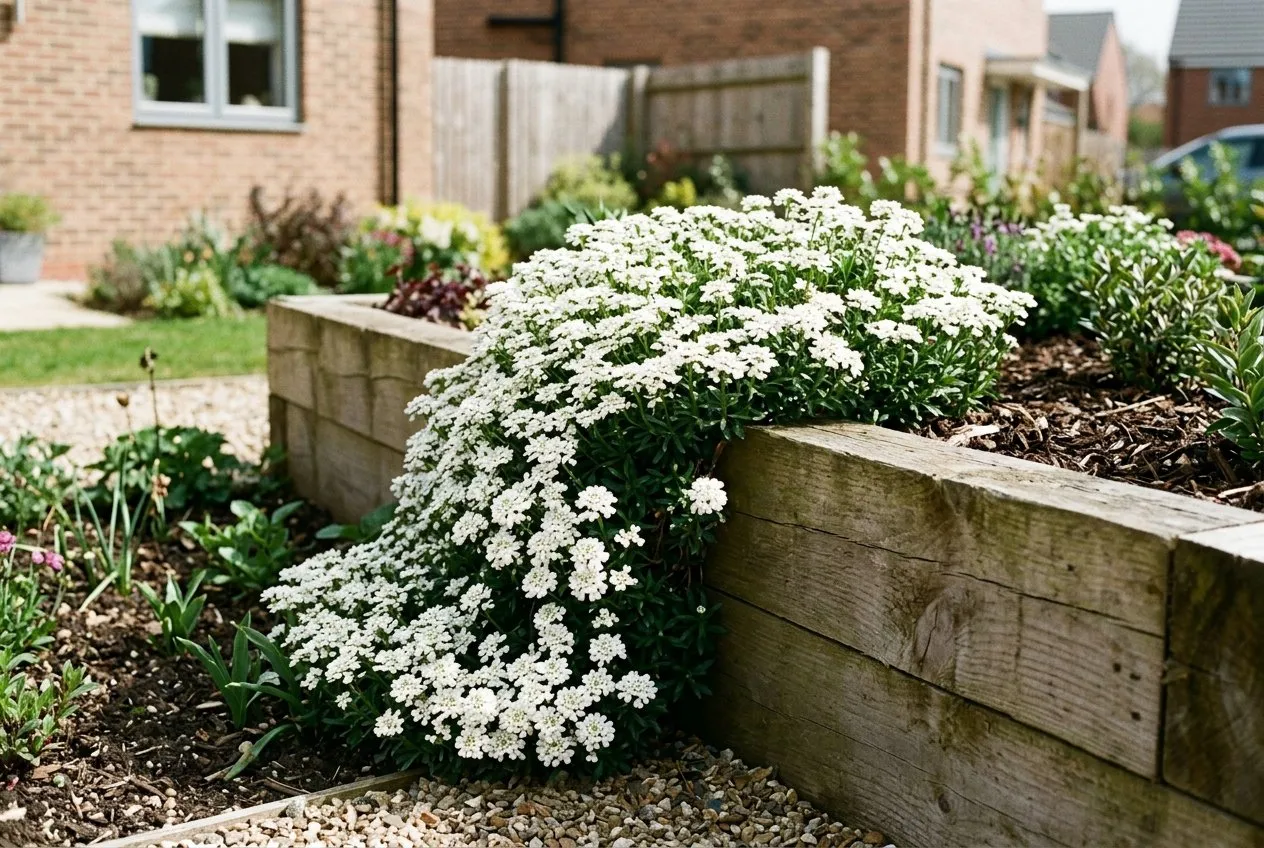
Perennial candytuft loves a raised edge to spill over. Trim it after flowering to keep it dense like this.
What soil and position does candytuft need?
Candytuft needs full sun and sharp drainage, and it actually prefers poor soil. In shade it grows leggy and flowers poorly.
It’s happy on thin, stony, chalky and alkaline soil that many plants struggle with. Rich, manured beds give soft, leafy growth and fewer flowers, so don’t feed it up. On heavy clay, plant on a slight mound or in a raised bed so winter wet drains away.
Candytuft care through the year
| Month | Task |
|---|---|
| January | Nothing to do. The perennial stays green through frost |
| February | Clear fallen leaves off perennial mounds |
| March | First sowing of annual candytuft |
| April | Perennial in full flower. Sow more annuals |
| May | Trim perennial by a third as flowers fade. Last annual sowing |
| June | Annuals start flowering. Snip off faded heads |
| July | Peak annual flowering. Cut for posies |
| August | Stop deadheading a few annuals so they set seed |
| September | Autumn sowing on free-draining ground for earlier flowers |
| October | Collect ripe annual seed if you want to sow it yourself |
| November | Compost dead annuals. Leave the perennial alone |
| December | Nothing to do |
Feeding is barely needed. A light sprinkle of general fertiliser in spring is plenty for the perennial. Annuals need nothing on ordinary garden soil. Snipping off faded flower heads keeps annuals flowering longer.
Is candytuft good for bees and hoverflies?
Yes. Both types carry masses of small flowers in flat heads, which give bees, butterflies and hoverflies an easy landing pad.
Perennial candytuft flowers in April and May, when insects still need early food. It sits well with other early spring pollinator plants. The annual then takes over through summer.
Hoverflies are a bonus. The adults feed on the nectar, then lay eggs nearby, and the larvae eat aphids. Grow annual candytuft along the edge of a veg bed as part of your companion planting and they’ll work right where you need them.
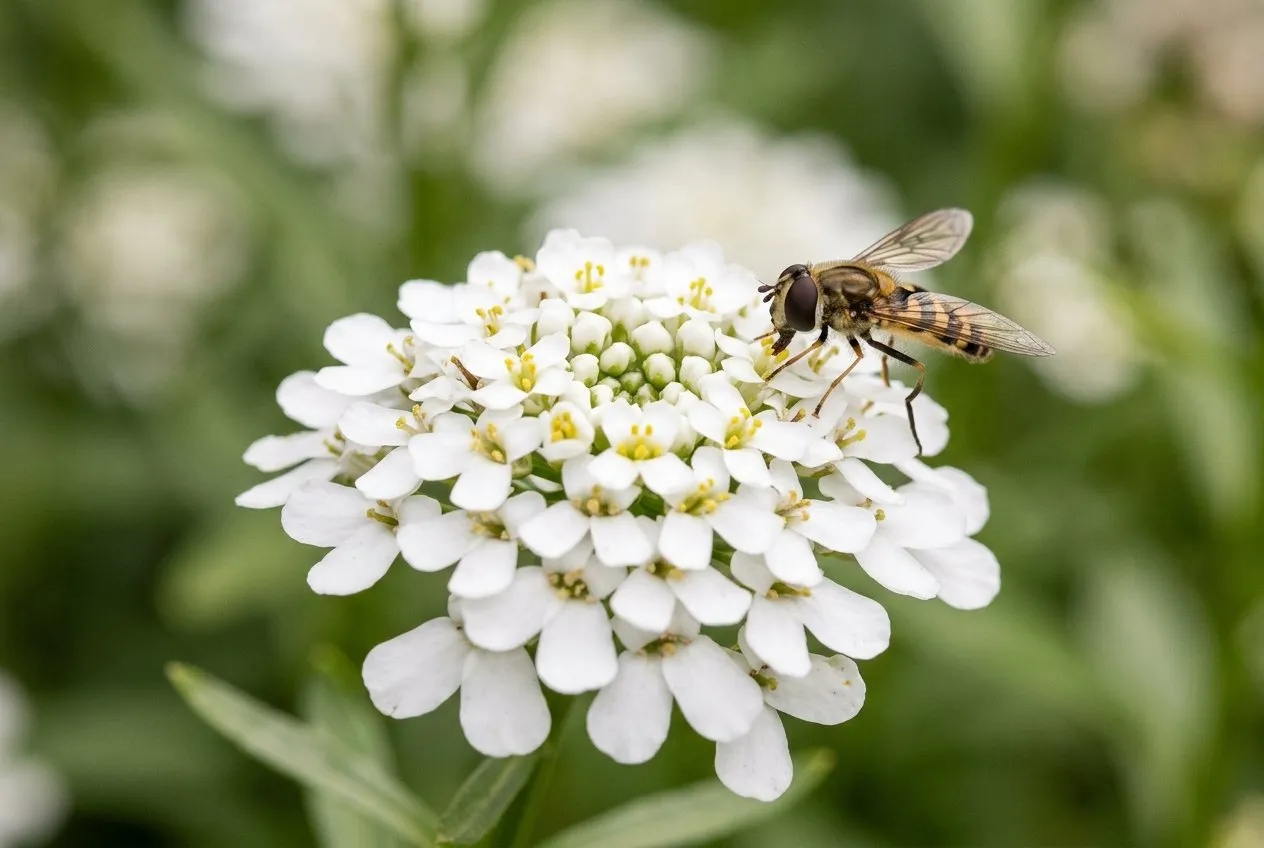
Hoverflies love candytuft. Their larvae then go hunting for aphids on nearby plants.
How to manage self-seeding candytuft
Annual candytuft self-seeds freely, which means free plants every year. Let the last flower heads ripen in late summer and seedlings come up around the parent next spring. It’s one of the easy self-seeding plants for low-effort gardens.
Seedlings have shallow roots, so hoe out any in the wrong place. For more control, collect the seed instead. Snip ripe heads into a paper bag in October, let them dry and rub out the seed. Store it somewhere cool and dry, then sow where you want it next spring.
Cutting candytuft for the vase
Annual candytuft makes a pretty little cut flower for jam-jar posies. Iberis amara has scented white spikes, and umbellata gives mixed coloured domes.
Cut in the cool of the morning, when about half the flowers in a head are open. Strip the lower leaves and put the stems straight into cold water. Cutting also works as deadheading, so the plant keeps making more stems.

A handful of annual candytuft makes a sweet kitchen posy, and picking keeps the plants flowering.
Common candytuft problems and mistakes
Most candytuft failures come from soil that’s too wet or too rich, or a perennial that’s never been trimmed.
- Wet winter soil. Cold, waterlogged ground rots the perennial. Plant on a mound, add grit, or use a raised bed or wall.
- Never trimming the perennial. It goes woody and bare in the middle. Shear by a third every year after flowering.
- Overfeeding. Rich soil gives leaves, not flowers. Candytuft flowers best a little hungry.
- Slugs on seedlings. They can graze off a fresh row overnight in a damp spring. Check at dusk and pick them off until the plants toughen up.
- Planting in shade. It grows thin and leggy. Give it full sun.
Candytuft is in the cabbage family, so it can get club root, a soil disease that swells the roots. On ground where brassicas have had club root, plant it somewhere else.
Frequently asked questions
How long does candytuft take to flower from seed?
Annual candytuft usually flowers about two months after sowing. Sow it direct from March to May for flowers from early summer. Sow a short row every three or four weeks to keep it going into September.
Is candytuft an annual or a perennial?
Both, depending on the species. Iberis umbellata and Iberis amara are hardy annuals sown each year. Iberis sempervirens is an evergreen perennial that comes back for years. Seed packets are usually the annual; potted plants are usually the perennial.
Does candytuft come back every year?
The perennial does; the annual self-seeds instead. Iberis sempervirens is hardy and evergreen and lasts for years with a yearly trim. The annual dies after flowering but drops seed that comes up the next spring.
Where is the best place to plant candytuft?
Full sun on free-draining soil. It does well on poor, stony and chalky ground and hates wet soil. The perennial looks best spilling over a wall, raised bed or rockery. Avoid shade and heavy, soggy clay.
Is candytuft good for bees and pollinators?
Yes, it’s great for bees, butterflies and hoverflies. The flat flower heads make an easy landing pad. The perennial flowers in spring when food is still scarce, and hoverfly larvae it attracts eat aphids.
How do you stop candytuft getting leggy?
Trim perennial candytuft by a third right after flowering. Left uncut, it goes woody and bare in the middle. A trim in late May keeps the mound tight and leafy. Do it every year.
Can you grow candytuft in pots?
Yes, both types grow well in pots and troughs. Use gritty, free-draining compost and a pot with drainage holes. Water in dry spells, but never let the pot stay soggy, as that rots the roots.
For more bright, easy whites to go with it, see the best white flowers for UK gardens, or browse more in flowers and plants.
Our team produces practical UK gardening guidance from source research, contributor records and established horticultural practice. Editorial standards are overseen by Matt W.