Key takeaways
- Plant pot-grown magnolias in spring, in neutral to acid soil
- Star magnolia and 'Susan' are the best picks for small gardens
- Avoid east-facing spots, where morning sun can brown frosted buds
- Prune as little as possible, and only in midsummer
- Expect the first flowers a few years after planting
- Don't dig around the roots of an established tree
Magnolias are some of the oldest flowering trees on Earth. They were around before bees, so beetles were their first pollinators. In a UK garden, they give one of the best spring shows of any tree, with big flowers opening on bare branches from March.
Growing them is straightforward once you get three things right: the soil, the spot and a bit of patience. Most problems come from chalky soil, an east-facing position where morning sun spoils frosted buds, or expecting flowers too soon. Get those right and your magnolia could easily outlive you.
Here’s how to choose a variety, prepare the soil, plant, care for it and grow one in a pot.
Why magnolias are well suited to UK gardens
Magnolias love our mild, damp winters and cool springs. There are lots of species, but around 20 are commonly grown here, and most are very hardy.
The spring show is hard to beat. Deciduous magnolias flower on bare wood before the leaves arrive, so the branches are covered in goblet or star-shaped blooms. A big saucer magnolia in full flower really stops people in the street. The flowers last a few weeks, depending on the weather.
They look good the rest of the year too. Magnolia grandiflora, the evergreen one, has big glossy leaves with rusty-brown backs. In autumn, some magnolias grow cone-like seed pods that split to show bright red seeds. Even in winter, the furry flower buds are lovely.
Best of all, they need very little looking after. They rarely need pruning, have few pest problems and, once settled, need little watering. Like the best flowering shrubs, a well-placed magnolia is close to plant-and-forget.
Best magnolia varieties for UK gardens
Choosing the right one matters most. They range from small shrubs to big trees, so match the plant to your space.
Magnolia stellata (star magnolia)
The best choice for small gardens. It forms a slow-growing, bushy shrub around 2-3m tall, with masses of white, star-shaped flowers in March and April. It’s also the best magnolia for a pot.
Magnolia soulangeana (saucer magnolia)
The classic garden magnolia. It has large goblet-shaped flowers in pink, white and purple on bare branches in April. It grows 6-8m tall and about as wide, so it needs a good-sized garden. It’s been grown in British gardens for around 200 years and is still the most popular.
Magnolia grandiflora (bull bay)
The evergreen magnolia. It has huge, waxy white flowers from June to September and glossy leaves all year. It can grow into a big tree. It’s often trained against a sunny south or west-facing wall, where the extra warmth helps it flower.
Magnolia liliiflora ‘Nigra’ (lily magnolia)
A compact magnolia around 3m tall. Its dark purple-red, tulip-shaped flowers are among the deepest colours of any magnolia. They come in April and May, sometimes with a few more in late summer. It can take a few years to start flowering. Its upright shape fits nicely in a border among other shrubs.
Magnolia ‘Susan’
One of the “Little Girl” magnolias, bred in the 1950s for small gardens. It grows 3-4m tall, with scented reddish-purple flowers that fade to pink. It flowers in late April and May, which means it usually misses the worst of the late frosts. That makes it one of the most reliable choices.
Magnolia ‘Leonard Messel’
A cross between Magnolia kobus and a pink star magnolia. It grows 5-6m tall and is covered in soft pink, star-shaped flowers in April. It’s a good middle choice for a medium garden where star magnolia is too small and saucer magnolia is too big.
 Star magnolia is the top choice for small gardens, with masses of white flowers in early spring.
Magnolia variety comparison table
Here are six popular magnolias side by side, from smallest to biggest.
| Variety | Type | Size | Flower colour | Flowers | Good for |
|---|---|---|---|---|---|
| Star magnolia | Deciduous | Small, 2-3m | White stars | March to April | Small gardens, pots |
| M. liliiflora ‘Nigra’ | Deciduous | Small, about 3m | Dark purple-red | April to May | Borders, tight spaces |
| M. ‘Susan’ | Deciduous | Small, 3-4m | Reddish-purple to pink | Late April to May | Frosty areas, small gardens |
| M. ‘Leonard Messel’ | Deciduous | Medium, 5-6m | Soft pink stars | April | Medium gardens |
| Saucer magnolia | Deciduous | Large, 6-8m | Pink, white, purple | April | A feature tree on a lawn |
| M. grandiflora | Evergreen | Large | Big waxy white | June to September | Sunny walls, sheltered spots |
Best magnolias for small gardens
Lots of people think magnolias are too big for their garden. That’s only true of the saucer magnolia and Magnolia grandiflora. Several lovely ones stay under about 4m.
Magnolia ‘Susan’ grows 3-4m and flowers later, so frost is less of a worry in colder gardens. It’s more upright than star magnolia, so it takes up less width.
Magnolia liliiflora ‘Nigra’ fits neatly into a mixed border. Its dark flowers look great next to white clematis or pale pink roses.
For really tight spots, star magnolia ‘Royal Star’ stays compact and has larger flowers than the plain species. Plant it about 1.5m from fences. It copes with a bit of shade from nearby buildings.
Handy tip: Plant your magnolia where you can see it from the house. The flowers only last a few weeks, so put it in view of the kitchen or living room window and enjoy every day of them, even when it’s too cold to sit outside.
How to plant a magnolia
Planting carefully matters more with magnolias than most trees. Their roots are thick and fleshy, and they snap rather than bend. Damaged roots are slow to recover.
When to plant
Plant pot-grown magnolias from March to May. That gives the roots a full summer to settle before winter. Autumn planting can work in mild southern gardens, but young roots can rot in cold, wet soil.
Don’t buy bare-root magnolias. Their roots don’t like drying out or being disturbed. Pot-grown or root-balled trees are the reliable choice.
Choosing the right position
The direction it faces really matters. Avoid east-facing spots. There, early morning sun thaws frosted flower buds too quickly and turns them brown. A west or south-west-facing spot is much safer.
Shelter from cold north and east winds helps too. A spot near a wall, fence or hedge is a few degrees warmer than an open, exposed one.
 Saucer magnolia’s big goblet-shaped flowers last longest in a sheltered spot.
Soil preparation
Magnolias like neutral to acid soil. They struggle on chalk, where the leaves turn yellow because the tree can’t take up iron.
A cheap soil test kit will tell you where you stand before you buy. If your soil is only slightly limey, mixing ericaceous compost into the planting hole helps for a while. On real chalk, a pot is a better bet.
The ideal soil is moist but well drained and rich in organic matter. Plenty of magnolias grow happily on clay. Just mix grit and a bucket of garden compost into the soil you put back.
Planting method
- Dig a hole three times as wide as the rootball but no deeper.
- On clay, mix the soil you dug out with garden compost and grit.
- Ease the tree out of its pot. Don’t tease out the roots, as they snap easily.
- Set the rootball so its top is level with the ground. Don’t bury the stem.
- Backfill and firm gently. Don’t stamp it down.
- Water well, about a bucketful, and make a shallow dip around the base to hold water.
- Mulch with 7-8cm of bark, keeping it a hand’s width from the trunk.
- Only stake in a windy spot. Use a short stake angled into the wind, and take it out after two years.
 Plant in spring, with the top of the rootball level with the soil around it.
Seasonal care calendar for magnolias
Magnolias are easy-going. Here’s what to do through the year.
| Month | What to do |
|---|---|
| January | Check stakes on young trees after storms. No pruning. |
| February | Mulch with bark around the roots, clear of the trunk. |
| March | Early magnolias flower. Drape fleece over small trees on frosty nights. Water new trees if dry. |
| April | Peak flowering. Scatter blood, fish and bone around the roots. Water new trees weekly in dry spells. |
| May | Later magnolias flower. Keep watering new trees. |
| June | Magnolia grandiflora starts to flower. Water young and potted trees in dry weather. |
| July | Prune only if you must (dead or crossing branches). This is the best time. |
| August | Check dead wood for coral spot. Water pots daily in hot spells. |
| September | Seed pods ripen. Water less. No more feeding. |
| October | Leaves fall. Rake them up for the compost heap. Top up the mulch. |
| November | Check stakes. No feeding or pruning. |
| December | Enjoy the furry flower buds on the bare branches. |
Soil requirements and feeding
Avoid chalky soil and you’re most of the way there. Magnolias are happy in clay, loam or sand, as long as it isn’t limey.
pH ranges and tolerance
| Your soil | How magnolias do |
|---|---|
| Acid | Very well |
| Neutral | Well, including neutral clay |
| Slightly limey | So-so. Add ericaceous compost and watch for yellow leaves |
| Chalky | Poorly. Grow one in a pot instead |
Feeding programme
Established magnolias need very little feed. A sprinkle of blood, fish and bone in April, following the pack, is enough. Scatter it out to the edge of the branches and water it in.
For young trees in their first few years, a liquid seaweed feed every two weeks from April to July helps keep the leaves green, especially on borderline soil.
For magnolias in pots, give a balanced liquid feed every two weeks from April to August, following the label. Stop in September so the new growth can toughen up before winter.
Pruning magnolias
The best pruning advice for magnolias is: don’t. They grow into a graceful shape on their own and rarely need tidying. Heavy pruning causes more trouble than it fixes.
Why magnolias dislike pruning
Magnolia wood heals slowly. Open cuts can let in coral spot, a fungus that kills branches. The risk is highest in autumn and winter, when it’s wet.
Magnolias also flower on older wood, so pruning removes next year’s flowers. A hard-pruned tree can take years to flower well again.
When pruning is necessary
Only prune in these cases:
- Dead branches: Remove any time, back to healthy wood.
- Crossing or rubbing branches: Take out the weaker one in July or August.
- Storm damage: Cut cleanly back to a branch junction. Don’t leave stubs.
- Low branches over a path: Remove them gradually over a few years.
- Magnolia grandiflora on a wall: Trim after flowering to keep its shape, and tie in new growth.
Pruning technique
Cut back to a branch junction or a healthy outward-facing bud with sharp secateurs or loppers. Don’t use wound paint. Let the tree seal the cut itself.
For bigger branches, use three cuts so the bark doesn’t tear. First cut partly through from underneath, then cut from above a little further out, then make the final clean cut just outside the branch collar.
Common problems with magnolias in the UK
Magnolias are pretty trouble-free. Most problems come down to the weather or the soil rather than pests.
Frost damage to flower buds
The most common problem. When frosted buds thaw too fast in morning sun, the petals turn brown and mushy.
What to do: Plant facing west or south-west. On frosty nights during flowering, drape fleece over small trees and take it off in the morning.
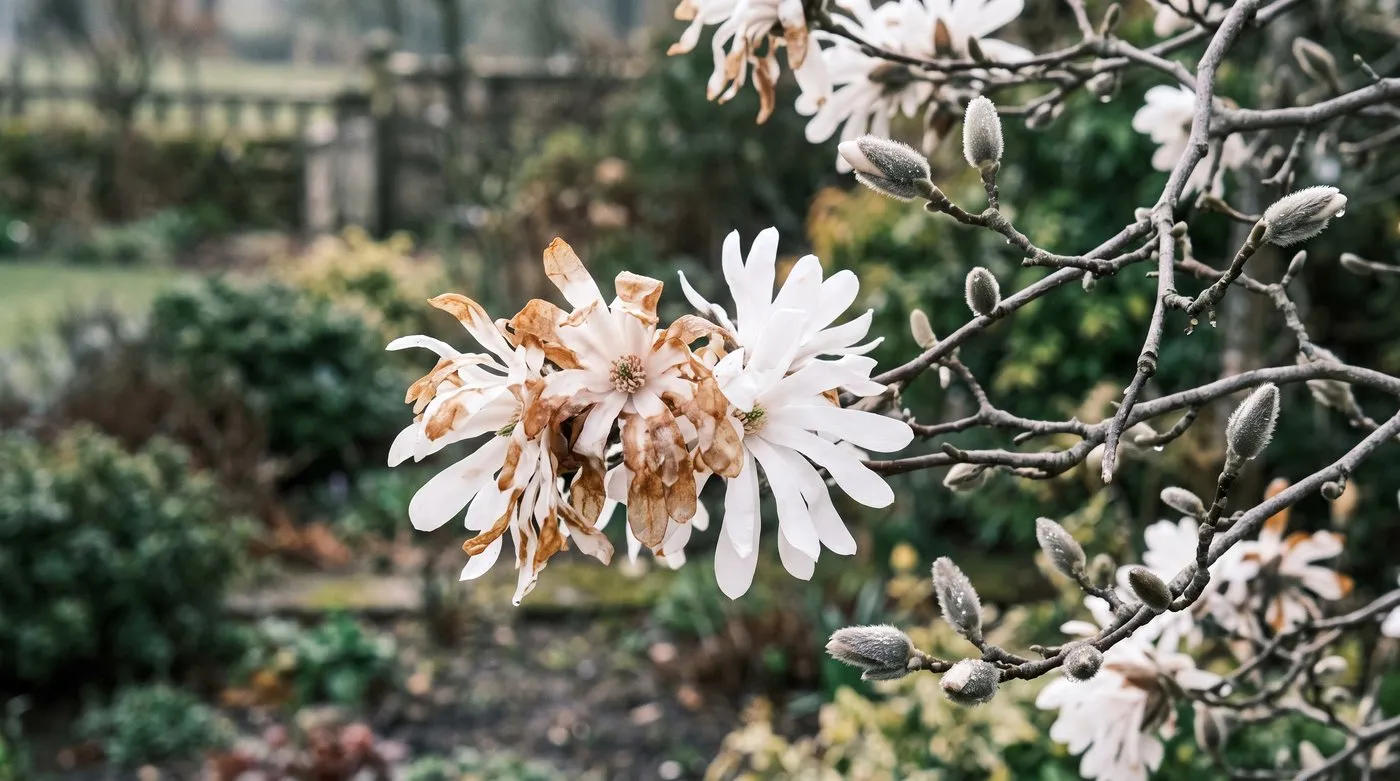
Browned petals like these happen when frosted flowers thaw too fast in morning sun. A west-facing spot is much kinder.
Leaf yellowing (chlorosis)
Yellow leaves with green veins mean the soil is too limey and the tree can’t take up iron.
What to do: Water on a sequestered iron product in April, following the label. Mulch each year with ericaceous compost. On chalk there’s no lasting fix, so a pot may be the answer.
Coral spot (Nectria cinnabarina)
Little pink-orange spots on dead or dying branches. It gets in through cuts and damaged bark and can spread down a branch.
What to do: Cut out affected wood well below the last spot. Clean your tools between cuts and bin the prunings rather than composting them. Prune as little as possible.
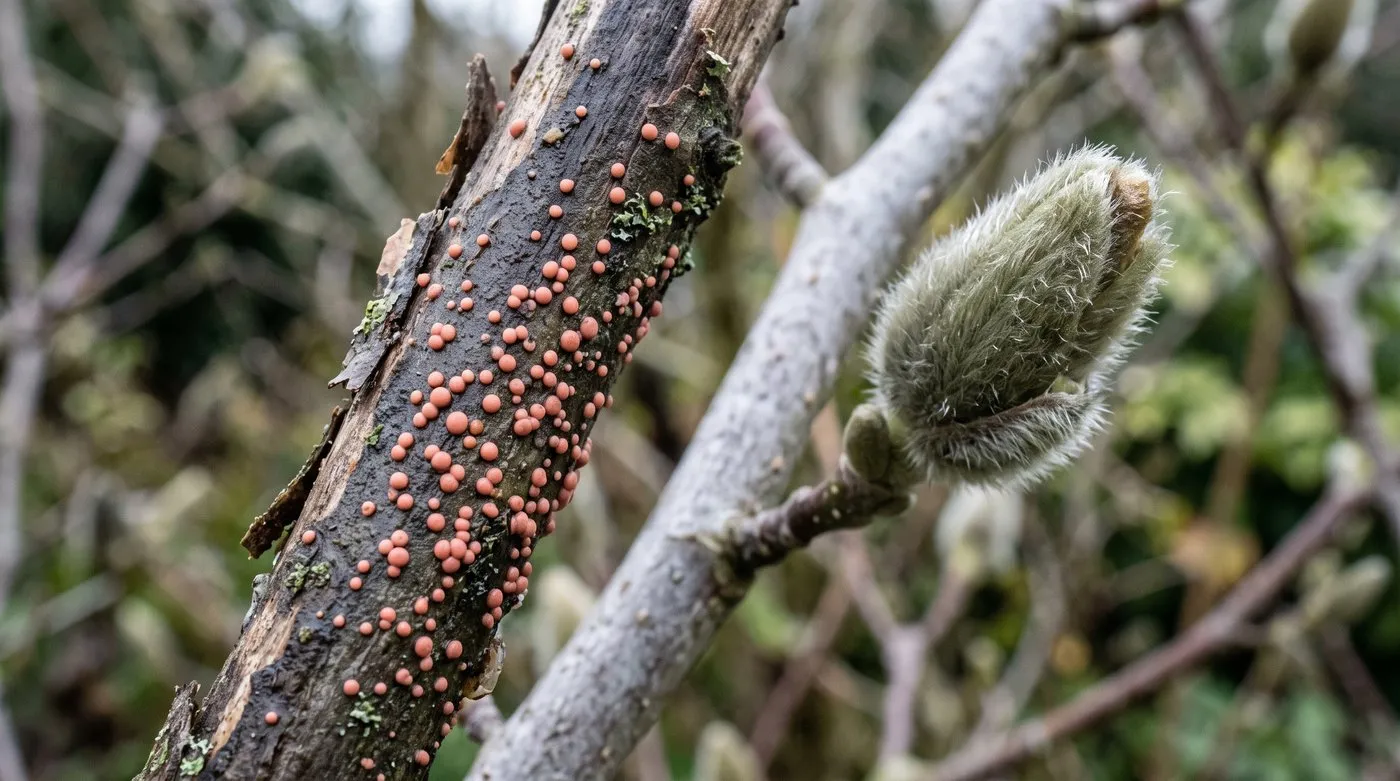
Pink pimples on dead wood mean coral spot. Cut back well below the last spot and bin the prunings.
Honey fungus (Armillaria mellea)
Look for white fungal sheets under the bark near the ground, black bootlace-like strands in the soil and honey-coloured toadstools in autumn. Once a tree is badly affected, it can’t be saved.
What to do: There’s no chemical cure. Remove the tree, including the stump and as many roots as you can, and don’t replant a magnolia in the same spot. The RHS honey fungus guide explains how to spot it and what to do.
Black sooty mould
A black, sooty coating on the leaves. It isn’t a disease of the magnolia itself. It grows on the sticky honeydew left by sap-sucking insects such as scale insects and aphids.
What to do: Deal with the insects. Scrape scale off by hand where you can reach, or use an authorised spray labelled for scale insects, following the label. The mould washes off once the honeydew stops.
Growing magnolias in containers
A pot lets you grow a magnolia even on chalk or heavy, wet clay, and on balconies, patios and courtyard gardens.
Best varieties for containers
Only compact, slow-growing magnolias are happy in a pot long term:
- Star magnolia: The best choice. It stays small in a pot for years.
- Star magnolia ‘Royal Star’: Compact, with bigger flowers.
- ‘Susan’: Copes well with life in a pot.
- Magnolia liliiflora ‘Nigra’: Compact enough for a large pot.
Container requirements
Use a pot at least 50cm wide and 50cm deep, with good drainage holes. Terracotta is heavier, so it’s less likely to blow over, but it dries out faster.
Fill with ericaceous compost mixed with some perlite. Ordinary multipurpose compost isn’t acid enough long term. The perlite stops the compost getting soggy, which is the main thing that kills potted magnolias.
Container care regime
| Job | How often | Tips |
|---|---|---|
| Watering | Every few days in summer, less in winter | Keep moist, not soggy. Check daily in a heatwave |
| Feeding | Every two weeks, April to August | Balanced liquid feed, following the label |
| Repotting | Every three or four years | Go up a size, or trim the roots and refresh the compost |
| Top-dressing | Each March | Swap the top 5cm of compost for fresh ericaceous mix |
| Winter care | November to March | Wrap the pot in bubble wrap or hessian |
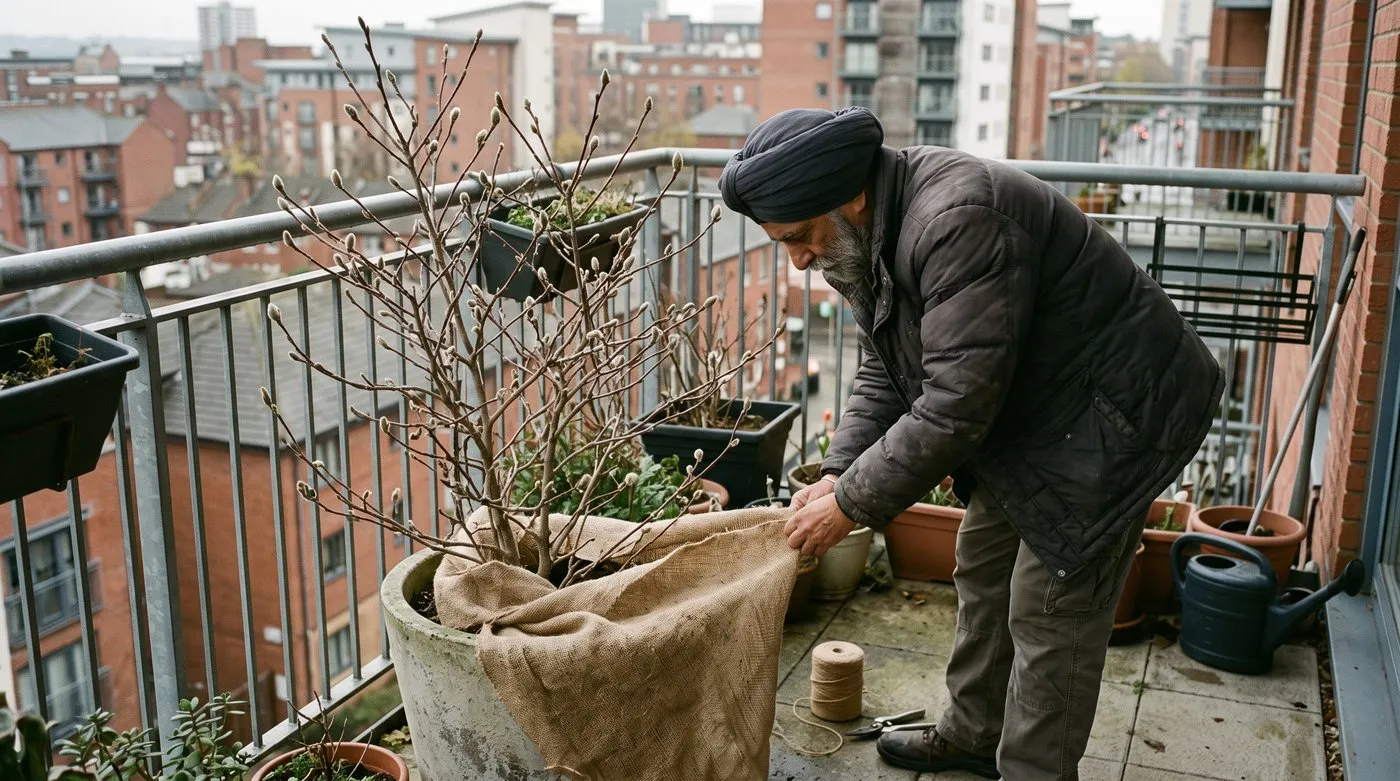
Wrap the pot, not the tree, from November to March. Roots in pots feel the cold far more than roots in the ground.
Companion planting under magnolias
Magnolia roots are shallow and fleshy, so don’t dig around an established tree. Choose small plants you can tuck into the mulch without disturbing anything.
Good plants to grow under a magnolia:
- Hellebores: Flower from late winter into spring, before the magnolia’s leaves come out.
- Cyclamen coum: Little pink or white flowers from January to March. Happy in the dry shade under deciduous magnolias.
- Epimedium: Heart-shaped leaves and dainty spring flowers. Copes with dry shade and roots.
- Snowdrops: Flower in January and February while the branches are bare, and spread over time.
- Ferns: Lovely texture from spring to winter. Plant small ones so you don’t need to dig deep.
- Brunnera ‘Jack Frost’: Silver leaves and blue spring flowers that brighten the shade.
Avoid vigorous ground cover such as vinca or hypericum right over the roots. They compete hard for water near the surface, right where the magnolia’s roots are.
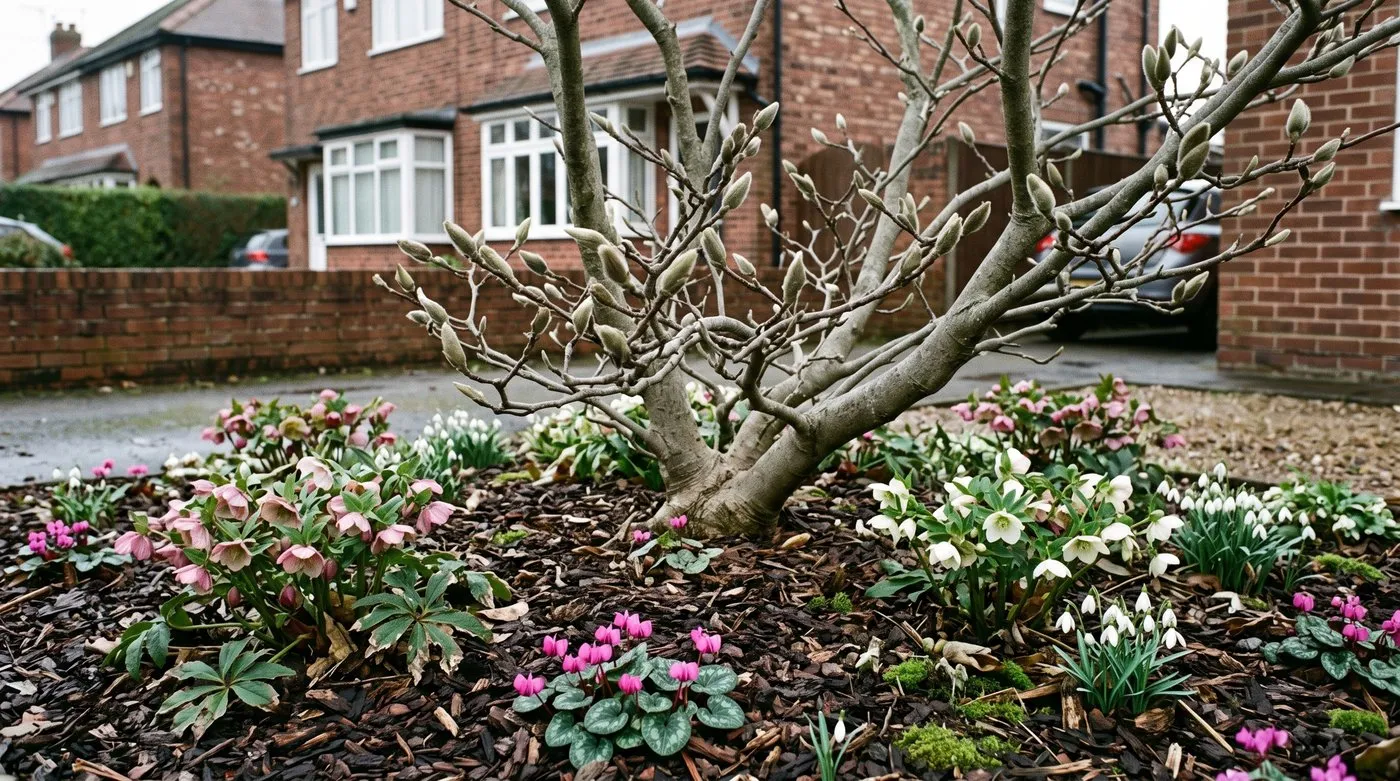
Choose small plants you can tuck into the mulch without digging. Magnolia roots are shallow and snap easily.
How long magnolias take to flower
Patience pays with magnolias. It depends on the variety and how the tree was raised.
Pot-grown trees from a nursery usually flower within a few years of planting. Some give a few flowers in their second spring, with more each year after. Star magnolia is often the quickest.
Trees grown from seed can take many years to flower, which is why nurseries usually sell grafted or cutting-raised plants.
Things that delay flowering:
- Heavy pruning, which removes flower buds
- Too much fertiliser, which gives leaves instead of flowers
- Deep shade
- Soggy soil
- Youth, especially in Magnolia grandiflora grown from seed
Common mistakes when growing magnolias
Mistake 1: Planting on an east-facing wall
East-facing spots get the first morning sun. On a frosty spring morning, that sun thaws the buds too fast and they go brown. A west-facing spot warms up more gently later in the day, which is much kinder.
Mistake 2: Growing on alkaline soil without amendment
On chalky soil, magnolia leaves turn yellow with green veins and growth stalls. Feeding won’t fix it. Test your soil before you buy.
Mistake 3: Planting too deep
A buried rootball keeps the base of the stem wet, which can lead to rot. Set the top of the rootball level with the soil around it, not above and not below.
Mistake 4: Pruning at the wrong time
Pruning in autumn or winter leaves open cuts in the wettest months, which lets coral spot in. If you must prune, do it in July or August.
Mistake 5: Disturbing the roots of established trees
Magnolia roots are shallow and brittle. Digging nearby to plant bulbs, put in edging or lay a path can damage them, and the tree may sulk for a few years. Keep the spade away.
Next, have a look at our guide to the best trees for small gardens for more lovely trees that fit compact spaces.
Frequently asked questions
When is the best time to plant a magnolia in the UK?
Plant pot-grown magnolias from March to May. That gives the roots a full summer to settle before winter. Avoid bare-root magnolias, as their fleshy roots don’t like being disturbed. Autumn planting can work in mild areas, but the roots are more likely to rot in cold, wet soil.
Can I grow a magnolia in a small garden?
Yes, star magnolia stays around 2-3m tall. It suits front gardens, courtyards and narrow borders. ‘Susan’ and Magnolia liliiflora ‘Nigra’ are other compact choices. Leave the big saucer magnolia and Magnolia grandiflora for larger gardens.
Why did my magnolia not flower this year?
Frost damage to the buds is the most common reason. It’s worst in east-facing spots, where morning sun thaws frosted buds too fast. Heavy pruning, a young tree and soggy soil can also stop flowering. A late April frost can brown flowers that have already opened.
Do magnolias grow well on clay soil?
Yes, as long as it doesn’t get waterlogged. Mix grit and garden compost into the soil you put back in the hole. Don’t plant in a dip where water collects. Neutral clay suits the common garden magnolias without any acid compost.
How do I prune a magnolia tree?
As little as possible, and only in midsummer. July and August are best, as cuts heal quickly then. Only remove dead, damaged or crossing branches. Never cut back an old magnolia hard, as big cuts heal slowly and can let in coral spot.
Can I grow a magnolia in a pot?
Yes, star magnolia is happy in a big pot. Choose one at least 50cm wide, filled with ericaceous compost mixed with some perlite. Water regularly, as pots dry out faster than the ground. Feed every two weeks from April to August and repot every three or four years.
How long does a magnolia tree take to grow?
Most grow at a steady, moderate pace. Star magnolia is one of the slowest. Magnolia grandiflora is quicker. A young saucer magnolia can take around ten years to make a decent-sized small tree. Trees grown from seed can take many years to flower.
Our team produces practical UK gardening guidance from source research, contributor records and established horticultural practice. Editorial standards are overseen by Matt W.