
Key takeaways
- Fans suit stone fruit and figs; apples and pears are usually espaliered or cordoned
- Put up horizontal wires about 15cm apart and 10cm off the wall before planting
- Plant a young tree about 20cm from the wall and build the fan over three years
- Peaches, nectarines, apricots and sweet cherries need a sunny south or west wall
- Morello cherries are the classic fan for a shady north-facing wall
- Prune stone fruit in spring and summer, never in winter, to keep out silver leaf
A fan-trained fruit tree grows flat against a wall, with its branches spread out like the ribs of a fan. It’s the classic way to grow peaches, apricots, plums and cherries in Britain, because a sunny wall gives them extra warmth to ripen. It also takes up almost no border space.
This guide covers which fruit suits a fan, how to put up the wires, how to shape the tree over its first three years and how to prune it once it’s fruiting. For apples and pears in flat horizontal tiers, see the espalier training guide instead.
Which fruit trees are best for fan training?
Fans suit stone fruit (peaches, nectarines, apricots, plums and cherries) and figs. Their flexible young shoots are easy to tie in at an angle. Apples and pears can be fanned, but they fruit on short spurs that sit more neatly along an espalier.
| Fruit | Good variety | Wall | Rootstock for a fan |
|---|---|---|---|
| Peach | Peregrine | South or south-west | St Julien A |
| Nectarine | Lord Napier | South or south-west | St Julien A |
| Apricot | Moorpark | South, sheltered | St Julien A or Torinel |
| Sweet cherry | Stella | South or west | Gisela 5 |
| Acid cherry | Morello | North, east or anywhere | Gisela 5 |
| Plum | Victoria | South or west | Pixy or St Julien A |
| Fig | Brown Turkey | South, roots restricted | Own roots |
Rootstock is the root system the tree is grafted on, and it controls the size. St Julien A is a good middle-sized choice that fills a typical wall. Pixy and Gisela 5 suit a smaller space.
The peach growing guide and nectarine growing guide cover varieties and care in more depth.
Which way should the wall face?
South or south-west is best for peaches, nectarines, apricots and sweet cherries. The bricks soak up warmth by day and the shelter helps early blossom. West walls suit plums and sweet cherries in most areas.
North walls get little sun, but they’re the classic spot for a Morello cherry. It’s sour, so it’s grown for cooking, and it doesn’t need much sun to ripen.
East walls are trickier for early blossom. Early sun on frosted flowers can damage them, so choose later-flowering fruit there.
How to put up wires for fan training
Fix the wires before you plant.
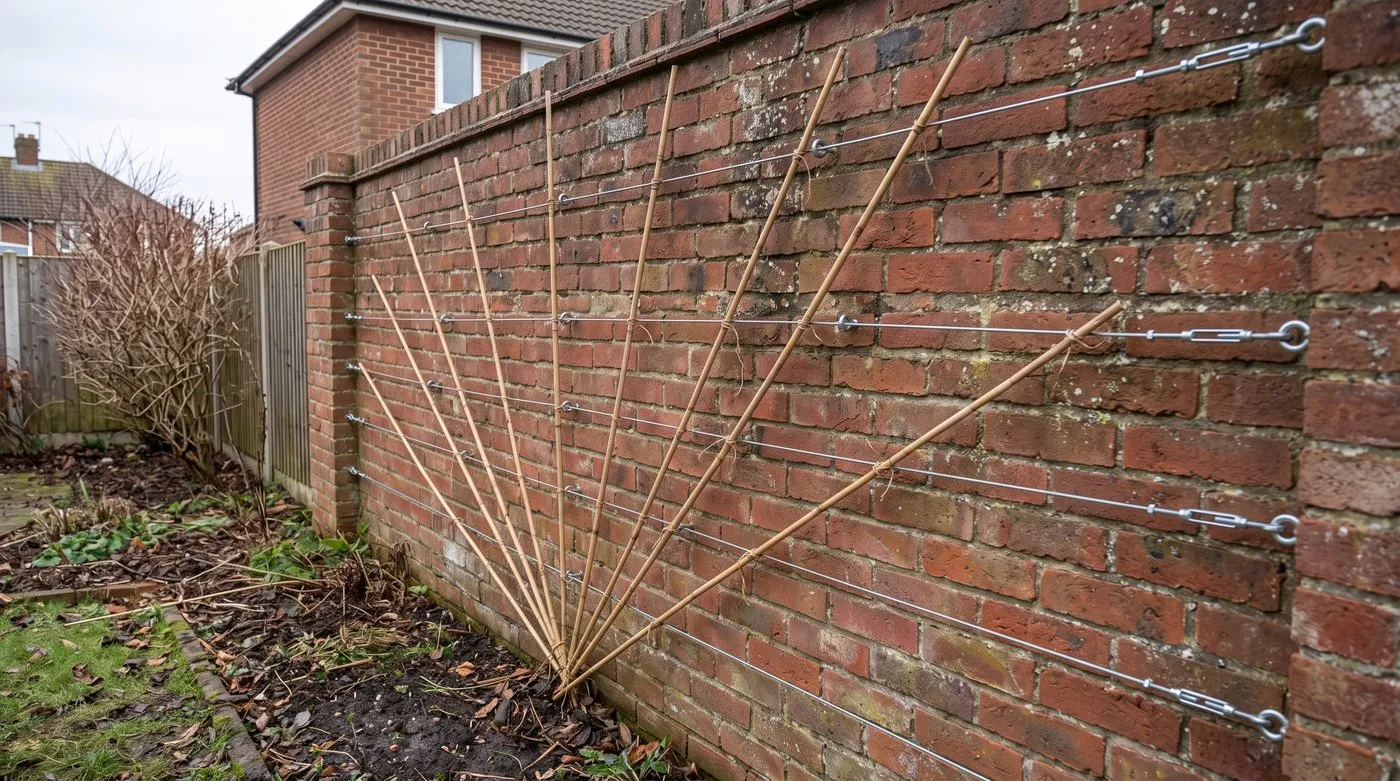
Wires and canes go up before the tree does, with a gap behind them for air to move.
- Screw vine eyes into the wall, so the wires sit about 10cm out from the brickwork. That gap lets air move behind the branches.
- Run horizontal galvanised wires about 15cm apart, from about 40cm above the ground to the top of the wall.
- Tension each wire with a straining bolt at one end.
- For a fence, fix the wires to the posts in the same way.
Tie branches to canes, then tie the canes to the wires. Use soft twine in a loose figure of eight. Check the ties every year and loosen any that are biting into the bark.
Fan training in year one
Start with a young tree, ideally a one-year-old maiden or a ready-started “partly trained” fan from a nursery. A partly trained fan saves you a year or two.
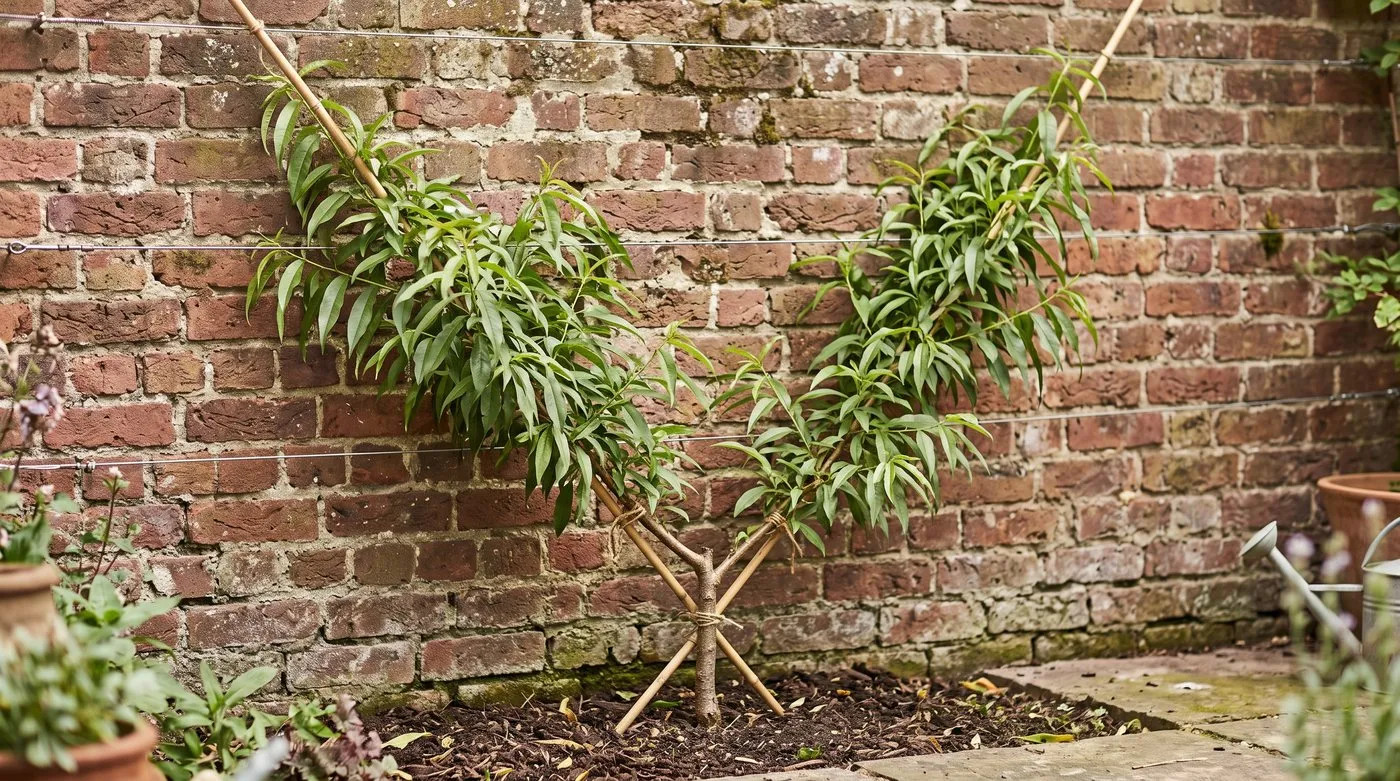
By the end of the first summer, two arms in a simple V are all you need.
Plant it in winter about 20cm from the wall, leaning very slightly in towards it. Water well. Walls cast a rain shadow, so the soil at their foot is often dry.
In early spring, as the buds start to swell, cut a maiden’s main stem back to about 60cm above the ground. Choose two strong buds or side shoots about 30cm up, one on each side. These become the first two arms of the fan.
Through summer, tie each arm to a cane fixed to the wires at about 40-45 degrees. Rub out other shoots on the main stem. Once both arms are growing strongly, cut the central stem off just above them. By autumn you should have a simple V.
Fan training in years two and three
In early spring of year two, shorten each arm by about a third, cutting just above a bud. This makes each arm branch out.
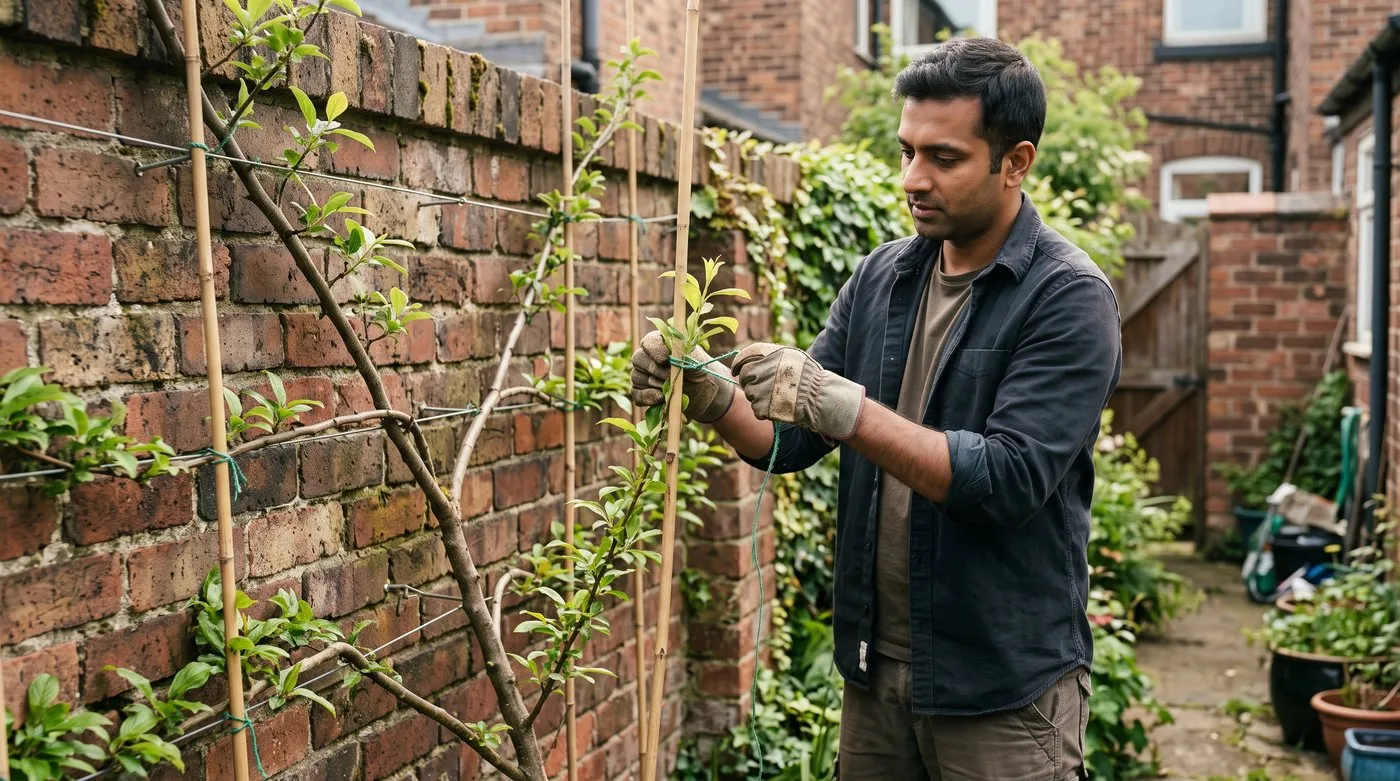
Tie new shoots into the gaps so the ribs spread evenly across the wall.
Through summer, let the tip of each arm keep growing. On each arm, choose about two well-spaced shoots on the upper side and one on the lower side. Tie each to its own cane, fanning them out so the gaps between ribs are even. Rub out any shoots growing towards the wall or straight out from it.
In year three, repeat the process. Shorten the new ribs by about a third in early spring and tie in more shoots to fill the gaps. By the end of the third summer the wall should be well covered. From then on, pruning is about keeping the fan fruiting rather than building it.
Keep the centre of the fan open. If upright shoots appear in the middle, they’ll take over, so remove them.
How to prune a fan-trained peach or nectarine
Peaches and nectarines fruit on shoots that grew the summer before. A shoot fruits once, so the trick is to grow a replacement every year.
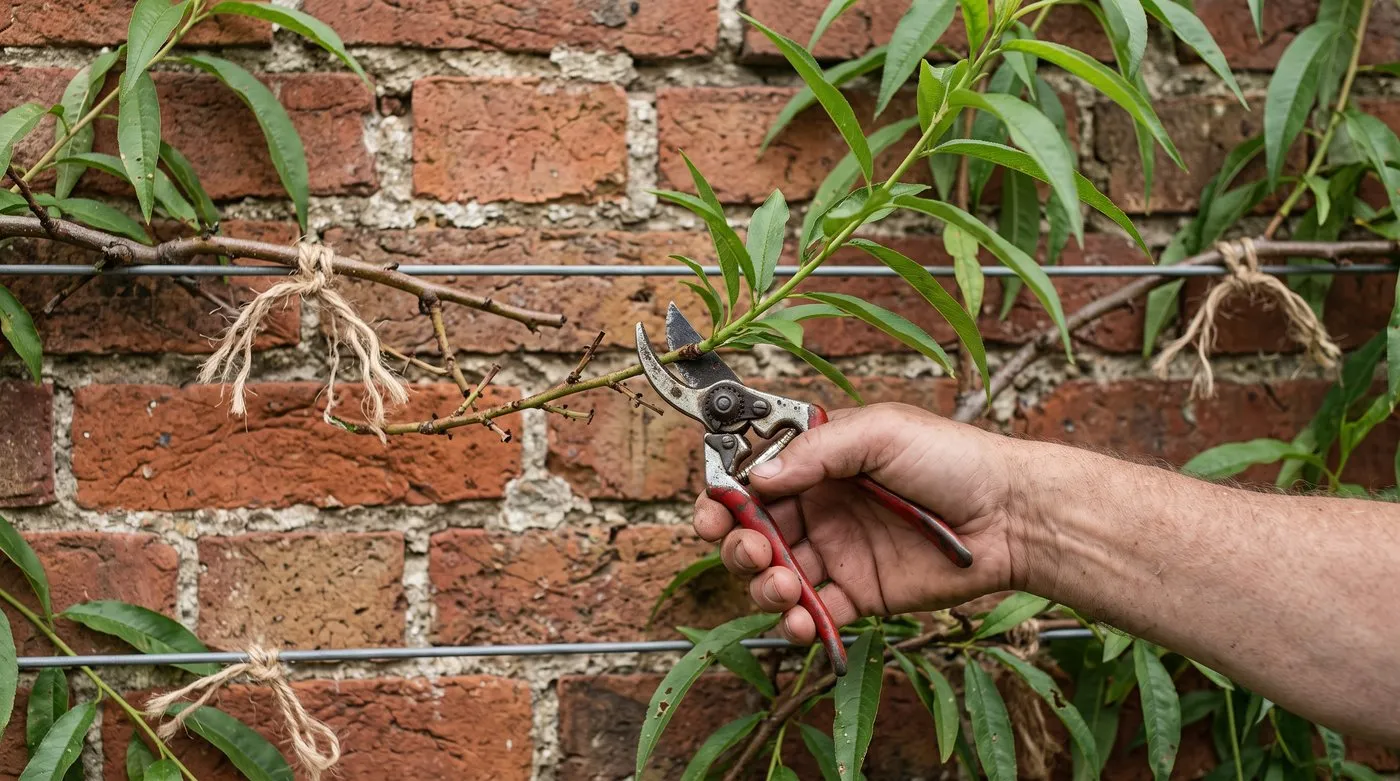
After picking, cut each fruited shoot back to its replacement, ready to fruit next year.
- In spring, on each shoot carrying flower buds, keep one new shoot near its base as the replacement. Keep one more partway along as a reserve. Pinch out the rest, along with any growing towards or away from the wall.
- In summer, tie in the replacement shoots as they grow.
- After picking, cut each fruited shoot back to its replacement. Tie the replacement in to fill the space.
Thin the fruit in late spring as it swells, so the final peaches sit about 15-20cm apart. You’ll get bigger, better-flavoured fruit. Peach leaf curl is the other big worry: a clear polythene cover over the fan from midwinter to late spring keeps the rain, and the disease, off. The guide to peach leaf curl explains how.
How to prune fan-trained plums and cherries
Plums and sweet cherries fruit on short spurs on older wood, as well as at the base of last year’s shoots. In summer, pinch back new side shoots to about six leaves. After picking, cut those same shoots back to about three leaves. Remove any shoots growing towards or away from the wall.
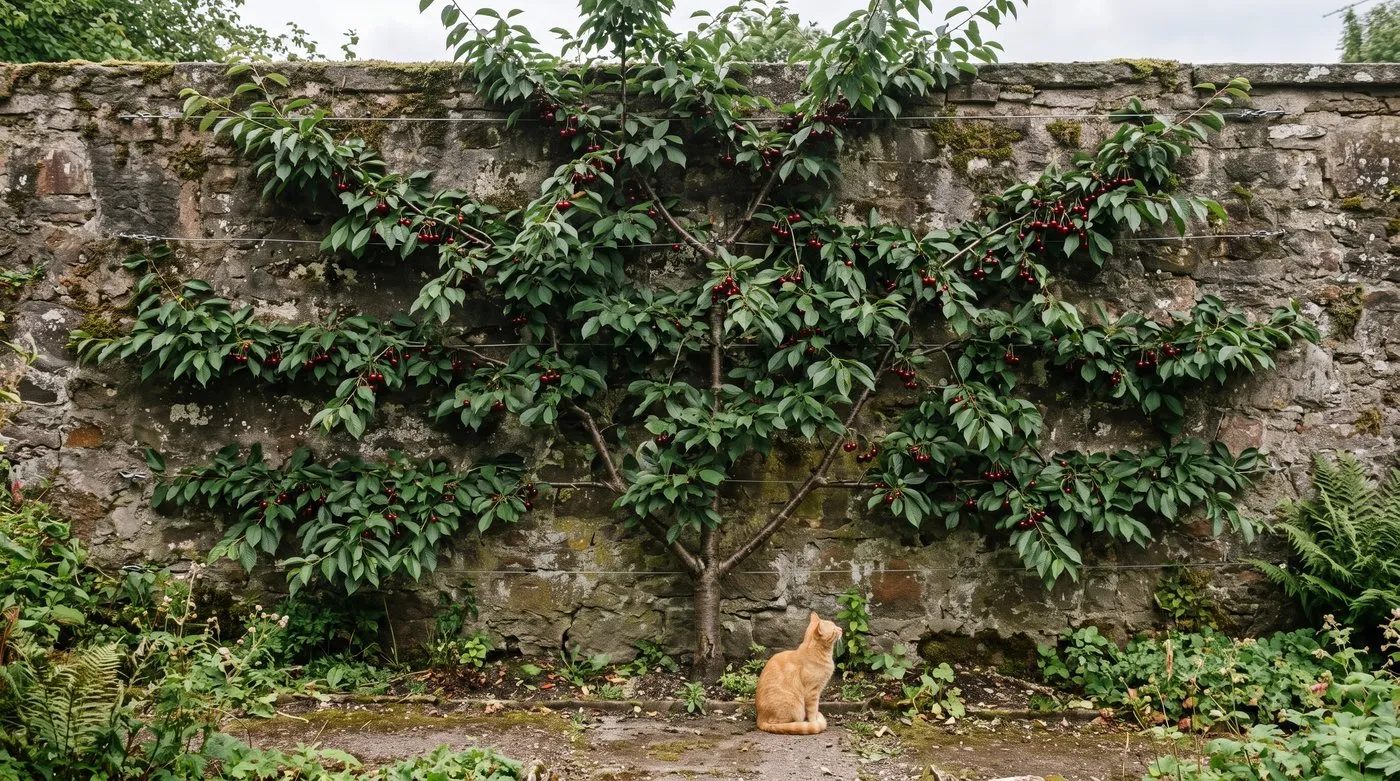
A Morello cherry happily fruits on a shady north wall where little else would ripen.
Morello cherries fruit mostly on last year’s shoots, like peaches. Prune them the same way, keeping a replacement shoot for each one that fruits.
Always prune cherries and plums in spring and summer. Silver leaf and bacterial canker both get in through cuts made in autumn and winter. The silver leaf guide shows what to look for. For more on cherries, see how to grow cherry trees.
Looking after a fan-trained tree through the year
Water. Soil at the foot of a wall is often dry. Water well every week or so in dry spells from spring to late summer, especially while fruit is swelling.
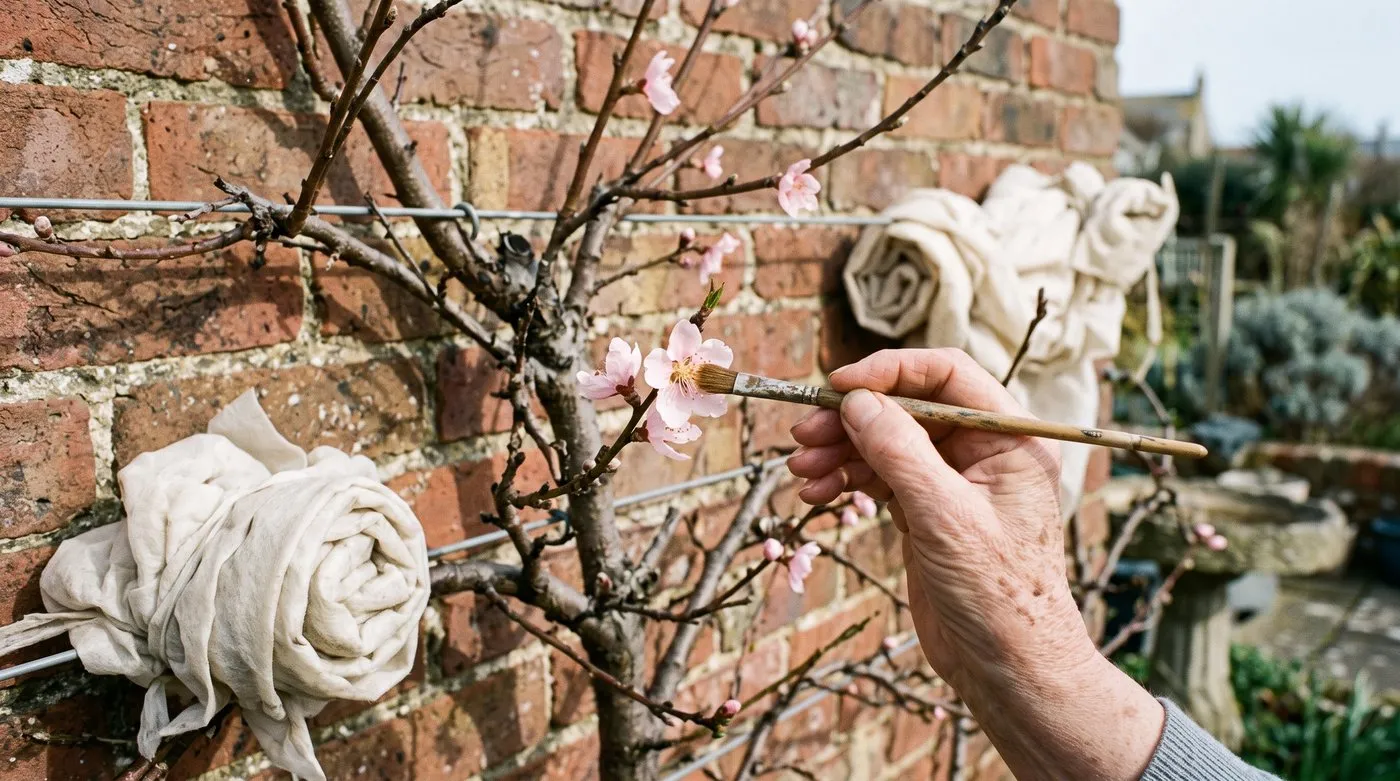
A soft brush does the bees’ job when peach blossom opens before many insects are about.
Feed and mulch. Give a balanced feed in late winter and mulch with well-rotted compost in spring, keeping it clear of the trunk.
Pollinate. Peaches, nectarines and apricots flower in early spring, when few insects are flying. Dab each open flower with a soft paintbrush on dry, sunny days. Throw fleece over the blossom on frosty nights and remove it in the morning.
Net. Birds love ripening cherries. Drape netting over the fan as the fruit colours.
Common fan training mistakes
Pruning stone fruit in winter. It invites silver leaf and canker. Stick to spring and summer.
Letting the centre fill up. Strong upright shoots in the middle soon dominate. Keep the middle open and the ribs spread.
Tying too tightly. Twine that’s never checked cuts into the bark as branches thicken. Loosen ties every year.
Forgetting to water. Walls keep rain off the roots. Wall fruit often goes thirsty.
Choosing a vigorous rootstock for a small wall. You’ll be fighting it every summer. Match the rootstock to the space.
Fan-trained fruit tree calendar
| Month | Job |
|---|---|
| November to February | Plant bare-root trees. Cover peaches against leaf curl. No pruning |
| February to March | Hand-pollinate peaches and apricots. Fleece blossom on frosty nights |
| March to April | Formative pruning as buds break. Feed and mulch |
| May | Choose replacement shoots on peaches. Start thinning peach fruit |
| June to July | Tie in new shoots. Pinch back plum and cherry side shoots |
| August to September | Pick fruit. Cut fruited peach shoots back to replacements |
| September | Shorten plum and cherry side shoots after picking. Check ties |
| October | Remove netting. Clear fallen leaves and fruit. No pruning until spring |
Frequently asked questions
What is the difference between fan training and espalier?
A fan’s branches spread out at angles; an espalier’s run in flat horizontal tiers. Fans suit stone fruit such as peaches, plums and cherries. Espaliers suit apples and pears, which fruit on short spurs.
Can I fan train an apple tree?
You can, but an espalier or cordon usually suits apples better. Their short fruiting spurs sit neatly along horizontal branches. Fans are the usual choice for stone fruit and figs.
Which wall is best for a fan-trained peach?
A sunny, sheltered south or south-west facing wall. The wall soaks up warmth by day, which helps the fruit ripen. West-facing walls can work in milder areas. North walls are too cold for peaches.
When should I prune a fan-trained cherry or plum?
In spring and summer, never in winter. Silver leaf and bacterial canker get in through pruning cuts during the dormant season. Make shaping cuts in spring as growth starts, and routine cuts in summer.
How much space does a fan-trained fruit tree need?
Usually a wall about 2m high and 3.5-4.5m wide. Trees on dwarfing rootstocks need less room. A narrow wall can take a half-fan trained to one side.
Do I need to hand-pollinate a fan-trained peach?
It helps a lot. Peaches flower in early spring, when few insects are flying. Dab each open flower with a soft paintbrush on dry, sunny days while the blossom is out.
How long before a fan-trained tree produces fruit?
Usually within two to four years of planting. Shaping comes first, so expect a few fruits once the framework is filling out. Crops grow as the fan covers the wall.
Now your fan is under way, read the guide to pruning fruit trees for the rest of the orchard, or browse more fruit growing guides.
Our team produces practical UK gardening guidance from source research, contributor records and established horticultural practice. Editorial standards are overseen by Matt W.


