Key takeaways
- Brown grass after a heatwave is usually resting, not dead
- Pull a few shoots and check the base. Firm and pale means alive
- One deep soak a week beats a daily sprinkle, if watering is allowed
- Raise the mower to 5-6cm and wait for green growth before cutting
- Feed lightly with a low-nitrogen feed, not a high-nitrogen spring one
- Overseed truly dead patches in early autumn with a drought-tolerant mix
A brown lawn after a heatwave looks awful, but it’s rarely the disaster it seems. The grasses in most British lawns simply go to sleep in a drought and wake up again when the rain comes back. The biggest mistake is panicking and ripping up turf that would have recovered for free.
Here’s how to tell if your grass is alive, how to water it sensibly, and a simple four-week plan to get it green again. Often the kindest thing is to do less, not more.
What dormancy really is
Our everyday lawn grasses, like ryegrass, fescues and meadow grass, are made for cool, damp summers. When it gets hot and the soil dries out, they stop growing and pull their energy down into the crown, the growing point right at the base of the plant. The blades go brown, but the crown stays alive and waits.
That’s dormancy. It’s a survival trick, not death. What wakes the lawn up is water soaking back into the soil, not cooler air. A good soaking of rain is usually enough to bring fresh green shoots through within a couple of weeks. A very long, bone-dry spell can kill some patches, especially on thin soil.

After the record heat of summer 2022, large parts of southern England went brown from end to end. Most of those lawns were green again by autumn once the rain returned. That’s the usual pattern for a healthy lawn. Lawns on shallow soil over chalk, packed clay, or a sunny slope of sandy soil are slowest to come back.
Not every grass is equally tough. Annual meadow grass, a weedy grass that sneaks into most lawns, copes badly with drought and may die off in patches. That’s no great loss. The gaps it leaves are a chance to sow tougher grasses.
The UK heatwave context
Where you live makes a difference. Gardens in the south and east of England get the longest dry spells, and lawns there go brown in many summers. The Midlands and south-west see it now and then. In the north, west Wales and Scotland it only happens in really hot years. The south and east took the hardest hit in 2026, when England had its driest July on record. Our UK gardening statistics track which areas are in drought. The plan below works wherever you are.
Your soil matters too. Sandy and gravelly soils drain fast and dry out within days. Heavy clay holds water but cracks in hot weather, so roots can’t reach the moisture. Loamy soil copes best. Knowing your soil helps you know what to expect.
How to read your lawn after a heatwave
Three things tell you what’s going on:
- Colour: an even straw-brown across whole areas is classic dormancy. Patchy yellow rings are more likely a fungal disease (see lawn diseases identification and treatment to tell them apart).
- The base of the grass: pull a few shoots. Firm, pale bases mean it’s resting. Dry, brittle bits that crumble mean that patch has died, usually only in the worst spots like sunny slopes or packed ground near trees.
- Green weeds: yarrow, plantain and clover stay green when grass goes brown. If the only green bits are weeds, you may have a wider weed problem to tackle too (see lawn weeds identification and control).
Think of the lawn as a patchwork. Most of it will be alive, some will be thin, and a few small areas may really have died. The plan below treats each one a little differently.
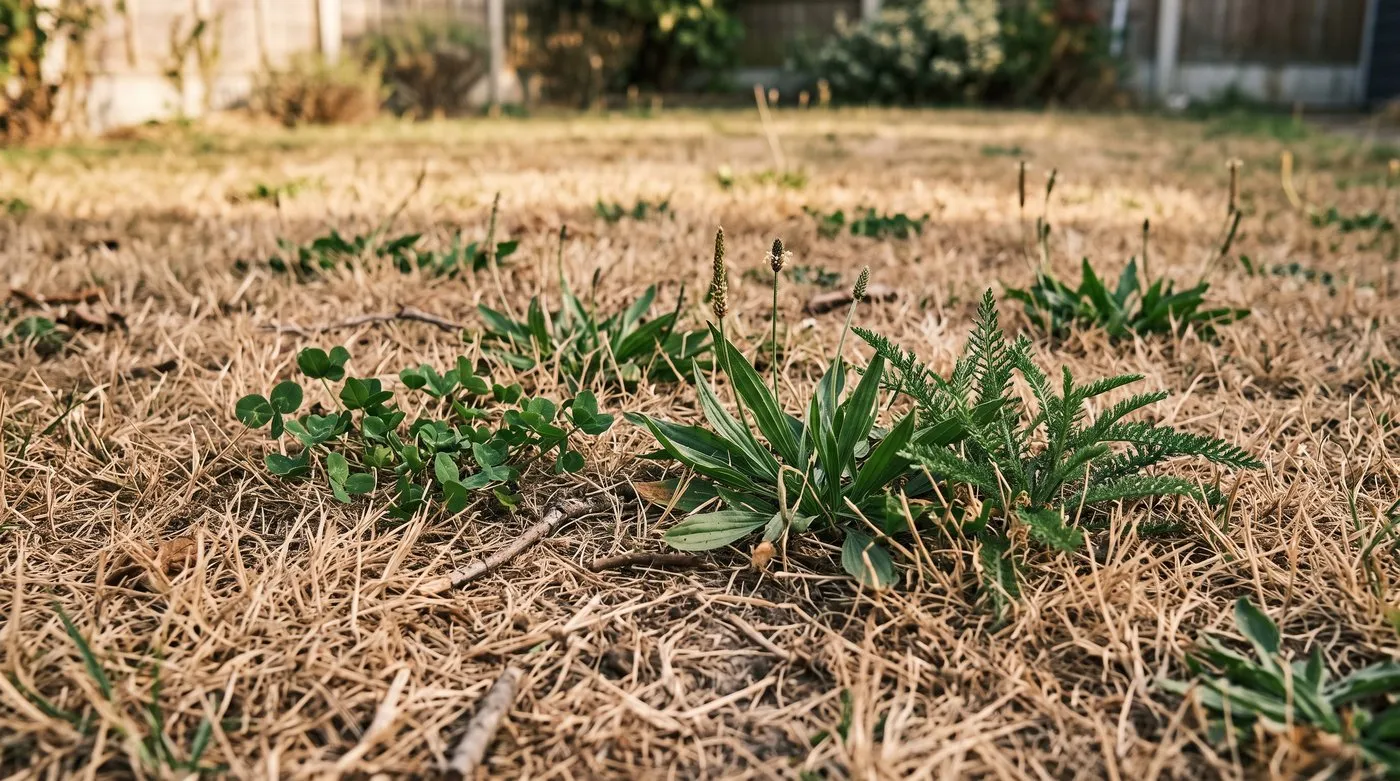
Clover, plantain and yarrow stay green when grass goes brown. If they’re the only green bits, you may have a weed problem to tackle too.
Watering rules during and after drought
Lots of us water lawns the wrong way, and getting how often to water a lawn right matters just as much during recovery. A quick sprinkle every evening only wets the surface and keeps roots shallow, which makes the next drought worse. Instead, give about 25mm of water in one go, once a week, early in the morning, as long as there’s no hosepipe ban.
To check how long that takes, put a few empty tuna tins across the sprinkler’s reach and time how long they take to fill to 25mm. Don’t water at midday, when most of it evaporates, and avoid the evening, when wet grass overnight invites disease.

During a hosepipe ban, leave the brown lawn alone. It will cope. Save your washing-up and bath water for trees, shrubs and the veg patch, which struggle far more than grass.
Wetting agents won’t keep a dry lawn green. They help water soak into very dry soil, so they’re only useful once you can water again or the rain returns.
Those tuna tins are handy for measuring rain too. Leave a few out on the lawn, away from trees. If they collect about 15mm or more in a week, there’s no need to water. If they collect less, top up to roughly 25mm.
The four-week recovery programme
Once the rain is back or the hosepipe ban lifts, this simple plan gets a resting lawn back faster than any big, dramatic fix.
Week 1: stop, deep water, raise the mower
Week one is about taking it easy. If there’s been little rain that week, give one deep 25mm soak. Raise the mower to 5-6cm and keep it there for the rest of the season. Cutting brown grass short can scalp the crowns and finish them off.
That may mean the first mow cuts nothing at all, which is fine. Wait until you see green growth, then never take off more than a third of the height in one go.
Keep feet off the worst bits too. Weak grass tears easily under garden furniture, paddling pools and football boots. Move tables, trampolines and heavy items off the worst patches for a couple of weeks.
If you have a dog, keep it off the weakest areas for a while, perhaps with a bit of string and some canes. Dog wee can finish off grass that’s already struggling.
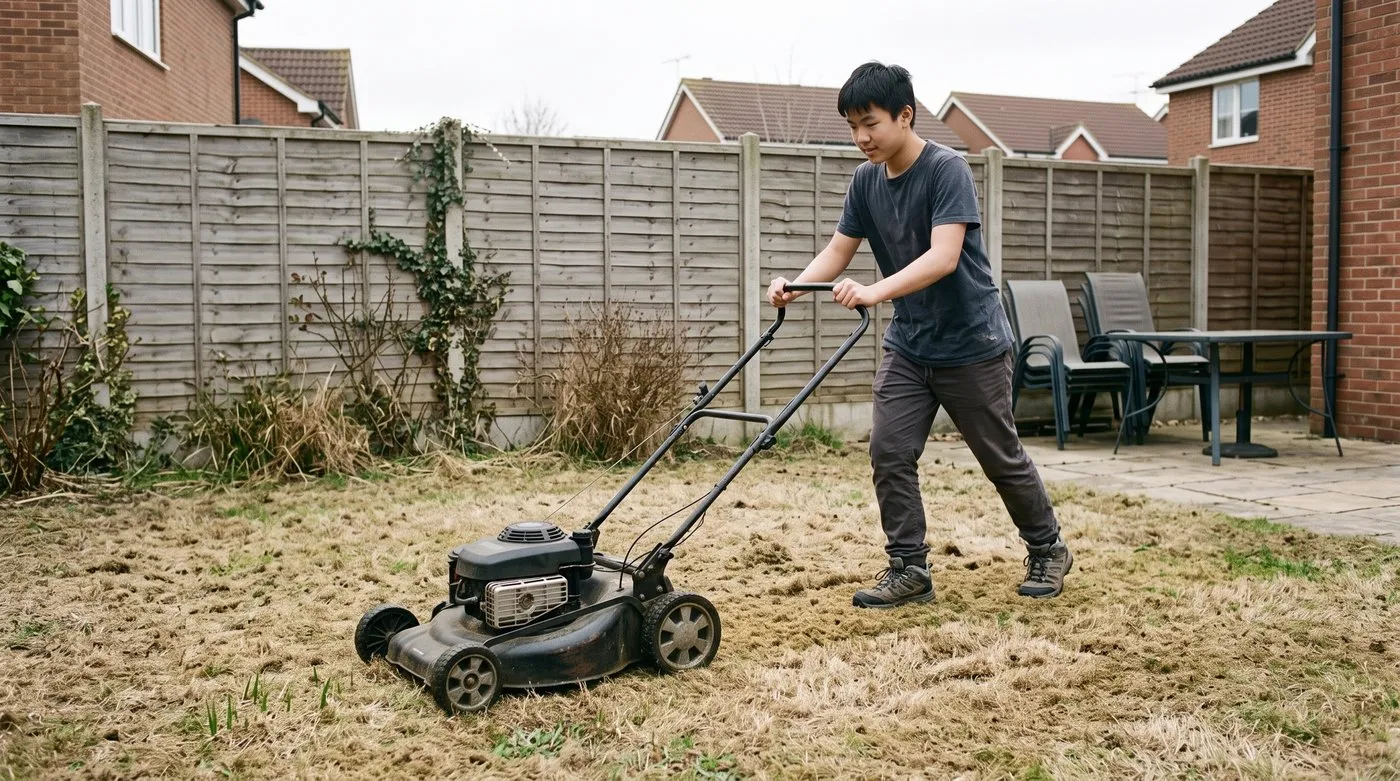
Raise the mower to 5-6cm and keep it there. Cutting brown grass short can scalp the crowns that are only resting.
Week 2: assess and feed lightly
By the end of week two you should see green shoots coming through at the base of much of the brown grass. Now’s the time to feed, but pick the right feed.
Skip the high-nitrogen spring or summer lawn feed. Nitrogen pushes soft leafy growth, when a stressed lawn needs to rebuild its roots first. Use a low-nitrogen feed that’s rich in potassium, such as sulphate of potash or an autumn lawn feed, at the rate on the pack.
For more on feeding through the year, see how to feed a UK lawn and our UK lawn care calendar.
Sulphate of potash keeps for ages if it stays dry, so store the bag in a dry shed. You can scatter it by hand wearing a glove, or use a hand-spreader on a low setting.
Timing matters more than the exact product. Feed too early, before any green appears, and it’s wasted. Leave it too late and the lawn has used up its reserves. About two weeks after the rain returns is a good rule of thumb.
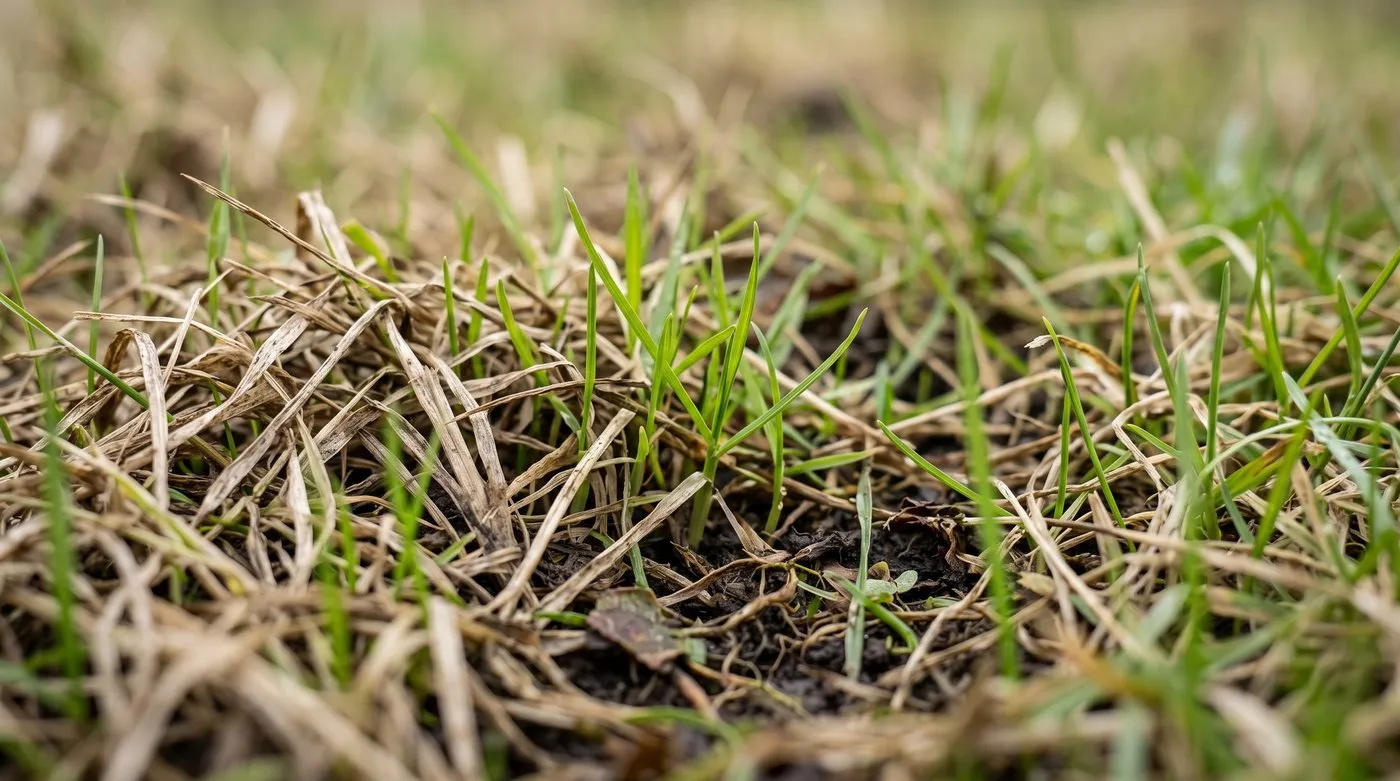
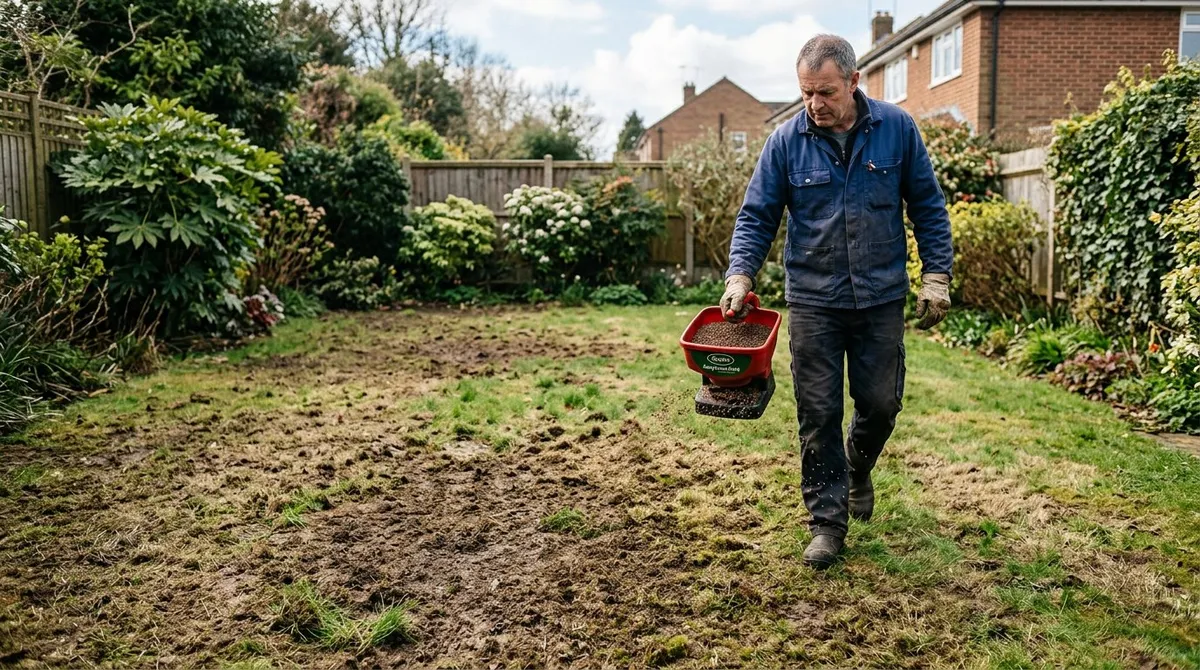
Green shoots at the base mean the lawn is waking up. Now’s the time for a low-nitrogen, potassium-rich feed.
Week 3: scarify and overseed bare patches
By week three there’s a layer of dead brown grass, called thatch, lying on the surface. Left there, it smothers new growth and can harbour disease. Rake it out gently with a spring-tine rake, or use an electric scarifier on its lightest setting. The aim is to lift the dead stuff without tearing up living grass.

Now look for patches that really are dead, with no green at all. Overseed those with a drought-tolerant seed mix, at the rate on the pack, ideally between early September and early October. Thin patches with some green just need a lighter sprinkle. For step-by-step help, see how to fix a patchy lawn and how to scarify and aerate a lawn.
Keep newly sown patches damp until the seedlings are up and growing. This is the one time a little-and-often approach is right, because the seedlings have no roots to speak of yet.
Getting seed in contact with soil is the key. Seed scattered on thatch or crusty soil comes up poorly. Rake the surface lightly, scatter the seed, then walk over it or press it down with the back of a rake. A thin layer of sieved soil on top helps keep birds off.
Seed comes up fastest when the soil is still warm in September. Once it turns cold in late October, it slows or stops, so don’t leave it too late.
Week 4: top-dress and water in
Spread a thin top dressing of sandy loam over the lawn and work it in with the back of a rake so it falls between the blades. It fills small dips, helps heavy soil drain and gives new seed a cosy covering.
Our guide on how to top-dress a UK lawn covers how to do it. Water it in well. From now on the lawn is on its normal autumn routine: mow as it greens up (see when to mow a UK lawn for autumn heights), no more feeding until spring, and keep an eye out for weeds and moss.

Drought-tolerant grass species worth knowing
Hot, dry summers are becoming more common in the UK, so it’s worth slowly shifting your lawn towards tougher grasses.
| Grass | Copes with drought | Copes with wear | Best for |
|---|---|---|---|
| Perennial ryegrass | Good | Very well | Family lawns. Browns quickly but bounces back |
| Turf-type tall fescue | Very well | Very well | Hot, dry, sunny lawns. Deep roots, stays greener |
| Strong creeping red fescue | Well | Fairly well | Shady and quiet lawns. Fine leaves, fills its own gaps |
| Smooth-stalked meadow grass | Fairly well | Well | Mixed family lawns. Slow to start but spreads to fill gaps |
| Micro-clover | Very well | Fairly well | Wildlife-friendly lawns. Feeds itself, stays green |
For a sunny lawn on sandy soil, a mix led by tall fescue with some ryegrass and a little micro-clover copes far better with a heatwave than ryegrass alone.
You don’t need to dig up your lawn to switch. Just overseed the worst areas with the new mix each autumn, and over a few years the tougher grasses take over.
When recovery is not realistic
A few lawns won’t come back, even with the right care. This table helps you decide.
| What you see | Will it recover? | What to do |
|---|---|---|
| Brown all over, but bases are firm and pale | Yes | Follow the four-week plan |
| Brown patches, about half still alive | Yes, with help | Four-week plan, plus overseed the dead patches |
| Brown after a very long drought, bases all dry and brittle | No | Lift, level and reseed or returf |
| Lots of green weeds taking over | Maybe | Deal with the weeds first, then look at the grass |
| Packed, bare patches with nothing left | No | Aerate, top-dress and reseed |
| Heavy shade, no recovery after six weeks | No | Use shade-loving grass or a lawn alternative |
If most of the lawn has really died, starting again is quicker than patching. Lift the dead turf (you can hire a turf cutter), dig over, rake level, then reseed or returf. Seed is cheaper and often gives deeper roots in the long run.
Future-proofing against the next heatwave
Getting the lawn back is half the job. The other half is helping it cope better next time. Five changes make a real difference.
- Mow higher, at about 5cm. Longer grass shades the soil, holds moisture and grows deeper roots.
- Top-dress with sandy loam in spring. Over a few years it improves heavy clay so it holds water better.
- Bring in tougher grasses. Overseed each autumn with a drought-tolerant mix led by tall fescue.
- Try a wildflower area on sunny plots. A strip of yarrow, self-heal, clover and bird’s-foot trefoil stays green with far less water. Our guide on how to create a wildflower lawn shows you how.
- Give up on the worst corners. Where grass struggles every year, swap it for ground cover (see lawn alternatives and ground cover). Tough, drought-loving plants like gaura love those hot, dry spots.
A smaller lawn with a wildflower patch or ground cover uses less water, looks better through a dry summer and needs far fewer mows.
Common mistakes that ruin recovery
- Mowing too short, too soon. Cutting brown grass low can kill crowns that were only resting. Wait for green growth first.
- A big nitrogen feed straight away. It pushes soft top growth instead of roots and can scorch weak grass. Save it for spring.
- Reseeding before you’ve checked. Buying seed or turf in week one wastes money on patches that would have recovered. Give it a few weeks first.
- Little and often watering. A daily sprinkle keeps roots shallow. One deep weekly soak is better.
- Ignoring packed soil. Hard, well-trodden ground keeps water and air away from roots. Aerate in early autumn before you overseed.
A note on mushrooms and disease after recovery
Wet weather after a long drought is perfect for lawn fungi. Fairy rings, ink caps and red thread can all appear as the grass regrows. Some lawn mushrooms are poisonous, so pick them off if children or pets use the lawn. Our guide to UK lawn mushrooms explains which to watch out for.
Patches with yellow or pink threads point to a lawn disease. Our guide to lawn diseases identification and treatment helps you work out what it is and what to do.
When professional help is worth it
For big lawns, or ones that still haven’t recovered after two seasons, a soil test and a quote from a lawn specialist can be money well spent. A good contractor can aerate, scarify, overseed and top-dress in one autumn visit, leaving the lawn better set up for the next dry summer.
A soil test tells you three useful things: how acid or alkaline the soil is, whether it’s short of nutrients like potassium, and how much organic matter it has. You can’t see any of these by looking, which is why a test can save you guessing.
Once the lawn is back on track, our UK lawn care calendar sets out the monthly jobs that keep it ready for the next heatwave.
Frequently asked questions
Is my brown lawn dead or just dormant after a UK heatwave?
It’s almost certainly dormant, not dead. Lawn grasses stop growing and turn straw-coloured in heat and drought to save water, but the growing points at the base usually survive. Pull a few brown shoots and look at the base. Firm, pale growth means it’s alive. Dry, brittle bits that crumble suggest that patch has died.
How long does it take a UK lawn to recover from drought?
Most lawns start greening up within a few weeks of steady rain. Full recovery can take several weeks more, depending on how long the drought lasted. After a very long dry spell some patches may not come back, and these can be overseeded in early autumn. Go easy on the lawn while it recovers.
Should I water a brown lawn during a UK hosepipe ban?
No, a resting lawn doesn’t need it. Established grass usually survives drought and greens up when rain returns. Using a hosepipe during a ban isn’t allowed, and a lawn isn’t worth hand-watering. Once the ban lifts, water deeply and less often rather than giving a light daily sprinkle, which keeps roots shallow.
When should I overseed a drought-damaged lawn in the UK?
In early autumn, from early September to early October. Wait a few weeks after the rain returns to see which patches are really dead. The soil is still warm, so seed comes up fast, and autumn rain saves on watering. Choose a drought-tolerant seed mix and sow at the rate on the pack.
How do I stop my UK lawn going brown next summer?
Mow higher, help roots grow deep and choose tougher grasses. Raise the mower to about 5cm in summer, as longer grass shades the soil and holds on to moisture. Aerate and top-dress to improve the soil. Overseed with drought-tolerant grasses such as fescues. And accept a bit of browning in dry spells, because grass bounces back.
Related guides
For more lawn help, try how to feed a UK lawn, how to top-dress a UK lawn, how to scarify and aerate a lawn, how to fix a patchy lawn and the UK lawn care calendar. If something else seems wrong, see lawn diseases identification and treatment and lawn weeds identification and control. Thinking of a change? Lawn alternatives and ground cover is a great place to start.
Our team produces practical UK gardening guidance from source research, contributor records and established horticultural practice. Editorial standards are overseen by Matt W.