Key takeaways
- Coppicing cuts to a stool near ground level, pollarding cuts to a 2 to 3m trunk framework
- Both are dormant-season jobs, done November to March, avoiding the bird nesting season
- Hazel coppices on a 7 to 10 year rotation, sweet chestnut on 12 to 18 years, willow annually
- A coppice stool can live for centuries, far longer than an uncut tree of the same species
- Establish a young tree for 2 to 3 years before the first pollard, then re-cut every 1 to 5 years
- Our Staffordshire hazel stool cut on a 7-year cycle since 2016 yields 40+ pea sticks per cut
Pollarding and coppicing are two of the oldest tree management methods in Britain, and both are simpler than they look. Coppicing cuts a tree down to near ground level, and pollarding cuts it back to a raised trunk. Each one forces a flush of new stems, gives you a renewable crop of poles and rods, and keeps a tree small for life. This guide draws on a decade of cutting hazel, dogwood and willow on heavy clay in north Staffordshire. It covers what each method means, which species take it, when to cut, and how to make a clean cut that heals instead of rots. Get the timing and the cutting height right, and one tree feeds your garden for decades.
Coppicing and pollarding: what each one actually means
Coppicing means cutting a tree or shrub right down to near ground level on a repeating cycle. The cut base is called a stool. From that stool the tree throws up many straight new stems, which you harvest years later and let regrow. Hazel, sweet chestnut and willow are the classic coppice species.
Pollarding means cutting all the branches back to a permanent trunk framework, usually at 2 to 3m above the ground. The knuckled head that forms is called a bolling. Each time you re-cut, you take the new growth back to the same point. The bolling swells over the years into a gnarled, distinctive shape.
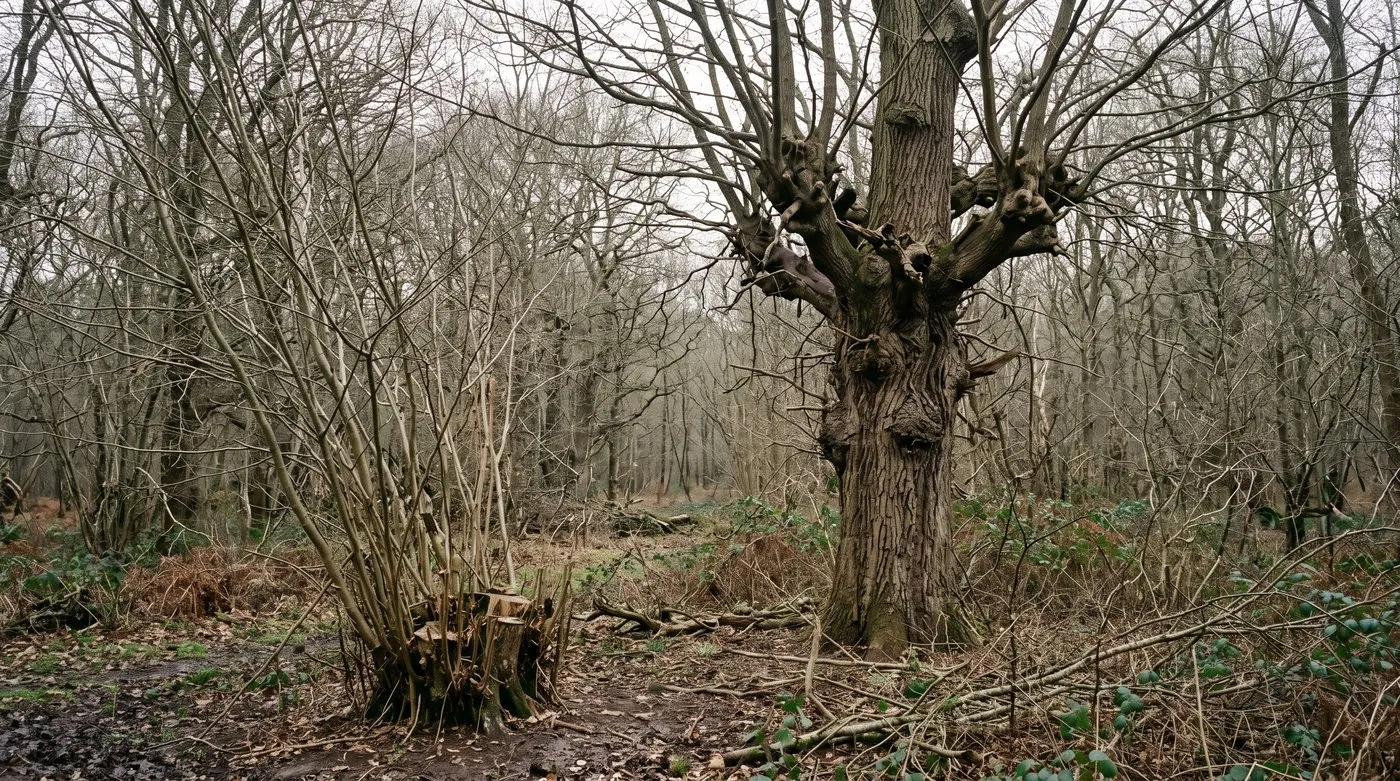 The height difference at a glance: coppicing cuts to a low stool near the soil, pollarding cuts to a raised bolling at 2 to 3m, above browsing height.
Coppicing versus pollarding compared
The two methods share a principle but suit different situations. Coppicing gives the biggest harvest of ground-level rods and creates open, sunny woodland floor. Pollarding keeps a tree small near buildings, paths and grazing animals. The table sets them side by side so you can choose.
| Feature | Coppicing | Pollarding |
|---|---|---|
| Cutting height | 5 to 15cm above ground | 2 to 3m, at the bolling |
| Regrowth from | A ground-level stool | A raised trunk framework |
| Main purpose | Renewable rods, wildlife cycle | Size control, above browsing |
| Best species | Hazel, sweet chestnut, willow | Willow, lime, plane, mulberry |
| Typical rotation | 1 to 18 years by species | 1 to 5 years |
| Suits | Woodland, boundaries, wildlife plots | Streets, small gardens, wood pasture |
| Grazing tolerance | Poor, shoots eaten to base | Good, regrowth out of reach |
Which trees coppice and pollard well
Not every tree regrows from a hard cut. The best candidates are broadleaves that carry dormant buds under the bark, ready to shoot when the top is removed. Most conifers lack this ability, so a pine or spruce cut to the ground simply dies. The exception among conifers is yew, which does regrow.
| Species | Method | Rotation | Main use |
|---|---|---|---|
| Willow (Salix) | Both | 1 year | Weaving, biomass, living structures |
| Dogwood (Cornus) | Coppice | 1 year | Coloured winter stems |
| Hazel | Coppice | 7 to 10 years | Pea sticks, bean poles, hurdles |
| Sweet chestnut | Coppice | 12 to 18 years | Fencing, stakes, cleft palings |
| Hornbeam | Both | 8 to 15 years | Firewood, poles |
| Lime | Both | 5 to 15 years | Poles, leaf fodder, street trees |
| Field maple | Coppice | 8 to 20 years | Firewood, hedging |
| Oak | Both | 20 to 30 years | Firewood, bark, slow poles |
Hazel is the beginner’s tree. It coppices willingly, regrows fast, and gives the most useful garden crop. If you are growing your own, our guide to growing hazel and cobnuts in the UK covers planting and nut harvests alongside the coppice cycle. For a wildlife-friendly boundary, mix your coppice species with other native trees for UK gardens so the cut plot supports a broad range of insects and birds.
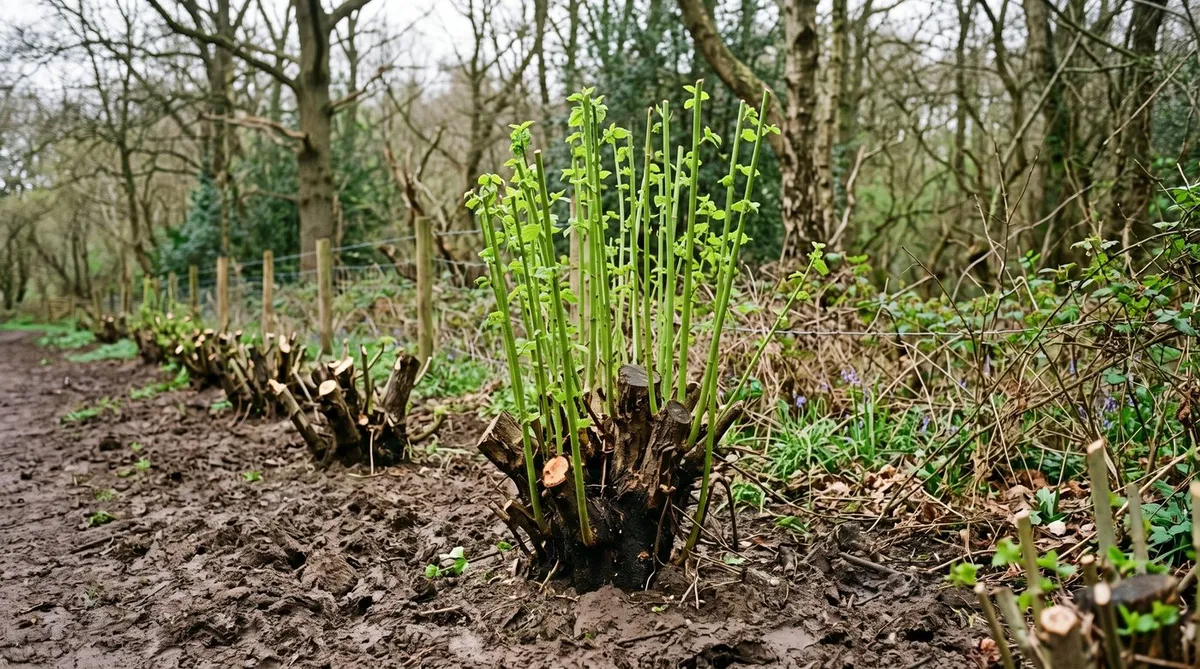
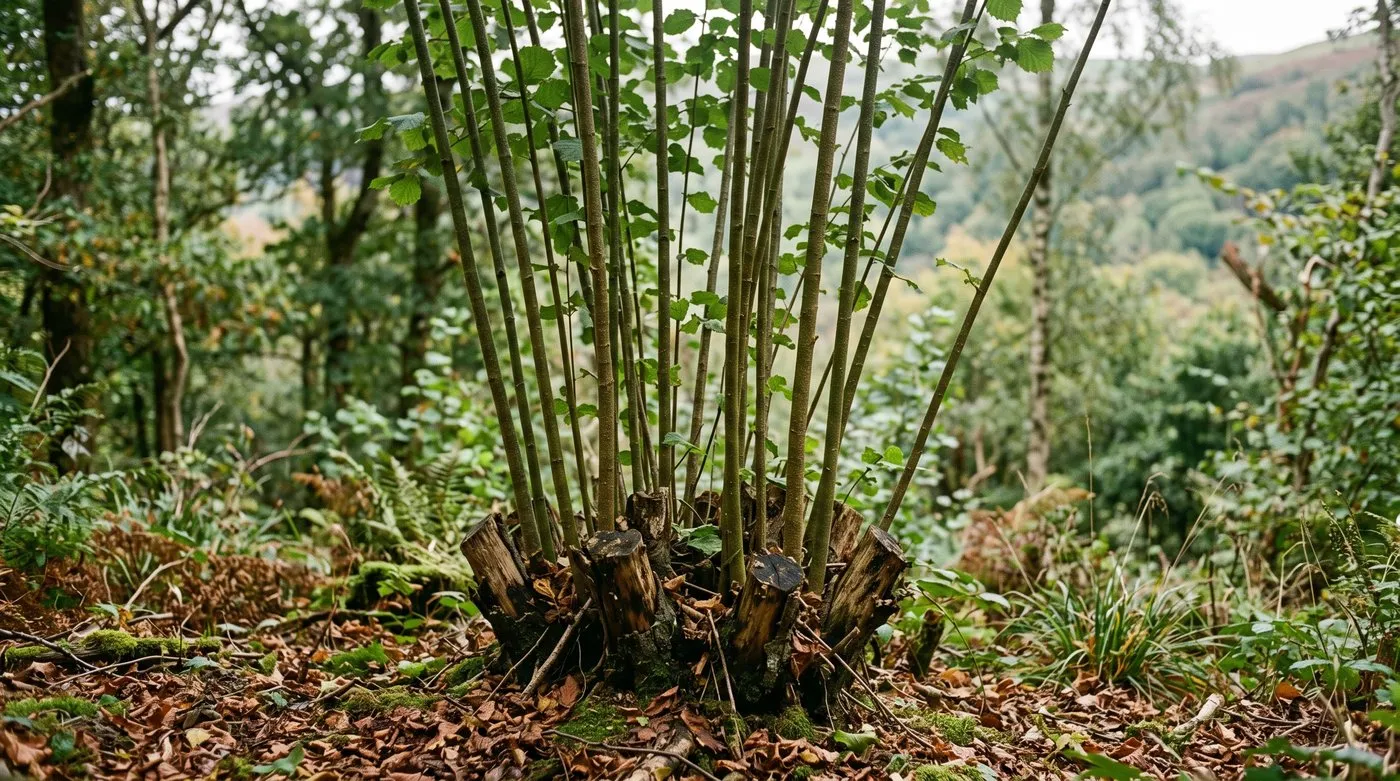 A hazel stool three years after cutting. From this single base rise 20 or more straight rods, the renewable crop that coppicing delivers.
When to cut: the dormant season window
Both jobs belong to the dormant season, roughly November to March. In that window the tree is leafless and resting, so it holds most of its energy in the roots and stool. Cut then and the regrowth is strongest. Cut in summer and you strip away the leaves the tree needs to feed itself, which weakens it badly.
Two rules narrow the window further. First, avoid hard frost: cutting frozen wood bruises the bark and slows healing, so pick a mild, dry spell. Second, respect the bird nesting season, which runs roughly March to August. It is an offence under the Wildlife and Countryside Act 1981 to disturb an active nest, so finish cutting by late February where you can.
Coloured-stem plants break the pattern slightly. Dogwood and coloured willow, grown for winter bark, are cut annually in early spring, usually March. You leave the bright stems standing all winter for the colour, then cut them back just as new growth begins.
| Month | Coppice and pollard work |
|---|---|
| November | Start cutting hazel, hornbeam and sweet chestnut once leaves fall |
| December | Main cutting month, work on dry, frost-free days |
| January | Continue coppicing, split and stack firewood and poles |
| February | Finish most cutting before birds start nesting |
| March | Cut coloured dogwood and willow to the base for fresh stems |
| April | Stop cutting, protect soft new regrowth from browsing |
| May to August | No cutting, nesting season, let growth run |
| September to October | Plan the next rotation, mark stools due for cutting |
For a fuller month-by-month plan across every pruning job, our year-round pruning calendar for the UK sits alongside this timing table.
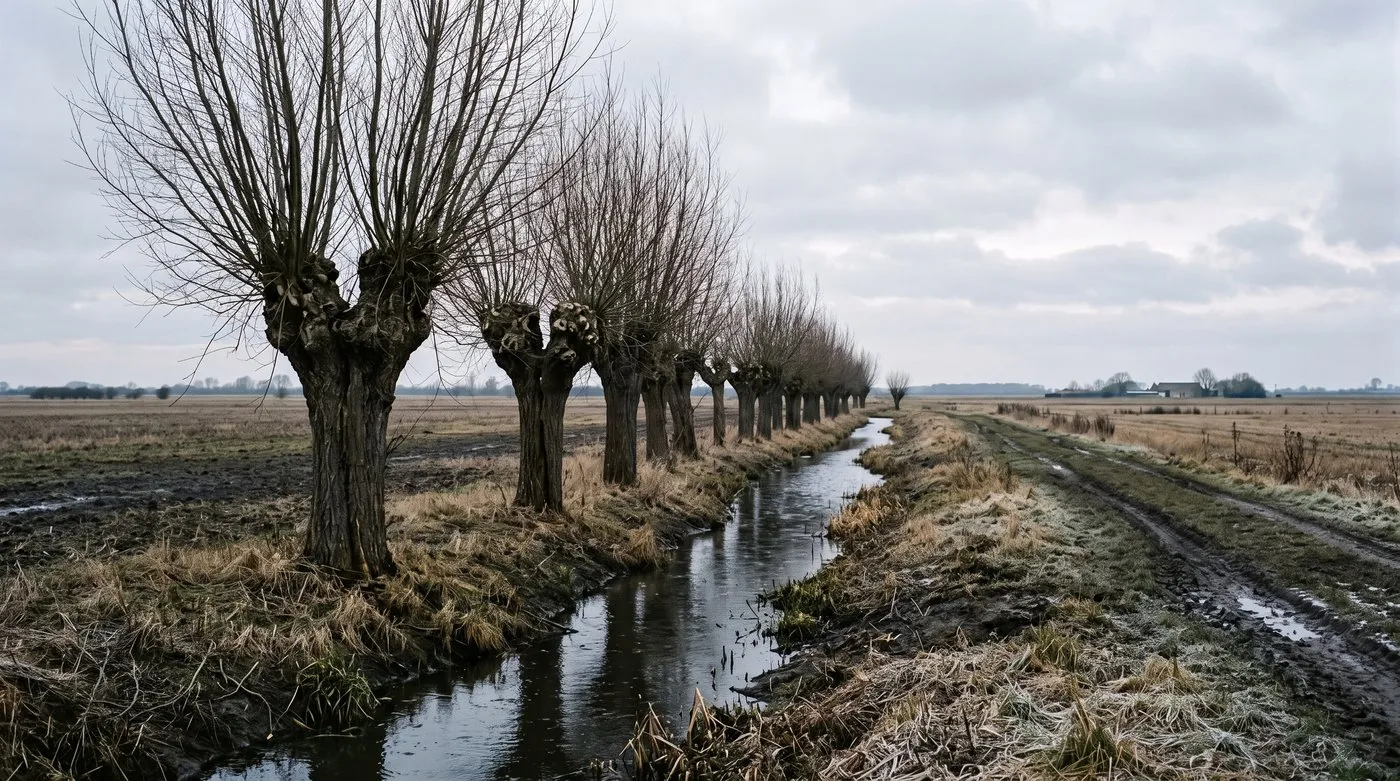 A line of pollarded willows on a fen edge, cut back to their knuckled bollings. Winter is the time to re-cut, while the trees are dormant and leafless.
How to coppice a tree step by step
Coppicing is straightforward once you have sharp tools and the nerve to cut low. The instinct is to leave a tall stump, but that is a mistake. Cut to 5 to 15cm above the ground and the stool stays low, tidy and long-lived.
Work through each stem with a pruning saw for anything thick and loppers or a billhook for the thin rods. Angle every cut slightly, so rainwater runs off the face rather than sitting on it and rotting the wood. Cut cleanly in one pass where you can, because a ragged, crushed cut lets in fungal rot.
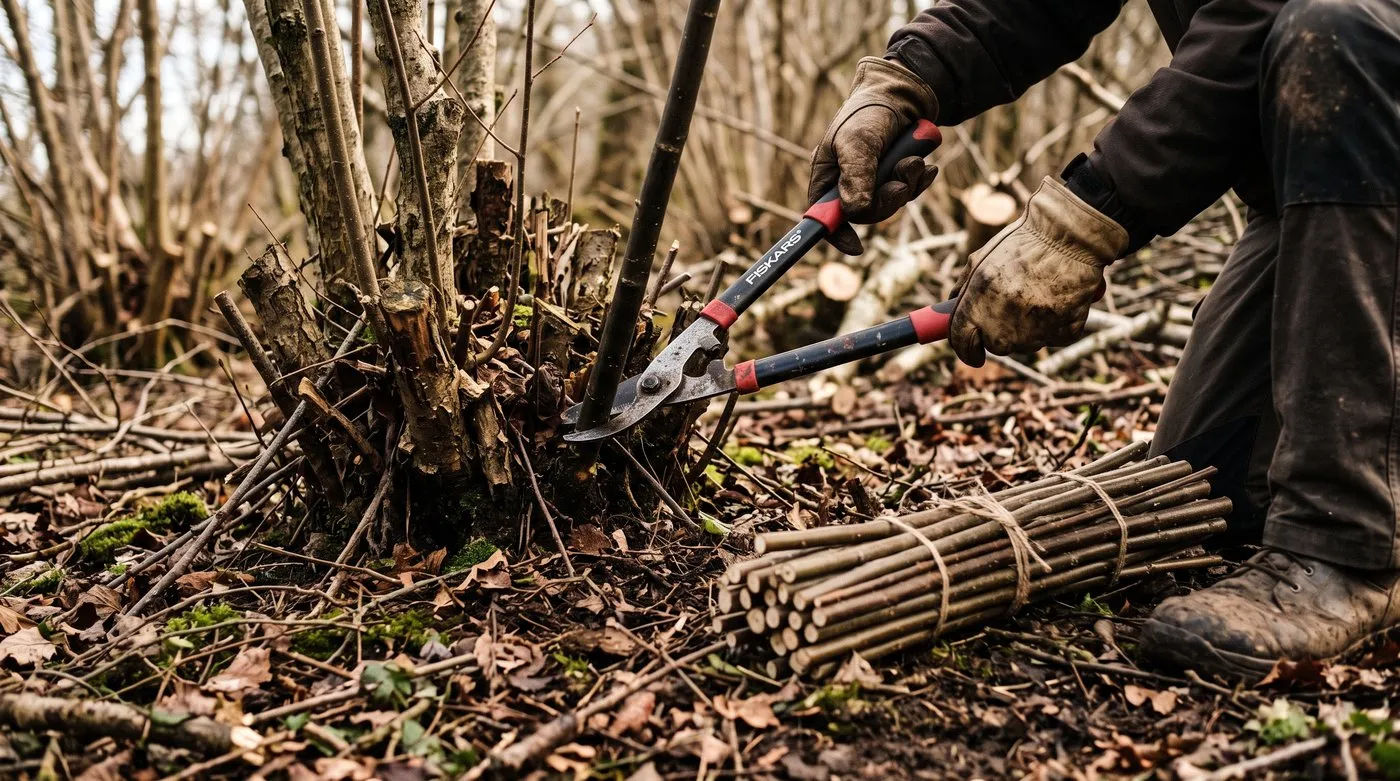 Cutting hazel rods low on the stool and bundling them by size. Thin straight rods make pea sticks, stouter ones become bean poles.
How to pollard a young tree correctly
Pollarding starts younger than most people expect. The trick is to begin before the tree is mature, then keep to the same framework for life. Let a young tree establish for 2 to 3 years after planting, until the trunk reaches your chosen height of 2 to 3m. Then make the first cut, removing the top and shortening the side branches to short stubs.
From that first cut the tree forms a bolling, the knuckled head where all future growth starts. Every re-cut goes back to the same bolling, never into the older wood below it. Cut just above the previous cut point, leaving the swollen knuckle intact. Re-pollard on a 1 to 5 year cycle depending on the species and the size you want.
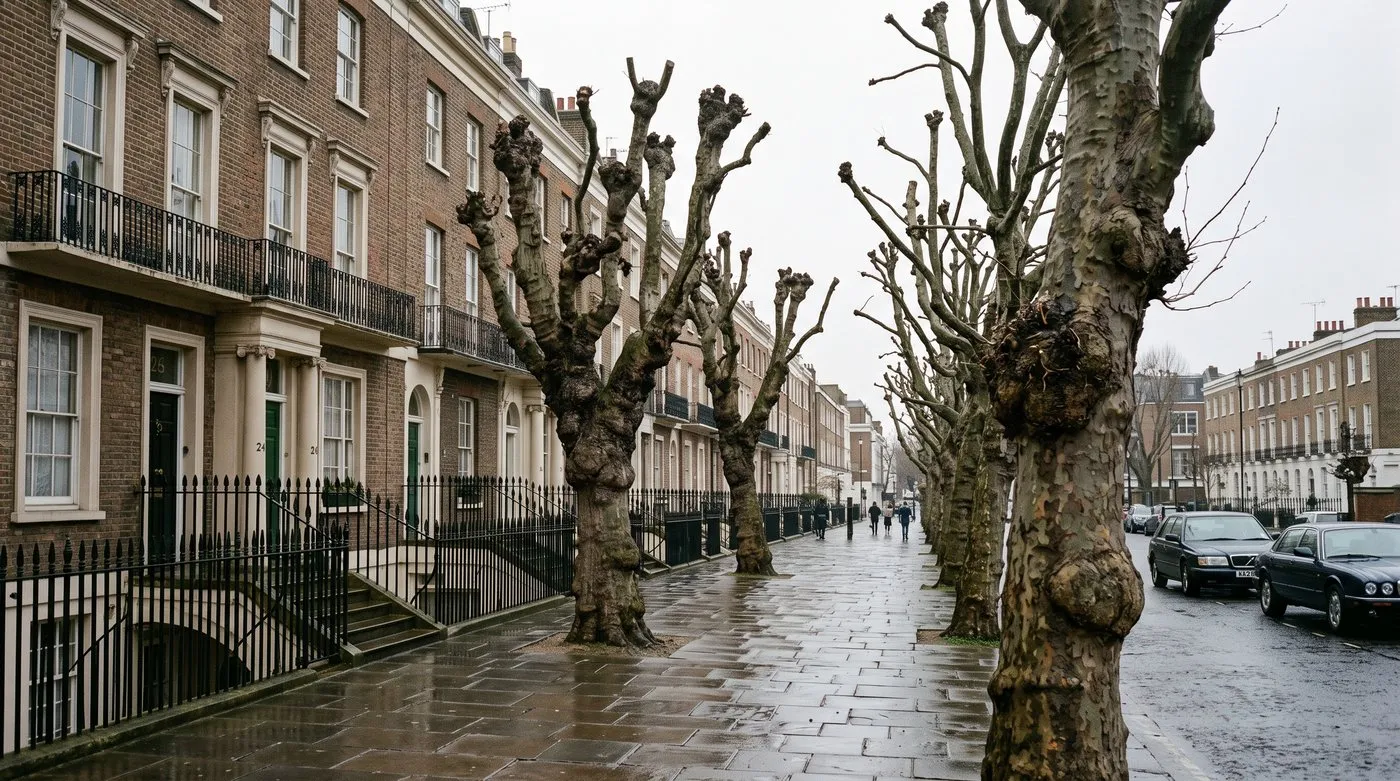 Pollarded London plane street trees, cut back to their bollings each winter. Pollarding keeps big trees small and safe beside pavements and buildings.
The critical warning is about age. Never pollard a large, mature tree that has never been cut. Taking a heavy crown off old wood can leave big wounds that rot, and the sudden loss of the canopy can kill the tree or make it structurally unsound. Formative pollarding of a young tree is a safe garden job. Restoring a lapsed old pollard is specialist work. For the general principles of cutting back woody plants, our guide on how to prune shrubs in the UK explains where and how growth responds to a cut.
Warning: Do not start pollarding a tree that is already tall, old and never cut, especially oak, beech or ash. The large wounds invite decay and the tree can become dangerous. Begin pollarding while a tree is young, or leave a mature tree to a qualified arborist.
Making a clean cut with sharp tools
The single biggest factor in a healthy stool or bolling is the quality of the cut. A clean cut with a sharp blade seals over quickly. A torn, crushed or ragged cut stays open and lets in the fungi that rot the wood. Before any cutting session, file and hone every edge: billhook, loppers and saw.
For any stem thicker than about 5cm, use the three-cut method so the falling wood cannot tear the bark. First, make an undercut on the underside of the limb, about 20cm out, cutting a third of the way through. Second, cut down from the top a little further out until the limb drops. Third, remove the remaining stub with a clean final cut at the stool or bolling. Without the undercut, a heavy limb peels a strip of bark down the trunk as it falls, opening a long wound.
Keep cuts angled and just proud of the collar or knuckle. Do not cut flush, and do not leave long snags. On our willow pollards, a clean saw cut at the bolling calluses over within one season. A ragged cut from a blunt saw took three years to close and grew a bracket fungus in the meantime. For taking off bigger limbs safely, our guide on how to remove large tree branches in the UK walks through the three-cut sequence in more depth.
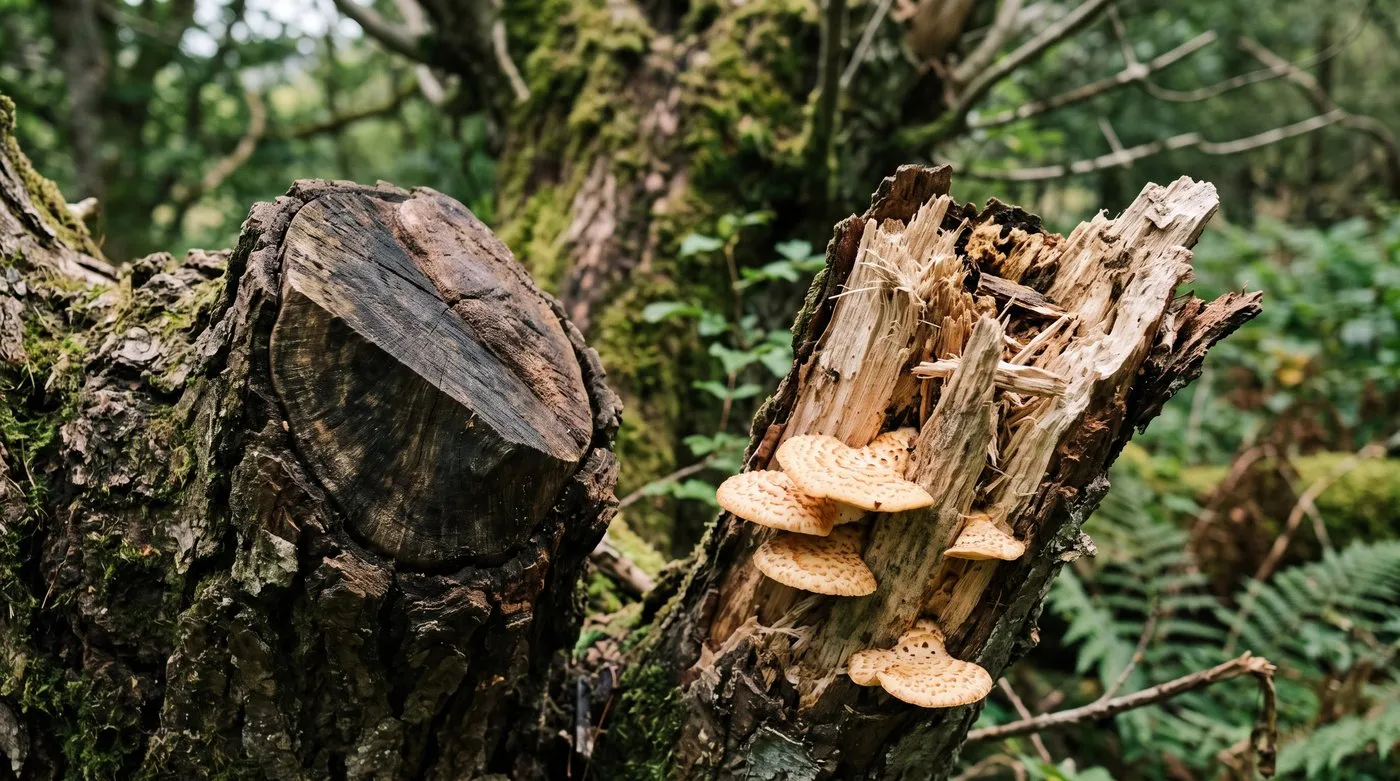 Left, a clean angled cut that will callus over in a season. Right, a torn cut from a blunt saw that let in rot. Sharp tools make the difference.
Hazel is the tree we would plant first for anyone starting out. It grows on almost any UK soil, tolerates our heavy clay, and regrows reliably. The rods are the most useful garden material a tree can give you. If you want to weave with the harvest as well, coppiced willow bends far better than hazel, and our guide to growing pussy willow in the UK covers the fast annual cutting cycle it needs.
The science: why cutting hard makes a tree live longer
It seems backwards that cutting a tree to the ground extends its life, but the biology is clear. A tree carries dormant buds under its bark, laid down years earlier and held in reserve. When you remove the top, you trigger these buds to shoot, drawing on the energy stored in the root system. The tree effectively resets to a juvenile state.
This is why a coppice stool outlives an uncut tree of the same species. An uncut hazel might live 60 to 80 years before it collapses under its own weight. A regularly coppiced stool keeps renewing and can reach several hundred years. The oldest coppice stools in Britain, some ash and small-leaved lime, are estimated at over 1,000 years old. The rhythm of cut, regrow, cut keeps the root system alive while the top is forever young.
Common mistakes when coppicing and pollarding
- Cutting in the growing season. Cut a tree in full leaf and you strip away the food factory it needs. Regrowth is weak and the tree is stressed. Always cut in the dormant season, November to March, and never disturb nesting birds.
- Leaving the coppice cut too high. A tall stump grows leggy, unstable stems and rots at the top. Cut the stool low, to 5 to 15cm, so new rods rise cleanly from near the ground and the base stays sound.
- Pollarding a mature, never-cut tree. Taking a big crown off old wood leaves wounds that decay and can make the tree dangerous. Start pollarding while a tree is young, or call an arborist for an old one.
- Using blunt tools. A crushed, torn cut is the main route for rot into the stool or bolling. Sharpen your billhook, loppers and saw before every session and cut cleanly in one pass.
- Abandoning the rotation. A stool left decades past its cut grows thick, heavy stems that are hard to saw and slow to regrow. Keep to the rotation, log your cut dates, and the stool stays productive for a lifetime.
Wildlife and the coppice cycle
Coppicing is one of the most wildlife-rich things you can do to a small plot of trees. Each cut opens the ground to light, and that light triggers a burst of woodland flowers that had been shaded out. Primroses, bluebells, wood anemones and violets respond within a year or two of a cut.
That flush of flowers feeds insects, and the insects feed everything above them. Fritillary butterflies in particular depend on the warm, open conditions of freshly cut coppice, laying eggs on the violets that colonise a cut plot. As the coppice regrows over the following years, the habitat shifts from open ground to scrub to shade, and different species use each stage. Cutting different plots in different years creates a patchwork of all these stages at once. The Woodland Trust has long championed this rotational cutting as a way to lift woodland biodiversity.
You do not need a wood to get the benefit. Even a short coppiced boundary throws up nectar and shelter that a static hedge cannot match. Pair it with the right nectar plants and the effect multiplies. Our guide to the best plants for butterflies in the UK lists partners that feed the adults your coppice clearing helps to breed.
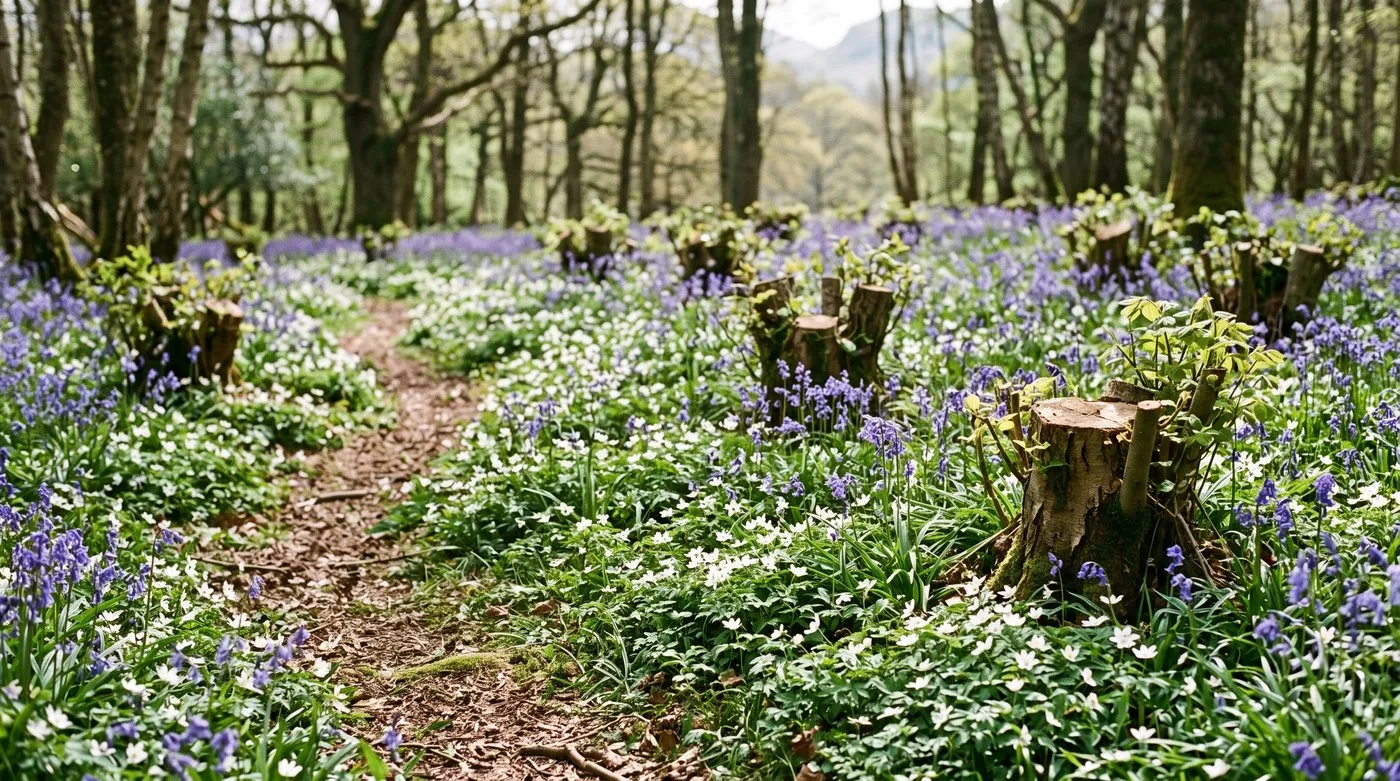 Spring flowers carpet the floor of a freshly cut coppice plot. The light let in by cutting triggers bluebells, anemones and the insects that follow.
Now you understand pollarding and coppicing, read our guide on growing hazel and cobnuts in the UK for the next step in setting up your own renewable rod supply.
Frequently asked questions
What is the difference between pollarding and coppicing?
Coppicing cuts a tree to ground level, pollarding cuts it to a raised trunk. Coppicing produces a low stool that throws up new stems from near the soil. Pollarding leaves a permanent trunk framework at 2 to 3m, so regrowth starts above the reach of grazing animals.
When should you coppice or pollard a tree in the UK?
Cut in the dormant season, November to March. The tree is leafless and resting, so it loses least energy and bleeds least sap. Avoid hard frost and never cut between March and August, when nesting birds are protected by law.
Which trees can be coppiced?
Hazel, sweet chestnut, willow, hornbeam, ash, oak, lime and field maple all coppice well. These broadleaves regrow strongly from a cut stool. Most conifers do not coppice, so pines, spruces and firs will die if you cut them to the ground.
How often do you coppice hazel?
Does coppicing or pollarding kill a tree?
No, done correctly it extends the tree’s life. Ancient coppice stools and pollards can be several hundred years old. The risk comes from pollarding an old, never-cut tree, which can rot or fail, so start young.
How high should you pollard a tree?
Pollard to a trunk framework at 2 to 3m above the ground. This keeps the regrowth above browsing height for deer and cattle. On street trees the height is set to clear traffic, pavements and buildings.
Can I coppice an overgrown shrub to rejuvenate it?
Yes, cutting overgrown hazel, dogwood, elder or willow to the base renews them. The hard cut forces vigorous new growth from the stool. For coloured-stem dogwood, cut annually in early spring to keep the brightest young bark.
Our team produces practical UK gardening guidance from source research, contributor records and established horticultural practice. Editorial standards are overseen by Matt W.