
Key takeaways
- Cut stem dogwoods down to about 15cm each March for the brightest winter colour
- Cornus alba 'Sibirica' has glowing red stems from November to March
- Cornus kousa is a flowering tree, so never cut it down hard
- Stem dogwoods cope with heavy clay, wet ground and part shade
- Mix red, orange and yellow stems for a cheerful winter display
- Hardwood cuttings in late autumn root easily in the open ground
Dogwood is one of the most useful shrubs you can grow. From November to March, when the rest of the border is asleep, its stems glow red, orange or yellow. Plant a group of Cornus alba ‘Sibirica’ and you’ll have stems like red lacquer shining in the low winter sun.
There’s more to dogwood than winter stems, too. Some are lovely small trees with big summer flowers and fiery autumn leaves. Cornus mas has cheerful yellow flowers on bare branches in late winter. Here’s how to choose, plant and prune them. For more winter colour, see our best winter flowering shrubs.
Which cornus species grow best in the UK?
There are five main dogwoods you’ll find in UK gardens. The big thing to know is how to prune each one. Stem types get cut back hard every spring. Flowering types must never be cut back hard.
| Species | Type | Main feature | Pruning |
|---|---|---|---|
| C. alba | Shrub | Red, dark or variegated winter stems | Cut to 15cm in March |
| C. sanguinea | Shrub | Orange and flame winter stems | Cut to 15cm in March |
| C. sericea (stolonifera) | Shrub | Yellow-green winter stems | Cut to 15cm in March |
| C. kousa | Small tree | White or pink flowers in June | Light shaping only |
| C. mas | Small tree or big shrub | Yellow flowers in February, red fruit | Just remove dead wood |
All of these are hardy in the UK. Cornus sanguinea is one of our own native hedgerow shrubs. The RHS hardiness ratings page explains how hardiness is measured if you’re curious.
What soil and position does cornus need?
Stem dogwoods grow wild along riverbanks and damp woodland edges. They’re happy in wet soil that would rot most shrubs. They grow in drier soil too, just a bit shorter.
For the brightest stems, plant in full sun or light shade. In deep shade the stems grow thin and the colour is weaker. A spot where the low winter sun hits the stems is perfect.
Flowering dogwoods like Cornus kousa prefer neutral to slightly acid soil that drains well. They don’t like thin chalk. On heavy clay, our clay soil improvement guide shows how to get the ground ready first. Cornus mas is the tree type that’s happy on chalk.
Best cornus varieties for vivid winter stems
These are the ones to choose for winter colour.
Cornus alba ‘Sibirica’ (red stems)
The classic. Bright coral-red stems that really glow in winter sun. It’s easy, reliable and looks wonderful in a group. If you only grow one dogwood, make it this one.
Cornus alba ‘Westonbirt’ (dark red stems)
Very similar to Sibirica, with a slightly deeper red. Some people find it a touch less bright from a distance. Worth trying if you spot it.
Cornus sanguinea ‘Midwinter Fire’ (orange-flame stems)
Each stem shades from yellow at the base through orange to red at the tips, like a flickering flame. A real winter favourite. A little less vigorous than Cornus alba types.
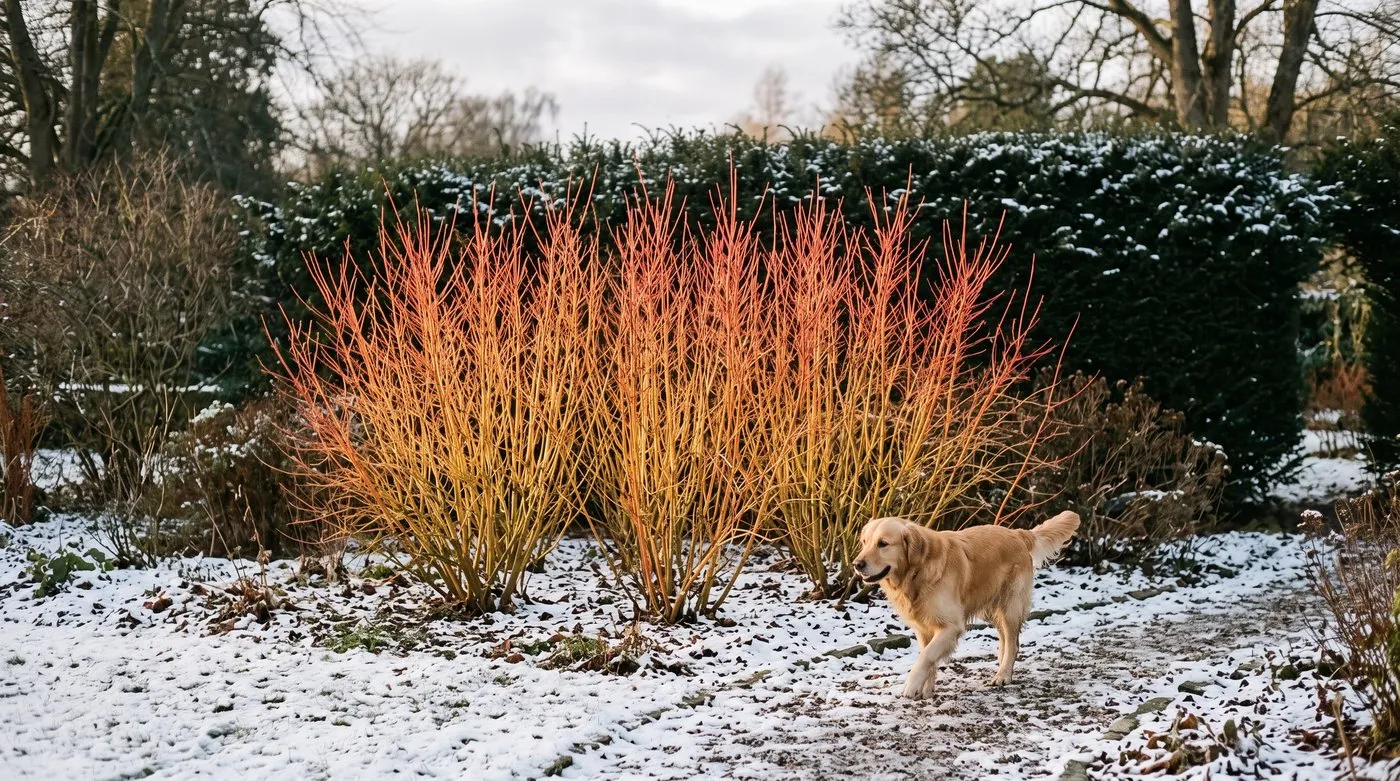
Each Midwinter Fire stem fades from yellow to orange to red, like a flame. A dark hedge behind and low winter sun make the colours glow.
Cornus sericea ‘Flaviramea’ (yellow-green stems)
Bright lime-yellow stems that look fantastic next to red ones. It spreads by suckers, so give it about 1.5m of space. Lovely beside water, where the stems reflect.
Cornus alba ‘Kesselringii’ (near-black stems)
Dark purple-black stems. Less showy from afar, but striking up close, especially against snow or white-barked birches.

Cornus kousa in flower. The white “petals” are really bracts around a tiny flower cluster. Never cut this one back hard.
How to plant cornus dogwood
Plant bare-root dogwoods from November to March, or potted ones any time. Bare-root plants are cheaper and settle in quickly. Our guide to planting bare-root trees shows how.
For a good winter show, plant stem types in groups of three or five, about 60-90cm apart. One plant on its own can look a bit lonely.
Planting steps
- Dig a hole twice as wide as the roots and the same depth.
- Loosen the bottom of the hole with a fork, especially on clay.
- Plant at the same depth it was growing before.
- Fill in with the soil you dug out.
- Water in well, even if the ground is damp.
- Mulch with bark or compost, keeping it off the stems.
Stem dogwoods don’t need a stake.
How to coppice cornus for the brightest winter stems
Cut stem dogwoods right down to about 15cm in March. This is the one job that makes all the difference. Without it, the colour fades as the stems get older and browner.
The brightest colour is on young stems. Cutting the plant down each spring gives you a fresh crop of stems that colour up by November. The same trick keeps the flamingo tree, Salix ‘Hakuro-nishiki’, bright and compact, so the two look great together. Coloured-stem willow can be cut back the same way.
Coppicing method
Use sharp loppers, or a pruning saw for thick stems. Cut every stem to 10-15cm above the ground with clean cuts. Clear the cuttings away.
Then sprinkle a handful of general fertiliser around the base and water it in. Mulch with compost or well-rotted manure. The plant grows a lot over the summer, often a metre or more, so a good feed helps.
Don’t like the bare look in summer? Cut half the stems each year, alternating sides. You still get bright young stems, with leafy growth on the other half.
The most common mistake is not cutting hard enough. Leave tall stumps and you get a top-heavy plant with colour only at the tips. Cut low and don’t be shy.
For more on pruning shrubs, see our step-by-step guide. Our spring pruning guide has the full March to-do list.

Cut all the stems to 10-15cm in March. It looks bare, but fresh coloured stems will be back by November.
How to grow Cornus kousa as a garden tree
Cornus kousa is a different plant altogether. It’s a small, spreading tree that looks good all year: white or pink flowers in June, layered branches in summer, red-purple autumn leaves and strawberry-like fruits in September.
It grows slowly into a broad tree of about 4-7m over many years. It’s one for patient gardeners, but it’s one of the loveliest small trees you can grow.
Best C. kousa varieties
Cornus kousa var. chinensis is the most popular form. Large white flowers that fade to pink.
Cornus kousa ‘Miss Satomi’ has soft pink flowers that deepen through June, plus crimson and purple autumn colour.
Cornus kousa ‘Milky Way’ flowers very freely, covering the branches in white.
Kousa likes neutral to acid soil that drains well. It dislikes thin chalk and waterlogged clay. On chalky soil, grow Cornus mas or a stem dogwood instead. For more ideas, see our best trees for small gardens.
Pruning flowering dogwoods
Never coppice flowering dogwoods. They flower on older wood, and cutting them down hard can kill them.
They only need a light tidy in late winter. Remove dead, damaged or crossing branches. Shape gently if you need to, taking off only a little each year. The layered branches are part of the charm, so work with them.
Winter stem colour guide: planning a mixed display

Red, yellow and orange stems together by water. The reflection doubles the colour.
Mixing stem colours gives you a cheerful show from November to March. The classic trio is red ‘Sibirica’, yellow ‘Flaviramea’ and orange ‘Midwinter Fire’.
Design approach
Plant each in groups of three or five, and let the groups blend at the edges. Put the tallest, ‘Sibirica’, at the back, ‘Midwinter Fire’ in the middle and ‘Flaviramea’ at the front.
A dark background makes the colours pop. A yew hedge is classic, but a dark fence or holly works too. Underplant with snowdrops, winter aconites and crocuses for colour at ground level.
Where to use cornus in the garden
Beside water is the classic spot. A row along a pond or stream looks natural and gives winter shape.
Winter borders pair dogwood with other winter plants. See our best winter flowering plants for ideas.
Informal hedges of Cornus alba, planted about 45cm apart, can be cut back each year for colour or left to grow taller.
Tricky spots like wet hollows, heavy clay and north-facing borders suit stem dogwoods well. For more shade-lovers, see our best shrubs for shade.
Cornus problems and pests in the UK
Dogwoods are mostly trouble-free. Stem types rarely have any real problems.
Anthracnose is a disease that can hit flowering dogwoods, especially Cornus florida, in cool, wet springs. Look for brown leaf spots and dying shoots. Cut out and dispose of affected branches. Cornus kousa is much more resistant, which is one reason it’s the better choice here.
Leaf scorch turns leaf edges brown in hot, dry summers, mainly on Cornus kousa in exposed spots. It’s just thirst, not disease. Mulch well and water deeply in dry spells.
Suckers from ‘Flaviramea’ can creep into nearby beds. Pull or cut them out each spring when you prune.
How to propagate cornus from hardwood cuttings
Hardwood cuttings are the easiest way to get more stem dogwoods. Take them in November or December, when the plant is dormant. No special kit needed.
Step-by-step method
- Choose straight, healthy stems about as thick as a pencil.
- Cut 20-25cm lengths. Make a flat cut just below a bud at the bottom and a sloping cut above a bud at the top, so you know which way is up.
- Make a narrow slit trench in a sheltered spot that drains well.
- Add a little sharp sand to the bottom.
- Push the cuttings in two-thirds deep, 10-15cm apart.
- Firm the soil and water.
- Leave them alone for a year.
By the next autumn most will have rooted and sprouted. Move them to their final spot that November. Free plants, just like the parent.
Cornus kousa is much harder from cuttings. Layering a low branch in spring is the easier option for the tree types.
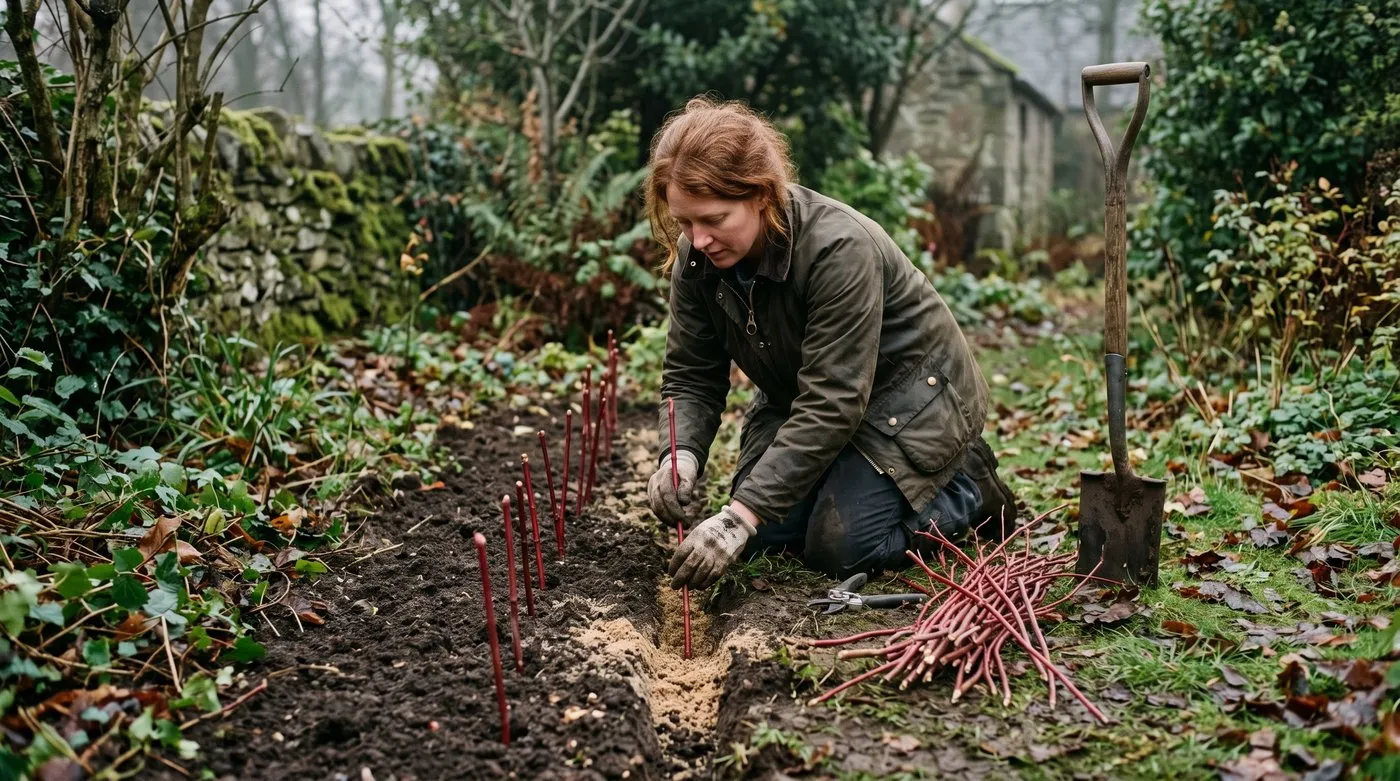
Push pencil-thick cuttings two-thirds into a slit trench and leave them be. By next autumn most will have rooted, ready to move.
Month-by-month cornus care calendar
| Month | Jobs |
|---|---|
| January | Enjoy the winter stems. Plan any changes |
| February | Order bare-root plants. Cornus mas flowers |
| March | Cut stem types down to 15cm. Feed and mulch |
| April | New shoots appear. Water if dry |
| May | Growth speeds up. Kousa buds forming |
| June | Kousa in flower. Water new trees in dry spells |
| July | Water first-year plants if dry |
| August | Keep watering new plants in dry weather |
| September | Kousa fruits ripen. Autumn colour starts |
| October | Best autumn leaves on kousa and florida |
| November | Plant bare-root dogwoods. Take hardwood cuttings |
| December | Winter stems at their best. Mulch young plants |
For more partners, our guides to flowering shrubs and trees for autumn colour are full of plants that look great with dogwood.
Frequently asked questions
When should I prune cornus dogwood for winter stems?
Prune in late winter or early spring, around March. Cut all the stems down to about 10-15cm above the ground. This is called coppicing. Young stems have the brightest colour. For a fuller shrub, cut out a third of the stems each year instead.
Can I grow cornus dogwood in heavy clay soil?
Yes, stem dogwoods are great on heavy clay. Cornus alba and our native Cornus sanguinea cope with damp, heavy ground and even the odd flood. Just add a little organic matter at planting.
What is the difference between Cornus alba and Cornus kousa?
One is a stem shrub and the other is a flowering tree. Cornus alba is grown for its bright winter stems and is cut back hard each spring. Cornus kousa is a small tree with white or pink flowers in early summer and good autumn colour. It needs very little pruning.
How fast does cornus grow after coppicing?
Very quickly, often a metre or more in one season. That’s why yearly coppicing works so well. By late autumn the new stems are showing their full winter colour. It grows best in moist soil and sun.
Which cornus has the best red winter stems?
Cornus alba ‘Sibirica’ is the favourite for bright red stems. They glow coral-red in low winter sun. For red stems plus white-edged summer leaves, try Cornus alba ‘Elegantissima’. Plant either where the low sun can light them up.
Is cornus dogwood poisonous to dogs or cats?
There’s no clear answer, so play it safe. Don’t let pets chew the stems or eat the berries. If a pet eats some and seems unwell, call your vet.
How do I take hardwood cuttings from cornus?
Take them in late autumn or winter once the leaves have dropped. Cut pencil-thick stems into 20cm lengths, flat below a bud at the bottom and sloping above a bud at the top. Push them two-thirds deep into a trench outside. Most will root by the next autumn.
Our team produces practical UK gardening guidance from source research, contributor records and established horticultural practice. Editorial standards are overseen by Matt W.


