Key takeaways
- Willow roots easily from cuttings pushed into damp soil in winter
- Cut coloured-stem willows down in late February for bright stems
- 'Britzensis' gives orange-red stems and 'Vitellina' golden-yellow
- Living willow tunnels and domes go in between November and March
- Goat willow is native and its catkins feed early bees
- Keep big willows well away from buildings and drains
Willow is one of the most forgiving trees you can grow. It’s happy in wet ground that drowns most plants, grows from bare sticks pushed into the soil, and gives you catkins in spring and glowing stems in winter. Few trees give so much for so little effort.
There’s a willow for almost every spot. Big weeping willows for lakesides, neat shrubby ones for borders and pots, native goat willow for wildlife, coloured-stem types for winter, and living willow woven into tunnels and domes. Here’s how to grow these native and garden trees, and how to keep them in check.
What types of willow grow in the UK?
For gardeners, willows fall into four handy groups. Britain has a good number of native willows, plus plenty of garden varieties.
Weeping willows
Big, graceful trees for big spaces. Salix x sepulcralis ‘Chrysocoma’ and its relatives are the classic weeping willows. They grow 15 to 25m tall and almost as wide, with branches sweeping the ground. They need a large garden. Their roots hunt for water, so plant them well away from buildings, drains and walls.
Pussy willow and goat willow
Goat willow (Salix caprea) is our native pussy willow. It grows as a large shrub or small tree, 6 to 10m tall. Fluffy silver catkins appear in February and March before the leaves, giving bees one of their first meals of the year. Male plants have the showiest catkins. ‘Kilmarnock’ is a little weeping form grafted onto a short stem, perfect for small gardens.

Pussy willow catkins open from February, an early feast for bumblebees waking from winter.
Coloured-stem willows
Grown for bright bark in winter. The colour is strongest on young stems, so cut them down every year.
- Salix alba ‘Britzensis’: orange-red to scarlet stems. The most popular one
- Salix alba ‘Vitellina’: golden-yellow stems. Lovely next to ‘Britzensis’
- Salix alba ‘Yelverton’: orange stems fading to yellow at the tips
- Salix daphnoides: plum-purple stems with a white, waxy bloom

Orange-red ‘Britzensis’ and golden ‘Vitellina’ glowing on a frosty morning.
Compact and ornamental willows
Salix integra ‘Hakuro-nishiki’ (flamingo willow) is a small, shrubby willow about 1.5 to 2m tall. Its new leaves come out pink and white. It’s often sold as a lollipop-shaped standard. Prune it hard in March to keep the colour coming. Our flamingo tree care guide has the full details.
Best willows for UK gardens
| Willow | Type | Size | What you’ll love | Best for |
|---|---|---|---|---|
| Weeping willow | Large tree | 15-25m | Sweeping branches | Big gardens by water |
| Goat willow | Native shrub or tree | 6-10m | Early catkins | Wildlife, hedges |
| ’Kilmarnock’ | Small weeping standard | 1.5-2m | Catkins, compact | Small gardens, pots |
| ’Britzensis’ | Cut back each year | Shrubby | Orange-red stems | Winter colour |
| ’Vitellina’ | Cut back each year | Shrubby | Golden stems | Winter colour |
| S. daphnoides | Cut back each year | Shrubby | Purple stems with white bloom | Winter colour |
| ’Hakuro-nishiki’ | Compact shrub | 1.5-2m | Pink and white leaves | Borders, pots |
| S. purpurea | Hedging shrub | 2-4m | Slim purple stems | Low hedges, screens |
How to plant willow
The easiest way is to push cuttings straight into the ground. No special kit or rooting powder needed.
Planting hardwood cuttings
This works for all willows except grafted ones like ‘Kilmarnock’. Take cuttings between November and February.
- Pick straight, healthy, pencil-thick stems from this year’s growth
- Cut them into 20 to 30cm lengths, flat at the bottom and sloping at the top so you know which way up they go
- Push two-thirds of each cutting into moist soil
- Firm the soil around it and water well
- Roots form over the next few weeks as the soil warms
Willow roots so easily that cut stems will even grow roots in a jar of water. For larger nursery willows, follow our guide to planting bare-root trees, at the same time of year.
Where to plant
Sun and moist soil suit willow best. Most types are happy in heavy clay, soggy patches, and beside ponds, streams and ditches. Goat willow and ‘Hakuro-nishiki’ cope with drier soil better than most.
Keep big willows away from buildings and drains. Willow is very thirsty, and on shrinkable clay its roots can cause subsidence. Plant full-sized willows at least 12m from buildings and 15m from drains, and further on clay. Willows cut back hard every year stay small and are much less of a worry.
Living willow structures
Push freshly cut willow rods into damp soil in winter, and they’ll root and leaf up by summer. You can make tunnels, arches, domes, screens and fedges (a cross between a fence and a hedge).
How to build one
Build between November and March, while the willow is dormant. Use fresh rods 1.8 to 2.5m long, from vigorous types like Salix viminalis (common osier) or Salix alba.
- Mark out the shape with canes or string
- Push rods 30 to 40cm deep into moist soil, about 15 to 20cm apart
- Weave rods across every 30cm or so to make it sturdy
- Tie crossing points with natural twine, which rots away as the willow knits together
- Water weekly through the first summer in dry spells

A living willow tunnel in its second year, leafy and shady by midsummer.
Trim living willow two or three times each summer to keep its shape, or it’ll quickly turn into a thicket. The thick growth gives birds great nesting cover, which makes it a nice addition to a wildlife garden.
Best willows for weaving
- Salix viminalis (common osier): long, straight, bendy rods. The classic weaving willow
- Salix purpurea: thinner, more flexible stems for fine work
- Salix alba: strong, tall rods for bigger tunnels and screens
Coppicing and pollarding willow
Coppicing means cutting willow right down every year or two. It keeps it small, gives bright stems and keeps the plant going for years.
How to coppice
Cut all the stems down to 15 to 30cm in late February or early March, before the buds open. Use loppers for thin stems and a pruning saw for thicker ones. The stump (called a stool) soon sends up lots of new shoots, which can be head-high by autumn.
Cutting every year gives the brightest colour. Every two years gives longer, thicker rods for weaving. Every three years gives sturdy poles for stakes.
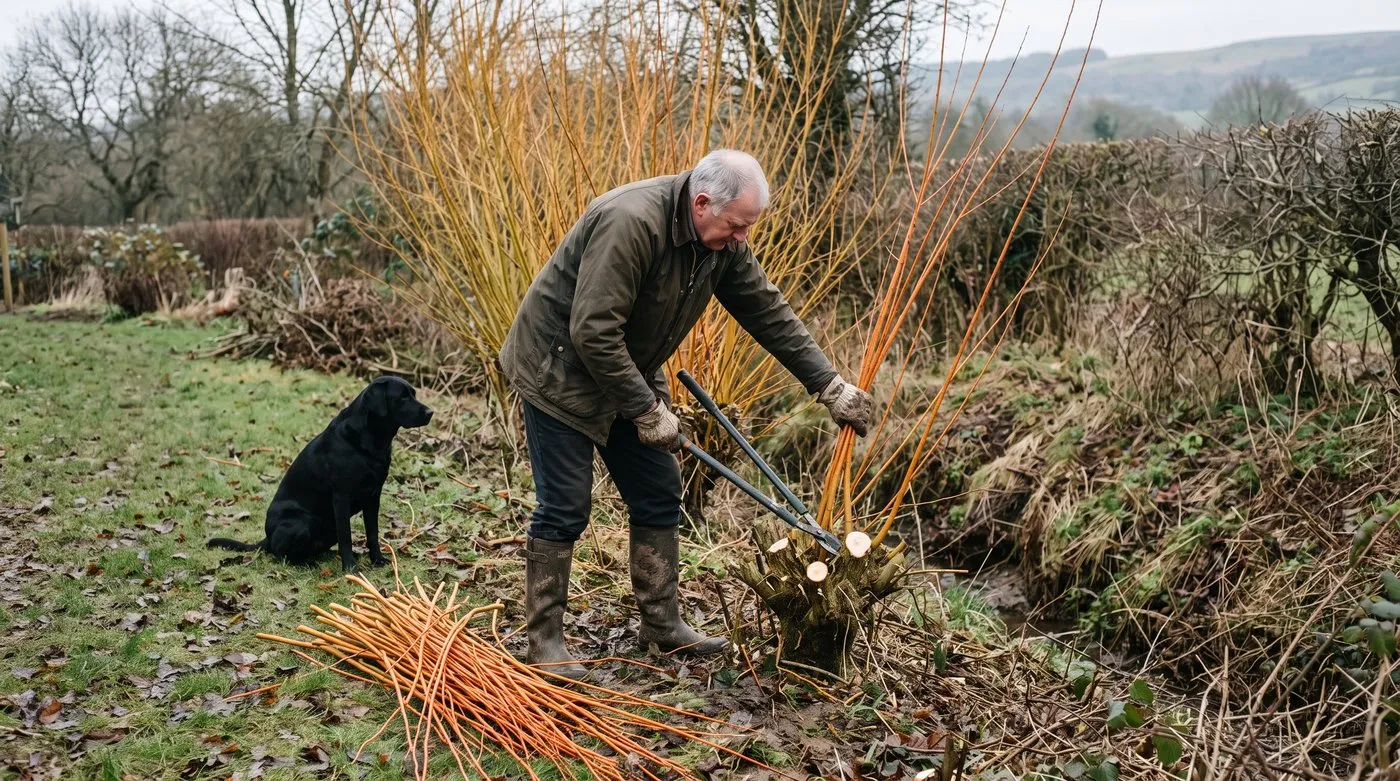
Cut back to a low stump before the buds open. Fresh shoots can be head-high by autumn, with the brightest winter colour.
Pollarding
Pollarding is the same idea, but you cut higher up, at about head height. You’ll see pollarded willows along rivers all over Britain. In a garden, it gives a knobbly framework with fresh coloured stems on top. See our guides to pollarding and coppicing and pruning for more.
Keeping willow under control
Willow grows fast, so it needs regular attention.
Near buildings
If you’re planting near a house, choose a small type or one you’ll coppice every year. You can also grow willow in a big container sunk into the ground to hold the roots in.
Stopping it spreading
Fallen twigs can root where they land on damp ground. Check around willows each spring and pull up any you don’t want. Crack willow (Salix fragilis) is especially good at this, which is why it spreads along rivers.
Willow jobs month by month
| Month | Jobs |
|---|---|
| January | Take hardwood cuttings |
| February | Coppice or pollard before the buds open |
| March | Plant new willows |
| April to May | Weave and tie in living willow |
| June to August | Trim living structures two or three times |
| September | Last trim of living structures |
| October | Order fresh rods for winter planting |
| November to December | Build new structures and enjoy the winter stems |
Willow for wildlife
Willow is brilliant for wildlife. Few native trees support so many insects.
Early food for bees
Willow catkins are one of the first big pollen sources of spring. Goat willow and grey willow flower from February, well before most trees. Bumblebee queens coming out of hibernation rely on them. Even one goat willow makes a difference.
Food for caterpillars
Willow feeds the caterpillars of the purple emperor butterfly, puss moth, eyed hawk-moth and many more. Its thick leaves shelter warblers, long-tailed tits and wrens. Leave a bit of dead willow wood lying around for beetles and fungi.
Buying healthy plants
Buy UK-grown willow from a good nursery. Watermark disease is a bacterial disease of willows, especially cricket-bat willow, that causes stained wood and dieback. Healthy, UK-grown stock is the best way to avoid bringing problems in.
Willow hedges
Willow makes a quick, wildlife-friendly hedge for damp ground. Salix viminalis and Salix purpurea are the best types. Push cuttings in 20 to 30cm apart in a staggered double row in winter. It grows fast, so trim it twice a year, in June and October.
Willow hedges are great beside streams, ditches and soggy field edges where other hedging plants struggle. The roots also help hold stream banks together. On damp ground, mix willow with silver birch and alder for a native boundary.
Growing willow in pots
Compact willows like ‘Hakuro-nishiki’ and ‘Kilmarnock’ are happy in big pots. Use a pot of at least 40 litres with drainage holes and a loam-based compost that holds moisture. Water daily in summer, because willow in pots dries out fast. Feed monthly from April to August with a balanced liquid feed. Repot every few years, trimming the roots back a little.
Frequently asked questions
When should I plant willow in the UK?
Plant between November and March, while it’s dormant. Cuttings pushed into moist soil in winter root reliably by spring. Potted willows can go in at any time, but winter is best. Avoid frozen or waterlogged ground.
How fast does willow grow?
Very fast, often a metre or more a year. Coppiced willow on damp soil can grow head-high in a single season. Big weeping willows end up 15 to 25m tall. Even compact types grow quickly, so prune them every year.
Can I grow willow in a small garden?
Yes, if you pick a compact type and prune it each year. ‘Hakuro-nishiki’ stays at 1.5 to 2m when cut back hard each March. ‘Kilmarnock’ is a little weeping willow on a short stem that doesn’t get taller. Avoid full-sized weeping willows, which need lots of space.
How do I take willow cuttings?
Take them between November and February. Cut straight, pencil-thick stems from this year’s growth into 20 to 30cm lengths. Push two-thirds of each into moist soil. You don’t need rooting powder, as willow roots very easily.
Will willow damage my drains or foundations?
It can, because willow roots chase water. They can get into cracked drains and cause subsidence on shrinkable clay. Plant full-sized willows at least 12m from buildings and 15m from drains, and further on clay. Willows coppiced every year stay small and are much less of a risk.
What is coppicing and why do it?
It means cutting the stems right down near the ground in late February. The stump sends up lots of fresh shoots in spring. Doing it every year gives the brightest winter stems, rods for weaving and a plant that stays a manageable size.
Which willow is best for wildlife?
Goat willow is a wonderful choice. It feeds lots of insects, including purple emperor and puss moth caterpillars. Its catkins give bumblebees early pollen from February. Grey willow is another great native choice.
Our team produces practical UK gardening guidance from source research, contributor records and established horticultural practice. Editorial standards are overseen by Matt W.