Key takeaways
- Plant bulbs three times their own height deep, in autumn or early spring
- Put a layer of grit under each bulb, especially on clay
- Asiatics flower in early summer, Orientals in late summer
- Lilies love pots, so they're great if your soil is heavy
- Pick off red lily beetles every day from April
- All parts of lilies are very dangerous to cats
Lilies are one of the most rewarding bulbs you can grow. They give you big, dramatic flowers from June to September for very little effort. Got a sunny border, a shady corner or just a few pots on the patio? There’s a lily for you.
What types of lily can I grow in the UK?
There are seven main groups. Each differs in height, scent and flowering time, so pick the one that suits your spot.
Asiatic lilies are the easiest for beginners. They flower first, in June and July, and grow 60-120cm tall. They have no scent but come in the widest range of colours, from red, orange and yellow to pink, white and almost black. They’re very hardy.
Oriental lilies have the biggest, most fragrant flowers. They bloom later, in August and September, and grow 90-150cm. They like lime-free soil. On a still evening you’ll smell them from across the garden.
Trumpet lilies are the tallest, reaching 120-200cm. They flower in July and August with large, scented trumpets. Lilium regale is the best-known and one of the easiest.
Martagon lilies are the ones for shade. Their small “Turk’s cap” flowers hang in clusters along the stem in June and July. They’re happy on chalky soil and spread gently in woodland.
LA hybrids cross Asiatics with Easter lilies. You get large flowers, good colours and strong stems in July. They’re great for cutting.
OT hybrids cross Orientals with trumpets. They’re vigorous, with huge scented flowers on tall stems. ‘Scheherazade’ is the best-known.
Species lilies are the wild originals. Lilium martagon, L. pyrenaicum and L. regale all grow happily in UK gardens and are good for naturalising in grass or woodland. For something a bit different, the climbing gloriosa, the flame lily, brings the same exotic shape to a warm, sheltered pot.
Best lily varieties for UK gardens
These six are dependable, good-looking choices.
‘Stargazer’ (Oriental) is the lily most people know. Deep pink with darker spots, very fragrant and about 90cm tall. It flowers in August and does well in pots.
‘Casa Blanca’ (Oriental) has huge pure white flowers and a powerful scent. It grows 100-120cm, likes lime-free soil and wants shelter from strong wind.
‘Regale’ (Trumpet) has white trumpets with a pink-purple back and a golden throat. The scent is sweet and honeyed. It’s the toughest, most forgiving lily here and flowers in July.
 Lilium regale in full flower. It’s a tough trumpet lily that copes with clay if you add grit.
‘Black Out’ (Asiatic) has deep maroon, almost black flowers on 90cm stems. No scent, but what a colour. The stems are sturdy enough to stand without a stake.
‘Enchantment’ (Asiatic) is bright orange with black spots, 80-100cm tall. It’s an old favourite that bulks up quickly in a border and flowers in June.
‘Scheherazade’ (OT hybrid) has deep crimson petals edged in cream. It grows 150-180cm and puts on a real show in July and August. Give it a sturdy stake.
How to plant lily bulbs
Depth and drainage matter most. Get those right and lilies will look after themselves for years.
When: October and November are ideal. March and April work too. Don’t plant into frozen or waterlogged ground.
Depth: Plant each bulb three times its own height deep. That’s usually 15-20cm.
Spacing: 15-20cm apart for Asiatics, 20-30cm for Orientals and trumpets. Leave room for clumps to spread.
Grit: Put a 5cm layer of coarse grit under each bulb so its base doesn’t sit in water. On heavy clay, don’t skip this.
Backfill: On clay, mix plenty of grit into the soil you put back. On lighter soil, the soil as it is will do. Firm gently and water in.
For more on timing, see our guide to planting spring bulbs, which covers all kinds of bulbs.
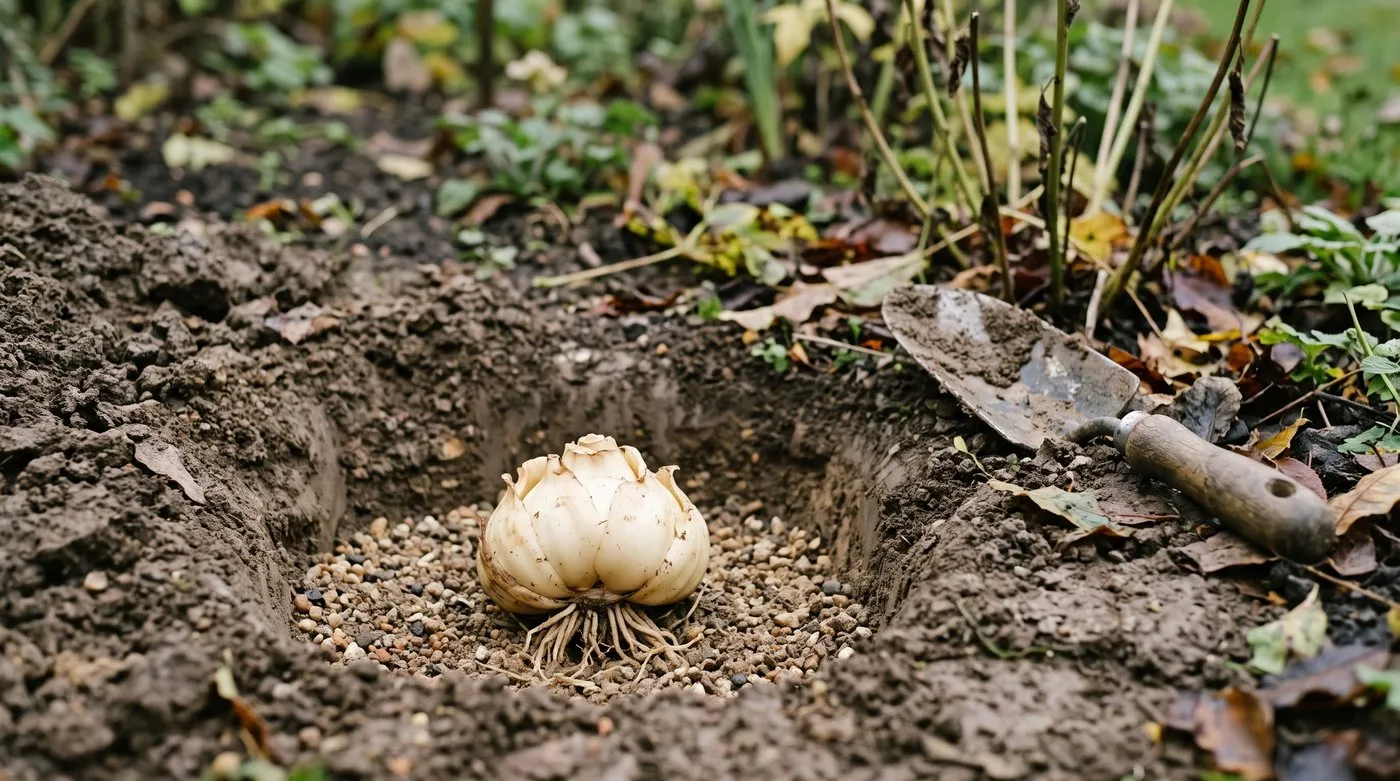
Plant three times the bulb’s own height deep, on a bed of grit. On clay, the grit stops the base sitting in water.
How to grow lilies in containers
Lilies make brilliant container plants because you control the drainage. If you garden on heavy clay, pots are often the easiest way to grow them.
 Oriental lilies in 30cm pots on a patio. In a pot, you choose the compost and the drainage.
Pot: At least 30cm wide and 30cm deep, with three bulbs per pot. For tall varieties, use a heavy pot so it doesn’t blow over.
Compost: John Innes No. 2 with a few handfuls of perlite or grit. For Orientals, mix in some ericaceous compost. Multipurpose compost on its own gets too soggy over winter.
Planting: Put grit in the bottom, add compost, and set the bulbs three times their height below the surface. Cover, water once and wait for shoots.
Watering: Once shoots appear, water when the top few centimetres feel dry. In summer that’s every two or three days. Too much water is the main thing that kills potted lilies.
Feeding: A tomato feed every two weeks from first shoots until the flowers fade. This builds up the bulb for next year.
Winter: Move pots against a house wall and wrap the pot (not the plant) in bubble wrap or hessian. Compost in a pot freezes much faster than soil in the ground.
Soil, position, and feeding
Soil: Lilies need good drainage above all. Mix grit into clay, and garden compost into sandy soil. Most lilies are happy in neutral soil. Martagons don’t mind chalk. Orientals want lime-free soil, so on chalk grow them in pots.
Position: Full sun to light shade. Most lilies flower best with six hours or more of sun. Martagons and some species lilies cope with dappled shade. Lilies like “warm heads, cool feet”, so plant low perennials around them or mulch to shade the soil.
Feeding: Start a half-strength tomato feed every two weeks once shoots reach about 15cm. Keep going until two weeks after the last flower fades. Fed bulbs flower much better the following year, just like your other scented plants.
Mulching: In late autumn, spread 5-7cm of bark, leaf mould or garden compost over the area. Keep it pulled back from new shoots in spring.
Staking tall lily varieties
Lilies over about 100cm usually need a stake, especially trumpets, OT hybrids and Orientals with lots of flowers. A stem loaded with big blooms is easily knocked over by wind and rain.
When: Put the stake in when shoots are 30-40cm tall, before the buds form.
How: Push a 150cm cane about 20cm into the ground, a few centimetres from the stem, so you miss the bulb. Tie the stem loosely with soft twine in two places: halfway up and just below the lowest bud.
Another way: Put ring supports or pea sticks around a group in early spring and let the stems grow through.
Short Asiatics and dwarf pot lilies don’t need staking at all. They’re the best choice for a windy garden.
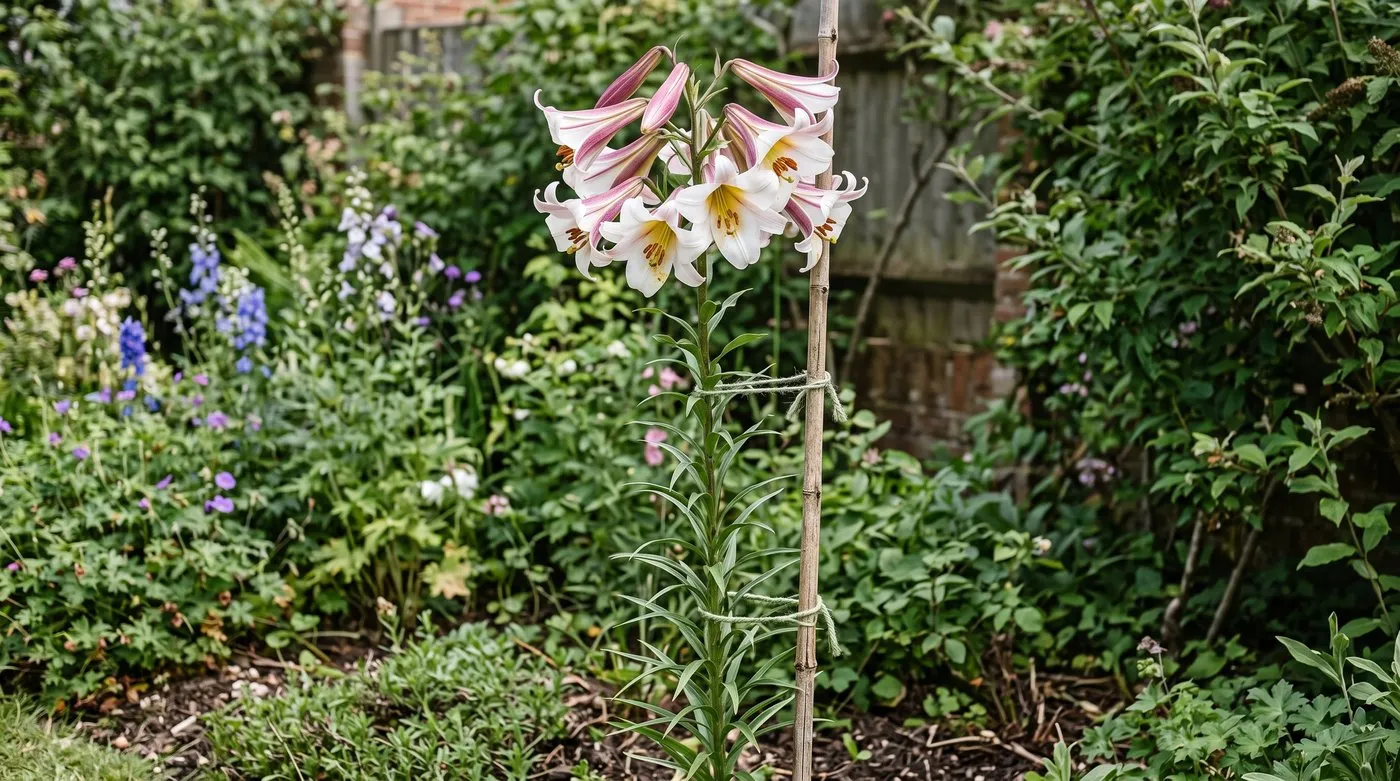
Put the cane in when shoots are 30-40cm tall, a few centimetres from the stem so you miss the bulb. Tie loosely in two places.
How to identify and control lily beetle
 An adult lily beetle: small, bright red and the biggest pest of lilies in UK gardens. Start checking in April.
What to look for: Adults are about 8mm long and bright scarlet with black legs. They even squeak when you pick them up. The grubs are orange-brown and cover themselves in their own slimy black droppings, so they look like bird mess on the leaves.
When they appear: Adults come out of the soil in spring and start nibbling the leaves. They lay rows of tiny orange eggs under the leaves, and the grubs that hatch strip the foliage fast.
Hand-picking: This is your best defence. Check every lily every day from April to September. Adults drop to the ground and land upside down to hide, so hold your hand or a white tray underneath first. Squash adults and grubs, and rub off any egg rows.
Sprays: Home-made neem, garlic or soap sprays aren’t authorised as pesticides in the UK, so they’re not a legal option. If hand-picking can’t keep up, use an authorised acetamiprid spray exactly as the label says. Never spray open flowers or when bees are about.
The RHS lily beetle advice is good on spotting them. For more detail, see our guide to lily beetle identification and control.
After flowering care
The weeks after flowering set up next year’s show. The leaves are busy feeding the bulb, so leave them be.
Deadheading: Snip off faded flowers just below the seed pod. Leave the stem and all the leaves. Making seed takes energy away from the bulb.
Leave the stem: Don’t cut the stem until it has turned fully yellow or brown, usually between late September and November.
Last feed: Give one more tomato feed after deadheading.
Cutting back: Once the stem has yellowed, cut it to about 5cm above the soil. Bin the stems rather than composting them, as they can carry grey mould and beetle grubs.
Lilies make wonderful cut flowers. When cutting for the house, take no more than a third of the stem so the bulb keeps enough leaves. For another late-summer scent in the cutting patch, see our guide to growing tuberose in the UK.
Overwintering lilies in the UK
Most lilies are fully hardy and can stay in the ground all winter. Only a few tender species need lifting or a thick mulch.
In borders: Mulch with 5-7cm of bark or leaf mould in November. It stops frost pushing shallow bulbs up out of the soil. Go a little thicker on exposed sites.
In pots: Move them against a south or west-facing house wall. Wrap the pot in bubble wrap or hessian and stand it on pot feet so it doesn’t sit in water. Water lightly about once a month, just so the compost doesn’t dry out completely.
Dividing: Every three or four years, lift crowded clumps in late autumn. Separate the bulbs, throw away any soft ones and replant straight away at the right depth, with fresh grit underneath.
To plan colour all year with layered bulbs, see our guide to bulb lasagne planting.
Lily type comparison table
| Type | Flowers | Scent | Good for |
|---|---|---|---|
| Asiatic | June to July | None | Beginners, any soil |
| Oriental | August to September | Strong | Pots, lime-free soil |
| Trumpet | July to August | Strong | Tall, sunny borders |
| Martagon | June to July | Light | Shade, chalky soil |
Asiatics are usually the longest-lived in borders, with trumpets close behind. Orientals are the fussiest on heavy soil and often do better in pots. Whichever you grow, grit under the bulb makes a big difference on clay.
Toxicity warning
All true lilies are very dangerous to cats. Any part, including pollen and the water from a vase, can cause kidney failure. If a cat touches lily pollen or chews any part of the plant, call your vet straight away.
If you have cats, it’s safest to skip lilies and choose other summer flowers, checking each one is cat-safe before you buy.
Frequently asked questions
When is the best time to plant lily bulbs in the UK?
October and November are best. Autumn planting gives the bulbs all winter to grow roots. March and April work too, though flowers may come a little later in the first year. Lily bulbs have no papery skin and dry out quickly, so buy firm, plump ones and plant them within a week.
How deep should I plant lily bulbs?
Plant them three times their own height deep. A 5cm bulb goes 15cm down and a 7cm bulb goes about 20cm down. Many lilies also grow roots on the stem above the bulb, so planting deep helps hold tall stems steady.
Can I grow lilies in pots and containers?
Yes, lilies are brilliant in pots. Use a pot at least 30cm wide and deep, with three bulbs in it. Fill with John Innes No. 2 mixed with a few handfuls of grit or perlite. Water every two or three days in summer and feed every two weeks with tomato feed. Move pots against a house wall for winter.
Why are my lily leaves turning brown?
Lily beetle, grey mould or soggy soil are the usual causes. Check under the leaves for red beetles and slimy brown grubs. Brown spots that spread in wet weather are grey mould (botrytis). If the whole stem browns from the bottom up, the bulb may be rotting in wet ground.
Are lilies poisonous to cats?
Yes, very. A tiny amount of pollen licked from fur can cause kidney failure in cats. If you have cats, don’t grow lilies anywhere they can reach, and don’t bring cut lilies indoors. If a cat touches or chews a lily, call your vet straight away.
How do I stop lily beetle destroying my plants?
Pick them off by hand every day from April. The adults are bright red and drop to the ground when disturbed, so hold a hand underneath first. Squash the slimy brown grubs under the leaves too. Home-made neem or soap sprays aren’t authorised in the UK. For a bad attack, use an authorised acetamiprid spray exactly as the label says.
Do lilies come back every year in UK gardens?
Yes, most lilies come back year after year. Asiatic and martagon lilies are the toughest. Good drainage is the key, because bulbs sitting in wet clay over winter will rot. Add grit when planting and divide clumps every three or four years to keep the flowers big.
Our team produces practical UK gardening guidance from source research, contributor records and established horticultural practice. Editorial standards are overseen by Matt W.