Key takeaways
- Horsetail roots go far deeper than you can dig, so digging it out of an established patch won't work
- Keeping it in check, not getting rid of it completely, is the realistic goal
- Smothering with thick black polythene for at least two years weakens it well
- If you use weedkiller, crush the stems first and paint on a gel
- Never rotavate a patch of horsetail, as it spreads bits of root everywhere
Horsetail (Equisetum arvense) is one of the trickiest weeds you can get. It’s an ancient plant, around since long before flowers, and it’s very good at surviving.
Two things make it hard work. Its roots can go down 2m, far below any spade. And its stems are tough and waxy, so most weedkillers just run off. Little tubers on the roots store food too, so it keeps coming back even after you’ve pulled every stem.
The good news? You can keep it under control. Here’s how to spot it, which methods work, and how long to expect. Knowing up front that the aim is to weaken it, not wipe it out, saves a lot of frustration.
How to Identify Horsetail
Horsetail looks like a tiny green bottle brush or a miniature pine tree. Young spring shoots look quite different, so it’s worth knowing both.

In early spring, pale brown shoots with cones on top appear first. The familiar green bottle-brush stems follow from May.
How to recognise it:
- Spring shoots (March-April): Pale pinkish-brown stems, 10-25cm tall, with a little cone on top. No leaves or branches.
- Summer stems (May-October): Upright, jointed, bright green stems with rings of thin, needle-like branches at each joint.
- Feel: Rough, like fine sandpaper. Run your fingers up a stem and you’ll know.
- Stems: Hollow and ridged, with dark rings at each joint.
- Where it grows: Wet, squashed or badly drained soil. It finds the soggiest corner first.
| Horsetail | Mare’s tail | Dutch rush | |
|---|---|---|---|
| Where | Garden soil, roadsides | In ponds and at the water’s edge | Wet woods, stream banks |
| Feel | Rough and scratchy | Smooth and soft | Rough and stiff |
| Branches | Lots of fine whorls | None | None |
| A garden weed? | Yes, a stubborn one | Rarely, it lives in water | Sometimes |
Mare’s tail often gets mixed up with horsetail, but it only grows in or beside water. It’s horsetail you need to worry about in borders and lawns.
Why Horsetail Is So Hard to Control
Deep roots and tough stems are the two big problems.
Problem 1: Root Depth
The roots go deep, often well below anything you can dig. Along them are small tubers, each one a little food store that can send up new shoots. Dig out the top layer, and the tubers lower down just keep going.

The roots go deep, and the little tubers along them can each send up new stems. That’s why digging doesn’t work.
So digging isn’t the answer for an established patch. In fact, it breaks the roots into pieces, and each bit with a tuber can grow into a new plant.
Problem 2: Silica Coating
The stems are coated in a hard, glassy layer (that’s what makes them feel rough). It stops weedkiller soaking in, so spray on unbroken stems has little effect.
The trick is to crush or bruise the stems first to break that coating, then apply weedkiller gel straight away. More on that below.
Method Comparison
| Method | Chemical-free? | How long | What to expect | Best for |
|---|---|---|---|---|
| Black polythene | Yes | 2+ years | Good thinning out | Open beds and cleared ground |
| Regular pulling or hoeing | Yes | Several years | Gradual weakening | Small patches, mixed borders |
| Crushed stems + weedkiller gel | No | 2-3 seasons | Good thinning with steady effort | Beds without precious plants |
| Better drainage | Yes | Ongoing | Makes it less at home | Everywhere, alongside other methods |
| Lined raised beds | Yes | Straight away | Grow food above the problem | Veg growing on infested ground |
| Root barrier | Yes | Straight away | Stops it creeping in from next door | Boundaries |
Controlling Horsetail: Step-by-Step Methods
Method 1: Black Polythene Smothering
This is the best method without chemicals, and the one the RHS suggests for horsetail where you can keep the ground covered for a long time.
How it works: Cut off the light and the plant has to use up its stored food to keep making new shoots. Horsetail has a lot stored away, so this takes at least two years.

Heavy black polythene, weighted down well. Leave it for at least two years before you check.
What you need:
- Heavy-duty black polythene, thicker than the standard kind
- Bricks, timber or soil to weigh down every edge
- Patience for two years
Step-by-step:
- Cut all the stems down to ground level. Don’t dig.
- Cover the whole patch with polythene. Leave no gaps, as shoots will find them.
- Overlap sheets generously and tape or pin the joins.
- Bury or weigh down every edge. Loose edges get pushed up surprisingly quickly.
- Check every month. Pull any shoots poking through gaps or edges.
- Leave it for at least two years. Lift it after one year and you’ll find weakened roots that bounce back quickly.
Cardboard and mulch on their own don’t work as well, as the sharp shoots push through soggy cardboard. They’re useful in a no-dig gardening system on top of polythene, not instead of it.
Method 2: Repeated Cutting
Keep taking the stems off and the plant slowly runs out of steam. It’s more effort than polythene, but it’s safe to use in a mixed border.
How often: Every week or so from spring to autumn. Skip a few weeks in summer and the plant tops up its food stores again.
How long: Expect it to take several seasons to see a real difference. Big patches rarely give in to cutting alone, so help the drainage too.
Pull or hoe off the stems as low as you can. Bag the roots rather than composting them.
Method 3: Crushing + Glyphosate Gel
Glyphosate can work, but only if you break the stems first.
How to do it:
- Crush the stems. Use a rolling pin, the heel of your boot or a stick, until the stems crack and split.
- Paint on glyphosate gel straight away. Don’t wait.
- Use gel, not spray. Spray drifts onto plants you want to keep. Gel goes exactly where you put it.
- Leave treated stems alone for a week or two so the weedkiller can travel down to the roots.
- Treat each new flush of growth a few times through the season, while the stems are still fairly short.
- Keep going for two or three seasons. The first year looks promising, but deep roots keep sending up new shoots.
Always follow the instructions on the label.
What to expect: Steady treatment for a couple of seasons should thin it out a lot, with a few top-up treatments after that.
If you’d rather avoid glyphosate, our organic weedkillers UK guide covers pelargonic acid products. These only kill the tops, so you need to use them more often and the results don’t last as long.
Method 4: Drainage Improvement
Horsetail loves wet, squashed soil, so making it drier and looser helps. It won’t kill the plant, but it makes it less at home and helps other plants compete.
Easy ways to improve drainage:
- Add organic matter: Dig in well-rotted compost or leaf mould every year. On clay, add horticultural grit too.
- Move water away: Where puddles sit, a shallow channel or a French drain can lead the water elsewhere.
- Don’t squash the soil: Keep off wet beds, and stand on a board if you need to work there.
Better drainage is especially helpful for stopping horsetail coming back once you’ve beaten it back. Our guide to improving clay soil has lots more on helping wet soil.
For more ways to keep weeds down, our guide to stopping weeds without chemicals covers mulching, healthy soil and planting thickly.
Method 5: Raised Bed Containment
For growing vegetables, the easiest answer is to grow above the problem.
Build raised beds with a lined base, using thick polythene or paving slabs, so roots can’t push up from below. Sit them on the infested ground, grow clean crops on top, and deal with the ground around them separately.
Our raised bed gardening for beginners guide explains how to build and line them.
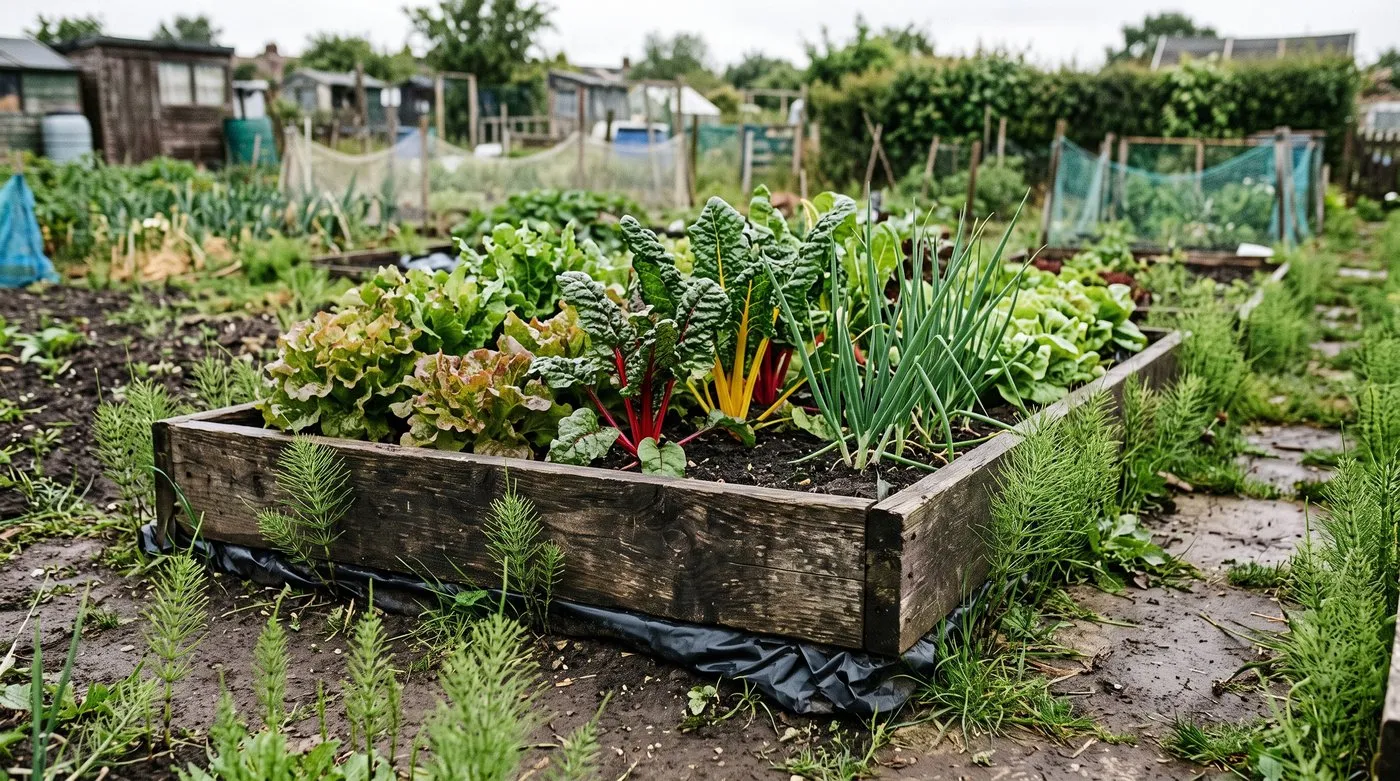
A raised bed lined with thick polythene lets you grow clean veg above the problem. Keep chipping away at the horsetail round the outside.
Managing Horsetail in Specific Situations
In Mixed Borders
Borders are the hardest place, because polythene and spray would harm your plants too. Your options:
- Weedkiller gel painted carefully onto crushed stems, with a small brush, keeping it off everything else
- Regular pulling or hoeing, more work but safe for your plants
- Lift and pot up favourite plants while you treat the bare soil, then replant after a season
In Lawns
Regular mowing keeps horsetail in a lawn in check. It doesn’t get rid of it, but you’ll rarely see much. It’s worst at the edges next to infested borders or paths. Treat those edges with crushed stems and gel, and spike the lawn to help it drain.
Arriving from Neighbouring Land
Horsetail can creep in under fences and walls. A root barrier stops it. Bury heavy-duty plastic sheeting upright along the boundary, about 60cm deep, with a little sticking up above the soil.
How to get rid of bindweed covers the same problem of roots creeping in from next door, and the same barrier idea works for both.
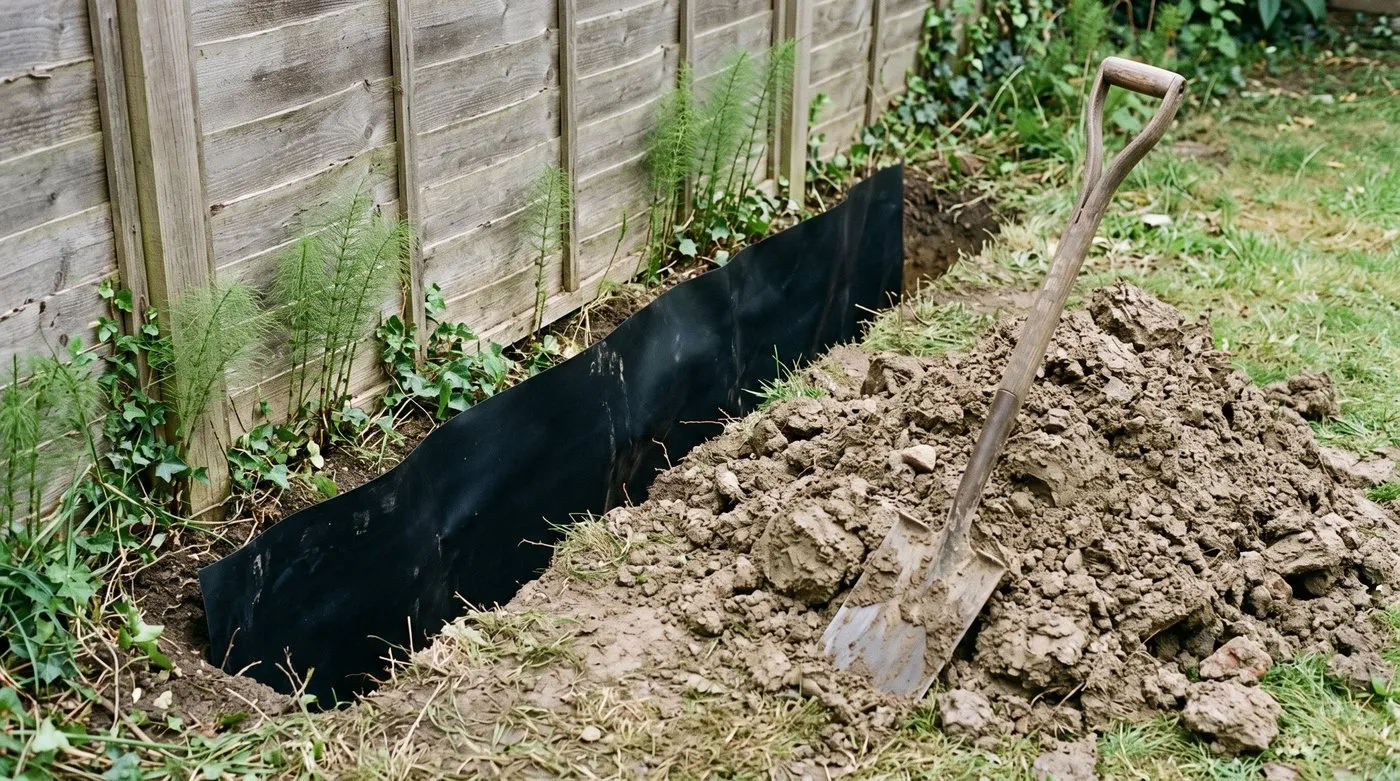
A barrier buried about 60cm deep stops horsetail roots sneaking under the fence. Leave a little sticking up so stems can’t hop over the top.
What Not to Do
Don’t rotavate. It chops the roots into hundreds of pieces and spreads them all over the plot.
Don’t rely on boiling water. It kills the tops but not the roots, and new shoots appear within weeks.
Don’t spray unbroken stems. It barely works. Crush them first and use gel.
Don’t lift polythene after a year. The roots will be weaker but still alive, and they’ll recover fast. Give it two full years.
Don’t put the roots on the compost heap. Bag them for the green waste collection instead.
Don’t forget the soil. Horsetail usually means wet, badly drained ground. Tackle that too, or the weed keeps the upper hand.
Japanese knotweed is another deep-rooted weed where it pays to understand what’s going on underground before you start.
Realistic Expectations: A Timeline
Think of this as a few years’ project, not a one-season fix. Knowing what to expect stops you giving up on something that’s working.
| When | What to expect |
|---|---|
| First spring and summer | Polythene down or first rounds of crushing and gel. The tops die back, but the roots are still busy. |
| Later in the first year | Under polythene, pale weak shoots appear and die. With gel, regrowth is weaker. Start on the drainage. |
| Second year | Keep going. Fewer stems push through. |
| Third year | Clearly fewer and smaller stems. Keep treating each new flush. |
| Fourth and fifth years | Much less horsetail with steady effort. A few stems still need attention. |
| After that | Keep an eye out. Check monthly in the growing season and deal with new stems straight away. |
Once you’ve thinned it out, a thick layer of mulch such as well-rotted wood chip helps keep the ground covered and improves the soil, so the bare patches don’t get recolonised.
For more chemical-free ideas, Garden Organic’s advice on horsetail is helpful.
A realistic five-year plan for horsetail
Grow food in lined raised beds over the worst patch, sort out the drainage, and stick with it for five years. You probably won’t get rid of it completely. But you will keep it in check and keep weakening it, and with horsetail, that’s a real win.
Frequently asked questions
Can you ever fully eradicate horsetail from a garden?
Rarely, once it’s established. The roots go too deep to reach. With a few years of steady work you can thin it right down and stop it spreading. A small, new patch caught early is your best chance of clearing it completely.
Why doesn’t glyphosate kill horsetail?
Its tough, waxy stems keep weedkiller out. Spray on unbroken stems does little. Crush or bruise the stems first, then paint on glyphosate gel straight away. You’ll still need to repeat it a few times each season for a couple of years.
How deep do horsetail roots go?
Often 60cm to 2m deep. They tend to be shallower but spread wider in clay, and go deeper in sandy soil. Little tubers along the roots store food and send up new shoots, which is why digging fails.
Does improving soil drainage help control horsetail?
Yes, it helps, but it won’t kill it on its own. Horsetail loves wet, squashed soil. Adding compost and grit, and not walking on the soil, makes it less at home and helps other plants compete. Use it alongside smothering or weedkiller.
What is the best organic method to control horsetail?
Smothering with thick black polythene for at least two years. Pulling or hoeing every stem every week or so also weakens it, but you need to keep it up for several years. Neither will clear an established patch, but both thin it out a lot.
Can horsetail be controlled without chemicals?
Yes, but it takes a few years of steady effort. Smother it with black polythene, pull or hoe stems every week or so from spring to autumn, help the drainage, and grow food in lined raised beds. Boiling water only kills the tops. Our guide to preventing weeds without chemicals has more ideas.
Is horsetail toxic to pets or livestock?
Yes, to horses and farm animals that eat a lot of it. It’s most risky in hay, where animals eat it more readily. It isn’t thought to be a serious risk to dogs or cats in a garden. If horses graze nearby, keep them away from it.
More weed guides
- How to Remove Ground Elder, another weed with deep, spreading roots
- How to Get Rid of Bindweed, whose roots also break up when disturbed
- Common Garden Weeds UK: Identification Guide, to help you name the weeds in your garden
- Organic Weedkillers UK, for alternatives to glyphosate
- No-Dig Gardening Guide, for using smothering and mulch on weedy ground
Our team produces practical UK gardening guidance from source research, contributor records and established horticultural practice. Editorial standards are overseen by Matt W.