
Key takeaways
- An alpine trough is shallow, usually 15-20cm deep, with several drainage holes
- Mix John Innes No. 2 with about an equal amount of horticultural grit
- Finish with a 1-2cm layer of grit right up to the plants' necks
- Most alpines want full sun; saxifrages and dwarf ferns cope with some shade
- Water only in long dry spells and keep the trough off soggy ground in winter
- A home-made hypertufa trough gives the stone look for much less money
An alpine trough is a shallow container planted with small mountain plants in gritty compost. It looks like a tiny scree slope, needs very little watering and stays interesting in winter. Get the drainage right and the rest is easy.
This guide covers choosing a trough, mixing the compost, planting ideas for different spots, and simple year-round care. If you have room for something bigger in the ground, see the guides to building a rockery or a crevice garden.
What makes an alpine trough different?
Three things set an alpine trough apart from an ordinary pot:
- It is shallow. Usually 15-20cm deep. Many alpines grow in thin soil and don’t need more.
- It drains fast. Alpines cope with cold, but sitting wet in winter rots them.
- It has a grit mulch. A 1-2cm layer of grit keeps the necks of plants dry and keeps weeds down.
Get one of these wrong and plants often fail in their first wet winter. Get all three right and a trough can carry on for years with little fuss.
Choosing a trough for alpines
Any shallow, frost-proof container with drainage holes will do. The main choices are:
- Old stone troughs and sinks. Beautiful, but heavy and pricey. Put them in place before you fill them.
- Hypertufa. Home-made from cement, coir and perlite. Looks like stone, weighs much less and costs little.
- Cast or reconstituted stone. Sold at garden centres. A good stone look at a middle price.
- Glazed or frost-proof terracotta. Fine if it has holes and is shallow and wide.
Make sure there are several drainage holes, not just one, as a single hole blocks easily. Cover each with a piece of broken pot or a scrap of mesh. An old sink with no holes needs them drilled with a masonry bit before you start.
Raise the trough on bricks or feet. It drains better, and it brings the tiny plants closer to eye level.
The best compost mix for an alpine trough
Mix John Innes No. 2 with about the same amount of horticultural grit. Some growers swap part of the grit for horticultural sharp sand. Mix it well before you fill the trough.
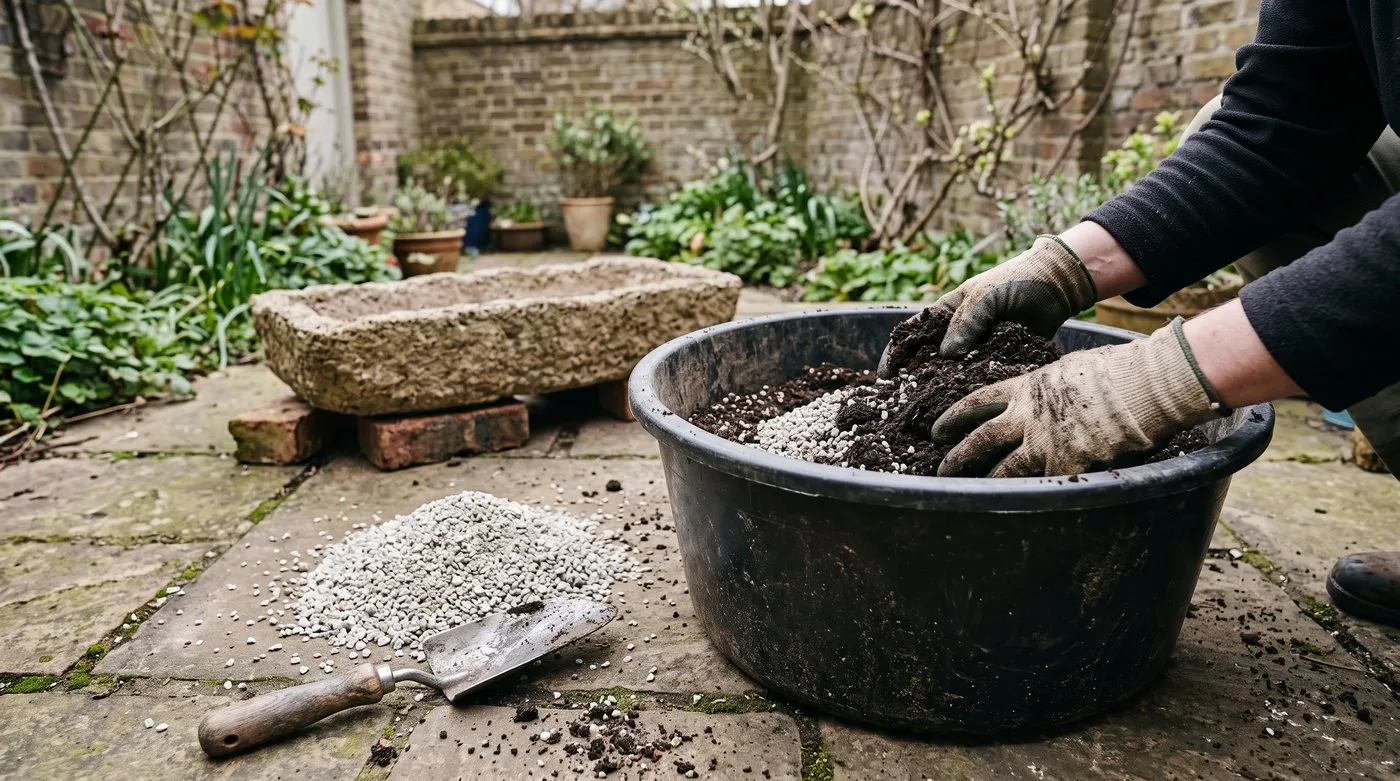
Plenty of grit in the mix is what keeps alpines alive through a wet winter. Water should run straight through it.
To test it, pour water on the surface. It should soak away quickly, not sit in a puddle. If it pools, add more grit.
Warning: Use horticultural grit or sharp sand, not builder’s sand. Builder’s sand is fine and soft, and it packs down into a wet, airless mass.
For lime-hating plants such as autumn gentians and dwarf rhododendrons, swap the John Innes for ericaceous compost. Water those with rainwater, as hard tap water slowly makes the compost less acidic.
Alpine trough planting ideas for every spot
Choose plants for where the trough will sit. These five ideas suit a trough about 60cm long. Use them as a starting point and swap in what your local nursery has.
Sunny scree trough
The easiest and toughest choice for a hot, sunny patio. Most of these cope with summer dry spells once settled.
- Houseleeks (Sempervivum), including the cobweb houseleek, Sempervivum arachnoideum
- Sedum spathulifolium ‘Cape Blanco’ to spill over the edge (the guide to growing sedum lists more low types)
- Dwarf pinks such as Dianthus ‘Pike’s Pink’
- Erodium reichardii for small pink-veined flowers all summer
- One dwarf conifer, such as Picea abies ‘Little Gem’, for height
The houseleeks and sedums here are the same tough plants covered in the guide to hardy cacti and succulents.

Houseleeks and sedums are the backbone of a sunny trough. They spread slowly into a tapestry of rosettes and need almost no water.
Classic sink garden
A traditional mix for an old stone sink in sun or light shade.
- Common houseleek (Sempervivum tectorum) in the centre
- Encrusted saxifrages such as Saxifraga ‘Tumbling Waters’
- Dianthus alpinus for big pink flowers on tiny cushions
- Creeping thyme (Thymus serpyllum) to trail over the edge
- Juniperus communis ‘Compressa’, a slim dwarf juniper, for structure
Shady woodland trough
For a north-facing or partly shaded spot that stays a bit cooler.
- Mossy saxifrages and London pride types
- Primula ‘Wanda’ for purple flowers in early spring
- Snowdrops (Galanthus nivalis) tucked between plants
- A small fern such as Adiantum venustum
Pet note: Snowdrops and primulas can upset a pet’s stomach if chewed. Hardy cyclamen, often suggested for shady troughs, are toxic to cats and dogs, so leave them out if you have a digger.

Trumpet gentians flower in spring and like a cooler spot that never dries out. Pair them with primroses for soft colour.
Cool, acid-soil trough
Some favourite alpines need lime-free compost. Fill the trough with an ericaceous mix and grit, and use rainwater.
- Autumn gentians (Gentiana sino-ornata) for vivid blue trumpets from September
- A dwarf rhododendron such as ‘Patty Bee’ for spring flowers
- A few dwarf bulbs for early colour
Keep this trough in part shade with morning sun. It does best in cooler, damper parts of the UK.
Spring bulb trough
For colour from late winter, plant dwarf bulbs in October:
- Iris reticulata in blue and purple
- Crocus sieberi ‘Tricolor’
- Narcissus ‘Minnow’, a tiny daffodil
- Anemone blanda
- Snowdrops
Plant them close together, a couple of bulb widths apart. Once they fade in May, the leaves die back. Low houseleeks planted on top give summer cover. The guide to growing iris, including Iris reticulata, has more on bulb care.

A bulb trough can be the first thing to flower in the garden. Iris reticulata and crocuses shrug off a hard frost.
How to plant an alpine trough
Spring and early autumn are the best times to plant. The soil is warm enough for roots to grow, and there is time to settle before winter.
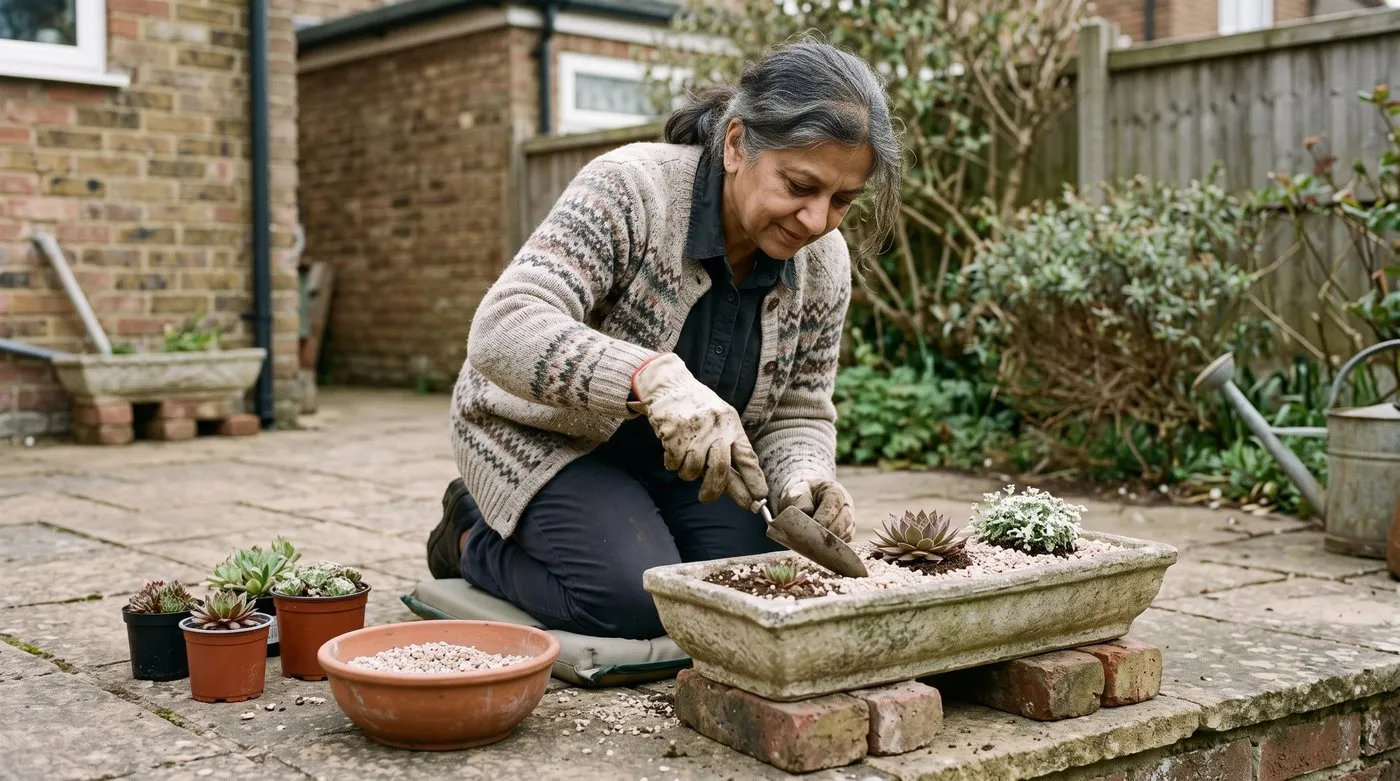
Finish with grit right up to the necks of the plants. It keeps rosettes dry and makes the whole trough look settled.
- Put the trough in its final spot on bricks or feet. A filled trough is heavy.
- Cover the drainage holes with broken pot or mesh.
- Add a layer of coarse grit in the base, then fill with your mix to about 2-3cm below the rim.
- Set out the plants in their pots on the surface. Move them round until the layout looks right.
- Plant the biggest first, such as a dwarf conifer, then the mid-sized plants, then the small cushions and trailers.
- Tuck in a few stones if you like, half buried, like rocks on a hillside.
- Spread 1-2cm of grit over the surface, right up to the necks of the plants.
- Water gently to settle everything.
Leave space between plants. A new trough looks sparse, but houseleeks and sedums fill out within a couple of years.
Caring for an alpine trough through the year
Alpine troughs need less work than almost any other container. Little and rarely is the rule.
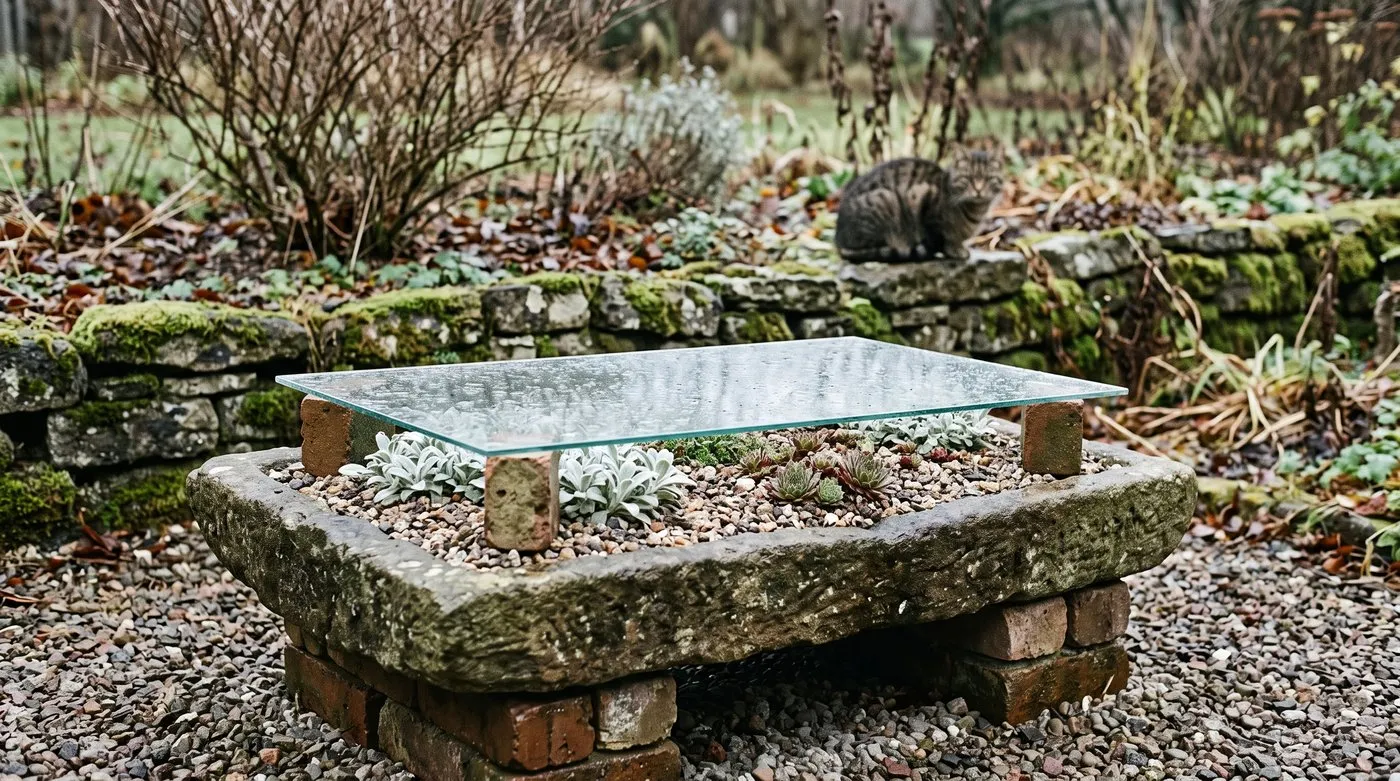
A propped sheet of glass keeps rain off woolly-leaved alpines but lets air through. Cold is fine, it is the wet they hate.
Watering. Water new plants until they root in. After that, water only in long dry spells, when the compost a couple of centimetres down feels dry. In winter, rain is plenty.
Winter wet. Cold rarely harms alpines, but soggy compost does. Keep the trough raised so it drains. Woolly-leaved plants hate rain on their leaves; a sheet of glass or clear plastic propped on bricks above them helps in a wet winter.
Feeding. Very little. A light liquid feed in spring is enough if plants look pale. Too much feed makes soft, floppy growth.
Grit. Top up the mulch each spring where it has thinned.
Tidying. Snip off dead flower stems and pull out any weeds or tree seedlings while they are small.
Houseleek offsets. Houseleeks make small baby rosettes around the parent. Pull some off and pot them up for a new trough. Each rosette dies after it flowers, so remove the old one and let the offsets fill the gap.
Alpine trough calendar month by month
| Month | Jobs |
|---|---|
| January | Check the trough drains. Brush off heavy snow from dwarf conifers |
| February | Enjoy the first iris and crocus. No watering needed |
| March | Top up the grit. Replace any plants lost over winter |
| April | Plant new troughs. Light feed if plants look pale |
| May | Peak flowering for many alpines. Water new plants in dry spells |
| June | Snip off faded flower stems |
| July | Water established troughs only in long dry spells |
| August | Pot up houseleek offsets for new troughs |
| September | Plant or replant troughs while the soil is warm |
| October | Plant dwarf bulbs. Prop a cover over woolly-leaved plants if wet |
| November | Clear fallen leaves off the grit so plants don’t rot |
| December | Little to do. Enjoy the dwarf conifers and rosettes |
Making your own hypertufa trough
Hypertufa is a mix of cement, coir and perlite that sets into a light, stone-like trough. It is a fun weekend job.
You’ll need cement, coir, coarse perlite, two cardboard boxes (one slightly smaller than the other), plastic sheet, a wheelbarrow, gloves and a dust mask.
- Mix 1 part cement with 1.5 parts coir and 1.5 parts perlite, by volume.
- Add water slowly until it holds together when squeezed, like stiff porridge.
- Line the larger box with plastic. Pack about 4cm of mix into the bottom.
- Push in short lengths of dowel for drainage holes.
- Stand the smaller box inside and pack mix into the gap to form the walls.
- Cover with plastic and leave somewhere frost-free to set for about a week.
- Remove the boxes and dowels. Rough up the surface with a wire brush.
- Leave it outside for a few weeks, rinsing it in the rain, before planting.
Warning: Wet cement burns skin and the dry dust irritates lungs. Wear waterproof gloves and a mask, and wash splashes off straight away.

A finished hypertufa trough, raised on bricks so it drains well. Moss and lichen soon soften the surface outdoors.
Common alpine trough mistakes
Using multipurpose compost on its own. It holds too much water and alpines rot over winter. Always add plenty of grit.
One small drainage hole. It blocks, and the trough becomes a pond. Use several holes and raise the trough off the ground.
Overwatering. Watering little and often keeps the compost wet. Water only in long dry spells.
Too much shade. Most alpines go leggy and stop flowering in deep shade. Use the woodland ideas for a shady spot.
Planting thugs. Snow-in-summer (Cerastium) and some aubrieta can smother a trough. Keep vigorous spreaders for walls and banks.
Skipping the grit mulch. Bare compost splashes onto rosettes and stays wet around their necks. A grit layer prevents both.
For more detailed notes on individual species, the Alpine Garden Society is the UK’s specialist body.
Frequently asked questions
What is an alpine trough?
A shallow container planted with small mountain plants in gritty compost. Old stone sinks and farm troughs were the original version. Today most are hypertufa, cast stone or concrete, and they copy the stony, fast-draining ground alpines grow in.
What plants suit an alpine trough?
Small, slow plants that stay under about 20cm tall. Houseleeks, sedums, saxifrages, dwarf pinks, thyme, erodium and dwarf conifers all work. Add dwarf bulbs such as Iris reticulata and Crocus sieberi for late winter colour.
What compost mix do alpines need?
John Innes No. 2 mixed with about the same amount of horticultural grit. Some growers add a little sharp sand too. The mix should drain fast when you water it. Multipurpose compost on its own stays too wet in winter.
How often should I water an alpine trough?
Only in long dry spells once the plants are settled. In a hot summer that might mean a soak every week or two. Newly planted troughs need watering until roots grow. In winter, rain is plenty.
Do alpines need full sun?
Most do, especially houseleeks, sedums, pinks and erodium. Mossy saxifrages, small ferns and some primulas prefer part shade. Choose plants to match where the trough sits.
Can I make a trough myself?
Yes, from hypertufa. Mix cement, coir and perlite, pack it round a cardboard box mould and let it cure for a few weeks. It looks like old stone and is far lighter than the real thing.
How long does an alpine trough last?
Many years with a little care. Top up the grit each spring, pull out offsets as houseleeks spread and replace any plants that die. Replant with fresh compost when the trough looks tired.
Now your trough is planted, try grouping pots for a layered display around it, or find more ideas in the garden design section.
Our team produces practical UK gardening guidance from source research, contributor records and established horticultural practice. Editorial standards are overseen by Matt W.


