Key takeaways
- Every 1mm of rain on 1 square metre of roof gives about 1 litre of water
- Slimline and wall-mounted butts fit narrow side returns where round barrels won't
- Raise any butt on a stand so a watering can fits under the tap
- Rain chains look lovely but splash in heavy rain, so plan where the water lands
- Copper chains turn brown, then slowly green, while stainless steel stays bright
- Keep a lid on every butt to keep out children, pets, leaves and mosquitoes
Decorative water butts and rain chains turn rainwater collection into something you’re happy to look at. In a small garden there’s often nowhere to hide a green plastic butt, so the tank needs to look good as well as work. This guide covers butt styles for narrow spaces, ways to screen a plain butt, and how to choose and fit a rain chain that copes with British weather.
For the practical side of collecting and using rainwater, see the rainwater harvesting guide. This article is about making it look lovely.
Slimline and wall-mounted butts for narrow side returns
A slimline water butt is flat-backed and shallow, so it sits against a wall without blocking a narrow path. It’s the best choice for side returns and small terraced gardens where a round barrel won’t fit.
Wall-mounted butts hang on strong brackets and leave the ground clear, so bins and bikes still fit underneath. They need sound brickwork, as a full butt is very heavy. Fence-style butts are shallower still and blend in along a boundary.
Two details decide whether you’ll actually use it:
- Tap height. Many taps sit too low for a watering can. Stand the butt on its matching stand, or on paving slabs and blocks, so the can fits underneath.
- Linking. Many slimline butts come with, or take, a linking kit. When the first fills, it overflows into the second, so you store more water in the same narrow strip.
The guide to installing a water butt walks through fitting a diverter to the downpipe.
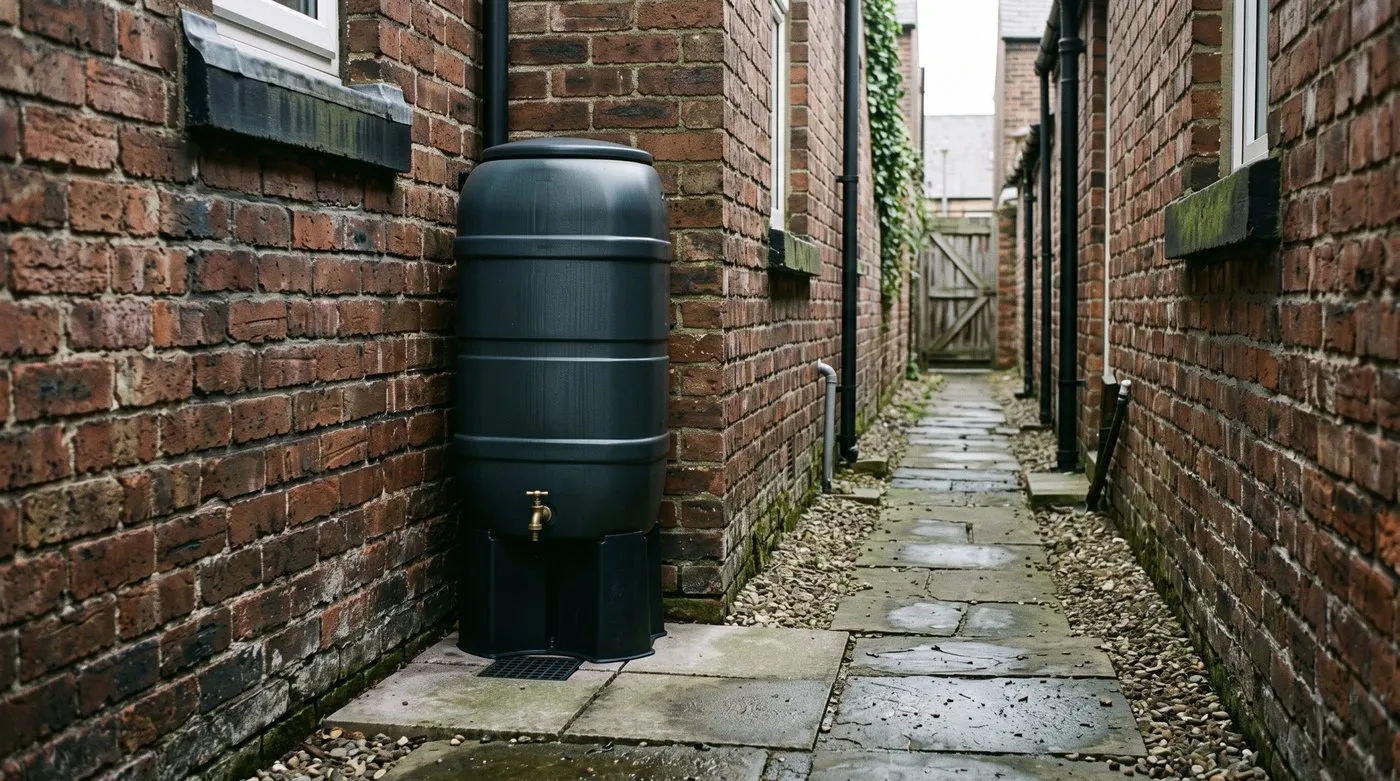
A slimline butt hugs the wall and leaves the path clear. The stand lifts the tap high enough for a watering can.
Oak barrel, stone-effect and planter-topped styles
Once you’ve sorted size, style is the fun part. Each look suits a different garden.
Oak barrels are often old whisky or wine casks. They look wonderful and weather to a soft silver-grey. The catch is that oak must never dry out completely, or the staves shrink and the joints leak. Keep them at least part-full all year.
Stone-effect and terracotta-effect butts are moulded plastic with a textured finish. From a few metres away they look convincing. Check they’re UV-stabilised, as cheaper ones can fade and go chalky in sun.
Planter-topped butts have a shallow tray in the lid for flowers or herbs. The tray takes up some of the water space and needs its own watering. Shallow-rooted plants like thyme, sedum and trailing lobelia suit them.
Modern colour-matched butts in anthracite, sage or charcoal are an easy win. Match one to your fence stain or window frames and it almost disappears.
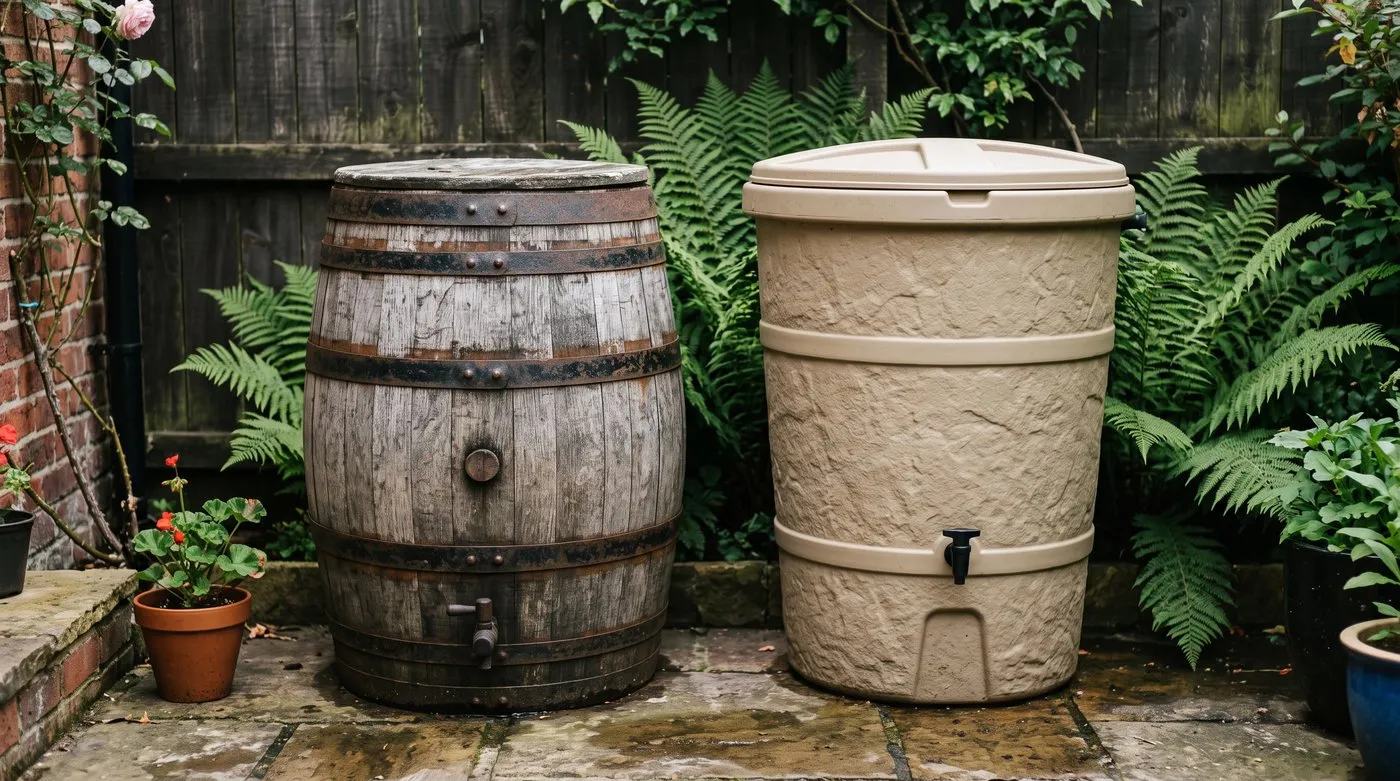
An oak cask and a stone-effect butt side by side. Oak weathers beautifully but must stay part-full so it doesn’t leak.
How to hide or screen a plain water butt
Sometimes the best answer is a better setting rather than a prettier butt. Three ideas work well in small gardens.
Slatted timber boxing is the neatest fix. Build a three-sided frame of treated timber, clad it with slats and leave small gaps for air. Keep the front open, or fit a door, so you can reach the tap. Stain it to match your fence and it looks like part of the garden.
Climbers soften rather than hide. Fix wires to the wall either side and grow star jasmine (Trachelospermum jasminoides) for evergreen cover, or a late-flowering clematis for colour. Keep plants back from the tap and lid. The guide to training climbing plants shows how to get them going.
Pots and planting in front of the butt break up its outline. A group of ferns, hostas or grasses does the job, and you can water them straight from the tap.
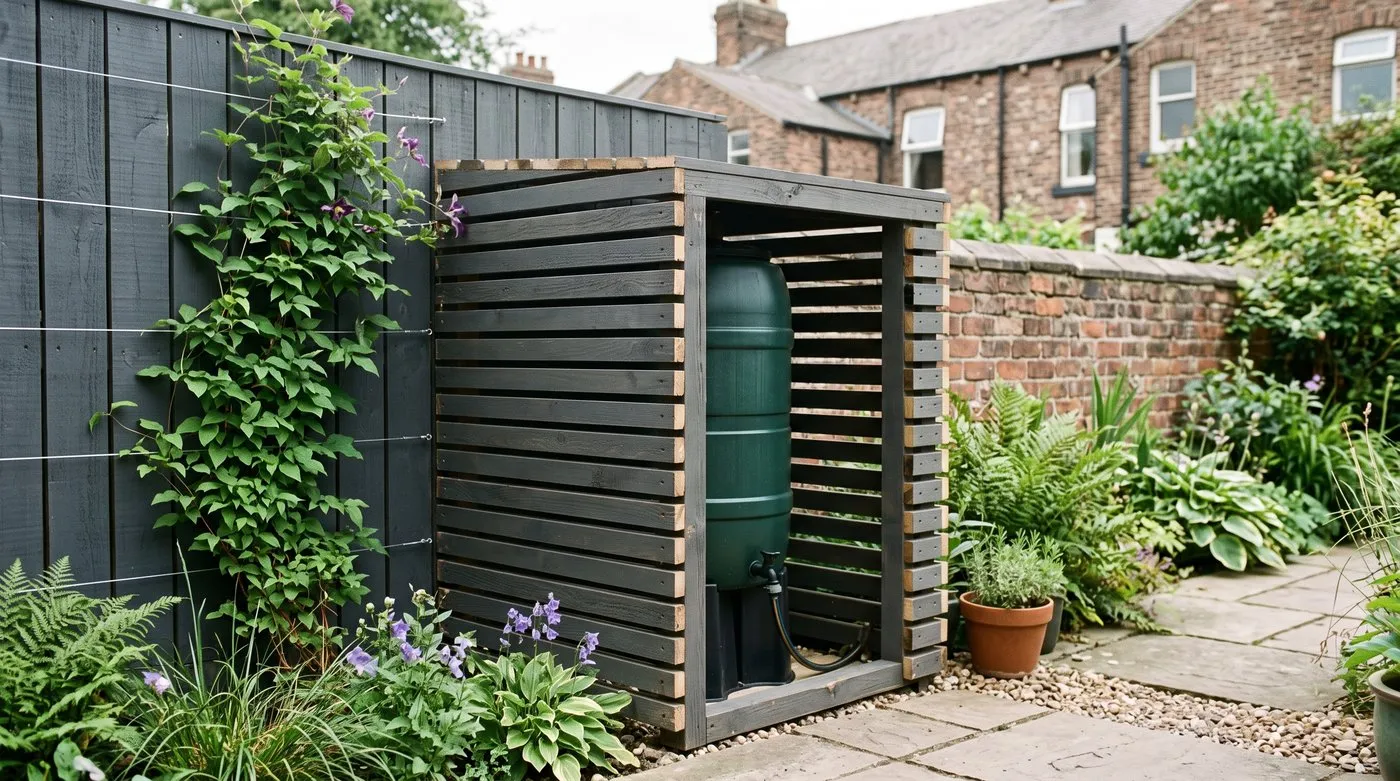
A slatted box stained to match the fence turns a plain butt into garden joinery. The open front keeps the tap easy to reach.
What is a rain chain?
A rain chain is a hanging chain of cups or links that replaces a closed downpipe. Rainwater runs down it from the gutter to a basin or butt below. It’s traditional in Japan, where it’s called kusari-doi, and it suits Japanese-style and modern gardens alike. The guide to Japanese garden design has more ideas for that look.
There are two main types:
- Cup chains have small open cups, one above another. Each fills and drips into the next, giving a lovely slow cascade. They carry more water and are the most popular.
- Link chains are plain loops or rings. They’re quieter and more modern-looking, but carry less water before it splashes off.
Rain chains are sold in lengths to suit single-storey and two-storey eaves, with extensions available. A full chain is heavy when wet, so make sure the gutter and its brackets are sound before you hang one.
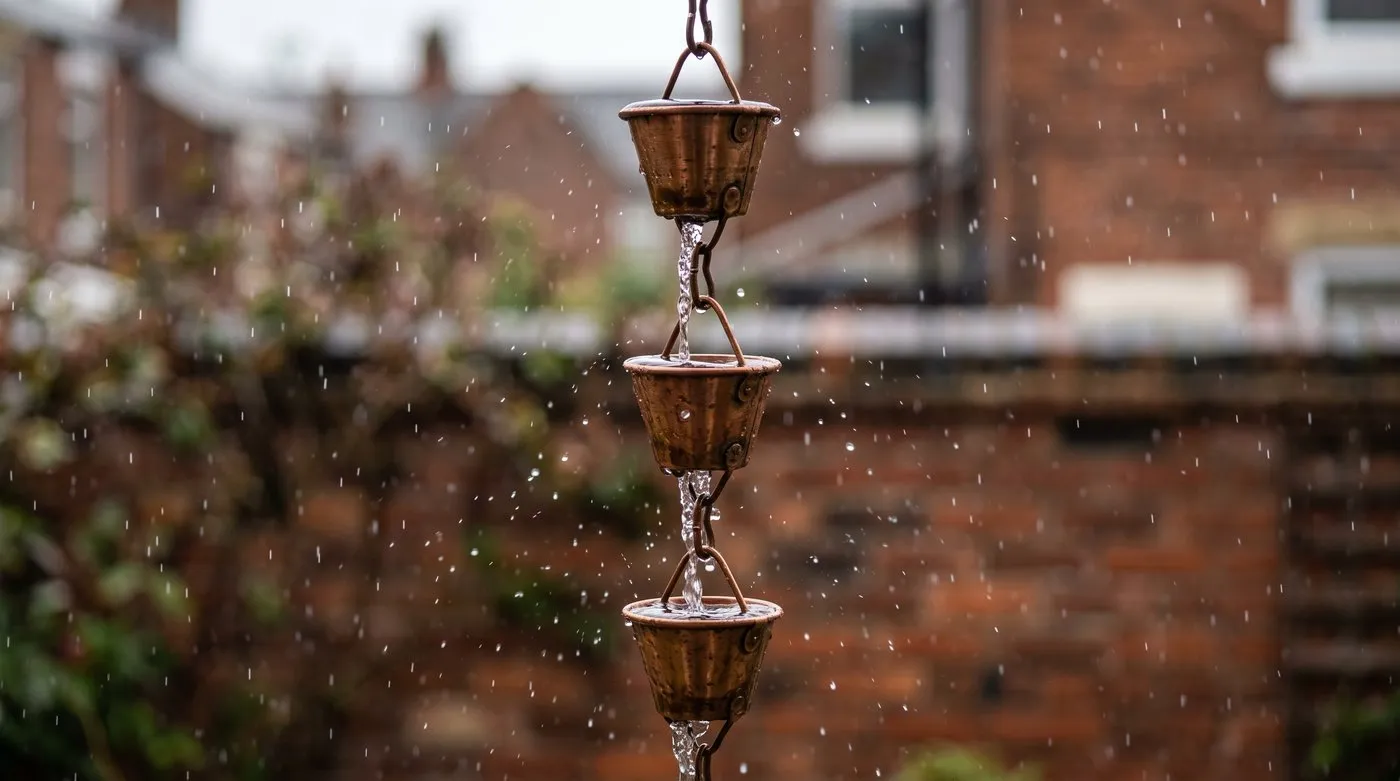
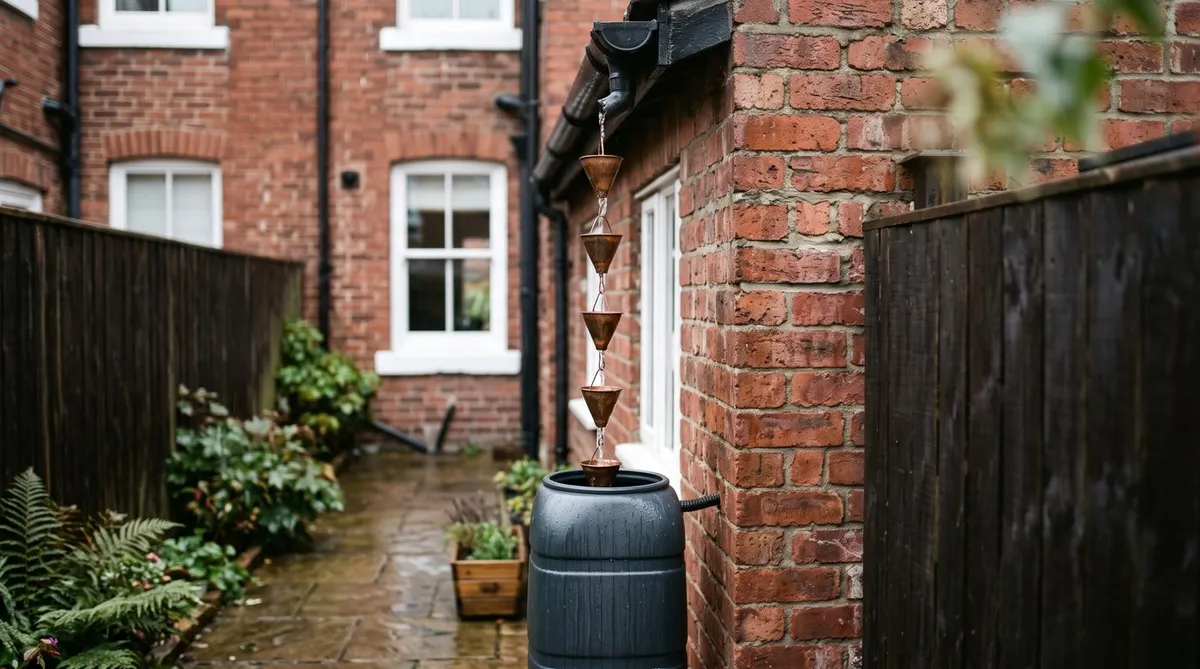
In steady rain, each cup fills and spills into the next. It’s the gentle cascade that makes a rain chain worth having.
Copper, stainless steel or aluminium rain chains?
Copper is the classic choice and ages beautifully. It starts bright, darkens to brown within months, and slowly turns green over several years. Sea air speeds this up. It’s fairly heavy, so it hangs still in wind.
Stainless steel stays close to its original colour and suits modern gardens. Near the coast, choose marine-grade (316) stainless, which resists salt air better.
Powder-coated aluminium is light and cheaper. Being light, it swings in wind, and the coating can chip where cups knock together. It’s best in a sheltered courtyard.
Avoid thin plain or galvanised steel chain. It rusts and leaves orange stains on whatever sits below.
| Material | How it ages | In wind | Best for |
|---|---|---|---|
| Copper | Brown, then slowly green | Hangs fairly still | Traditional and cottage gardens |
| Stainless steel (316) | Stays bright | Very stable | Modern and coastal gardens |
| Stainless steel (304) | Stays bright inland | Stable | Modern gardens away from the sea |
| Powder-coated aluminium | Coating can chip | Swings, needs anchoring | Sheltered courtyards |
| Plain or galvanised steel | Rusts and stains | Varies | Best avoided |
Do rain chains work in heavy rain?
In light and steady rain, yes. In a heavy downpour, a rain chain can’t carry water like a closed downpipe. Water jumps off the cups and sprays outwards, landing in a wide arc.
That happens a few times most summers, so plan for it:
- Keep the chain at least 60cm from doors, thresholds and rendered or timber walls.
- Choose a sheltered wall. On an exposed wall, wind pushes the chain sideways and throws water where you don’t want it.
- Keep your old downpipe parts, so you can refit them if the spot doesn’t work.
Warning: Don’t swap the only downpipe from a big roof above a basement stairwell, cellar door or below-ground entrance for a chain. In a cloudburst, the water won’t go where you need it to.
Where should a rain chain end?
End it in a water butt, a cobble-filled basin or a soakaway. The last few centimetres decide whether it works.
- Into a water butt. The best choice, because you keep the water. Use a wide funnel with a mesh leaf guard on top of the butt.
- Into a basin of cobbles over a soakaway. Set a stone or glazed basin at ground level, fill it with cobbles, and dig a pit beneath filled with clean stone. The cobbles soften the splash and the pit drains the water away.
- Into a rain garden. A planted dip that soaks up roof water is a lovely way to finish a chain.
Don’t let a chain drip onto bare soil or lawn. The steady stream washes out a hole and splashes mud up the wall.
Anchor the bottom of the chain with the stake or weight it came with. Otherwise wind swings it against the brickwork, which dents copper cups.
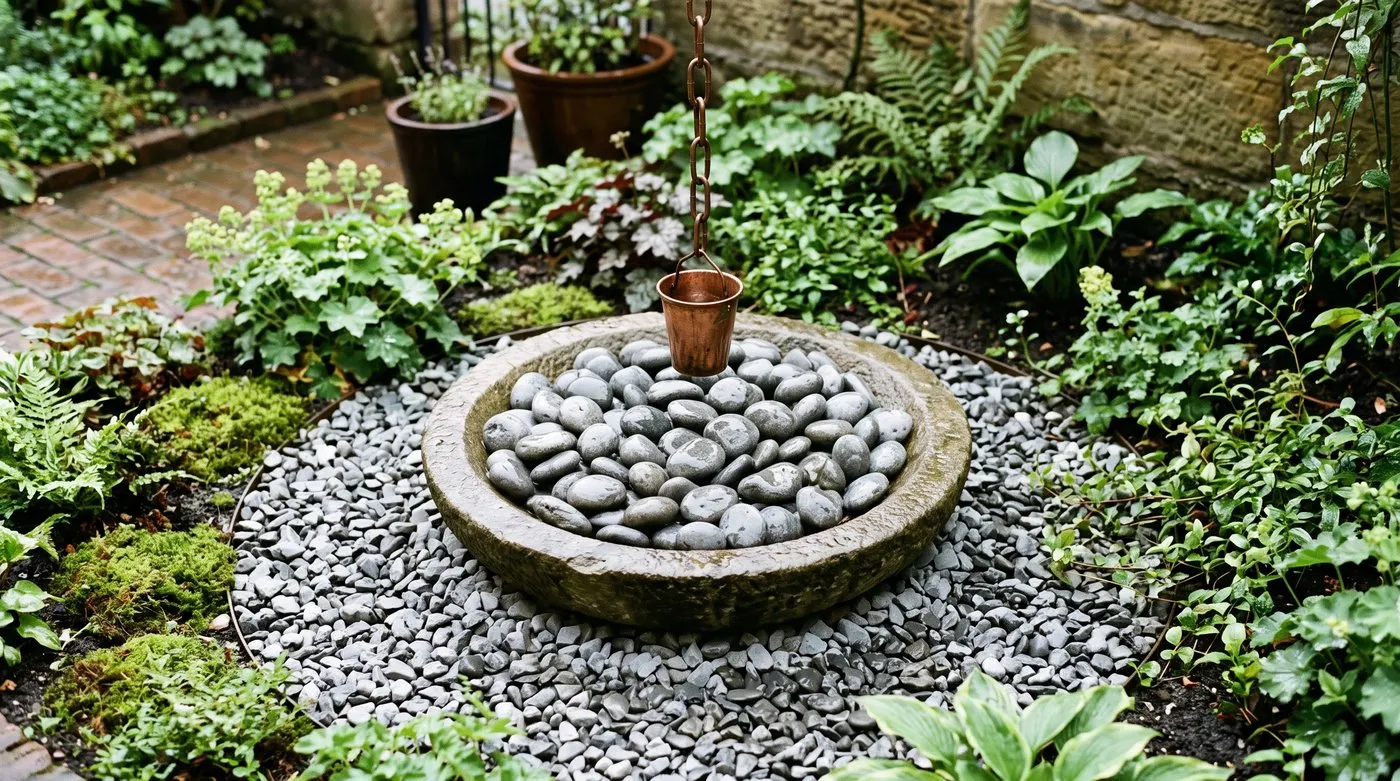
A basin of cobbles softens the splash and lets water drain away. It stops the chain carving a hole in the ground.
How to fit a rain chain to a UK gutter
Most UK gutters take a rain chain with a simple hanger or outlet adaptor. It’s usually a job of an hour or so, with someone footing the ladder.
- Measure the gutter outlet. Domestic outlets are usually round or square, in a few standard sizes. Buy the adaptor to match.
- Remove the downpipe. Unscrew the wall brackets and lift it off. Keep all the parts.
- Fit the hanger or adaptor. A V-shaped hanger sits across the gutter outlet with no cutting. An adaptor pushes into the outlet and centres the flow.
- Hang the chain from a stainless steel hook or quick-link, which won’t rust.
- Set the length so the bottom cup sits just above the basin or funnel.
- Test it by running a hose into the gutter and watching where the water goes.
If water pools along the gutter instead of running to the chain, the gutter may not slope towards the outlet. That needs fixing first.

Fitting a hanger into the gutter outlet is a quick job. Keep the old downpipe parts in case you want to swap back.
How much rainwater can you collect?
Roughly one litre for every millimetre of rain on each square metre of roof. Measure the roof’s footprint from above, not the sloping surface.
So a small shed roof of 6 square metres collects about 6 litres for every millimetre of rain. A 30 square metre extension roof collects about 30 litres per millimetre. A decent shower fills a single butt surprisingly fast, after which the rest overflows.
That’s why decorative butts are best for looks and top-up watering. If you want more storage, link a second butt or tuck a larger plain tank out of sight. Pair it with water-efficient gardening habits and your stored water goes much further, especially during a hosepipe ban.
Month-by-month care for butts and chains
| Month | Job |
|---|---|
| January | Drain or lag outdoor taps in hard frost |
| February | Check the chain’s anchor after winter gales |
| March | Empty, scrub and rinse the butt before spring rain |
| April | Refit any diverter you took off for winter |
| May | Keep oak barrels topped up so the staves stay swollen |
| June | Clear seeds and petals from funnel mesh |
| July | Use water often in hot spells, so it stays fresh |
| August | Rinse out any butt that has turned green |
| September | Clear gutters before the leaves fall |
| October | Check leaf guards weekly as leaves drop |
| November | Leave a little room in the butt before hard frosts |
| December | Leave copper patina alone, as it protects the metal |
Common mistakes with decorative butts and rain chains
Skipping the stand. If a watering can won’t fit under the tap, you’ll stop using the butt. Raise it from day one.
Blocking the overflow. A butt with nowhere to overflow floods the base of the wall. Run the overflow to a border, soakaway or rain garden.
Leaving the lid off. An open butt is a drowning risk for small children and pets, and lets in leaves and mosquitoes. Keep a secure lid on.
Hanging a chain on an exposed wall. Wind swings it and throws water sideways. Pick a sheltered spot you can see from a window.
Ending the chain on soil or grass. The stream digs a hole. Always finish in a basin, butt or soakaway.
Gardener’s tip: Stand your butt in shade if you can. Algae grows in light, so a shaded butt stays clearer for longer. Use stored rainwater on established plants and tap water for seedlings.
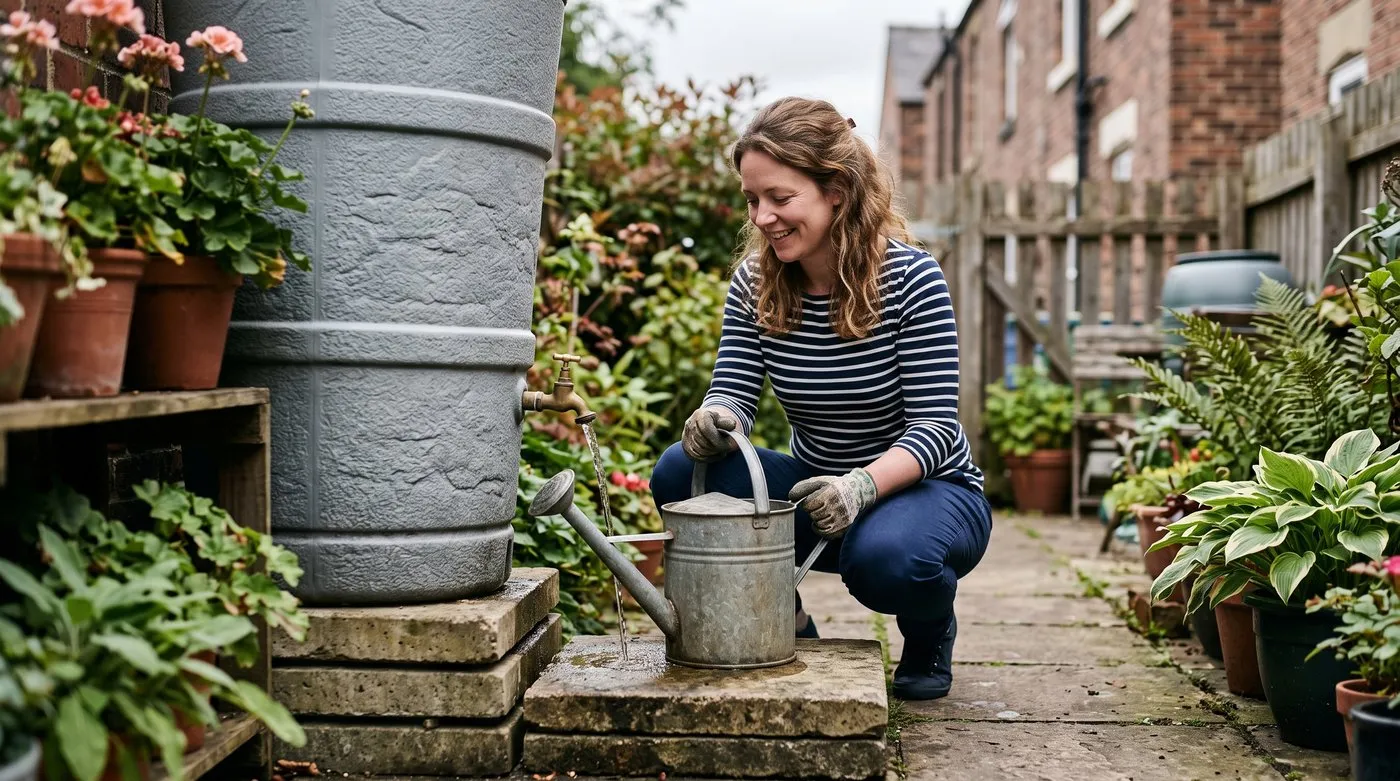
Raised on a couple of slabs, the tap clears a full-size watering can. That small step is what keeps a butt in daily use.
Frequently asked questions
Do rain chains work in heavy rain?
They work well in light and steady rain but splash in downpours. In heavy bursts, water jumps off the cups and sprays outwards. Fit the chain away from doors and walls, and end it in a cobble basin or butt.
How much water does a decorative water butt hold?
Most decorative butts hold roughly 100-250 litres. Slimline and wall-mounted styles are at the smaller end, and oak barrels and large stone-effect butts at the bigger end. Check the usable volume between the tap and the overflow.
How much rainwater can I collect from my roof?
About one litre for every millimetre of rain on each square metre of roof. Measure the roof’s footprint from above, not the sloping surface. Even a shed roof fills a small butt quickly in a wet spell.
Can you fit a rain chain to a normal UK gutter?
Yes, most UK gutters take a rain chain with a simple hanger or outlet adaptor. Take off the downpipe, fit the hanger in the gutter outlet and clip the chain on. Measure the outlet before buying.
Do copper rain chains go green?
Yes, copper slowly turns green outdoors. It darkens to brown within months, then gradually develops a green patina over several years. Stainless steel stays close to its original colour if you prefer a bright finish.
Are slimline water butts worth it for a narrow garden?
Yes, they fit side returns where a round barrel would block the path. They sit flat against the wall, and many can be linked together to store more water in the same narrow space.
Where should the bottom of a rain chain end?
Into a water butt, a cobble-filled basin or a stone-filled soakaway. Don’t let it drip onto bare soil or lawn. The steady stream soon washes out a hole and splashes mud up the wall.
Want somewhere beautiful for the overflow to go? Our guide on how to make a rain garden shows you how. For more ideas, browse the garden design hub.
Our team produces practical UK gardening guidance from source research, contributor records and established horticultural practice. Editorial standards are overseen by Matt W.