
Key takeaways
- Watch your garden through the seasons before making big changes
- Put the plants you pick daily by the kitchen door and leave the far end wilder
- Group fruit trees with helpful plants like comfrey, chives and nasturtiums
- Catch rain from every roof and keep soil covered with mulch
- Grow lots of different plants rather than big blocks of one
- Start small, see what works, then build on it
Permaculture is a way of planning your garden so it grows food, builds its own soil, saves water and helps wildlife, without you needing to buy lots in. The name blends “permanent” and “agriculture”. The idea is a garden that looks after itself more each year, rather than needing constant replanting and feeding.
What are the 12 permaculture principles?
The 12 principles were set out by David Holmgren, one of the founders of permaculture. Think of them as handy ways of thinking about your plot rather than strict rules. Each one has simple, practical uses in a British garden.
Behind them sit three ideas: care for the earth, care for people and share what you have fairly. If something in your plan doesn’t help with at least one of those, it probably doesn’t need to be there.
1. Observe and interact
Watch your garden through a full year before making big changes. Notice where the sun falls in each season, which corners stay soggy after rain, where frost settles first and where the wind comes from. A notebook and a few photos are all you need.
2. Catch and store energy
Catch sunshine, rain and garden waste while there’s plenty about. In the UK that’s very seasonal. Long summer days give lots of light, while autumn and winter bring most of the rain.
Easy ways to do it:
- Set up rainwater harvesting on every roof you can, including the shed
- Grow sun-lovers against south-facing walls and fences, which soak up warmth
- Compost all your garden waste and kitchen scraps so the goodness stays in the garden
- Put deciduous trees where they’ll shade you in summer but let winter light through
3. Obtain a yield
Everything in the garden should give you something back. That doesn’t mean it all has to be edible. A hawthorn hedge gives birds a home, blocks the wind and feeds bees. A plain fence panel does none of that. Swap it for a mixed native hedge and you get food, shelter and beauty in one go.

An apple tree with its helper plants. Comfrey makes feed and mulch, chives fill the gaps and nasturtiums can lure blackfly away.
4. Apply self-regulation and accept feedback
Look at what’s working each season and change what isn’t. If a crop fails in one spot, move it. If a path floods, reroute it. Your plan can always change.
5. Use and value renewable resources
Use things that grow back rather than things you buy. Comfrey ‘Bocking 14’ is a permaculture gardener’s best friend. Cut it a few times a year and it just regrows. Use the leaves as mulch, liquid feed or to get the compost heap going.
Other free, renewable helpers:
- Green manures add goodness to the soil from a packet of seed
- Home-made compost means you need to buy much less fertiliser
- Willow cuttings make free plant supports and living fences
- Rainwater means less tap water
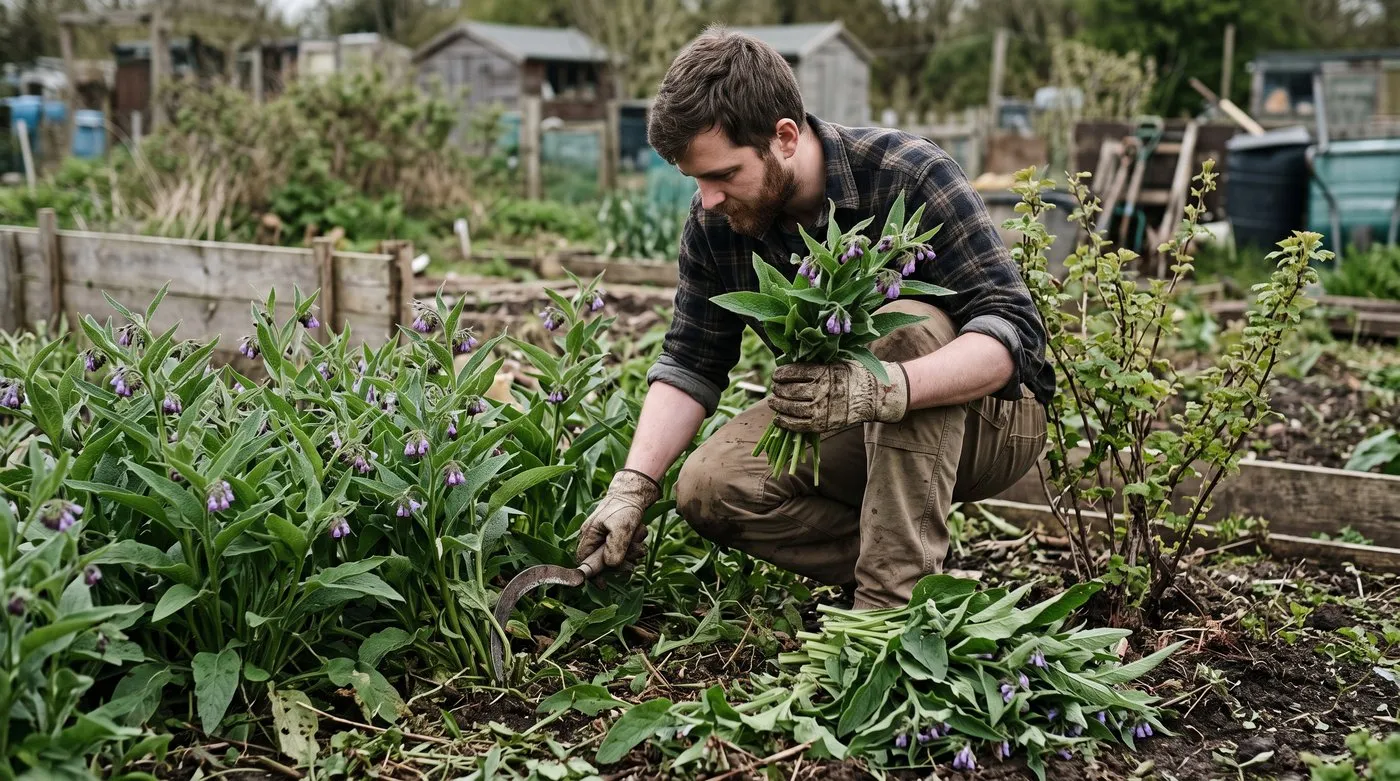
Comfrey bounces back after every cut, so it’s a free, renewable feed. Lay the leaves straight round fruit bushes as a mulch.
6. Produce no waste
Make every leftover useful. Kitchen scraps feed the compost. Compost feeds the soil. Soil feeds the plants. Plants feed you. Round it goes.
7. Design from patterns to details
Plan the big picture before you choose plants. In the UK, that means the wind (mostly from the south-west), the low winter sun, dry summers in the south-east and wetter weather in the north and west.
Sort out the bones first. Put windbreaks on the windy side, run beds north to south for even light and store water uphill. Only then decide which apple or herb goes where.
How do permaculture zones work in a UK garden?
Zones arrange the garden by how often you visit each bit. The things you need most sit by the house. The things you rarely touch go at the far end. You spend less time walking back and forth.

Zones in a typical UK garden: herbs and salads by the back door, veg in the middle, fruit trees further out and a wild patch at the end.
Zone 1: The kitchen doorstep (0-3 metres)
This is for everything you pick every day. Rosemary, thyme, parsley, chives and mint (in a pot) belong within easy reach of the kitchen door. Salad leaves and spring onions fit here too. If you’re making a herb garden for the first time, start here.
A cold frame or mini greenhouse here helps you pick salad for more of the year.
Zone 2: Intensive food production (3-8 metres)
Main veg beds, soft fruit, compost bins and the water butt go here. No-dig beds are perfect: a thick layer of compost on top, fixed paths and plants packed in. Pop in daily in summer and every few days in winter.
This is where companion planting comes into its own. Grow carrots near onions, edge beds with marigolds and let climbing beans scramble up sweetcorn. A good mix of plants brings in helpful insects.
Zone 3: Fruit trees and main crops (8-12 metres)
Fruit trees with their helper plants, potatoes, squash and perennial vegetables go here. You’ll visit weekly rather than daily. Mulch well to keep weeds down and the soil damp.
Zone 4: Semi-wild and foraging (12-15 metres)
If your garden is long enough, Zone 4 can hold a forest garden layer, with nut trees, elder, wild garlic and other easy plants. A comfrey patch for feed sits well here too.
Zone 5: Wildlife habitat (boundary)
Leave the far corners alone. A log pile, some nettles, long grass and native shrubs give hedgehogs, slow worms, frogs and nesting birds a home. This isn’t neglect, it’s wildness on purpose. Even a small patch of unmown grass helps.
What is a permaculture guild?
A guild is a group of plants that help each other. Each one has a job, such as making mulch, bringing in pollinators, covering the ground or adding goodness to the soil.
A classic UK guild is built around an apple tree:
| Layer | Plant | What it does |
|---|---|---|
| Tree | Apple on MM106 rootstock | Fruit, grows to about 3-4m |
| Shrub | Blackcurrant or gooseberry | Soft fruit, copes with some shade |
| Feed maker | Comfrey ‘Bocking 14’ | Leaves for mulch and liquid feed |
| Edging | Chives or garlic chives | Fills gaps, flowers for bees |
| Lure plant | Nasturtium | Can draw blackfly away from other plants |
| Soil helper | White clover | Living mulch that adds nitrogen |
| Ground cover | Wild strawberry | Keeps weeds down, gives fruit |
Plant your guild in autumn. Space the shrubs 60-90cm from the trunk. Give it a couple of years to knit together. After that it mostly looks after itself, apart from chopping the comfrey and picking the fruit.
How do you build a hugelkultur bed?
A hugelkultur bed is a raised bed built on a pile of rotting wood. The wood soaks up water like a sponge and slowly feeds the soil as it breaks down. It’s especially handy on dry, sandy soil.

A hugelkultur bed being built. Big logs at the bottom hold water, and each layer above feeds the soil as it rots.
Building layers (bottom to top)
- Big hardwood logs like oak, beech or birch. Part-rotted ones are best
- Smaller branches and twigs to fill the gaps
- Autumn leaves, about 10cm deep
- Grass clippings or green waste, about 5cm, to get things rotting
- Compost or well-rotted manure, about 10cm
- Topsoil, 15-20cm on top to plant into
Skip walnut (it can hold back other plants), treated timber and conifer wood. Hardwood that’s sat in a log pile for a year or two is ideal.
How do you harvest rainwater for a permaculture garden?
Every roof in your garden is a free water collector. Even a small shed roof fills a water butt surprisingly fast, and that water is gold in a dry July.
The permaculture motto for water is: slow it down, spread it out and let it sink in.
- Swales are shallow ditches dug across a slope. They catch run-off and let it soak in, watering plants below
- Rain gardens are planted dips that collect roof water and let it soak away. Marsh marigold and purple loosestrife love them
- Mulch keeps the soil damp by stopping it drying out in the sun
- Grey water from the bath or washing-up (without bleach) can go on ornamental plants once cooled. Don’t use it on crops you’ll eat
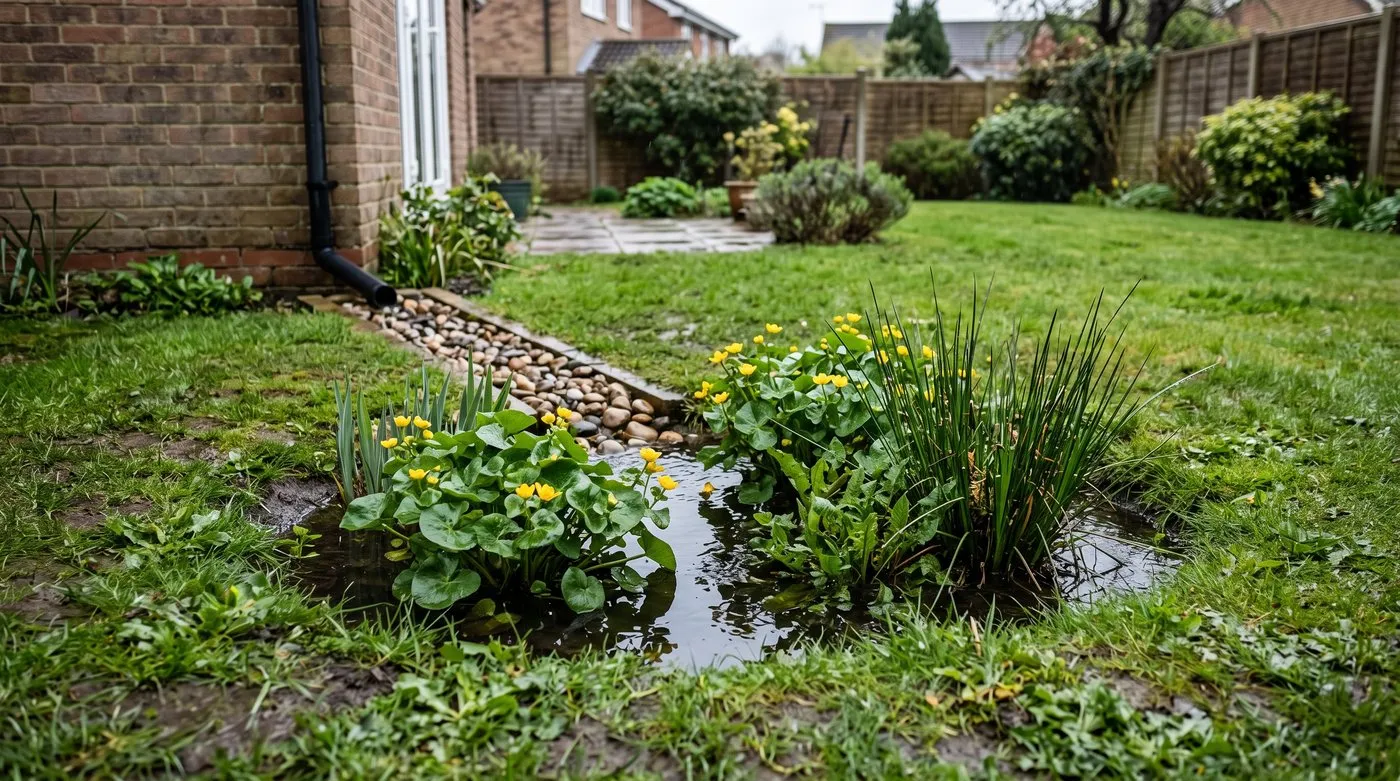
A planted dip lets roof water soak in slowly instead of rushing down the drain. Slow it, spread it, sink it.
The remaining permaculture principles applied to UK gardens
8. Integrate rather than segregate
Put things where they help each other. A pond near the veg beds brings in frogs that eat slugs. Chickens by the compost heap eat scraps and add manure. A bokashi composting system in the kitchen links your food waste straight to your beds.
No chickens? It still works. Put the compost bin where you can reach it from the kitchen and the veg beds. Keep tools where the main paths meet. Grow climbing beans up sweetcorn to share the space.
9. Use small and slow solutions
Start small. Build one hugelkultur bed and see how it goes. Plant one fruit tree guild before you plant ten.
Timing helps too. Bare-root trees planted between November and February are cheaper than potted ones and settle in well. A packet of green manure seed covers bare soil all winter for very little. Small, cheap jobs add up.
10. Use and value diversity
Grow lots of different plants. A big block of one crop is a feast for the pests that love it. A mix of plants is harder for pests to find and brings in more helpful wildlife.
In practice:
- Grow a wide range of vegetables rather than big blocks of a few
- Mix flowers right through your veg beds, not just round the edges
- Add some native wildflowers
- Try a few heritage varieties alongside modern ones
11. Use edges and value the marginal
Edges are where the action is. A pond’s shallow edge has more life than the deep water or dry land. A hedge bottom grows different plants from the lawn next to it. The edge of a path catches warmth and shelters seedlings.
Make the most of edges by:
- Curving bed edges rather than making them straight
- Giving a pond gently sloping, shallow sides
- Planting a mixed hedge instead of a fence
- Trying keyhole-shaped beds, which give you more edge to reach from
12. Creatively use and respond to change
Go with change rather than fighting it. UK winters are getting milder, summers drier and downpours heavier. Plan for it now.
Plant tough Mediterranean herbs in your sunniest spots. Store more rainwater than you think you’ll need. Enjoy the longer growing season by trying crops like outdoor sweet potatoes and oca.
How do you start a permaculture garden from scratch?
Take it step by step. Rushing in wastes time and money.
Year one: Watch and plan
- Note sun, shade, wind and wet spots through all four seasons
- Check your soil with a simple home kit, and see how well it drains
- Draw a rough map with buildings, trees, boundaries, slopes and paths
- Sketch out your zones on paper before anything goes in for good
- Have a look at the Permaculture Association’s beginner resources
Year two: Build the basics
- Put water butts on every roof
- Build a set of three compost bays: one filling, one rotting, one ready
- Cover grass with cardboard and a thick layer of compost to make new beds
- Plant bare-root fruit trees and hedging between November and February
- Sow green manure on any bare soil over winter
Year three onwards: Plant and tweak
- Plant fruit trees with their helper plants
- Add perennial veg like rhubarb, asparagus, globe artichoke and good King Henry
- Make no-dig beds for your annual veg
- Dig a wildlife pond, even a small one in a container
- Change your plan based on what’s worked and what hasn’t
Permaculture rewards patience. Each year the garden gives you more and asks a little less of you.
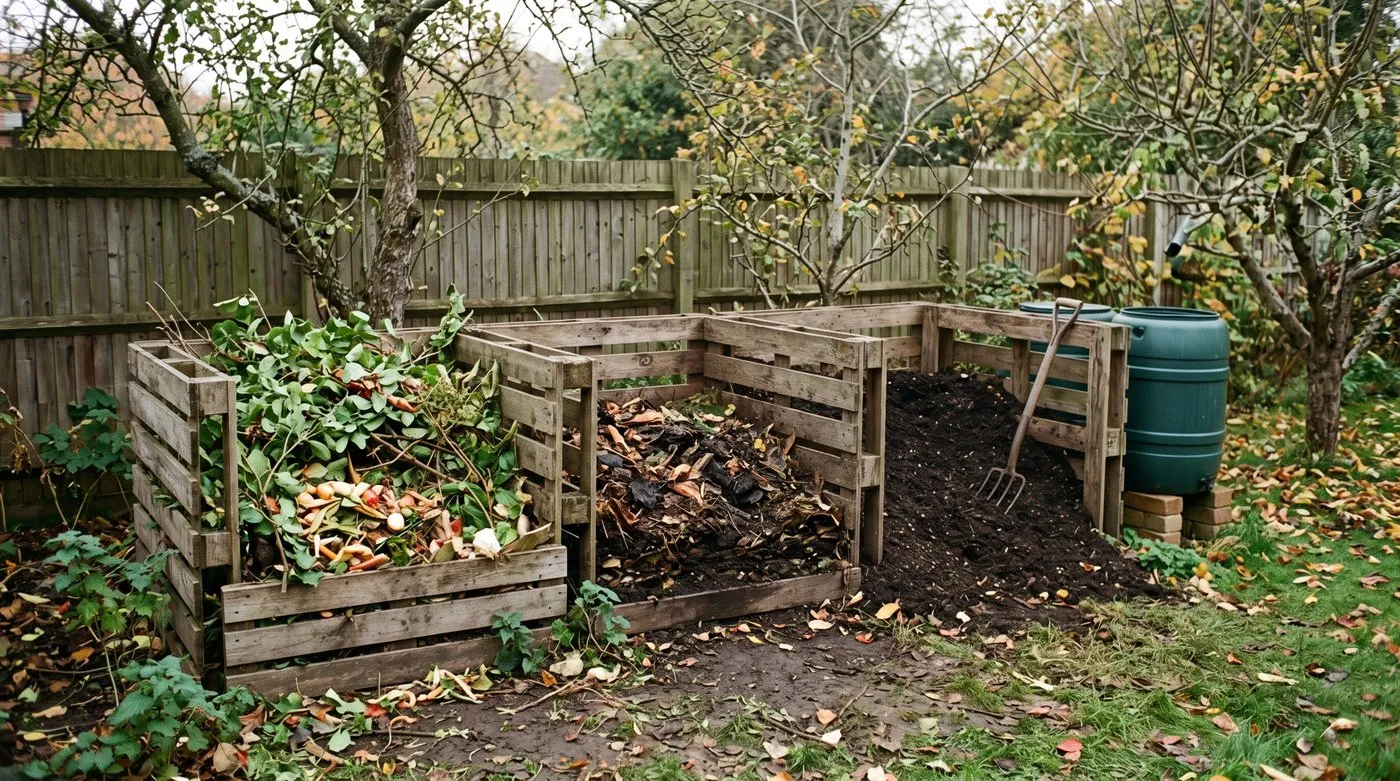
Three bays keep compost moving: one filling, one rotting and one ready to spread. It’s one of the best first jobs in a new permaculture garden.
Permaculture plant combinations for UK soil types
Match your plants to your soil and everything grows more happily.
| Soil type | Trees | Shrubs | Ground cover | Green manure |
|---|---|---|---|---|
| Heavy clay | Apple, plum, damson | Blackcurrant, comfrey | Creeping thyme, clover | Field beans, crimson clover |
| Sandy | Pear, cherry, hazel | Gooseberry, rosemary | Wild strawberry, sedum | Phacelia, buckwheat |
| Chalk | Walnut, medlar, quince | Lavender, sage | Marjoram, self-heal | Sainfoin, lucerne |
| Loam | Any fruit tree | Any soft fruit | Most ground covers | Any green manure |
| Acid | Blueberry, crab apple | Lingonberry, heather | Bilberry, wood sorrel | Lupins, winter tares |
Comfrey grows on almost any soil. Choose ‘Bocking 14’, which doesn’t spread by seed, and plant it about 1m apart around fruit trees. Cut the leaves when they’re about 45cm tall. The first cut is usually ready in late April.
Frequently asked questions
Can you do permaculture in a small UK garden?
Yes, it works in any size of garden. A 5m x 5m plot has room for herbs by the door, a dwarf fruit tree with helper plants, a compost bin and a water butt. It’s about how you plan the space, not how big it is. You can even try it on a balcony with pots.
How long does a permaculture garden take to establish?
Most take three to five years to really get going. You’ll pick vegetables in the first year and fruit bushes crop after two or three years. Fruit trees take a few years longer. It gets easier to look after each year.
What is the difference between permaculture and organic gardening?
Organic gardening means no man-made chemicals. Permaculture includes that, but it’s a way of planning the whole garden. It also looks at water, waste, wildlife and where everything goes. Organic growing is one part of it.
What are permaculture zones?
Zones are areas grouped by how often you visit them. Zone 0 is the house and Zone 1 is the herbs by the kitchen door. Zone 5 is a wild patch you leave alone. Most UK gardens cover zones 1 to 3.
Is permaculture expensive to set up?
It can cost very little. Cardboard, leaves, grass clippings and home-made compost are free. Water butts and bare-root fruit trees are fairly cheap, especially in winter. The biggest cost is your time spent watching and planning.
Do permaculture gardens look messy?
Not when they’re well planned. A good one looks like a busy, productive cottage garden. Every plant is there for a reason, the paths are clear and the edges are kept tidy.
What are the best permaculture plants for UK gardens?
Comfrey ‘Bocking 14’ is the top choice. Its leaves make a great liquid feed and mulch. Other favourites are apple trees on MM106 rootstock, blackcurrants, clover, nasturtiums and runner beans. All of them are hardy in the UK.
Our team produces practical UK gardening guidance from source research, contributor records and established horticultural practice. Editorial standards are overseen by Matt W.


