Key takeaways
- A 90cm charge of fresh strawy horse manure peaked at 64C on day 4 and stayed above 15C in the rooting zone for 47 days
- Never sow at the peak: wait until the rooting zone falls below 27C, which took 12 days in our January builds
- Manure must be under 6 weeks old with roughly 30-40% straw by volume; well-rotted manure generates almost no heat at all
- A January hotbed gave radish in 26 days and pulled carrots by 14 April, six weeks ahead of the open-ground control
- Build 1.5m square minimum.
- Total cost was £38 for a season using a scavenged frame; a heated propagator running the same 47 days cost £51 in electricity
Hotbed gardening is the technique of heating a cold frame from below with fermenting fresh manure. Bacteria breaking down straw and dung give off heat, the frame traps it, and you get a growing space several degrees above the outside air with no electricity involved. Victorian head gardeners used hotbeds to put salads on the table in February and, at the wealthy end, to force pineapples in Cornwall and Cambridgeshire.
How fermenting manure makes heat
The heat is biological, not chemical, and understanding the process tells you why every rule that follows exists.
Fresh stable litter is a mix of dung, urine and straw. The straw is carbon at roughly 80:1 carbon to nitrogen. The dung and urine are nitrogen-rich, around 15:1. Blend them and you land near 25:1 to 30:1, which is the ratio at which thermophilic bacteria work fastest.
Those bacteria are aerobic. They oxidise the carbon and release energy, most of it as heat rather than growth. In a mass large enough to insulate itself, that heat cannot escape faster than it is made, so the core temperature climbs. Thermophilic bacteria take over from mesophiles at around 45C and keep working up to about 70C, at which point they cook themselves and the process stalls.
This is exactly the same reaction as a hot compost heap. The difference is what you do with it. A compost heap wastes the heat into the sky. A hotbed puts 15-25cm of growing medium on top and a glazed lid over it, so the heat passes through your seedlings on its way out. Our guide to cold, fast and hot compost methods covers the same bacteria doing the same job for a different purpose.
Three things stop the reaction dead: not enough nitrogen, not enough air, and not enough mass. Old manure has already burned its nitrogen. Wet, compacted manure excludes oxygen and turns anaerobic, which produces almost no heat and a great deal of smell. A small heap loses heat to the air faster than it makes it.
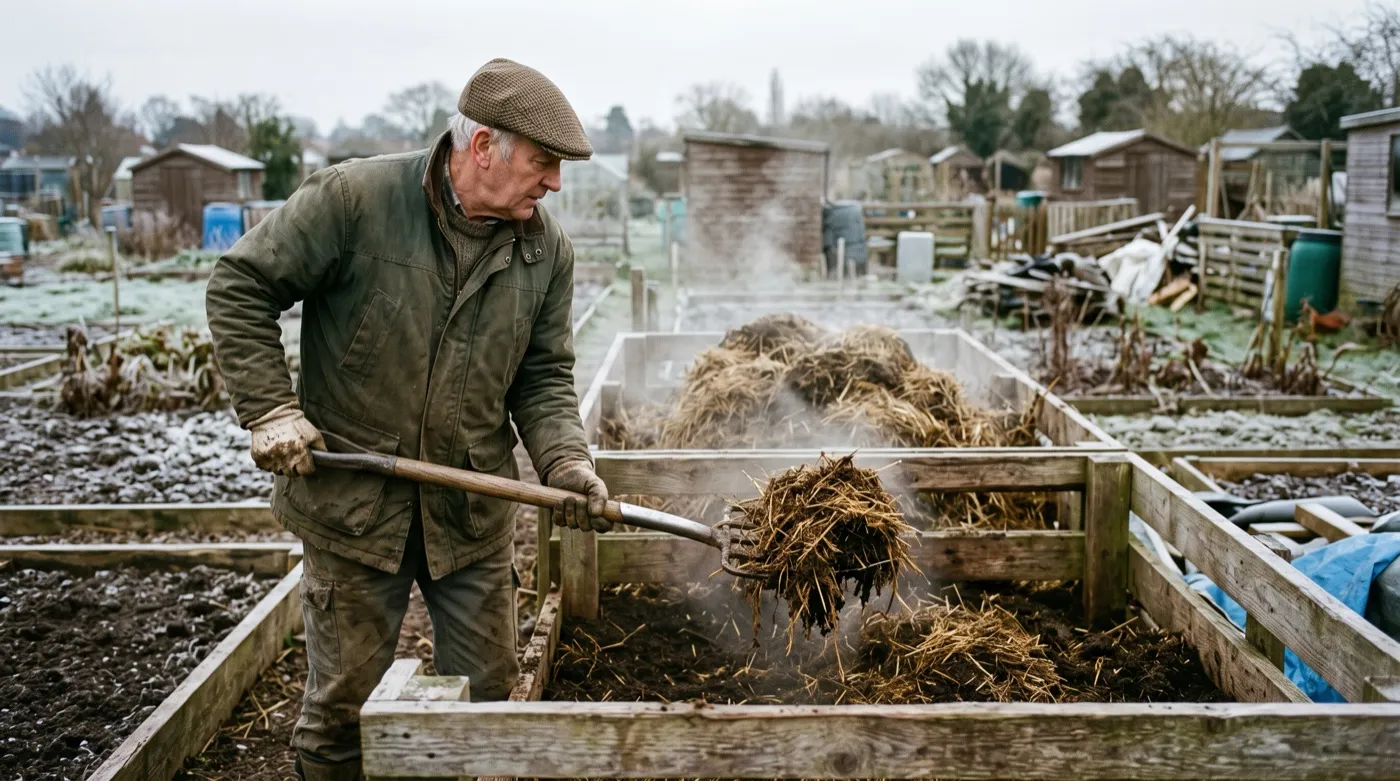 Fresh stable litter going in, straw and all. The pale straw is roughly a third of the volume, which is what the bacteria need to hit 60C.
The temperature curve: what actually happens day by day
Read the two columns against each other. The core is a furnace and the rooting zone is a nursery. The 20cm cap is doing the work of turning 64C into 34C, and the gap between the columns narrows from 30C on day 4 to just 4C by day 47.
The single most useful number here is day 12. That is when the rooting zone crosses below 27C and stays there. Sow before it and you cook the seed. Sow much after it and you waste the best fortnight of the curve.
What Victorian gardeners knew about hotbeds
The hotbed is not a novelty. It was standard infrastructure in every walled kitchen garden in Britain from roughly the 1750s to the 1930s.
Large estates ran hotbed yards of a dozen or more frames, recharged in rotation so that something was always at the right point on the curve. The frames were glazed with Dutch lights, timber-framed single panes roughly 1.4m by 0.8m, light enough for one gardener to slide off and heavy enough to stay put in wind.
The manure supply was the reason it worked. A large house kept horses, and a stable of twenty horses produced something like 10 tonnes of litter a year. That was a waste problem which the kitchen garden turned into a heating system, and then into next year’s soil. Nothing left the estate.
What killed the hotbed was the internal combustion engine, not electricity. When estates stopped keeping horses, the free heat stopped arriving in a barrow every morning. The technique is only unfashionable because the fuel moved.
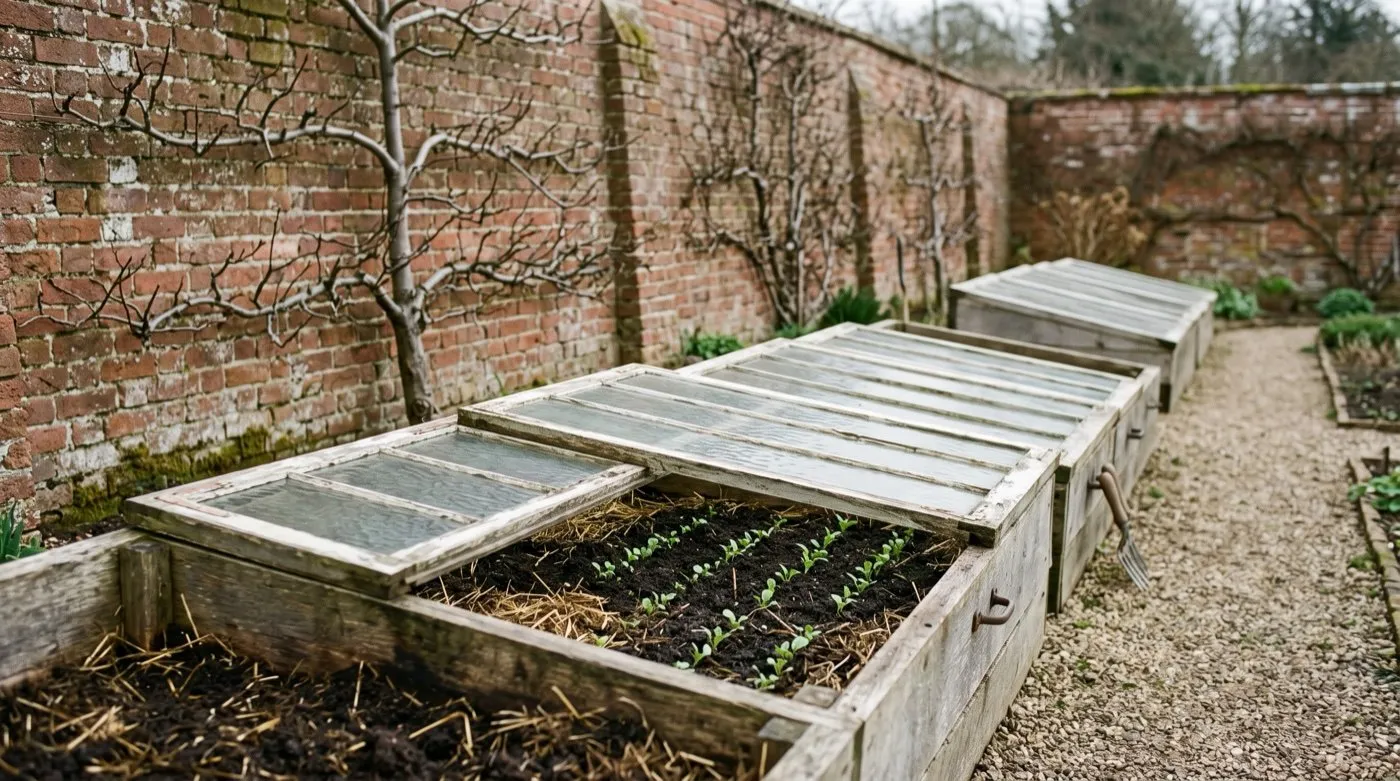 Dutch lights over a restored hotbed frame. Estates ran a dozen of these in rotation so one was always at the right point on the temperature curve.
Choosing manure: the freshness test that decides everything
Get this wrong and you have built a cold frame with a smell. Manure quality is the single biggest variable in hotbed performance, ahead of size, weather and construction.
Moisture. Squeeze a handful. It should feel like a wrung-out cloth, damp but not dripping. Water it if it is dusty. If it drips, mix in more dry straw. Sodden manure excludes air and the reaction stops.
The gold standard is fresh strawy horse litter under six weeks old, packed 90cm deep in a bed at least 1.5m square. Everything else is what you do when the livery has run out.
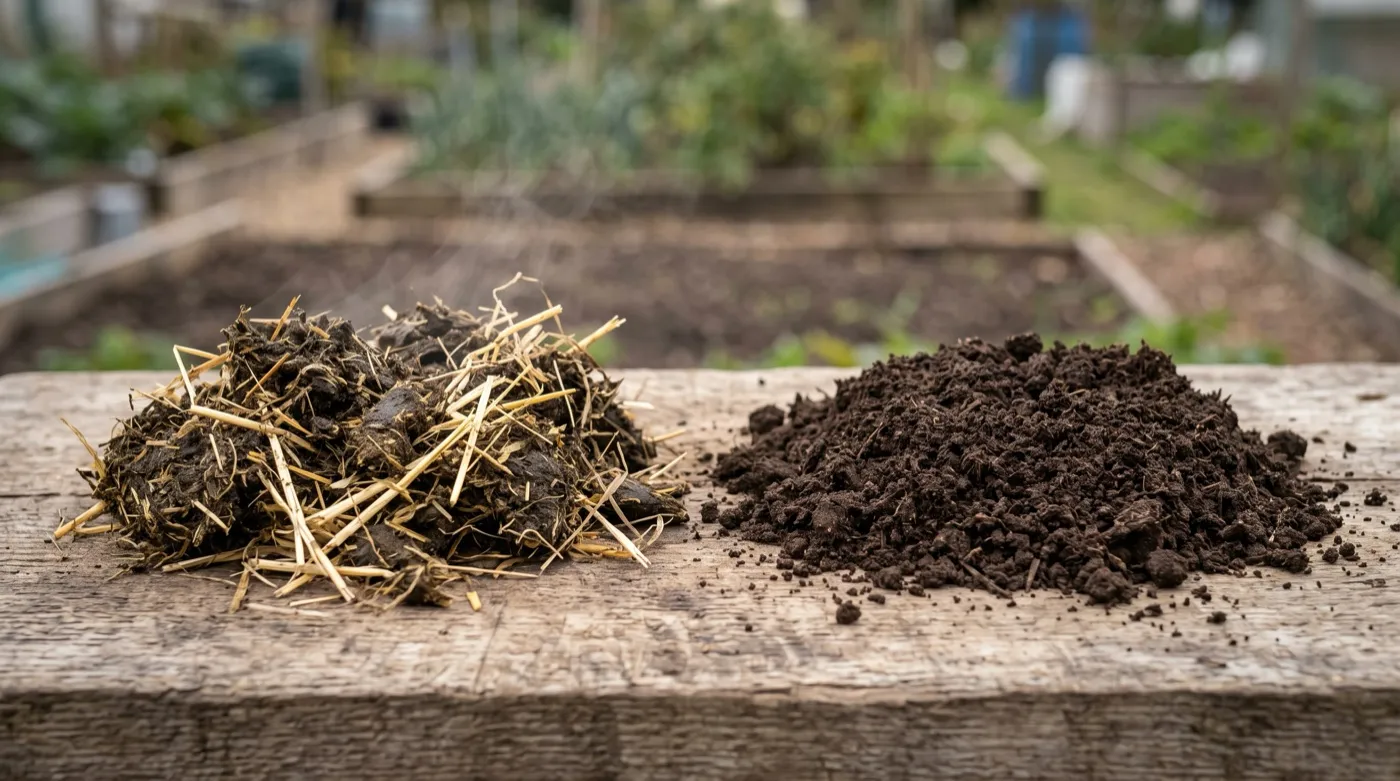 The freshness test. Fresh strawy litter on the left will reach 64C. The dark, well-rotted material on the right peaked at 31C and is useless as a charge.
Building a hotbed that holds 15C for six weeks
Six steps, one afternoon, and one rule that matters more than the rest: build it big.
- Site it south-facing and sheltered. Against a wall or fence if possible. A north-facing hotbed loses roughly 20% of its useful window to wind chill on the lid.
- Mark out 1.5m square minimum. This is not negotiable. Our 1m bed peaked 13C lower and lost its heat 2.4 times faster than the 1.5m bed built from the same barrow load on the same day.
- Build the manure stack 90cm deep. Fork it in loosely in 20cm layers, and tread each layer firm but not compacted. You want it dense enough to insulate and open enough to breathe. Water any dry patches as you go.
- Let it heat for 48 hours before capping. The stack will drop by roughly 15cm as it settles and starts working. Cap too early and you cap a void.
- Cap with 20cm of soil or spent compost. This is your rooting zone and the buffer that turns 64C into something a seed can survive. Under 15cm and the curve is too fierce. Over 25cm and you lose too much heat to reach the seedlings.
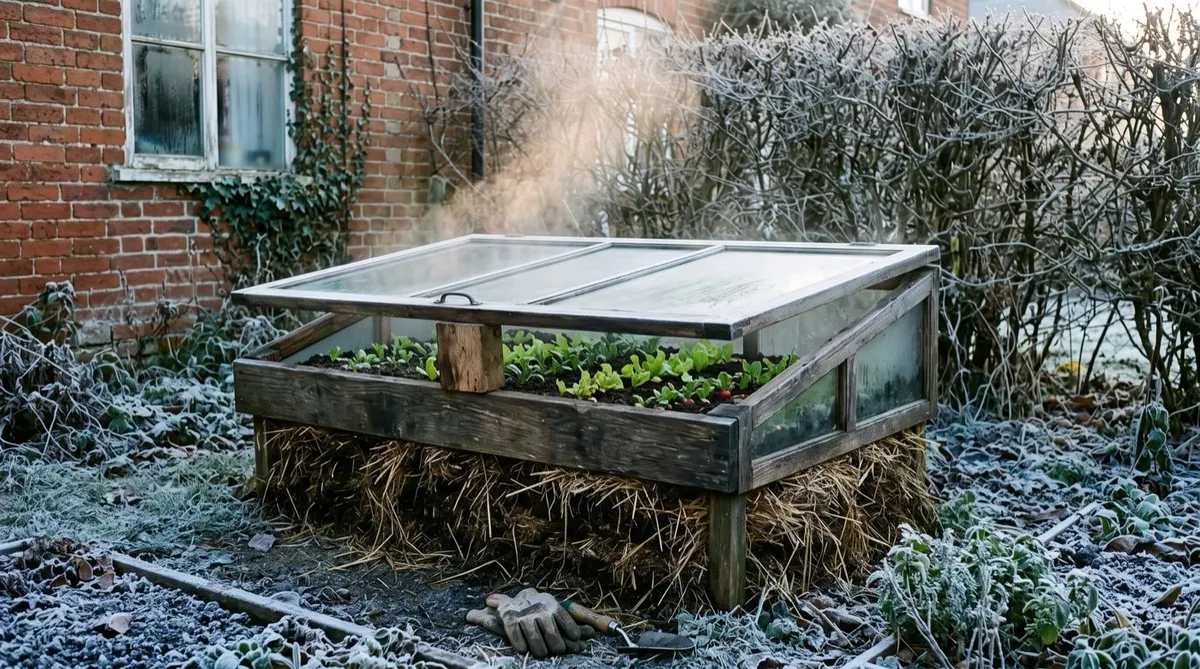
- Fit the frame and the lid. Sides at 30cm above the cap at the back, sloping to 20cm at the front so the light sheds rain and catches low winter sun. Any glazing works.
Cost matters here. Our 2023 bed came to £38 all in: manure free from a local livery for the collecting, £26 for a sheet of 4mm twin-wall polycarbonate, £12 for timber screws, and a frame scavenged from a skip. Running a 52W heated propagator of similar area for the same 47 days would have cost about £51 at 2026 electricity prices, and it would have warmed a fraction of the volume.
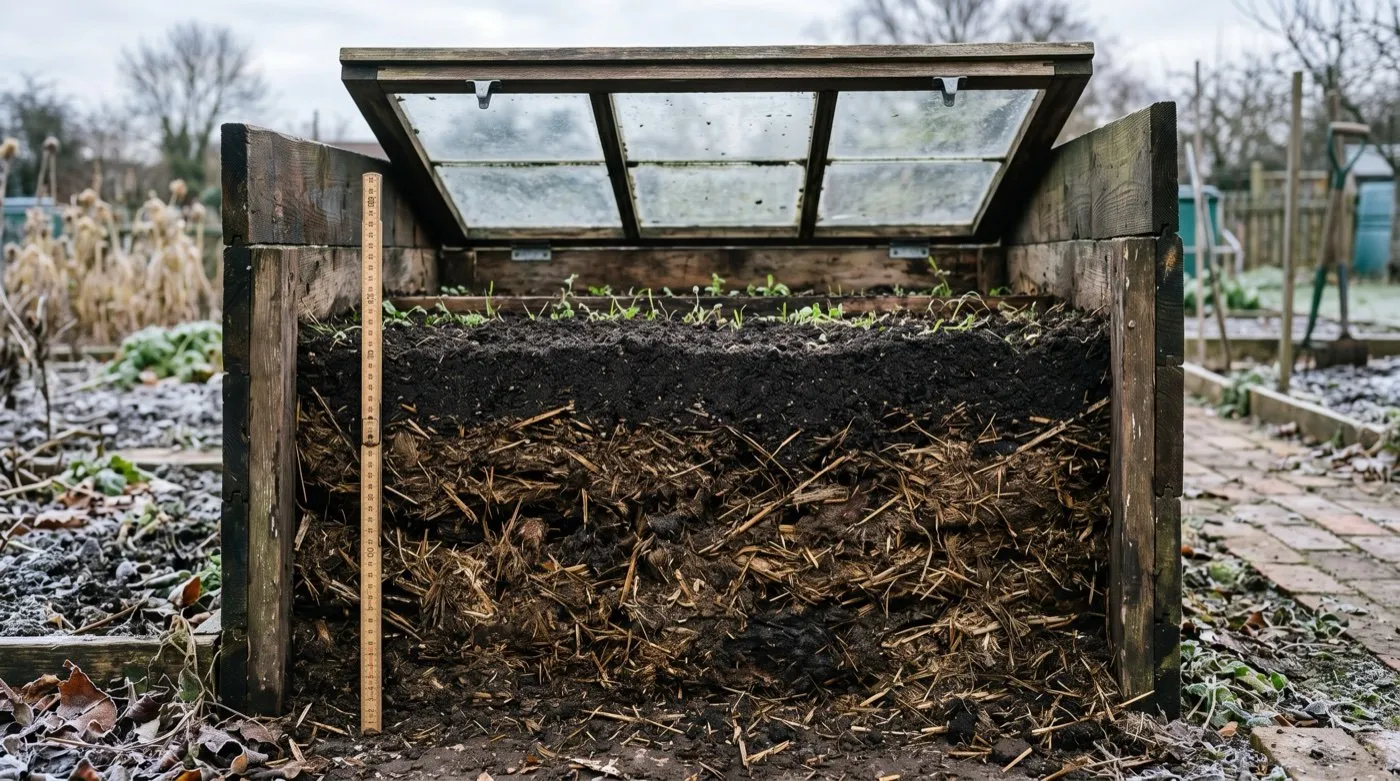 The construction that matters: 90cm of manure, a 20cm soil cap, and a frame with 30cm at the back sloping to 20cm at the front.
What to sow at each stage of the curve
Match the crop to the temperature and the hotbed does the work. Sow the wrong thing at the wrong point and you will conclude the technique does not work.
Days 20-35, rooting zone 21-18C. Sow carrots (‘Amsterdam Forcing’, ‘Early Nantes’), turnips (‘Snowball’), beetroot (‘Boltardy’), spinach (‘Medania’). Our 14 January carrot sowing pulled as finger carrots on 14 April, six weeks ahead of the open-ground control sown at the same time. That is the headline result of the whole trial.
Days 35-47, rooting zone 18-15C. Stop sowing and start using the bed as a nursery. This is the window for hardening off modules raised indoors, and for germinating half-hardy annuals that would sulk on a windowsill.
After day 47. The bed is a cold frame with a warm floor, and it runs on exactly as one. In May, fork the half-rotted manure out and onto your beds, where it will finish rotting in place. The February planting guide covers what to move out of it as the season turns.
Seed temperature thresholds decide all of this, and they are worth knowing cold. Lettuce goes thermally dormant above 25C. Carrot germinates between 7C and 30C with an optimum near 20C. Radish will run from 5C to 30C, which is why it is the forgiving first crop. Our seed germination temperature table has the rest.
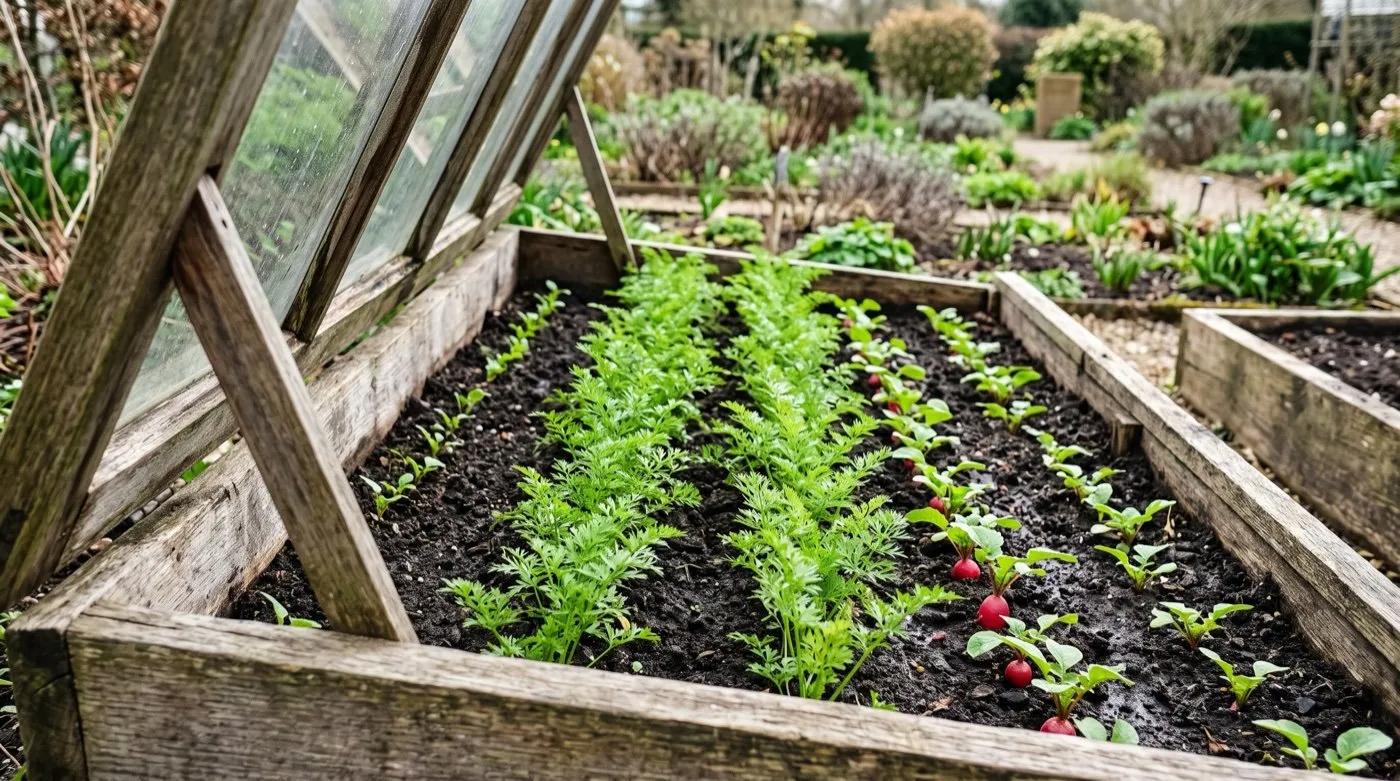 14 January carrots at eight weeks. These pulled as finger carrots on 14 April, six weeks ahead of the same seed sown in open ground.
Ventilation: the thing that kills more hotbed crops than cold
Here is the failure mode nobody warns about. A hotbed does not kill seedlings by freezing them. It kills them by cooking and drowning them.
Fermenting manure gives off heat, carbon dioxide and a great deal of water vapour. Under a sealed lid on a sunny March morning, the frame can hit 35C by 11:00 with the outside air at 8C. Condensation streams down the glass and drips onto the seedlings, and damping off follows within days.
The regime is simple and it is daily. Vent every morning the outside air is above 4C. Prop the lid on a 50mm block in cold weather, 150mm in mild, and take it off entirely above 12C. Close it by 15:00 in January and February to trap the day’s warmth before the temperature drops.
Wipe the underside of the lid dry once a week. Sow thinly, because crowded seedlings in a humid frame are damping-off waiting to happen. If you see a white fuzz at soil level, increase ventilation immediately rather than reaching for anything else.
Gardener’s tip: Put a cheap max-min thermometer inside the frame at seedling height and check it every evening, not the soil thermometer in the manure. The manure temperature tells you where you are on the curve. The air temperature tells you whether you cooked your lettuce at midday while you were at work. Ours read 37C on a bright March day with the lid shut and 9C outside.
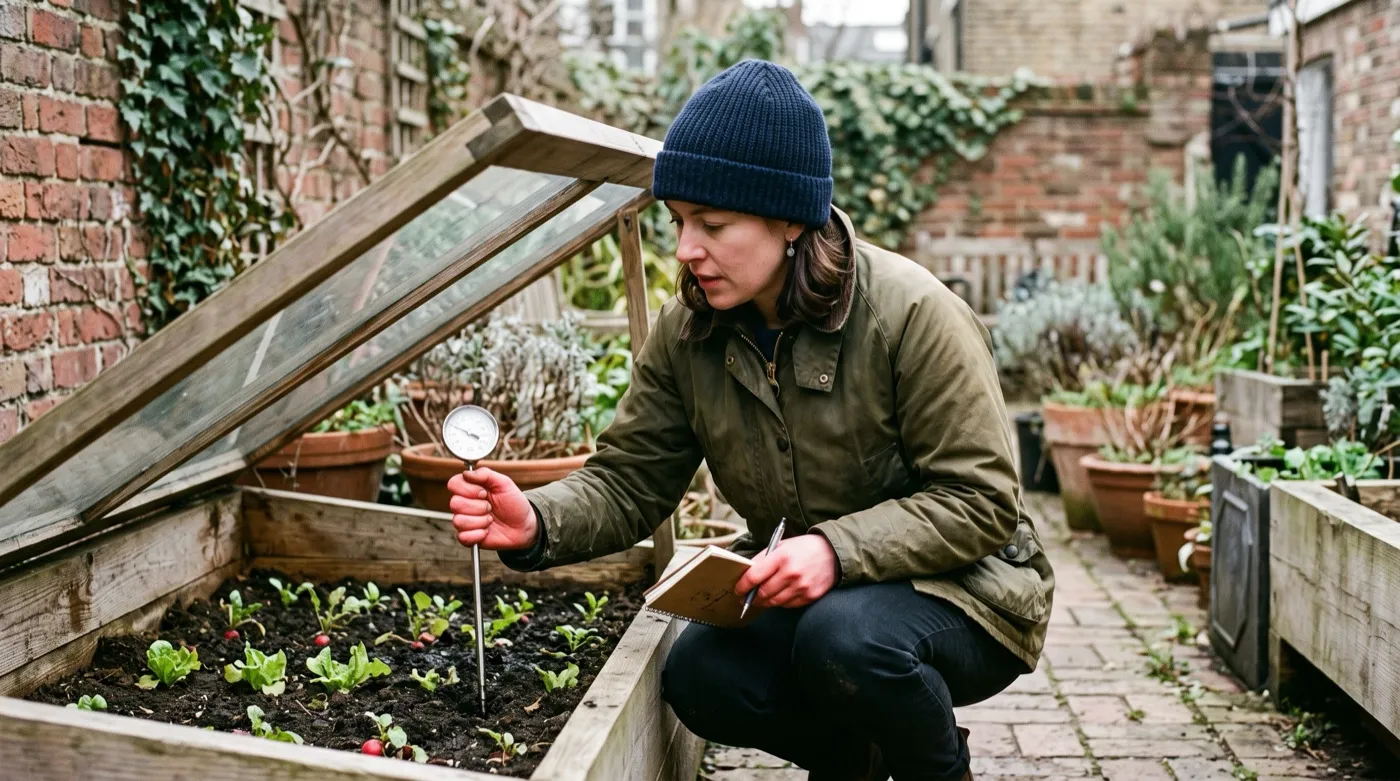 Reading the rooting zone at 10cm, not the manure core. Two consecutive mornings under 27C is the signal that it is safe to sow.
The root cause of most hotbed failures
Heat production scales with volume. Heat loss scales with surface area. Halve the linear dimensions of a bed and you cut the volume to an eighth while only cutting the surface area to a quarter. The ratio moves against you sharply, and the bed bleeds heat faster than the bacteria can replace it.
That is the arithmetic behind our two January 2023 beds. Same manure, same morning, same weather. The 1.5m bed peaked at 64C and held above 15C for 47 days. The 1m bed peaked at 51C and was through 15C by day 19. The small bed was not unlucky. It was too small to insulate itself.
The reason this gets missed is that a 1m frame looks perfectly reasonable in a small garden, and the failure appears three weeks later as slow growth rather than as an obvious event. People conclude that hotbeds are overrated when they have simply built a heap that could not hold its own heat.
Permanent prevention is dimensional. Never go under 1.5m square or under 90cm of manure. If you cannot source that much muck in one go, wait. Where space is genuinely tight, pack a 30cm skirt of fresh manure around the outside of the frame as insulation, which bought our small bed an extra 16 days above 15C when we retro-fitted it in February 2024.
Month-by-month hotbed calendar
The hotbed year runs backwards from everyone else’s. Your busiest month is January.
| Month | What to do |
|---|---|
| January | Build the main bed. Manure is plentiful and stables want rid of it. Sow radish and lettuce on day 12. |
| February | Sow carrots, turnips and beetroot as the curve settles to 21-18C. Vent every morning above 4C. |
| March | Heat is fading. Use the frame for hardening off. Watch for 35C spikes under a shut lid on bright days. |
| April | Pull the early carrots. Bed now runs as an ordinary cold frame with a warm floor. |
| May | Fork the half-rotted manure onto your beds. It finishes rotting in place over summer. |
| June | Frame is free for cucumbers or melons. Book your autumn manure with the livery now. |
| July | Nothing to do. Stables are at their busiest and muck is easiest to get if you want a head start. |
| August | Repair the frame and re-seal the glazing while the weather lets you work outside. |
| September | Build an autumn hotbed if you want winter salad. Curve is shorter: expect 30-35 days above 15C. |
| October | Sow winter lettuce and corn salad into the autumn bed once it drops below 27C. |
| November | Insulate the frame sides with straw bales. Reduce ventilation but never stop it entirely. |
| December | Collect and stack fresh manure under cover, ready for the January build. Do not let it get rained on. |
Common mistakes with hotbeds
- Sowing at the peak. On day 4 the rooting zone was 34C, which kills carrot seed and puts lettuce into thermal dormancy. Wait for two consecutive mornings under 27C at 10cm depth. That was day 12 in our January builds.
- Building too small. A 1m bed peaked 13C lower and lost its heat 2.4 times faster than a 1.5m bed from the same load. Under 1.5m square you are running a manure heap, not a hotbed.
- Using well-rotted manure. It looks better, smells better and does nothing. Our four-month-old batch peaked at 31C. If it does not smell of ammonia and stable, it will not heat.
- Never venting. Fermenting manure produces steam as well as heat. A shut frame on a bright March day hit 37C with 9C outside, and damping off follows the condensation within a week.
- Capping too early or too thin. The stack drops 15cm in the first 48 hours, so cap after it settles. A cap under 15cm passes the full heat of the core straight to the seed.
Why the hotbed deserves a second look
Hotbed gardening is the rare heritage technique that has not been improved on. A heated propagator warms a tray. A hotbed warms two square metres, feeds the crop as it goes, and hands you half-rotted manure for the beds in May. Ours cost £38 against £51 of electricity for the same window, and the electricity would have done less.
Now you know what the manure curve gives you, read our cold frame gardening guide for how to run the same frame through the other ten months of the year.
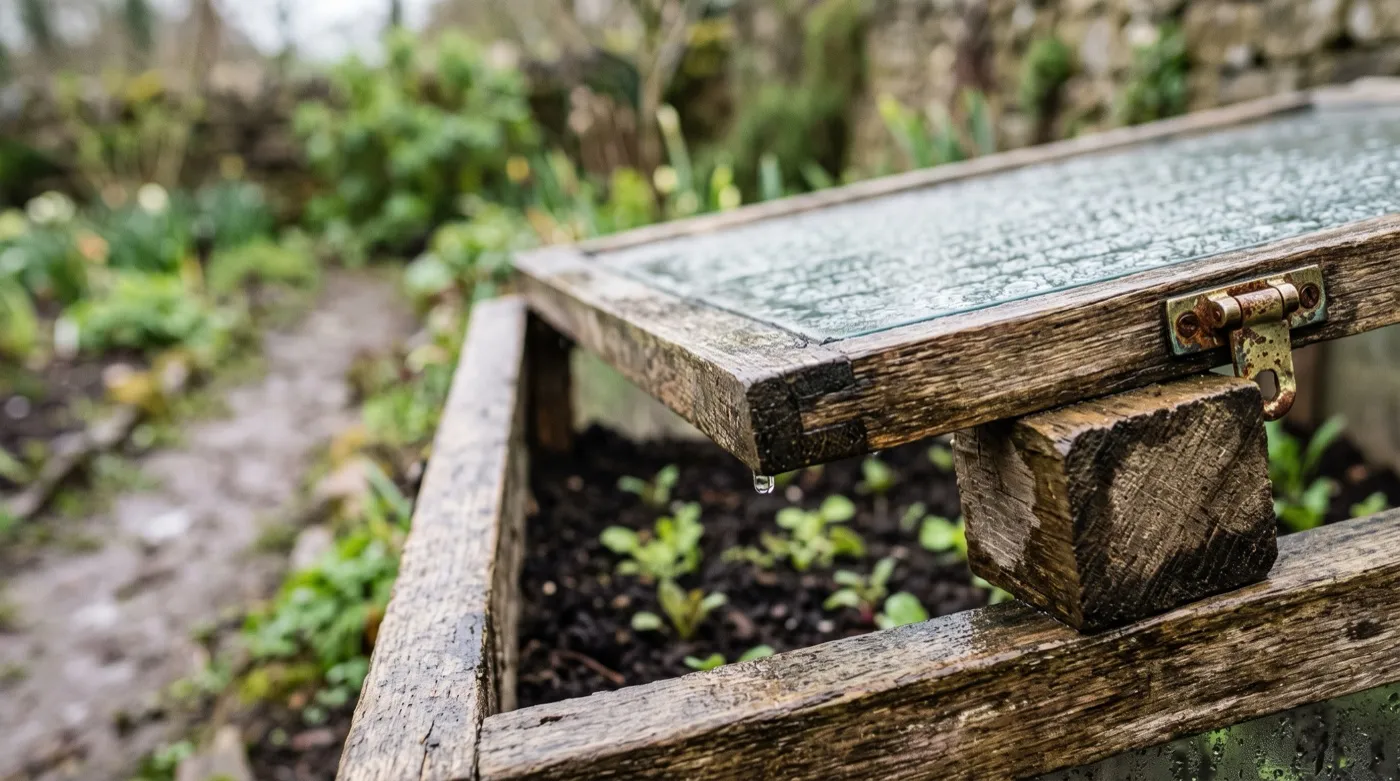 Venting on a 50mm block. More hotbed crops die from a shut lid at midday than from any January frost.
Frequently asked questions
What is hotbed gardening?
A hotbed is a cold frame heated from below by fermenting fresh manure. Bacteria breaking down the straw and dung release heat, which rises through a layer of soil or compost and warms the rooting zone. Victorian kitchen gardens used them to force salads, carrots and even pineapples through winter without any fuel. The technique needs no electricity and works on any UK plot with access to stable muck.
What manure is best for a hotbed?
Fresh strawy horse manure, under six weeks old, with 30-40% straw by volume. Stable litter is ideal because the urine-soaked straw is high in nitrogen, which is what drives the bacterial heat. Cow manure is wetter and denser and peaks around 10C lower. Well-rotted manure has already released its heat and will do nothing at all in a hotbed.
How hot does a hotbed get?
When can you sow into a hotbed?
Once the rooting zone at 10cm depth reads below 27C, usually 10-14 days after building. Sowing at the peak kills seed outright and cooks any transplants. Push a soil thermometer into the growing layer, not the manure, and wait for two consecutive mornings under 27C. In our January builds that point arrived on day 12.
What can you grow in a hotbed in winter?
How long does a hotbed stay warm?
Can you use a hotbed without a cold frame?
Our team produces practical UK gardening guidance from source research, contributor records and established horticultural practice. Editorial standards are overseen by Matt W.