Key takeaways
- Sow from early August to mid-September, not in winter
- Lamb's lettuce is the hardiest salad leaf and copes with hard frost outdoors
- Plants barely grow from late November to February, so pick gently
- Pick outer leaves and leave the centre to regrow for many harvests
- Open cold frames on sunny days, or plants can overheat
Yes, you really can pick fresh salad all winter in the UK. While most people put the tools away in October, a cold frame or unheated greenhouse keeps lamb’s lettuce, mizuna, winter purslane and hardy spinach coming right through the coldest months.
The secret is timing. You sow in late summer, not winter. Plants get growing in the mild days of September and October, sit quietly through December and January, then perk up again in February. This guide covers which leaves cope with frost and when to sow them. For lettuce choices, including the hardy ‘Winter Density’, see our guide to the best lettuce varieties.
Can you really pick salad all year round in the UK?
Yes, as long as you sow at the right time and pick hardy leaves. The thing that catches people out is that winter is for picking, not sowing. Once the days get really short in late November, salad plants almost stop growing, even in a greenhouse.
So sow in August and September. That gives plants several weeks of mild weather to get established before winter. By November, your lamb’s lettuce, mizuna and spinach are good-sized plants, ready to be picked a few leaves at a time until spring.
The RHS guide to salad leaves is a handy extra read. It covers many of the leafy oriental greens like mizuna, tatsoi and pak choi that make winter salads so much more interesting than plain lettuce.
 Lamb’s lettuce, mizuna and winter purslane growing on through a December frost.
Which salad leaves survive frost in a UK winter?
Lamb’s lettuce is the toughest, happily sitting through hard frost outdoors. Several others crop well through winter with a bit of help from a cold frame, cloche or greenhouse.
| Leaf | How hardy | Best grown | Flavour |
|---|---|---|---|
| Lamb’s lettuce (corn salad) | Very hardy | Outdoors or under cover | Mild, nutty |
| Hardy spinach | Very hardy | Outdoors or under cover | Earthy, rich |
| Lettuce ‘Winter Density’ | Hardy | Under cover is best | Sweet, crunchy |
| Lettuce ‘Arctic King’ | Hardy | Outdoors or under cover | Crisp, mild |
| Tatsoi | Hardy | Under cover is best | Mild mustard |
| Winter purslane (claytonia) | Hardy | Outdoors or under cover | Mild, juicy |
| Land cress | Hardy | Outdoors or under cover | Peppery, like watercress |
| Mizuna | Fairly hardy | Under cover looks better | Mild, feathery |
| Red mustards | Fairly hardy | Under cover looks better | Hot, spicy |
| Rocket | Fairly hardy | Under cover | Peppery |
| Endive | Fairly hardy | Under cover | Pleasantly bitter |
| Pak choi | Least hardy | Cold frame or greenhouse | Mild, crisp |
Picking the outer leaves regularly also keeps plants compact and tidy through the winter.
For more on growing lettuce all year, including summer varieties that are slow to bolt, see our dedicated guide.
When to sow winter salad for picking from January to March
Sow from early August to mid-September. Miss this window and plants won’t be big enough to keep you in leaves through winter.
| Crop | Sow | Weeks to baby leaf | Pick |
|---|---|---|---|
| Lamb’s lettuce | Early August to mid-September | 6-8 | October to March |
| Mizuna | Early August to early September | 3-4 | October to February |
| Rocket | Early August | 3-4 | September to December |
| Land cress | July to August | 6-8 | October to March |
| Winter purslane | August to September | 6-8 | November to April |
| Lettuce ‘Winter Density’ | August to September | 6-8 | November to March |
| Hardy spinach | August to September | 4-6 | October to March |
| Tatsoi | August to September | 4-5 | October to March |
| Red mustards | August to early September | 3-4 | September to December |
Light, not cold, is what holds plants back. From mid-November to late February, growth almost stops, however warm you keep the greenhouse. The plants are fine, just resting.
Start sowing again under cover from mid-February, beginning with hardy lettuces like ‘Arctic King’ and ‘Winter Density’. By early March, you can sow mizuna, mustards and pak choi again. Things speed up through March, and by April you’re back to normal succession sowing.
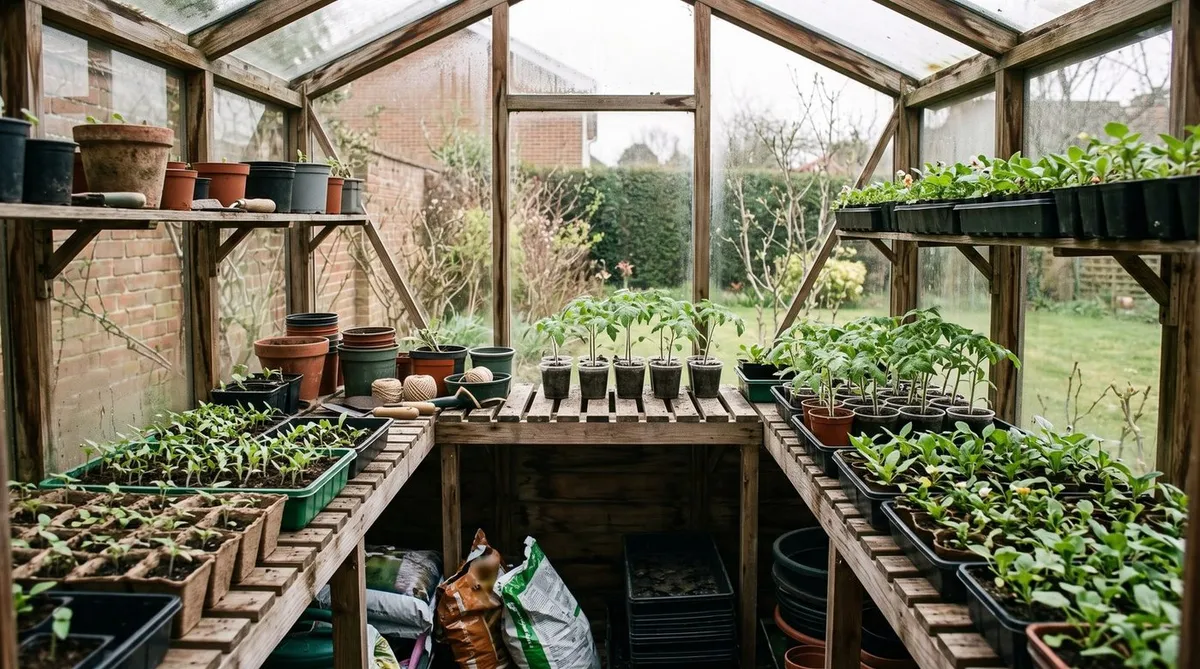
 Sowing winter salad in August. Seedlings in module trays can be planted out into a cold frame or greenhouse bed once they have 3-4 true leaves.
How cold does an unheated greenhouse get in winter?
An unheated greenhouse is a few degrees warmer than outside on a still night, and much warmer on a sunny day. That small gap is often enough to keep hardy salad leaves alive and picking. It can still freeze inside on a hard frosty night, but hardy leaves cope.
Wind makes a difference. On a windy night, the greenhouse loses its warmth faster. A greenhouse against a sunny wall or fence holds heat better than one standing out in the open.
For a little extra protection, line the inside with bubble wrap in winter. It cuts down heat loss, though it lets in a bit less light. On the coldest nights, drape horticultural fleece straight over the plants as well.
Our greenhouse insulation guide covers materials and methods. The greenhouse growing calendar has month-by-month sowing for all crops, not just salads.
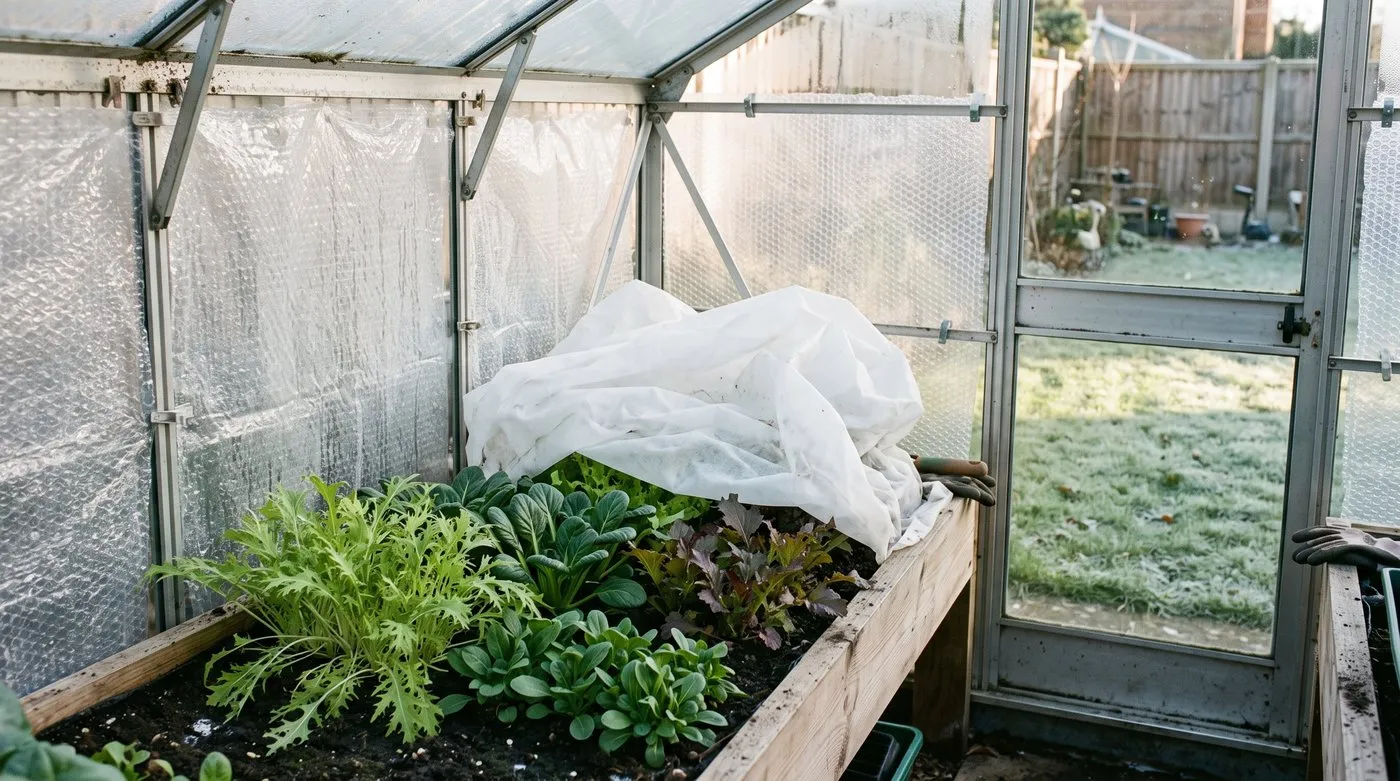
Bubble wrap on the glass cuts heat loss, and fleece over the plants adds a little more on the coldest nights. Hardy leaves cope with the rest.
How to use a cold frame for winter salads
A cold frame is the cheapest way to grow winter salad. It gives similar protection to an unheated greenhouse for much less money.
Put it against a sunny, south-facing wall, with the sloping lid facing the sun. The wall soaks up warmth by day and gives it back at night.
Ventilation tips that save your crop
This is where most people go wrong. A closed cold frame on a sunny day, even in January, can get surprisingly hot inside. Your salad can cook before the frost ever gets to it.
| Weather | What to do |
|---|---|
| Sunny and above about 10C | Prop the lid open a few centimetres |
| Warm, mild day | Open the lid fully |
| Mid-afternoon in winter | Close the lid to trap warmth |
| Hard frost forecast | Close fully and add fleece on top |
An automatic vent opener does the job for you. It opens the lid as it warms up and closes it again as it cools, which is great if you’re out all day.
Damp is a bigger problem than frost. Water sparingly, only when the top couple of centimetres of soil is dry. Water in the morning so leaves dry off before the lid closes. Pull off yellowing leaves straight away, as grey mould starts on dead leaves and spreads fast in damp, still air.
A sturdy aluminium frame with toughened glass lets in plenty of light and lasts for years. For more on cold frames all year round, see our cold frame gardening guide.
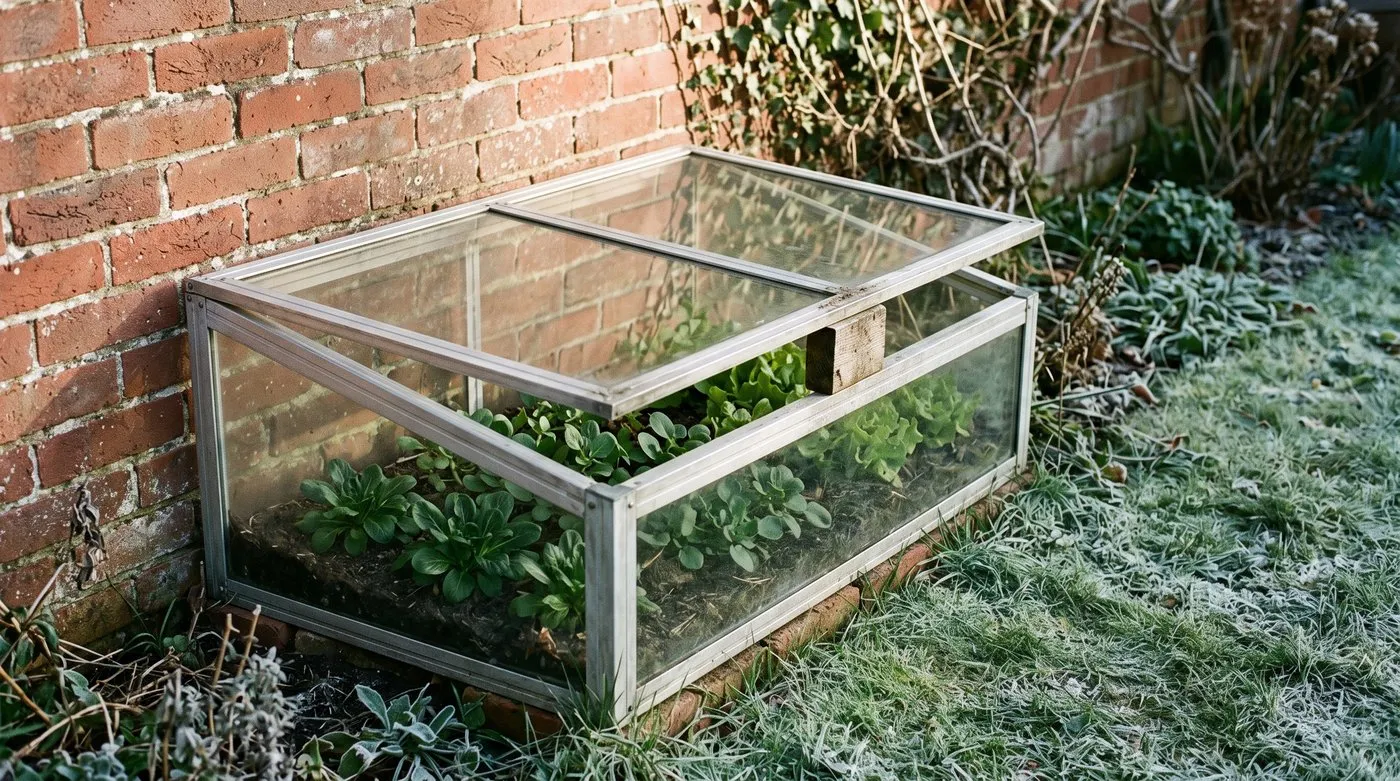
Even in January, a shut cold frame can overheat in sun. Prop the lid open on bright days and close it mid-afternoon to trap the warmth.
Cut-and-come-again: how to keep picking all winter
Pick the outer leaves and leave the centre of the plant to keep growing. The plant then sends up new leaves. In autumn this happens in a couple of weeks. In midwinter it takes much longer.
It’s easy. Use clean scissors and snip leaves when they’re 5-10cm tall, cutting 2-3cm above the base. Don’t pull leaves, as that damages the plant. Take the outer leaves first and leave the young ones in the middle to grow on.
Go gently in midwinter. In October and November you can pick every couple of weeks. From December to February, leave three or four weeks between pickings, as plants are growing so slowly. Pick more often again from late February.
Lamb’s lettuce, mizuna, tatsoi, rocket and spinach all regrow well. Loose-leaf lettuces cut well too. Hearting lettuces like butterheads and cos are better picked whole, then resown, more like succession sowing.
Leaf radish is another vigorous option for cutting, and suits a no-dig bed or a greenhouse border.
 Snip leaves 2-3cm above the base and the plant will grow more.
Five mistakes that ruin winter salad crops
Most winter salad failures come from sowing late and overwatering, not from cold.
1. Sowing too late. October sowings rarely get going before the short days. Seedlings sit tiny all winter and often rot. Sow by mid-September.
2. Overwatering. Winter salads need much less water than summer crops. Cold, soggy soil rots roots and invites grey mould. Water only when the top of the soil is dry, and always in the morning.
3. Forgetting to open the lid. A closed cold frame on a sunny day can overheat fast. Open it on bright days and close it again mid-afternoon.
4. Waterlogged soil. Plants struggle in cold, wet ground. On heavy clay, grow winter salads in raised beds or containers with good drainage. Our guide to growing in grow bags is a handy option for soggy plots.
5. Leaving dead leaves. Yellow and dead leaves are where grey mould starts. Remove them every time you pick. Tidiness matters more in winter because the air is damper and stiller under cover.
Planning your winter salad patch
You don’t need much space. One cold frame, a few containers or a short row in an unheated greenhouse gives plenty of mixed leaves for a couple of people. And salad is only the start, as there are lots of other vegetables to grow indoors in winter.
Start with the easy trio: lamb’s lettuce, mizuna and spinach. Between them you get mild, peppery and earthy flavours from one August sowing. Add winter purslane for juicy crunch, and land cress if you like a watercress kick.
In a greenhouse, tatsoi is a great addition. Its spoon-shaped leaves have a gentle mustard taste, lovely raw or quickly wilted. Pak choi needs the most protection in winter, but it grows fast again in spring.
In pots or grow bags, lamb’s lettuce and mixed winter salad seed are the easiest start. Sow fairly thickly, pick as baby leaves, and sow a little more every 3-4 weeks through August and September.
Related reading
- How to grow cress and watercress UK
- How to grow spinach UK
- How to grow lettuce UK
- Container vegetable gardening UK
- How to grow microgreens UK
Frequently asked questions
When should I sow winter salad seeds in the UK?
Sow from early August to mid-September. Plants need a few weeks of mild autumn weather to get going before the days get short. Growth slows right down from late November to February. Late sowings stay tiny until spring. You can start sowing again under cover from February.
Which salad leaves survive frost without protection?
Lamb’s lettuce is the toughest and copes with hard frost outdoors. Hardy spinach, land cress, winter purslane and lettuces like ‘Arctic King’ also cope well. Mizuna and mustards survive some frost but look better under cover. Pak choi needs a cold frame or greenhouse in winter.
Can I grow salad in an unheated greenhouse in winter?
Yes, hardy salads grow well in an unheated greenhouse. It keeps off wind and rain and is a little warmer than outside on many nights. That keeps hardy leaves alive and slowly growing. Bubble wrap adds extra protection, though it cuts the light a little.
How does cut-and-come-again work for winter salads?
You pick some leaves and let the plant grow more. Take the outer leaves, or snip a few centimetres above the base with clean scissors. New leaves then grow from the centre. Regrowth is quick in early autumn but very slow in midwinter. Lamb’s lettuce, mizuna and loose-leaf lettuces all work well.
Why have my winter salad leaves stopped growing?
Short, dark days are the main reason. Cold slows them down further. This usually happens from late November to February. It’s normal, and the plants are resting, not dead. They pick up again as the days get longer, so pick lightly until then.
Do I need to ventilate a cold frame in winter?
Yes, open it on mild or sunny days. A closed frame can overheat fast in winter sun, and damp, still air encourages mould. Prop the lid open during the day and close it mid-afternoon to trap warmth for the night. An automatic vent opener helps if you’re out all day.
What is the best cold frame for winter salad growing?
A sturdy frame that lets in lots of light is best. Aluminium frames with toughened glass or polycarbonate last well and let in good light. Wooden frames hold warmth well but need looking after. Choose a lid that opens and props easily. Stand it against a sunny, sheltered wall.
Our team produces practical UK gardening guidance from source research, contributor records and established horticultural practice. Editorial standards are overseen by Matt W.