Key takeaways
- Give monstera bright, indirect light. Leaves without splits usually mean too little light
- Water when the top 3cm of compost is dry, and never leave the pot standing in water
- A moss or coir pole lets it climb, which leads to bigger leaves
- Aerial roots are normal. Guide them into the pole or the compost
- Propagate from a stem cutting with at least one node, rooted in water
- Monstera is toxic to cats and dogs, so keep it out of reach
Monstera, the Swiss cheese plant, is one of the easiest big houseplants to grow in a UK home. Give it bright light without harsh sun, water it only when the top of the compost dries, and it rewards you with those famous split leaves. Keeping it alive is easy. Getting it to really thrive is all about light and a pole to climb.
This guide covers light, watering, aerial roots, poles, feeding, repotting and propagation. If yours already has yellow leaves, our guide to fixing yellowing monstera leaves goes straight to the cause.
How much light does a monstera need?
Monstera needs bright, indirect light. In the wild it grows under the rainforest canopy in dappled light. In a UK home, a spot within a metre or two of an east or west-facing window is ideal. A south-facing window works if it’s set back a little or has a net curtain to soften the summer sun.
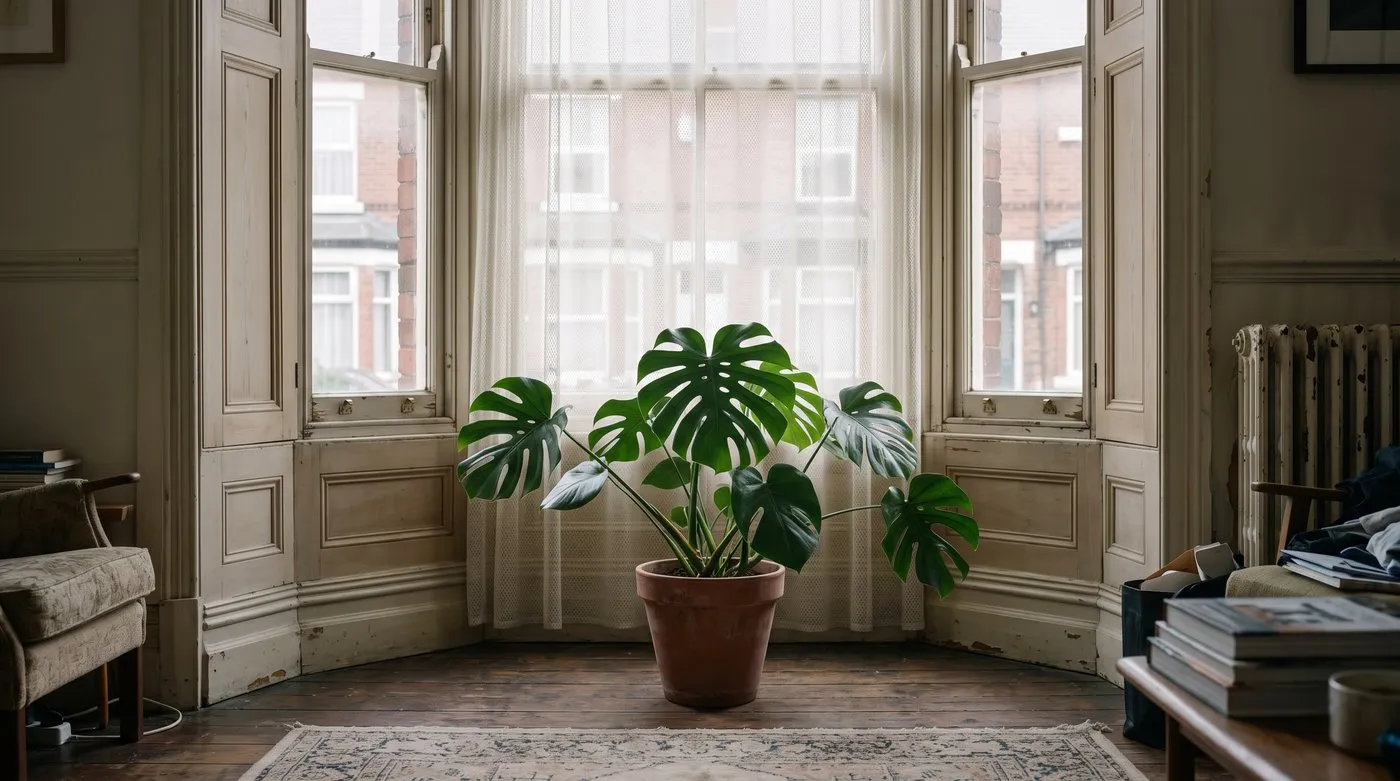
A metre or two back from a bright window, with a net curtain for summer sun, is the sweet spot.
Too little light shows quickly. New leaves come out small, pale and without splits, and stems stretch towards the window. North-facing rooms rarely give enough light for split leaves. In winter, move it closer to the glass, as UK light drops a lot from October to February.
Too much hot, direct sun scorches the leaves, leaving dry, papery brown patches. Our guide to the best indoor plants for UK homes explains how each window direction affects light.
How to water a monstera
Water when the top 3cm of compost is dry. Push a finger in to check. In summer that’s usually about once a week. In winter, when growth slows, it may be every two to three weeks.
Water thoroughly until it runs out of the drainage holes. Empty the saucer after half an hour. Soggy roots are the most common way to kill a monstera. It copes with drying out far better than sitting wet.
Don’t water on a fixed day. Pot size, room warmth and season all change how fast the compost dries.
Which monstera should you grow?
| Monstera | Leaves | Growth | How easy |
|---|---|---|---|
| Monstera deliciosa | Large, with deep splits and holes | Fast in good light | Easy, the best start |
| Monstera adansonii | Small, oval, full of holes | Climbs or trails | Easy |
| Thai Constellation | Large, splashed with cream | Slow | Fussy about light |
| Monstera obliqua | Tiny, mostly holes | Very slow | Rare and tricky |
Monstera deliciosa is the classic Swiss cheese plant and the one to start with. Monstera adansonii has smaller leaves full of holes and trails nicely from a shelf, making it one of the best hanging houseplants. Thai Constellation is a variegated form with cream patches. It grows more slowly because the pale parts have less green to make food, and it needs good light. True Monstera obliqua is rare, and many plants sold under that name are actually adansonii.

Monstera deliciosa (left) has big, deeply split leaves. Monstera adansonii (right) has smaller leaves full of holes.
What to do with monstera aerial roots
Aerial roots are the thick, rope-like roots that grow from the stem. They’re completely normal. In the wild, monstera uses them to climb tree trunks and take up moisture.
Guide them onto a moss pole, where they’ll grip and help the plant climb. Long roots trailing across the floor can be tucked into the compost, where they’ll take up water. You don’t need to cut them off, but trimming one that’s in the way won’t harm the plant.

Aerial roots gripping a pole. Once a monstera can climb, its new leaves tend to get bigger.
Which pole is best for a monstera?
A pole gives monstera something to climb, and climbing plants make bigger leaves. Without one, it sprawls outwards.
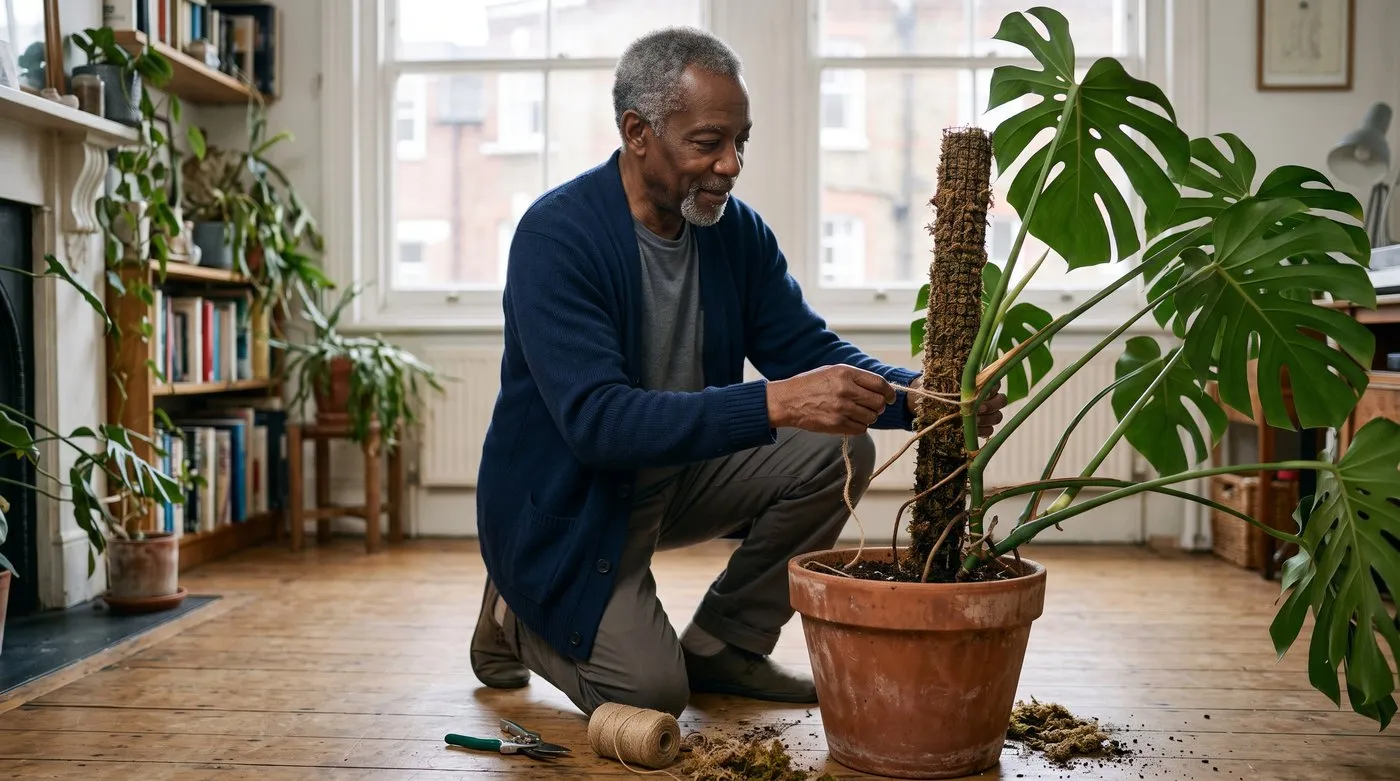
Tie stems loosely to the pole with soft twine. The aerial roots soon grip on by themselves.
Sphagnum moss pole. Holds the most moisture and gives aerial roots the best grip. It needs keeping damp, which means a regular spray in a heated room.
Coir pole. Cheaper, tidy and easy to find. It holds less water, so roots grip it less readily, but it’s fine for most homes.
Bamboo cane. Fine for a young plant, but roots can’t grip it, so the plant just leans on it.
Put the pole in when you repot. Pushing one into an established rootball damages the roots.
How to raise humidity for a monstera
Central heating dries the air in winter, and dry air gives monstera brown, crispy leaf tips. The plant won’t die, but it looks tatty.
- Group plants together. Several plants side by side keep the air around them a little moister.
- Use a pebble tray. Stand the pot on a tray of pebbles with water just below the top of the stones.
- Run a small humidifier nearby in winter, if you have one.
- Keep it away from radiators and hot, dry draughts.
Brown tips don’t recover, but new leaves will be healthier once the air improves.
How to feed a monstera
Feed once a month from April to September with a balanced liquid houseplant feed at half strength. Stop feeding from October to March, when growth slows right down. Too much feed builds up salts in the compost and can brown the leaf tips. Our guide to feeding houseplants has a simple year-round plan.
How to repot a monstera
Repot every year or two in spring, from March to May. It’s time when roots circle the pot or poke out of the drainage holes, water runs straight through, or the plant gets top-heavy.
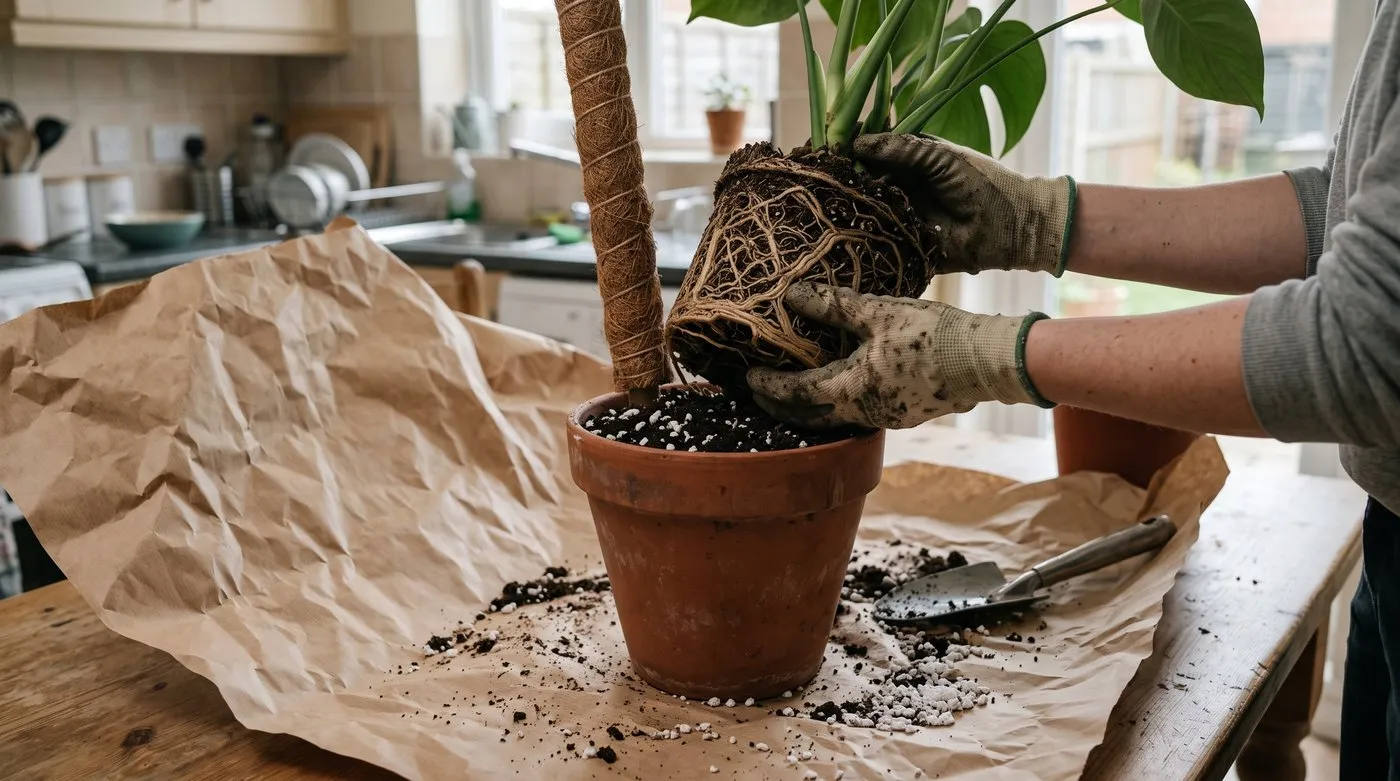
Go up one pot size and add the pole now, so you don’t disturb the roots later.
Go up just one pot size, about 3-5cm wider. A much bigger pot holds too much wet compost. Use two parts peat-free multipurpose compost to one part perlite so it drains well. Add your pole at the same time. Skip feeding for about six weeks afterwards, as fresh compost has enough food. Our guide to repotting houseplants walks through each step.
How to propagate a monstera
Monstera is easy to grow from stem cuttings. You need a section of stem with at least one node, the knobbly bump where a leaf and aerial root grow. A leaf without a node won’t root.
- Pick a healthy stem with a node and at least one leaf.
- Cut just below the node with a clean, sharp knife. A small aerial root at the node helps.
- Stand the cutting in a jar of water with the node under water and the leaf above it.
- Put it somewhere bright, out of direct sun.
- Change the water every week.
- Pot it up once the roots are a few centimetres long, in two parts compost to one part perlite.
Roots usually appear within a few weeks. Spring and summer are the best times, as cuttings root slowly in winter. You can also root cuttings straight into damp perlite under a clear bag. Our guide to rooting cuttings in water has more tips.

Keep the node under water and the leaf above it. Fresh roots grow from the node in a few weeks.
Common monstera problems
Yellow leaves. Usually overwatering. Let the compost dry out before watering again. One or two old lower leaves yellowing on a big plant is normal.
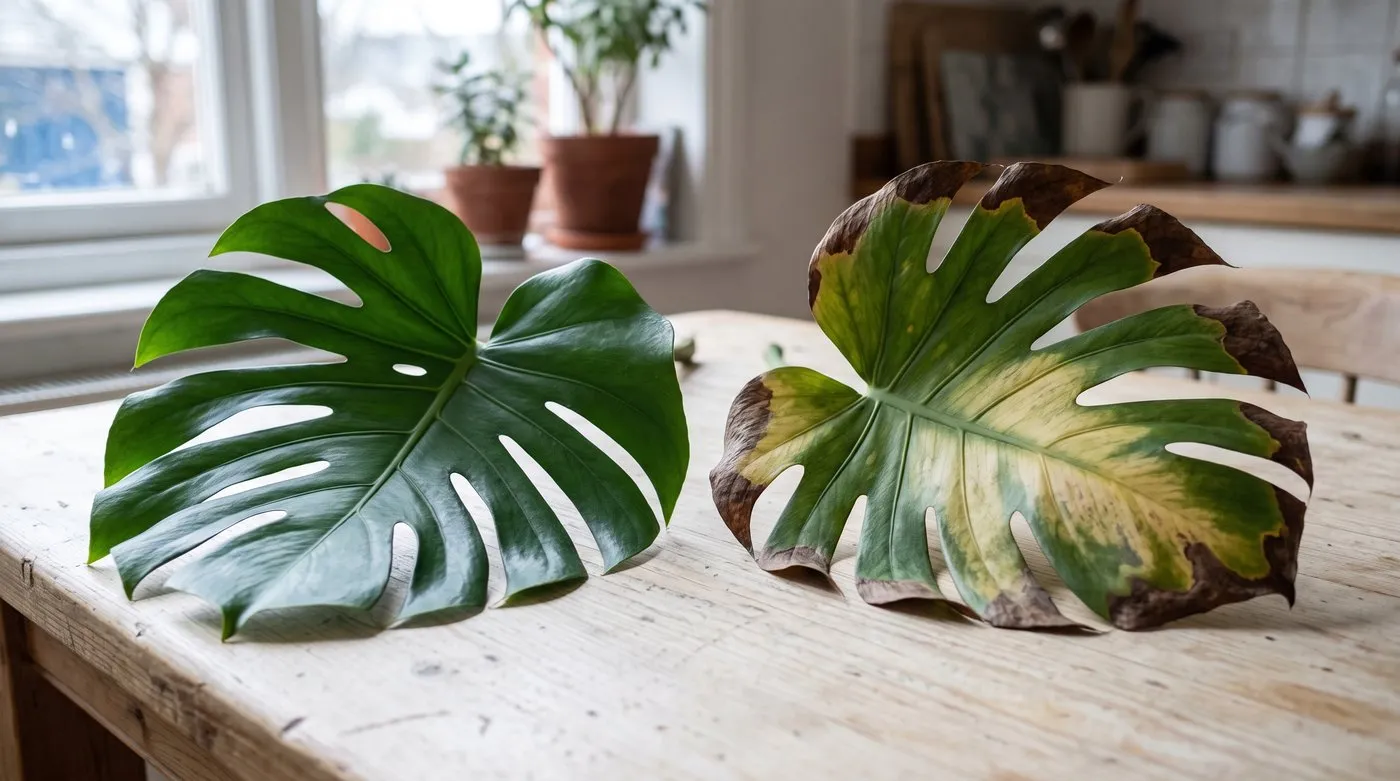
Crispy brown tips usually point to dry, heated air. New leaves recover once the air is moister.
Brown, crispy tips. Dry air from central heating, or too much feed. Group plants and cut back on feeding.
Brown patches. Soft, dark patches point to overwatering or root rot. Dry, papery patches mean sun scorch, so move it back from the glass.
No splits in the leaves. Not enough light, or the plant is still young. Move it closer to a bright window.
Pests. Look for scale (brown bumps on stems), spider mite (fine webbing under leaves in dry rooms) and thrips (silvery streaks). Wipe off scale with a damp cotton bud and rinse spider mite off in a tepid shower. Keep an affected plant away from others. If you need a spray, use an approved product for houseplants and follow the label. Our guide to scale insects shows what to look for.
Is monstera safe for pets?
No. Monstera is toxic to cats and dogs. It contains calcium oxalate crystals that cause mouth pain, drooling and vomiting if chewed. It’s rarely serious, but it’s painful. Keep it out of reach, and call your vet if a pet chews it.
Monstera care calendar
| Month | What to do |
|---|---|
| January to February | Water every two to three weeks. Check for scale and spider mite in dry rooms |
| March | Repot if needed. Move closer to light as days lengthen |
| April | Start monthly feeding. Water more as growth picks up |
| May to June | Take cuttings. Watch for scorch near sunny windows |
| July to August | Water about weekly. Keep feeding. Tie new growth to the pole |
| September | Last feed of the year |
| October to December | Water less. Move closer to the window. Raise humidity once heating is on |
Common mistakes with monstera
Overwatering. The top killer. Water only when the top 3cm is dry.
Too little light. No splits and leggy stems. Move it nearer a bright window.
Too big a pot. Extra compost stays wet. Go up one size at a time.
No support. Without a pole it sprawls and keeps its leaves smaller.
Harsh direct sun. Hot summer sun through glass scorches the leaves. Soften it with a net curtain.
Frequently asked questions
How often should I water a monstera?
Water when the top 3cm of compost feels dry. That’s roughly every week in summer and every two to three weeks in winter. Water until it runs out of the drainage holes, then empty the saucer. Check with your finger rather than watering on a fixed day.
Why does my monstera have no splits in its leaves?
Usually because it isn’t getting enough light. Move it closer to a bright window, out of harsh direct sun. Young plants also make whole, unsplit leaves for their first year or two, which is normal. Splits appear on new leaves once the plant is mature and well lit.
Should I cut off monstera aerial roots?
You don’t need to, as they’re a normal part of the plant. Guide them onto a moss pole or tuck them into the compost, where they help it climb and take up water. Trimming one that’s in the way won’t harm the plant.
How do I propagate a monstera?
Take a stem cutting with at least one node and one leaf. Cut just below the node, stand it in a jar of water in bright light and change the water weekly. Pot it up in free-draining compost once the roots are a few centimetres long.
How big do monstera plants get indoors?
Monstera deliciosa can reach 2-3m tall indoors over several years. Leaves get bigger as the plant matures, especially with a pole to climb. Monstera adansonii stays smaller and works well trailing from a shelf.
Is monstera toxic to cats and dogs?
Yes, monstera is toxic to cats and dogs. It contains calcium oxalate crystals that cause mouth pain, drooling and vomiting if chewed. Keep it out of reach, and call your vet if a pet chews it.
What is the best moss pole for monstera?
A sphagnum moss pole kept damp gives the best grip for aerial roots. Coir poles are cheaper and easier but hold less moisture. Put the pole in when you repot, so you don’t damage roots pushing it in later.
Now your monstera is thriving, browse more ideas in our houseplants hub, or give it a summer holiday with our guide to putting houseplants outside for summer.
Our team produces practical UK gardening guidance from source research, contributor records and established horticultural practice. Editorial standards are overseen by Matt W.