
Key takeaways
- NPK on the label tells you what a feed does: N for leaves, P for roots, K for flowers and fruit
- Feed from March to September only, while plants are growing
- Slow-release granules in spring keep feeding for months from one go
- Tomato feed is a great all-rounder for anything that flowers or fruits
- Too much feed causes more trouble than too little, so stick to the label
- If plants stay yellow despite feeding, check your soil and drainage
Feeding your plants well makes the difference between a garden that gets by and one that really thrives. Every plant needs three main nutrients: nitrogen, phosphorus and potassium. How much, when and in what form depends on what you’re growing and the soil you have.
Here’s what those nutrients do, which feeds to use, and a simple month-by-month plan so you know what to feed and when.
What NPK means and why it matters
NPK stands for nitrogen (N), phosphorus (P) and potassium (K). You’ll see three numbers on every pack of feed. A label saying 10-10-10 has equal amounts of each.
Know what each one does and you’ll know which feed to grab. Get it wrong and you’ll grow lots of leaves when you wanted flowers.
Nitrogen (N): the leaf builder
Nitrogen makes leafy, green growth. Plants with enough of it have dark green leaves and strong stems.
Too much gives soft, sappy growth that frost, aphids and diseases love. Lawns and leafy crops like lettuce, spinach and cabbage like plenty. Flowering and fruiting plants need less, especially once buds appear. Winter rain washes nitrogen out of the soil, which is why a spring feed helps.
Short of nitrogen? Older, lower leaves turn pale yellow-green first. Growth slows and stems are thin.
Phosphorus (P): the root developer
Phosphorus helps roots grow, which is why it matters most when plants are settling in. New shrubs, transplants and freshly split perennials all like it. Bonemeal is a popular high-phosphorus feed.
It moves very slowly through soil, so mix it into the planting hole rather than scattering it on top.
Short of phosphorus? Leaves may get a purple-red tint, especially underneath. Roots are small and flowering is poor.
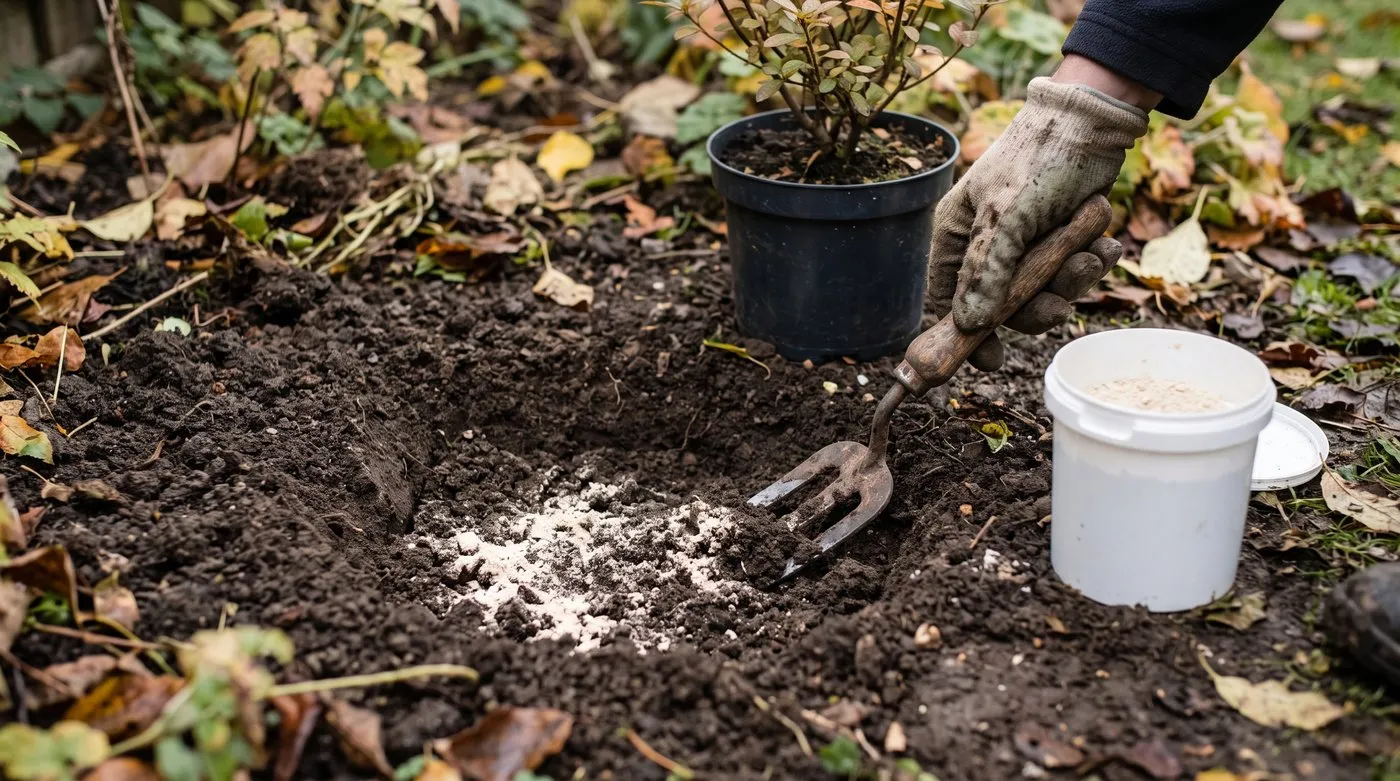
Phosphorus barely moves through soil, so mix it into the planting hole where new roots will find it, rather than scattering it on top.
Potassium (K): the flower and fruit driver
Potassium (often called potash) helps plants flower and fruit, and keeps them healthy. Tomatoes, roses, dahlias, sweet peas and all fruiting crops love it.
That’s why tomato feed is high in potassium. Fruiting plants need more of it once they start flowering.
Short of potassium? Leaf edges go brown and crispy. Flowers are small or fruit doesn’t set.
Secondary and trace nutrients
Plants also need small amounts of other nutrients, such as magnesium, calcium and iron. Most UK soils have plenty. If plants are short, it’s usually because the soil is too acid or too chalky for them to get at it. The classic example is a rhododendron in chalky soil, with yellow leaves and green veins.
How plants absorb nutrients
Plants take up food dissolved in water through their roots. That’s why watering, soil type and soil acidity matter as much as the feed itself.
The soil solution
No water, no feeding. Roots can only take up nutrients dissolved in the moisture in the soil. Scatter feed on dry soil and it just sits there.
Soil pH and nutrient lockout
Soil pH is how acid or chalky your soil is, and it decides how much of the feed your plants can use. In the middle, slightly acid to neutral, almost everything is available. At either extreme, some nutrients get locked away however much you add.
| Soil | What happens |
|---|---|
| Very acid | Many nutrients locked away, poor growth for most plants |
| Acid | Great for rhododendrons, blueberries and camellias |
| Slightly acid to neutral | The sweet spot, where most plants find everything they need |
| Slightly chalky | Fine for lime-lovers, but some plants start to struggle |
| Very chalky | Yellow leaves on many plants, and acid-lovers fail |
A cheap test kit from the garden centre tells you where you stand. For more detail, you can send a sample off to a lab. Our guide to soil testing and pH adjustment explains how.
Why temperature affects feeding
Cold soil means slow feeding. Plants and soil life wake up as the soil warms in spring. Feed into cold soil and much of it washes away before plants can use it. Start in mid-March in the south and a bit later further north.
 Scattering slow-release granules around shrubs in late March gets them off to a good start.
Fertiliser types ranked by effectiveness
Different feeds suit different jobs. Here’s a quick guide.
Fertiliser comparison table
| Feed | How fast | How long it lasts | Best for |
|---|---|---|---|
| Slow-release granules | Fairly quick | Several months | Borders and pots, one spring dose |
| Liquid tomato feed | Very quick | A week or two | Flowering and fruiting plants |
| Balanced granular feed | Quick | A few weeks | General use around the garden |
| Fish, blood and bone | Fairly quick | A few weeks | Borders, shrubs and roses |
| Well-rotted manure | Slow | Months | Improving soil |
| Garden compost | Slow | Months | Mulching and soil health |
| Bonemeal | Slow | Months | New plantings and bulbs |
| Sulphate of potash | Quick | A few weeks | A potassium boost for fruit and flowers |
| Seaweed extract | Very quick | A week or two | A gentle tonic |
| Chicken manure pellets | Fairly quick | A few weeks | Hungry vegetables |
Controlled-release granules: the gold standard
Slow-release granules are the easiest feed of all. They’re coated pellets that let out food gradually, faster when it’s warm and slower when it’s cool, so they keep pace with your plants. One dose in spring feeds most plants through to late summer.
Liquid feeds: fast but short-lived
Liquid feeds work fast but don’t last. They’re great for a quick boost and for hungry crops, but you need to repeat them every week or two.
Tomato feed is the handiest liquid feed in the shed. It’s high in potassium, so it suits anything that flowers or fruits, not just tomatoes. Try it on roses, sweet peas, dahlias, peppers, cucumbers, strawberries and all your container vegetables.
Always dilute it as the label says. Stronger isn’t better, and it can burn roots, especially in pots.
Organic vs synthetic: the real difference
Plants can’t tell the difference. Nitrogen from fish, blood and bone and nitrogen from a bought granule reach the roots in the same form. The difference is what happens to your soil.
Organic feeds like manure, compost, fish, blood and bone and seaweed feed the soil life as well as the plants. Over the years the soil gets crumblier, holds water better and fills with worms. They work more slowly, because soil life has to break them down first. The RHS guide to feeding plants is a good overview. For a free option, our homemade fish fertiliser recipe turns kitchen fish scraps into a liquid feed.
Synthetic feeds give exact amounts quickly and cheaply. They don’t improve the soil, but they’re handy for fixing a shortage fast or feeding hungry vegetables.
The best plan uses both. Spread well-rotted garden compost or manure as a mulch in autumn or early spring for healthy soil, then use bought feeds for particular crops in summer. Garden Organic’s feeding advice explains how organic matter builds up fertility over time.
 Liquid feed goes on with the watering, so it’s quick to give pots a weekly boost.
Why plants show deficiency despite feeding
If you feed regularly and plants still look poorly, something is stopping the roots using the food. The feed usually isn’t the problem.
Soil pH lockout
The most common hidden cause. In very acid or very chalky soil, some nutrients get locked away. A rhododendron in chalky soil will have yellow leaves with green veins whatever you feed it. The answer is to grow plants that suit your soil, or grow acid-lovers in pots of ericaceous compost.
Waterlogged soil
Roots need air to work. In waterlogged soil they can’t take up food, so the plant looks starved. Better drainage, by adding organic matter or grit, or by growing in raised beds, fixes it. Our guide to improving clay soil has practical tips.
Root damage
Damaged roots can’t feed the plant. Vine weevil grubs, chafer grubs and careless digging all cause it. Don’t pile on more feed, as strong feed around damaged roots makes things worse. Sort out the cause first.
Compacted soil
Squashed soil stops roots spreading. Heavy feet and machinery crush the air out of it. Forking or spiking the ground opens it up for roots and water.
Salt buildup in containers
Feed can build up in pots. A white crust on the compost or round the drainage holes is the giveaway, and plants may wilt even when the compost is damp. Water the pot through with plenty of plain water. Then feed less often or at half strength.
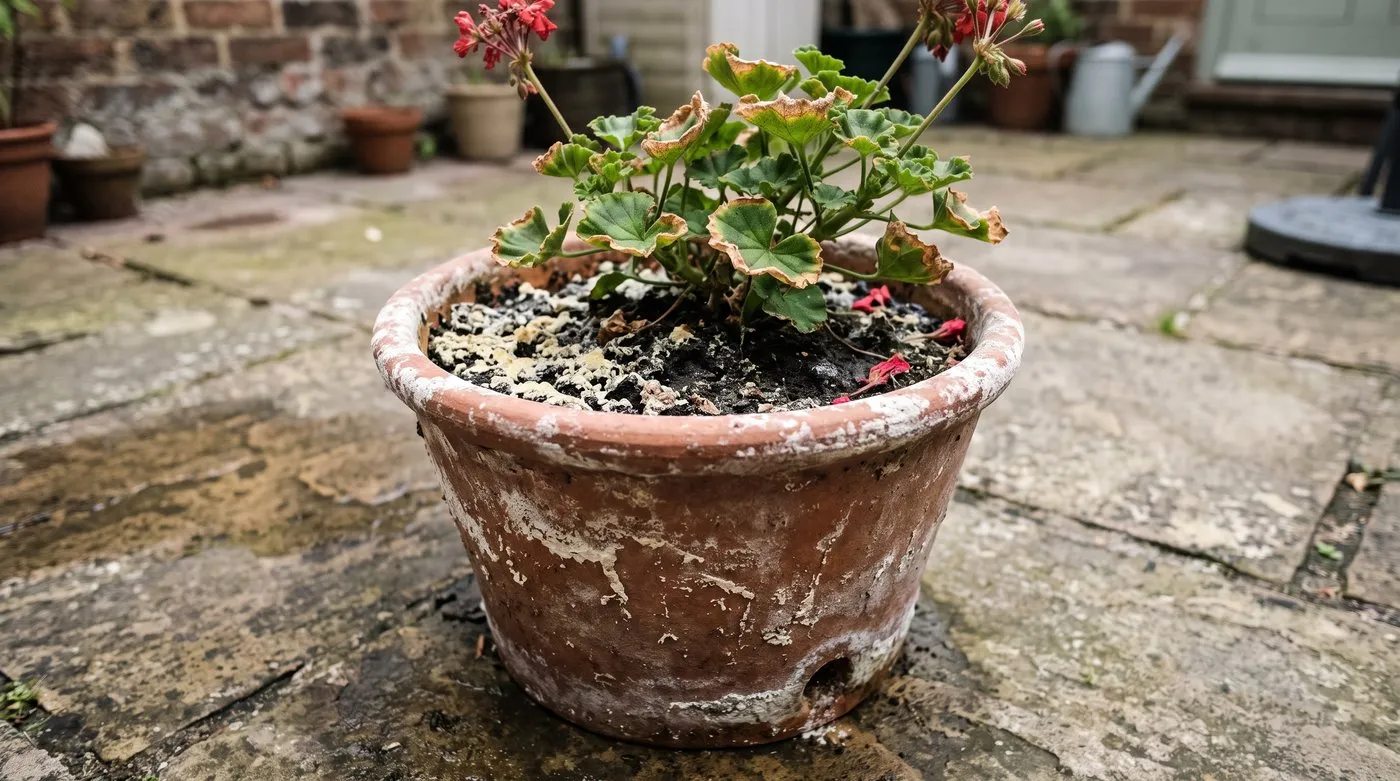
That white crust is leftover feed building up. Flush the pot through with plenty of plain water, then feed less often or at half strength.
Month-by-month feeding calendar
Timing matters as much as the feed you choose.
| Month | Borders and shrubs | Lawns | Pots | Vegetables | Fruit |
|---|---|---|---|---|---|
| January | No feeding | No feeding | No feeding | No feeding | No feeding |
| February | No feeding | No feeding | No feeding | No feeding | Sulphate of potash around fruit bushes |
| March | Slow-release granules or fish, blood and bone once soil warms | First spring lawn feed | Mix granules into compost when planting or repotting | Dig in compost or manure before sowing | General feed around fruit trees |
| April | Mulch with compost | Spring feed if not done in March | Start liquid feeding established pots every couple of weeks | Half-strength liquid feed for seedlings | Mulch fruit trees with well-rotted manure |
| May | Liquid feed hungry plants like dahlias and delphiniums | Nothing needed | Weekly liquid feed for flowering plants | Tomato feed once tomatoes and peppers flower | Liquid feed strawberries |
| June | Feed roses after their first flush of flowers | Summer feed | Feed every week or so | Weekly tomato feed. Nitrogen feed for cabbages and kale | Feed soft fruit while picking |
| July | Keep feeding roses and repeat-flowering plants | Nothing extra | Weekly for flowering and fruiting plants | Weekly tomato feed for fruiting crops | Keep liquid feeding |
| August | Last liquid feed mid-month. No more nitrogen | Nothing needed | Ease off to every two weeks | Keep up tomato feed | Last feed for autumn raspberries |
| September | Stop feeding | Autumn lawn feed | Stop liquid feeding | Stop feeding and let crops ripen | No feeding |
| October | Mulch borders with compost or manure | No feeding | Bring tender plants in. No feeding | Clear old crops. Sow green manures | Mulch fruit trees with compost |
| November | No feeding | No feeding | No feeding | No feeding | No feeding |
| December | No feeding | No feeding | No feeding | No feeding | No feeding |
For lawns, see our dedicated lawn feeding guide.
How to feed specific plant groups
Different plants have different appetites. Here’s how to feed the main groups.
Roses
Roses are hungry plants. Give them fish, blood and bone or a rose feed in March as growth starts. Feed again after the first flush of flowers in June to keep them coming. Avoid high-nitrogen feeds after July, as soft late growth gets hit by frost.
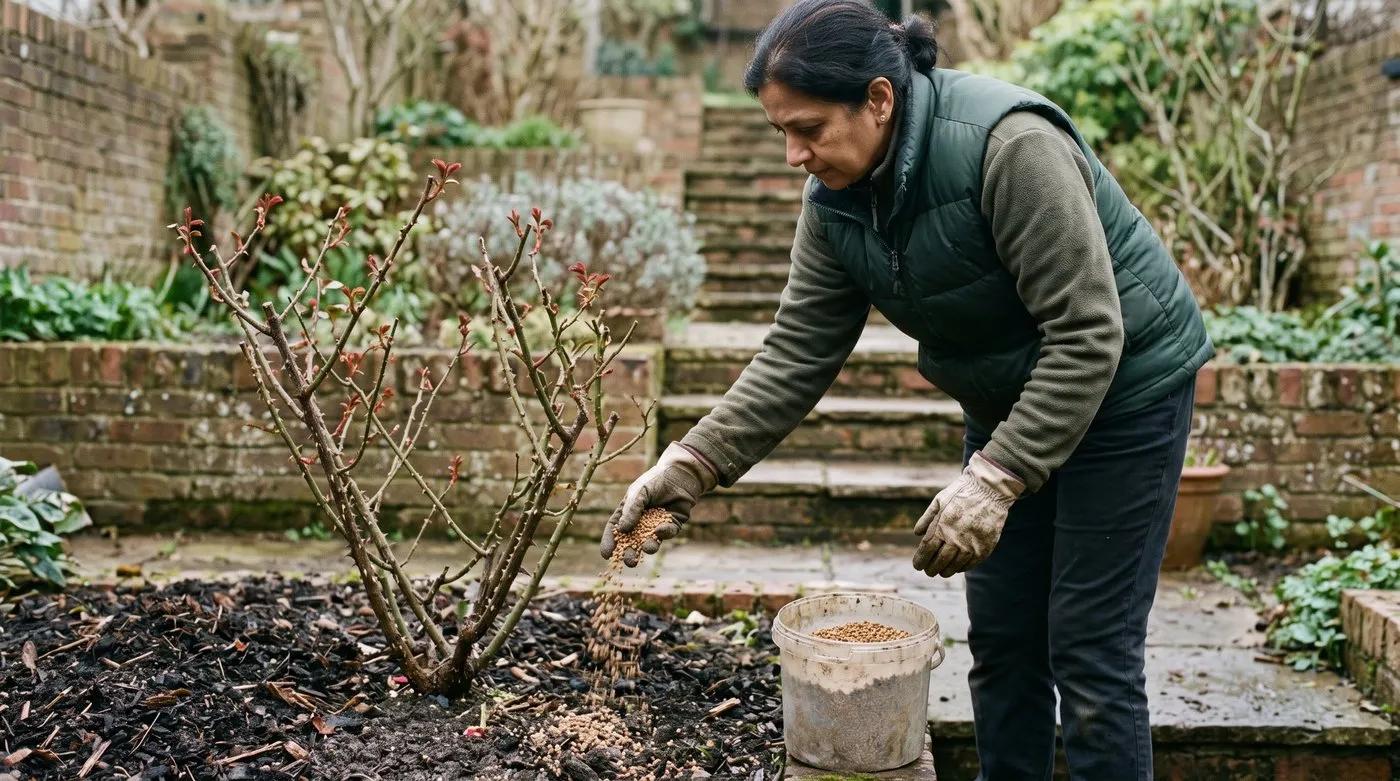
Roses are hungry plants, so feed them as new growth starts in March. A second feed after the first flush keeps the flowers coming.
Tomatoes and fruiting vegetables
Tomatoes like a general feed early on, then tomato feed once they flower. Once the first truss has set fruit, give liquid tomato feed every week or so. Water regularly too. Blossom end rot, the black patch on the bottom of the fruit, is caused by uneven watering, so keep the compost evenly moist.
Container plants
Pots need feeding more often than beds, because every watering washes some food out. Mix slow-release granules into the compost when you plant, at the rate on the pack. From early summer, add a liquid feed every week or two as the granules run low. Little and often, at half strength, gives the steadiest supply.
Acid-loving plants
Rhododendrons, camellias, blueberries and heathers need ericaceous feed. Ordinary feeds can make the soil less acid, which makes their yellowing worse. Use an ericaceous feed, and a sequestered iron tonic if leaves turn yellow between green veins.
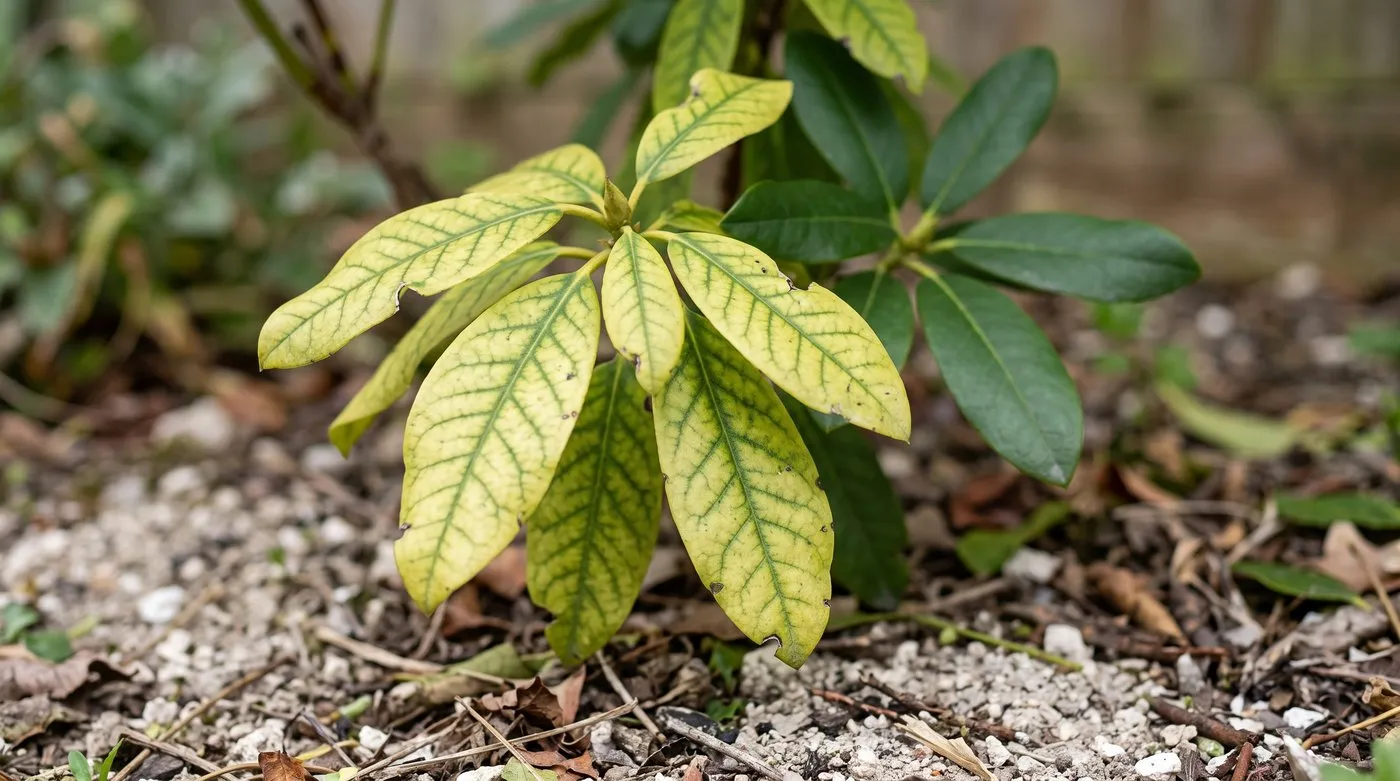
Yellow leaves with green veins on an acid-lover usually mean the soil is too chalky, not that it’s short of food. An ericaceous feed and iron tonic help.
Fruit trees and bushes
Established fruit trees need one feed a year. Scatter a general granular feed such as Growmore around the tree in March, out to the edge of the branches, at the rate on the pack. Soft fruit like blackcurrants, gooseberries and raspberries also like a dose of sulphate of potash in late winter.
 Common hunger signs: yellowing from the bottom up (nitrogen), purple tints underneath (phosphorus) and crispy brown edges (potassium).
Common mistakes when feeding garden plants
These five slip-ups cause most feeding problems.
Feeding in winter
Plants aren’t growing from November to February, so feed just washes away in the rain. Nitrogen in autumn also gives soft new growth that the first hard frost damages.
Ignoring soil pH
Buying feed without knowing your soil is guesswork. A cheap test kit takes a few minutes and tells you whether your soil can actually pass the food on to roots.
Over-feeding containers
More isn’t better. Doubling up on liquid feed, or using granules and liquid feed at full strength together, burns roots. Watch for brown leaf tips, wilting in damp compost and a white crust on the compost. Stick to the label, or use half if in doubt.
Using the wrong NPK ratio
Match the feed to the job. High-nitrogen lawn feed on flowers gives lots of leaves and few blooms. Tomato feed on the lawn does little good. Have a look at our guide to NPK ratios: nitrogen for leafy growth, potassium for flowers and fruit, and a balanced feed for everything else.
Dry feeding without watering in
Granules need water to work. Scatter them on dry soil and walk away, and much of the feed is wasted. Water well afterwards, or scatter just before rain.
Now you know how to feed your plants, read our guide on making compost tea to make your own liquid feed from kitchen and garden waste. For a free, potassium-rich alternative to tomato feed, see how to make comfrey and nettle feed.
Frequently asked questions
When should I start feeding garden plants in the UK?
In March, once the soil starts to warm up. Most plants start growing again from mid-March. Scatter the first granular feed when you see fresh green shoots. Stop feeding by mid-September so plants can toughen up before winter.
What is the best all-round fertiliser for UK gardens?
A balanced feed with equal N, P and K. It suits most plants. For flowers and vegetables, switch to a high-potash feed like tomato feed once buds form. Slow-release granules are the easiest option, as one spring dose lasts for months.
Can you over-feed garden plants?
Yes, and it does more harm than too little. Too much nitrogen gives soft, floppy growth that aphids and frost love. Strong feed can burn roots and scorch leaves. A white crust on the compost is a sign. Cut back, and water the pot through well with plain water.
Is organic fertiliser better than synthetic?
Each has its place. Organic feeds release goodness slowly and improve the soil over the years. Synthetic feeds work faster and are handy for a quick boost. Many gardeners use compost or manure for the soil and a bought feed for hungry crops.
Why are my plants yellow even though I feed them?
Something is stopping the roots using the feed. Soil that’s very acid or very chalky locks some nutrients away. Waterlogged soil stops roots working. Test your soil and check the drainage before adding more feed.
How often should I liquid feed container plants?
Every 1-2 weeks from late spring to September. Compost in pots runs out of food within a couple of months. Half-strength feed more often gives a steadier supply than full strength now and then. Slow-release granules mixed in at planting mean you need to liquid feed less.
Do I need to feed plants in the ground?
Usually, yes, but less than pots. Plants in the ground have more soil to draw from. Clay soils hold on to food well, while sandy soils lose it quickly and need feeding more often. A soil test shows what your ground really needs.
Our team produces practical UK gardening guidance from source research, contributor records and established horticultural practice. Editorial standards are overseen by Matt W.


