Key takeaways
- Full-spectrum white LEDs suit everything from seedlings to fruiting chillies
- Purple 'blurple' lights grow plants too but make it hard to spot pests and problems
- Buy on the real wattage drawn at the wall, not the 'equivalent' claim on the box
- Run lights 12-16 hours a day on a timer, and never leave them on round the clock
- Running cost is watts x hours / 1,000 x your electricity unit price
- Start with the light high and lower it gradually, watching for bleached or stretched leaves
LED grow lights let you grow fresh salads, herbs and even chillies indoors all year. For most people, a full-spectrum white LED is the one to buy. It suits every stage from seedling to harvest, and you can see your plants properly under it.
This guide is for growing crops indoors under lights, in a tent, on a shelf or in a spare room. It covers the type of light, how much power you need, how long to run it and what it costs. If you just want to raise sturdier seedlings in spring, our guide to grow lights for seed starting is a simpler place to begin.
Which type of LED grow light is best?
Full-spectrum white LEDs are the best all-rounder for home growers. They give a balanced white light that plants use well, and it looks like daylight to you.
| Type | Light colour | Best for | Downside |
|---|---|---|---|
| Full-spectrum panel | White | Tents, shelves, everything from seed to harvest | Costs a little more |
| Red and blue (‘blurple’) | Purple-pink | Growing plants on a budget | Hard to spot pests and problems |
| LED bars or strips | Usually white | Shelves and seed trays, hung close | Smaller area covered |
| Fluorescent tubes (T5) | White | Seedlings and microgreens | Less efficient, tubes wear out |
Blurple lights grow plants perfectly well. The trouble is the purple glow. Every leaf looks strange, so it’s hard to spot aphids, mildew or a hungry yellowing plant. Most people find it tiring to work under, too.
Full-spectrum white costs a bit more, but you can check your plants at a glance. For a light that lives in your home, that’s worth paying for.

Purple light on the left, white on the right. Same plants, but it’s far easier to check leaves under the white light.
How many watts does an LED grow light need?
Check the real wattage drawn at the wall, then match it to your growing area. Many cheap lights print an inflated “equivalent” wattage on the box. A light labelled “1000W” that actually draws 100W is a 100W light.
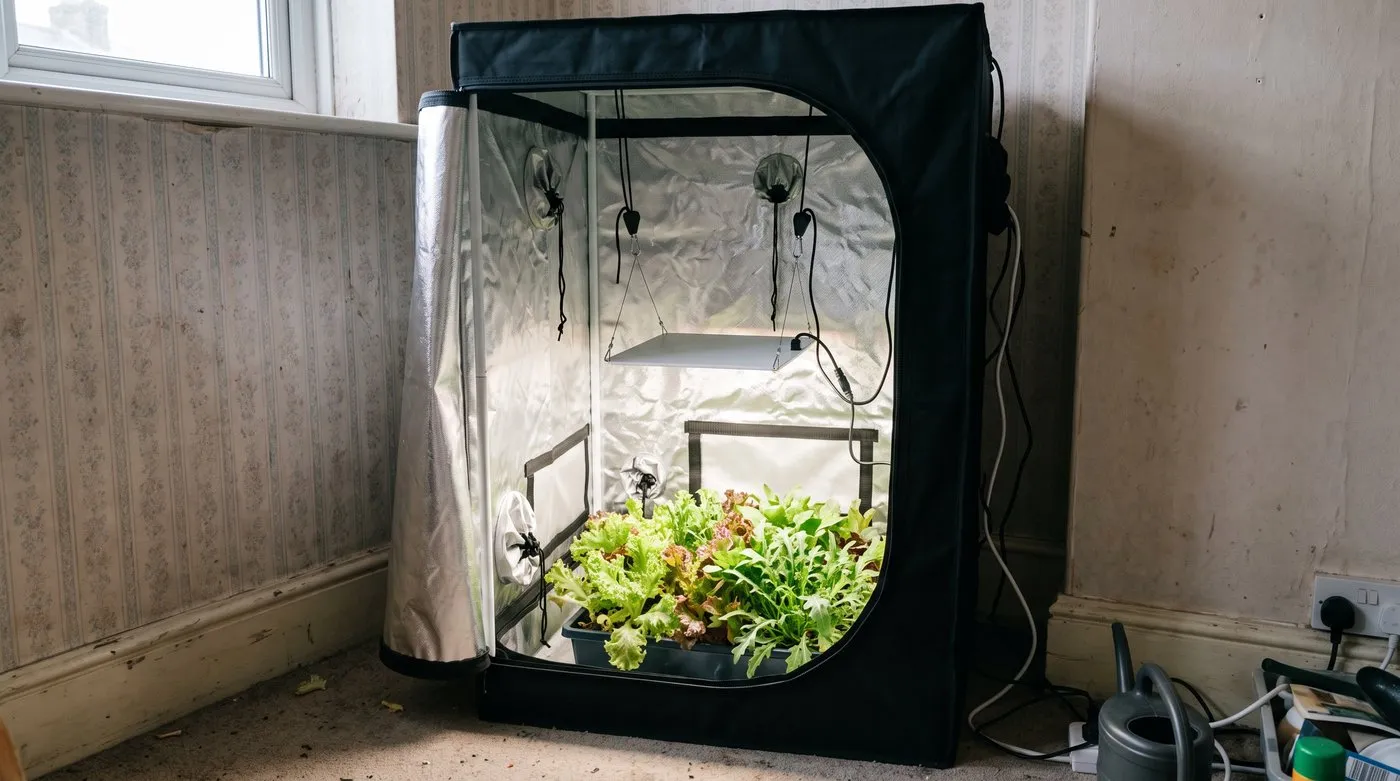
A modest panel over a small tent is plenty for salad leaves. Check the real wattage, not the ‘equivalent’ figure.
How much you need depends on what you’re growing:
- Seedlings, microgreens and salad leaves need the least light
- Herbs such as basil and parsley need a bit more
- Fruiting crops such as chillies, peppers and tomatoes need the most
Good makers give a coverage area for each stage, such as “seedlings 90x90cm, fruiting 60x60cm”. Use that to choose. As a rough guide, a panel drawing around 100W at the wall is a common choice for a 60x60cm tent. It’s plenty for seedlings and salads and enough for a couple of chilli plants.
Some boxes also quote PPFD, which is how much usable light reaches the plants. Higher numbers mean brighter light. You don’t need to measure it yourself. Just compare lights fairly at the same hanging height.
How far above plants should an LED grow light hang?
Follow the maker’s hanging guide, start at the higher end and lower it gradually. Lights vary so much that one distance doesn’t suit them all. Bars and strips usually sit closer than big panels.
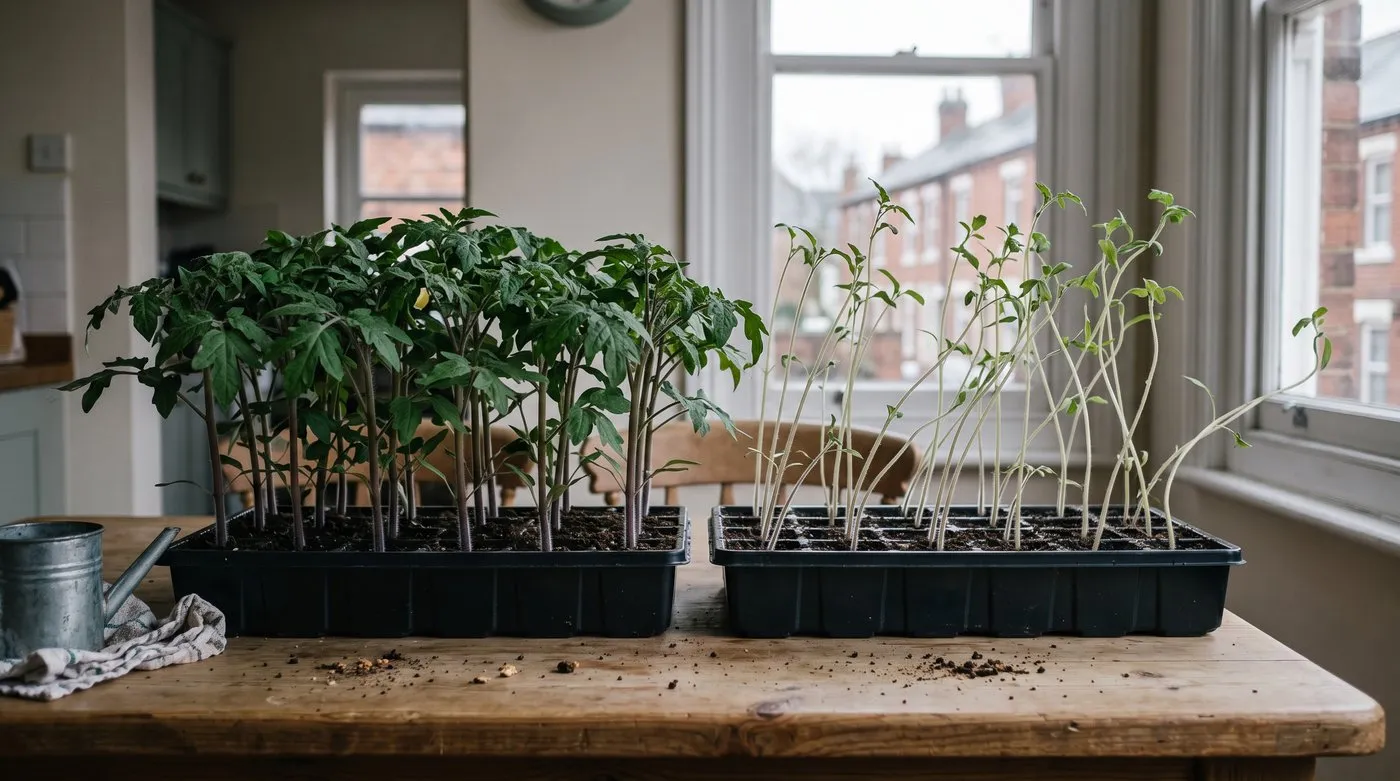
Short, sturdy seedlings mean the light is about right. Tall, pale, leaning ones need the light lower or brighter.
Your plants will tell you if it’s right:
- Too close: top leaves go pale, bleached or crispy in the middle of the light. Raise it
- Too far: stems stretch, leaves are spaced far apart and seedlings lean or flop. Lower it, or use a stronger light
- Just right: short, sturdy stems, deep green leaves and steady growth
Raise the light as plants grow so it stays at the right height above the top leaves. Stretched seedlings are a sign of too little light. Our guide to why seedlings go leggy covers the other causes too.
How many hours a day should a grow light be on?
Most crops do well on 12-16 hours of light a day. Always put the light on a timer and give plants a proper dark spell of at least 8 hours.
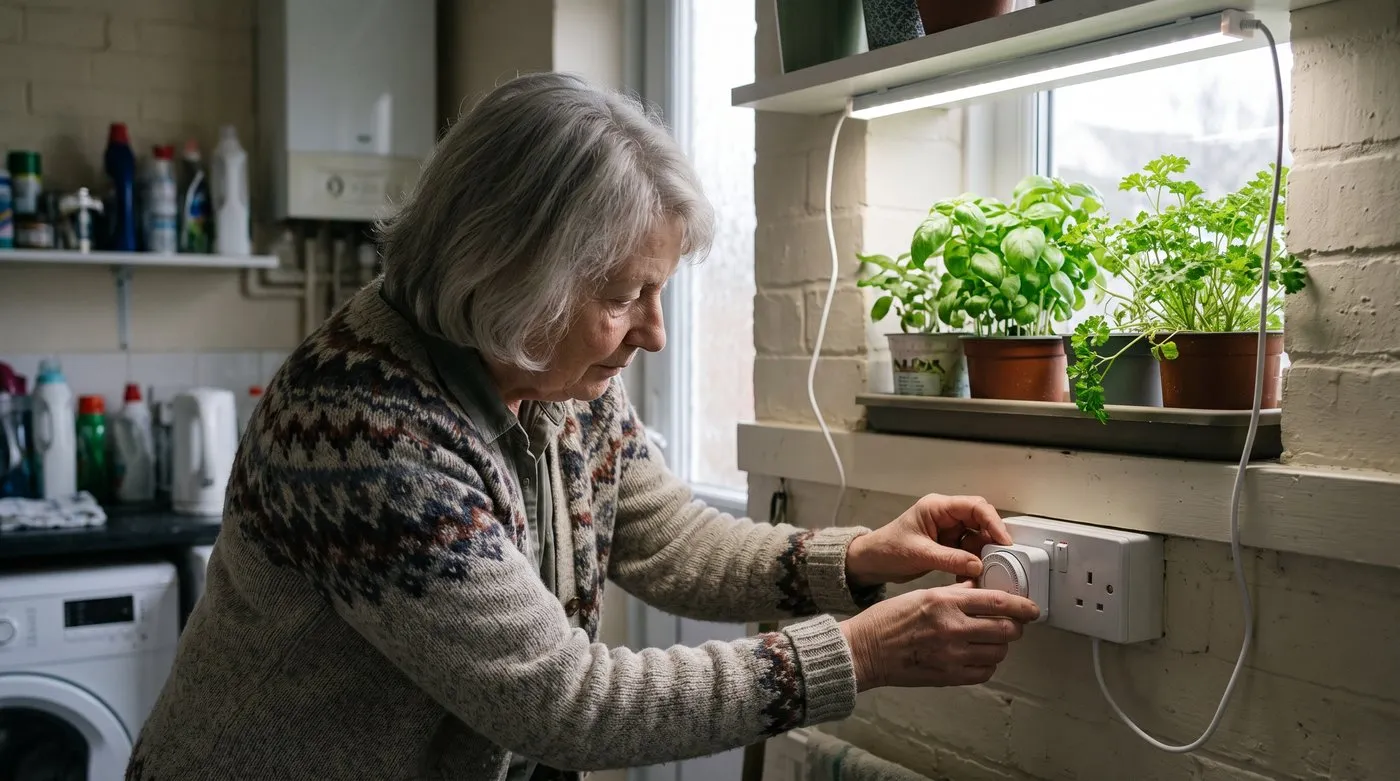
A cheap plug-in timer gives plants the same hours every day, and the dark spell they need.
| What you’re growing | Hours of light a day |
|---|---|
| Seedlings | 14-16 |
| Microgreens | 12-16 |
| Lettuce and salad leaves | 12-16 |
| Herbs such as basil | 14-16 |
| Chillies, peppers and tomatoes | 14-16 |
Never leave the light on round the clock. Plants need a rest, and tomatoes in particular can get damaged leaves under constant light. A cheap plug-in timer sorts this for you.
How much does an LED grow light cost to run?
Work it out with this sum: watts x hours a day / 1,000 x your unit price. Your unit price is on your electricity bill, in pence per kWh.
For example, a 100W light on for 16 hours uses 1.6kWh a day. At a unit price of 25p, that’s 40p a day, or about £12 a month. A 60W light on the same timer costs a little over half that.
Ways to keep the cost down:
- Buy a light that suits the space, not the biggest you can find
- Use reflective walls, such as a grow tent or white-painted shelves, so less light is wasted
- Only light what you need. A sunny windowsill may be enough from April to September
- Turn the light off over summer if your plants can go outside or into a greenhouse
How do you set up a simple grow light space?
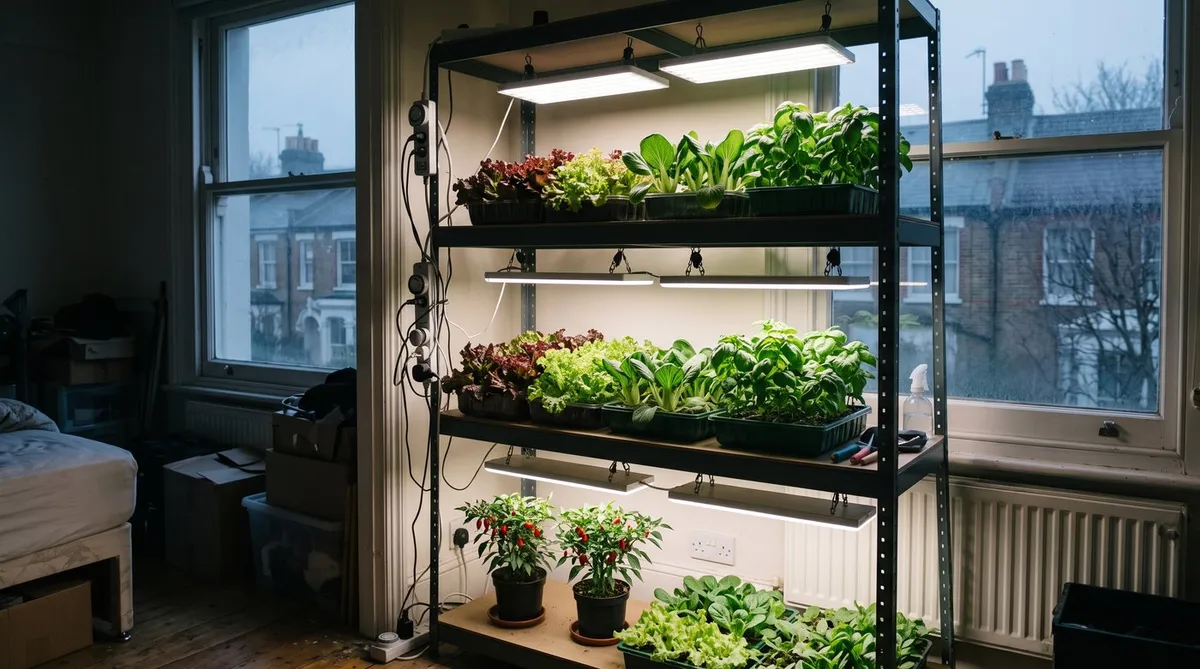
A light, a timer, a fan and somewhere to catch drips are all you need.
- Pick your spot. A spare room, a shelf unit or a small grow tent all work. Keep it away from where water could reach sockets
- Hang the light. Use adjustable hangers so you can raise it as plants grow
- Add a timer. Plug the light into a timer so it switches on and off at the same time every day
- Keep air moving. A small clip-on fan stops hot spots and helps stems grow sturdier
- Use trays. Stand pots in trays to catch water and protect the floor
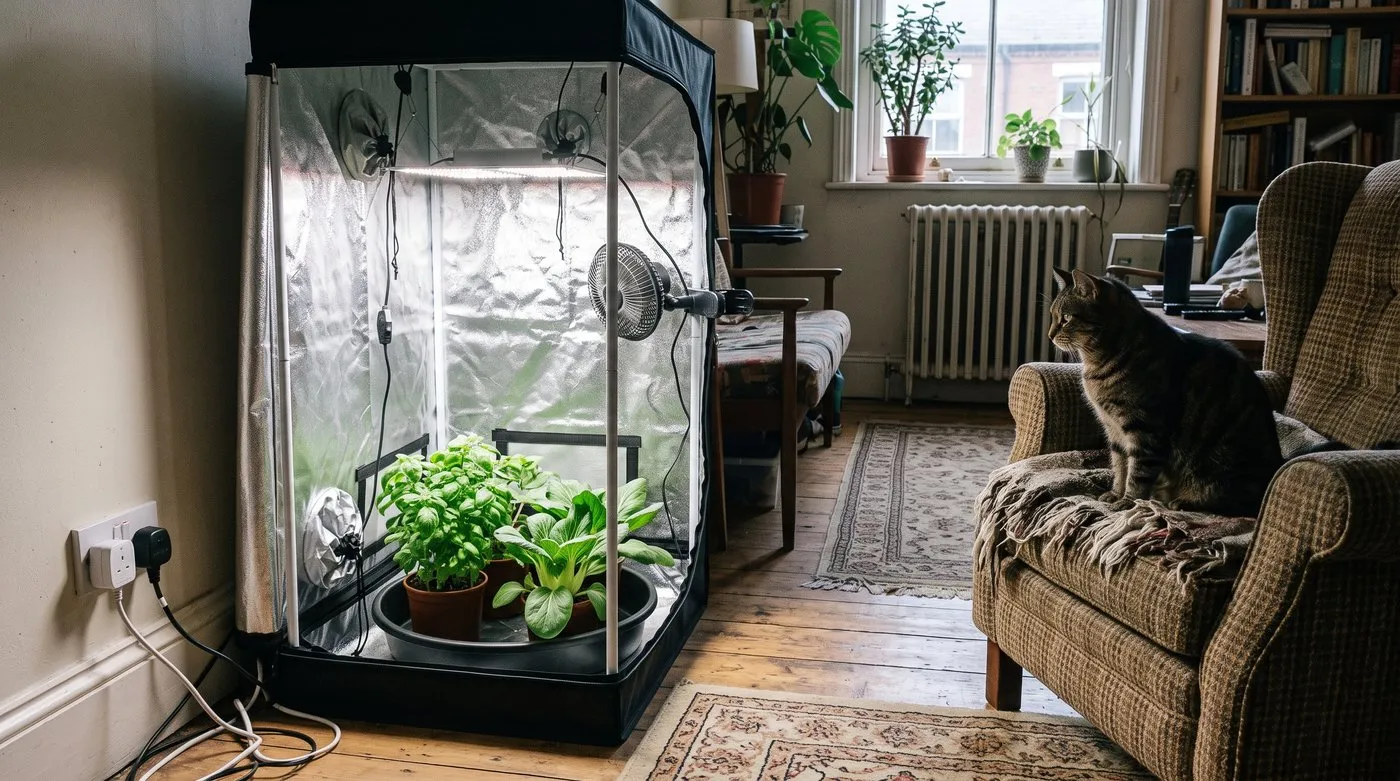
A light, a timer, a small fan and a drip tray are all a simple set-up needs. Keep water away from the plugs.
LEDs run much cooler than old-style grow lamps, but they still warm a small tent. If it gets too hot in summer, open the tent or add a small fan. For growing without soil, our hydroponics guide for beginners explains the next step.
Safety: Keep water, plugs and extension leads apart, and don’t overload sockets. Use an RCD plug if your sockets aren’t already protected.
What can you grow under an LED grow light?
Salads, herbs, microgreens and seedlings are the easiest wins. They grow fast and don’t need huge amounts of light.
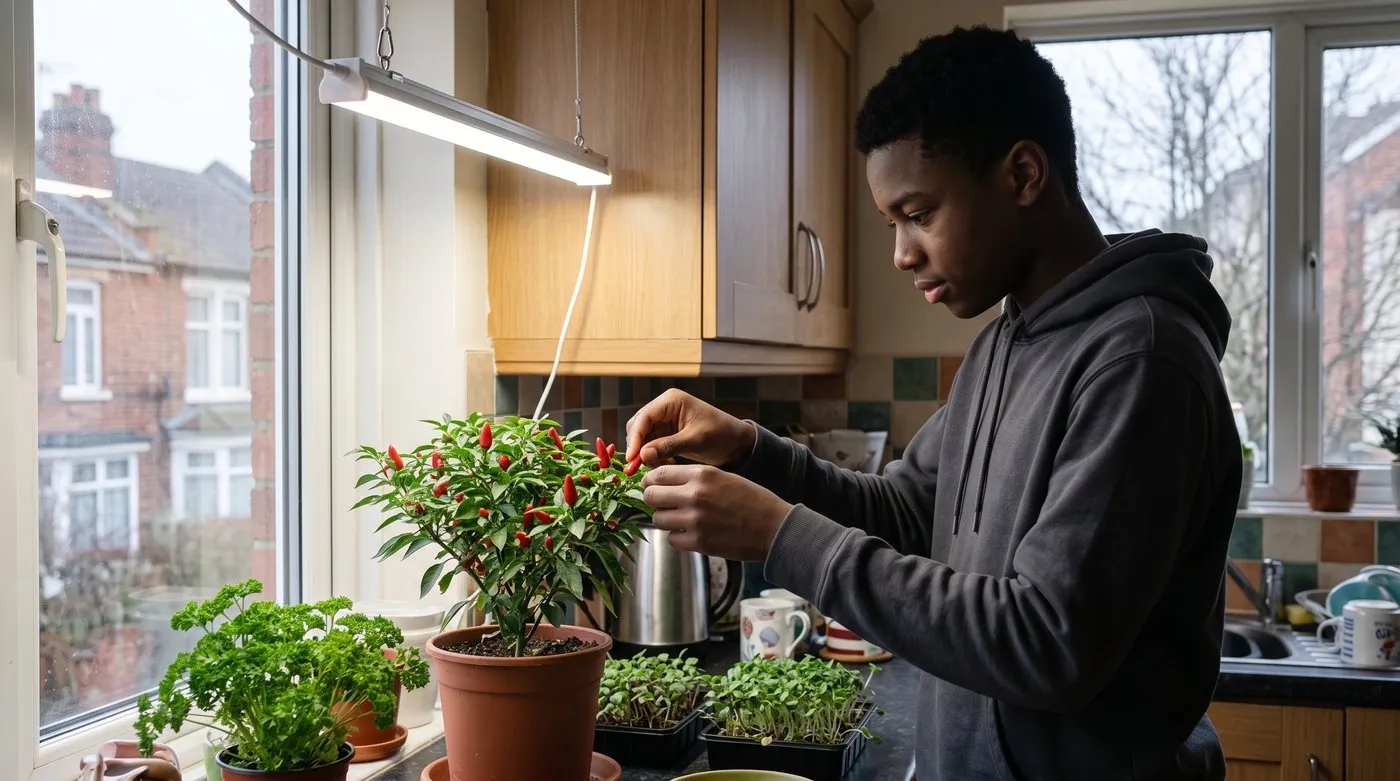
Compact chillies can fruit indoors with enough light, alongside quick crops like microgreens and herbs.
- Microgreens: ready in a week or two
- Salad leaves, rocket and pak choi: cut-and-come-again for weeks
- Herbs: basil, parsley and coriander do well
- Seedlings: tomatoes, peppers and chillies started early in spring
- Chillies: compact varieties can fruit indoors with enough light
Our guide to winter vegetables to grow indoors has more ideas, and our plan for indoor herbs from seed is a great first project.
LED grow light calendar: month by month
| Month | Grow light task |
|---|---|
| January | Salads, herbs and microgreens under lights. Sow chillies |
| February | Sow tomatoes and peppers under lights |
| March | Seedlings under lights 14-16 hours a day |
| April | Harden off early seedlings. Windowsills start to have enough light |
| May | Move seedlings outside or to the greenhouse. Lights off for most crops |
| June | Clean dust off the light and check the cables |
| July | Lights usually off unless growing indoors all year |
| August | Plan autumn sowings |
| September | Restart lights for autumn salads and herbs |
| October | Salad leaves and herbs back under lights |
| November | Microgreens, lettuce and basil under lights |
| December | Keep salads and herbs going for winter |
Common mistakes with LED grow lights
Trusting “equivalent” wattage. A “1500W” light that draws 150W at the wall is a 150W light. Check the real figure.
Hanging the light too close. Bleached top leaves mean it’s too near. Start high and lower it slowly.
Leaving it on all the time. Plants need a dark period. Use a timer.
Forgetting the heat in a small tent. A light in a closed tent warms it up. Add a small fan.
Moving plants straight outside. Plants grown under lights need hardening off before they go out. Our guide on how to harden off seedlings shows how.
Find more indoor growing ideas in our growing guides. Once your light is set up, try a quick crop from our guide to windowsill sprouts and microgreens.
Frequently asked questions
What wattage LED grow light do I need?
It depends on the area and what you’re growing. Check the maker’s coverage area for your crop. For a 60x60cm space, a panel drawing around 100W at the wall is a common choice. Fruiting crops need more light than seedlings or salads.
Are full-spectrum LEDs better than red and blue ‘blurple’ LEDs?
For home growers, yes. Both grow plants, but white light looks natural and lets you spot pests, disease and deficiencies. Purple light makes every leaf look odd and is tiring to work under.
How many hours a day should a grow light be on?
Usually 12-16 hours a day. Seedlings and leafy crops do well on about 14-16 hours. Always give plants a dark period of at least 8 hours. A cheap plug-in timer makes this easy.
How much does it cost to run an LED grow light?
Multiply watts by hours, divide by 1,000, then multiply by your unit price. A 100W light on for 16 hours uses 1.6kWh a day. At 25p a unit, that’s 40p a day.
How close should LED grow lights be to plants?
Follow the maker’s hanging guide, as lights vary a lot. Start at the higher end and lower it gradually. Bleached, pale top leaves mean it’s too close. Stretched, leggy growth means it’s too far away.
Do LED grow lights get hot?
They run much cooler than old-style lamps, but they still give off some warmth. In a small tent, this can push the temperature up. A small clip-on fan keeps air moving and stops hot spots.
Our team produces practical UK gardening guidance from source research, contributor records and established horticultural practice. Editorial standards are overseen by Matt W.