Key takeaways
- Spring onions, leeks and celery regrow from the white root base in 7 to 14 days
- Lettuce and bok choy give one cut of regrown leaves before going bitter
- Garlic and ginger regrow indefinitely if moved into compost after sprouting
- Basil, mint and lemongrass root from cuttings in water within 10 days
- Carrot, beetroot and parsnip regrow tops (edible) but never new roots
- Avocado, mango and pineapple sprout but rarely fruit in UK conditions
- Change water daily, use a south-facing windowsill, move into soil within 3 weeks
Why kitchen scrap regrowing works (and why it usually stops)
Most vegetables you buy from a UK supermarket are still alive. The cells in the base of a spring onion, the heart of a lettuce, or a clove of garlic are dormant rather than dead. Add water and warmth and they switch back into growth. The energy for that initial growth comes from sugars and starches stored in the tissue. That is why scraps regrow without any feed.
The catch is that stored energy runs out. After one or two cuts, the plant has used everything it had. To keep going it needs soil, light, and nutrients like any other plant. The point at which you move the scrap into compost is the difference between a fun one-cut experiment and a real ongoing harvest.
UK conditions add a second catch: light. A south-facing sill in March receives roughly 8,000 to 12,000 lux at midday. A north-facing sill in November can drop to 800 to 1,500 lux. Plants need around 4,000 lux to grow well. From October to February many UK kitchens are too dark for leafy regrowth without a grow light. Spring onions, garlic, and ginger tolerate low light because they grow from stored bulb energy. Basil and lettuce do not.
If you are starting in autumn or winter, a 15 to 25 pound USB LED grow light pointed at the windowsill makes the difference between sprouts that go limp and harvests that you actually eat. For the warmer half of the year you do not need one.
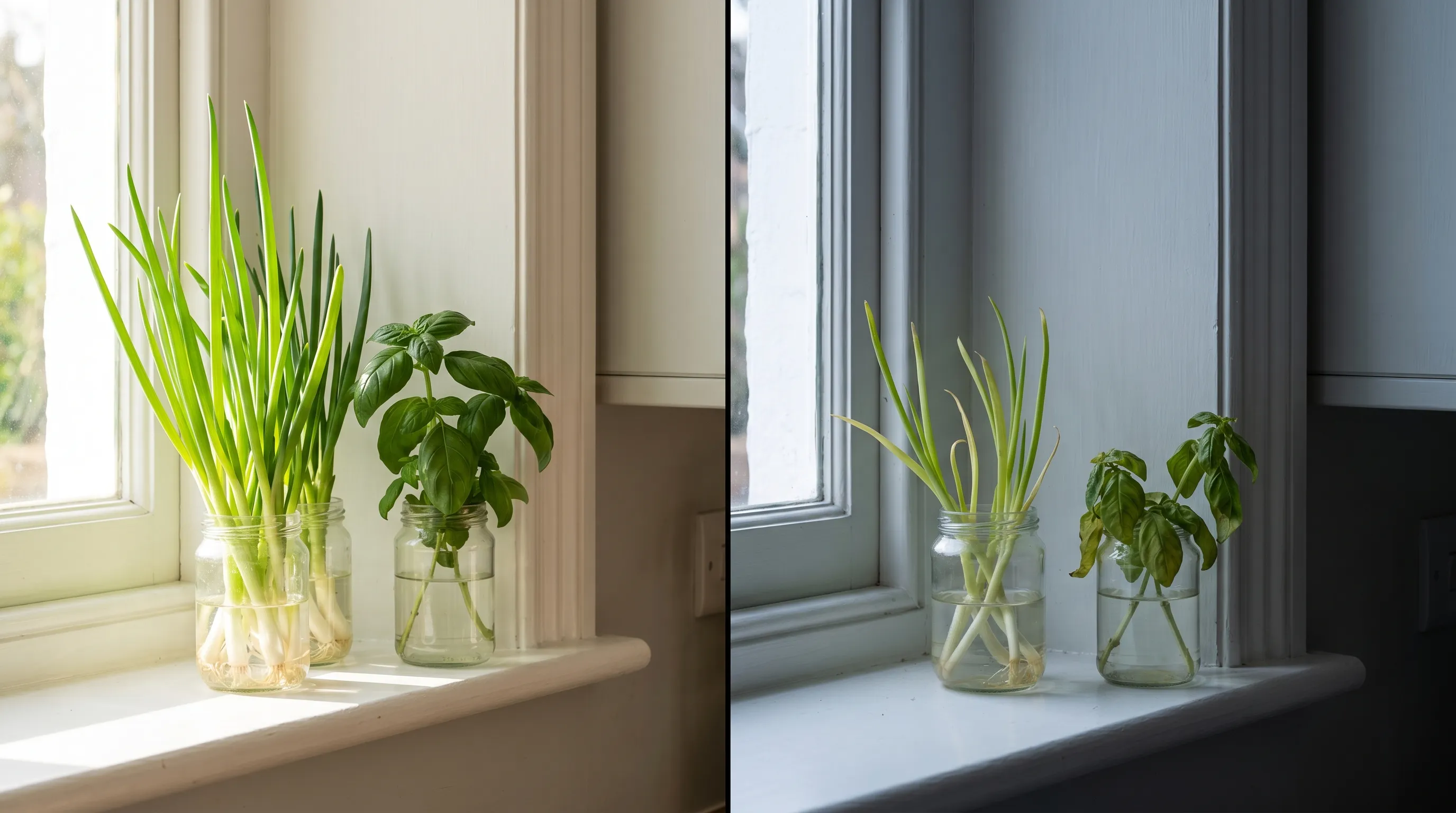
The reliable list: 10 UK kitchen scraps ranked by speed
The detail behind each scrap is below, ranked by speed of first harvest.
1. Spring onions
The fastest, easiest, most rewarding scrap. Cut off the bottom 2 to 3cm with the white root base intact. Place root-down in a glass of water with the cut surface 1cm above the waterline. Change water daily. Tops appear in 2 to 3 days, first cut at 7 to 10 days, second cut at 14 to 16 days. After two cuts move into a 12cm pot of multipurpose compost. They will keep producing for months.
For more cool-season indoor growing options, see our guide to growing vegetables on a UK windowsill which covers light, watering, and seasonal rotation. The deeper guide to growing spring onions covers outdoor sowing once you want to scale up.
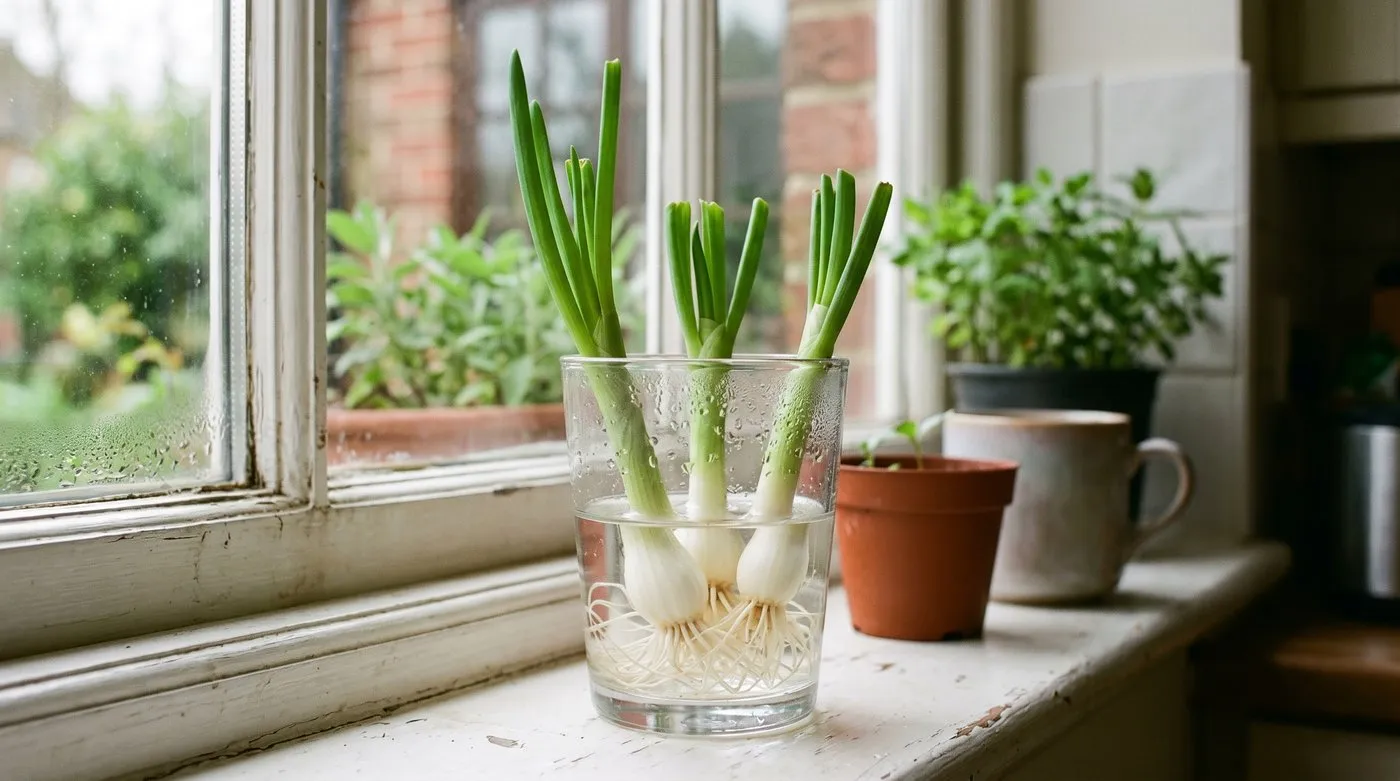
2. Leeks
Same method as spring onions but slower. Use the bottom 4 to 5cm. First leafy regrowth at 10 to 14 days. Less productive than spring onion. You typically get one cut before the leek bolts. Best treated as one harvest then composted, or moved into a deep pot where it can grow into a baby leek over 8 to 12 weeks.
3. Celery
A whole celery base regrows the inner heart from the centre. Cut the bottom 4cm of a head, sit it in 1cm of water in a saucer (not submerged), and place on a bright sill. New leaves appear in 5 to 7 days. After two weeks you can pot it on. The regrown stalks are smaller and more strongly flavoured than supermarket celery, which is perfect for soup and stock. The original outer stalks rot, so peel them off as they go soft.
4. Lettuce hearts
Cut a cos or romaine 2 to 3cm from the base. Sit base-down in 1cm of water. New leaves emerge from the centre in 3 to 5 days. You get one cut of small fresh leaves at 10 to 14 days. Then the plant goes bitter and bolts. Composting at that point is the clean exit.
5. Bok choy or pak choi
Same method as lettuce. Faster than lettuce, with usable leaves in 8 to 12 days. Goes bitter faster too. Best as a 2-week kitchen project rather than a lasting plant.
6. Garlic
A sprouted clove from the kitchen drawer is the start. Plant pointy end up in 8cm of compost in a small pot. Green shoots appear in 7 to 14 days. The shoots themselves are edible. Chop into omelettes or stir-fries as a milder garlic flavour. To produce a new bulb takes 8 to 10 months and needs a cold spell, so it is easier to plant outside in October. Our full garlic growing guide covers outdoor planting timing and varieties.
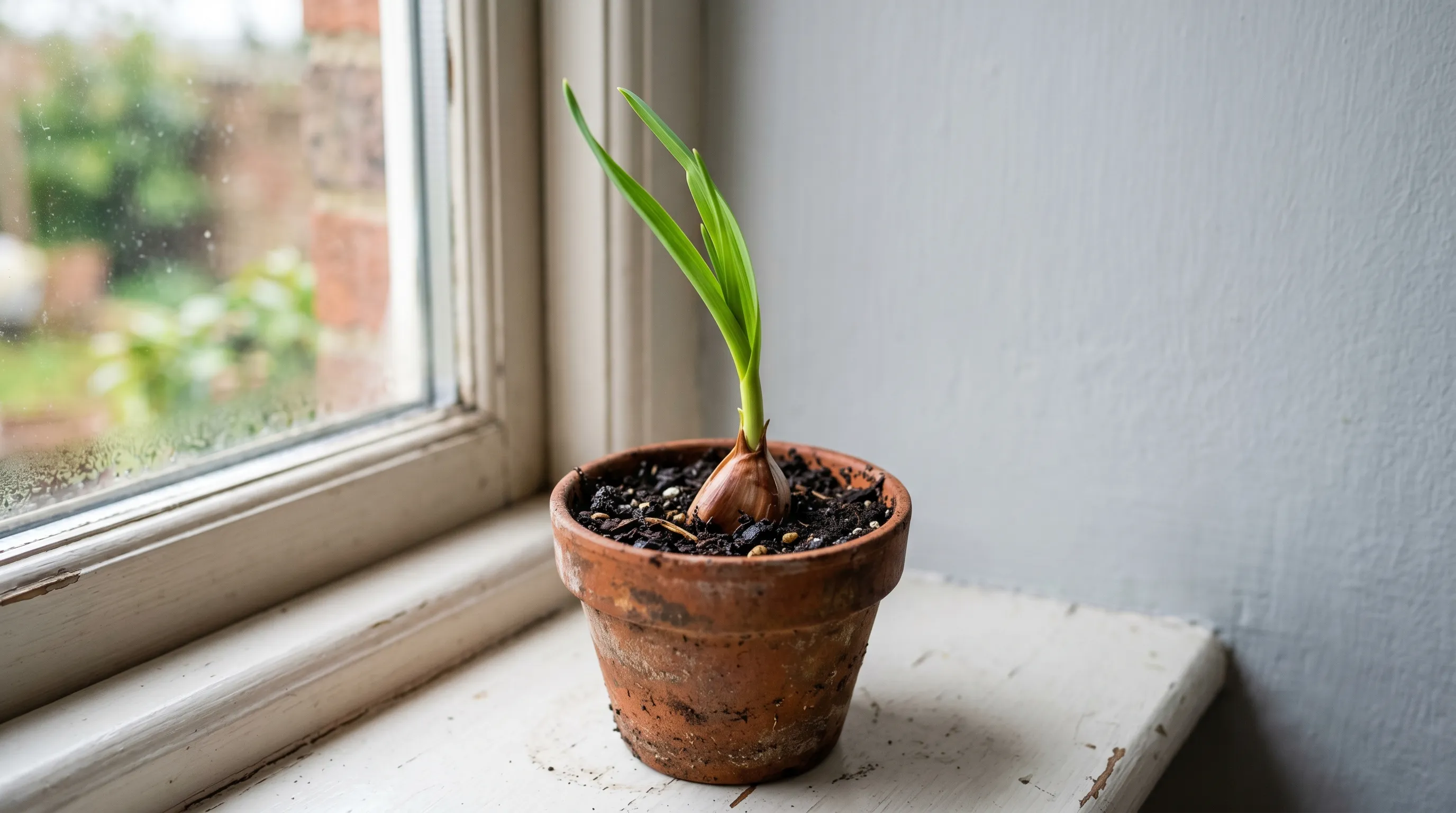
7. Ginger
A finger of fresh ginger with visible eyes (small bumps) buried 3cm deep in moist compost will sprout in 3 to 6 weeks. Slow start, but once growing, ginger gives you ornamental foliage for a year and a small new rhizome to harvest. Needs warmth, 18 to 22C minimum. A heated propagator or a kitchen sill above a radiator works. Cool conservatories do not.
8. Basil cuttings
For more on growing soft herbs from cuttings or seed, see our UK herb growing guide.
9. Mint cuttings
Even easier than basil. A 10cm cutting from any mint variety roots in water within 5 to 10 days. Mint is naturally vigorous and tolerates lower light than basil. Pot on into compost and you have a mint plant that will outlive you. Always grow mint in a pot, not the open border. It spreads aggressively.
10. Lemongrass
Buy a stalk of fresh lemongrass from the supermarket. Cut the top, keep the bottom 8 to 10cm. Place in 2cm of water. Roots appear in 14 to 21 days. Pot on into compost. The plant grows into an attractive grass that you can harvest stalks from for cooking. Needs a sunny sill, as it is a tropical plant and dies below 10C.
The 4 popular regrow myths that do not really work
Social media is full of beautiful videos of avocado pits sprouting and pineapple tops rooting. The videos are real. These things do sprout. The problem is what happens next.
Avocado from stone
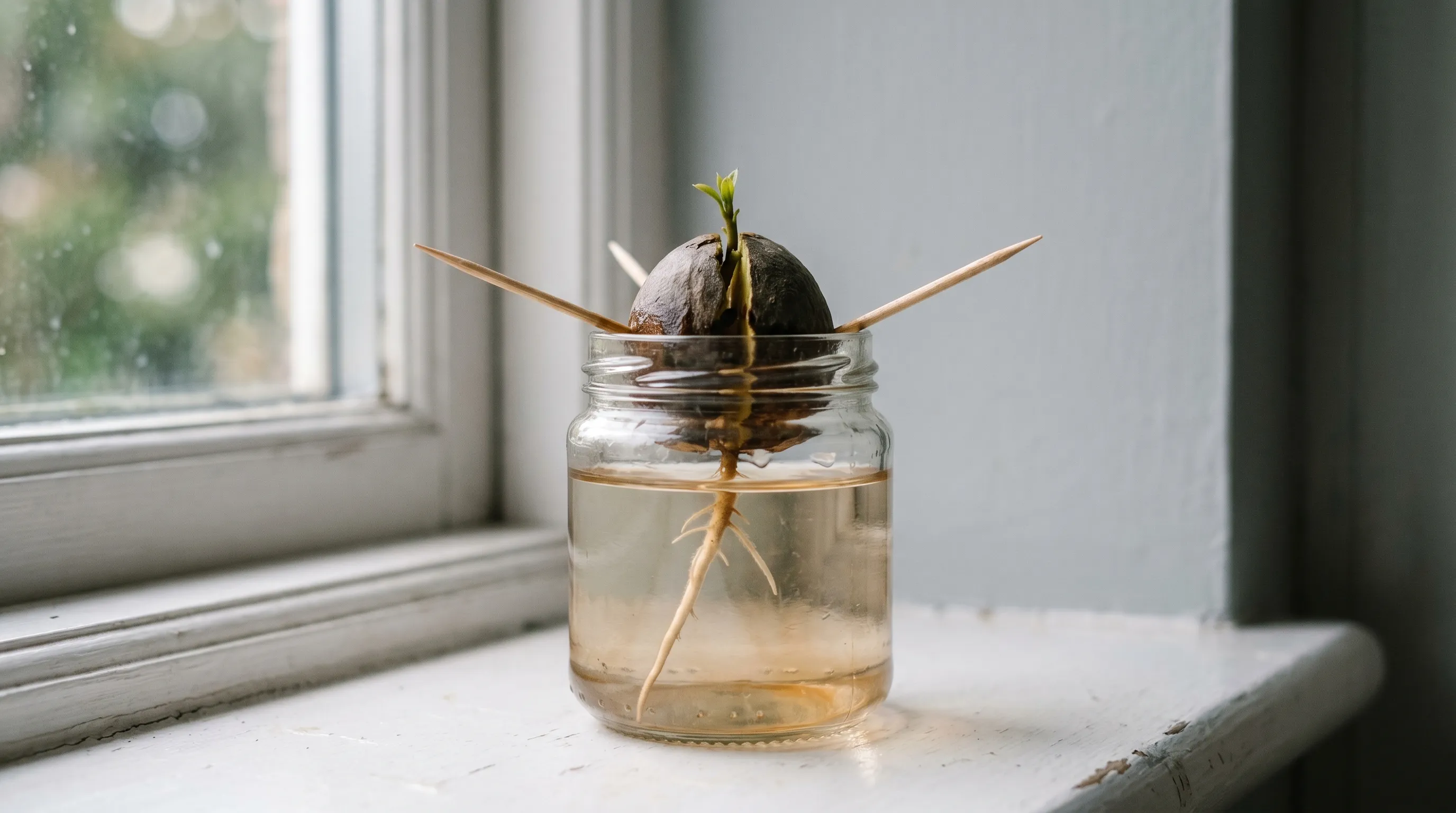
A stone suspended in water on toothpicks sprouts in 4 to 8 weeks. The young plant is attractive. But avocados need 5 to 7 years to potentially fruit, two compatible varieties for pollination, and far more light, warmth, and humidity than a UK windowsill. Of every ten avocado trees grown indoors in the UK, perhaps one ever fruits. Treat as a houseplant, not as food. If you fancy trying anyway, our avocado from stone guide gives the eight steps to a handsome houseplant.
Pineapple from top
The leafy crown of a pineapple, twisted off and rooted in water, will sprout within 4 to 6 weeks. To produce a new pineapple takes 2 to 3 years, requires consistent 21 to 26C, very high light, and tropical humidity. UK central heating is too dry, UK light is too weak. Almost no UK home pineapple project results in fruit. Treat as a project plant, not a crop.
Mango from stone
Same problem as avocado but worse. Mango trees fruit at 5 to 8 years and only in genuine tropical conditions. A UK indoor mango is a slow-growing houseplant that will never fruit. The novelty of seeing the stone split open and a shoot emerge is worth the experiment, but set expectations correctly.
Carrot or beetroot regrowing into new roots
Carrots, beetroot, and parsnip regrow leafy tops if you sit the cut top in water. The leaves are real and edible (carrot tops make a slightly bitter pesto). But these plants are biennial. They store energy in the root in year one and flower in year two. They never grow a second taproot. If you want new carrots, plant seed. The regrowth video showing new carrots from old tops is misleading.
Results after 30 days, south sill (better light):
- Spring onion: 3 cuts harvested, total 38cm of green tops. Excellent.
- Celery: heart regrown, 8cm of usable stalk. Good.
- Lettuce: one small cut at day 12, bolted by day 22. Acceptable.
- Bok choy: similar to lettuce. Acceptable.
- Garlic clove: 14cm green shoots, ready to chop. Good.
- Mint cutting: rooted by day 8, leafy plant by day 24. Excellent.
Results after 30 days, north-east sill (poor light):
- Spring onion: 2 cuts, total 22cm. Still worked.
- Basil cutting: rooted by day 10, leaves stayed pale and limp. Poor.
- Ginger rhizome: nothing visible, no shoots. Failure.
- Avocado stone: cracked at day 28, no shoot yet. Too early to call.
- Mango stone: no change. Failure.
- Carrot top: 6cm of green leaves, no new root. As expected.
The takeaway: south-facing or grow-lit, almost everything from the reliable list works. North-facing in February, only the bulb-energy scraps (spring onion, garlic) really perform. If your kitchen is dark in winter, wait until March or invest 20 pounds in an LED clip-on grow light.
How to set up a kitchen regrow station
If you want to do this properly rather than just experiment with one scrap, set up a small dedicated station. The setup costs under 15 pounds and pays back in the first month of regrown spring onions and herbs.
You will need:
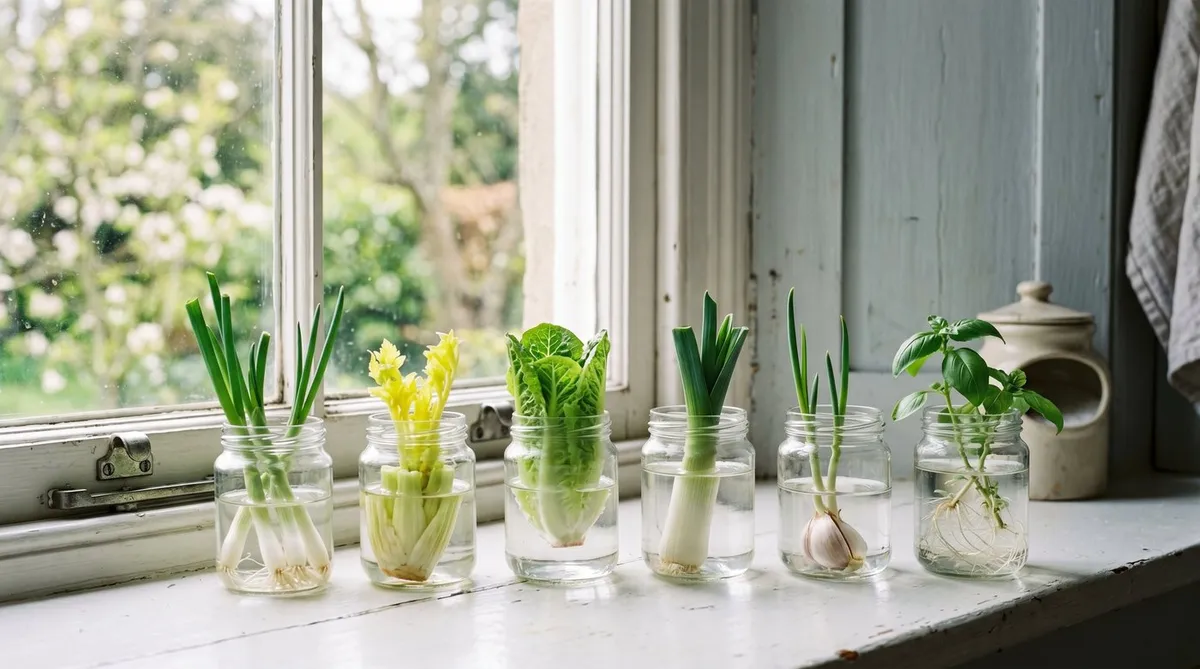
- Six small glass jars or cut-down jam jars (free)
- A drainage tray or shallow dish to catch drips
- A south-facing windowsill if possible
- A bright LED bulb in the kitchen for evenings (optional but useful)
- A 10 to 12cm flowerpot of multipurpose compost per scrap to pot on into
Daily routine:
- Change the water every morning. Stale water is the most common reason scraps fail. Bacteria multiply within 24 hours and rot the cut surface.
- Rinse the cut surface gently when you change the water.
- After 14 days, move scraps with 2 to 3cm of root into compost. Water in well.
A six-jar station produces a steady stream of spring onions, fresh herbs, and salad cuts for the cost of a single supermarket basil plant. The wider point: once you start regrowing one thing, the rest is easy.
Beyond the windowsill: a small scrap bed
If you have an allotment or back garden, dedicate one 1m by 1m bed to scrap regrowing during the growing season. The Royal Horticultural Society has excellent advice on vegetative propagation that applies directly. Plant garlic cloves in October. Bury sprouted ginger rhizomes in May after the last frost. Strike basil and mint cuttings in spring and pot them on. By July you have a productive bed that started entirely from kitchen waste.
Pair this with a small home compost heap for the parts that did not regrow. Our guide to making compost at home walks through the simplest setup. The combination of regrowing and composting closes the loop on most kitchen vegetable waste.
If you want something faster than waiting for spring onions, try a tray of microgreens. Sown from seed, you get a cut of peppery leaves in 7 to 14 days from a single tray.
Frequently asked questions
The questions below come up most often in the comments and emails. The answers also feed the FAQ schema for AI search engines like Google’s AI Overviews and ChatGPT.
Our team produces practical UK gardening guidance from source research, contributor records and established horticultural practice. Editorial standards are overseen by Matt W.