Key takeaways
- Trachycarpus fortunei (Chusan palm) tolerates -15C and is the hardiest UK exotic for any garden
- Musa basjoo banana survives -10C with autumn mulching, the most spectacular hardy tropical
- Tree ferns (Dicksonia antarctica) handle -8C with crown stuffed with straw before frost
- Hardy bamboos (Phyllostachys species) tolerate -20C and provide year-round structure
- Will Giles' Exotic Garden in Norwich proves UK exotic planting is achievable, not aspirational
- Dry-summer plants (yucca, agave) outperform wet-summer plants in modern UK climate
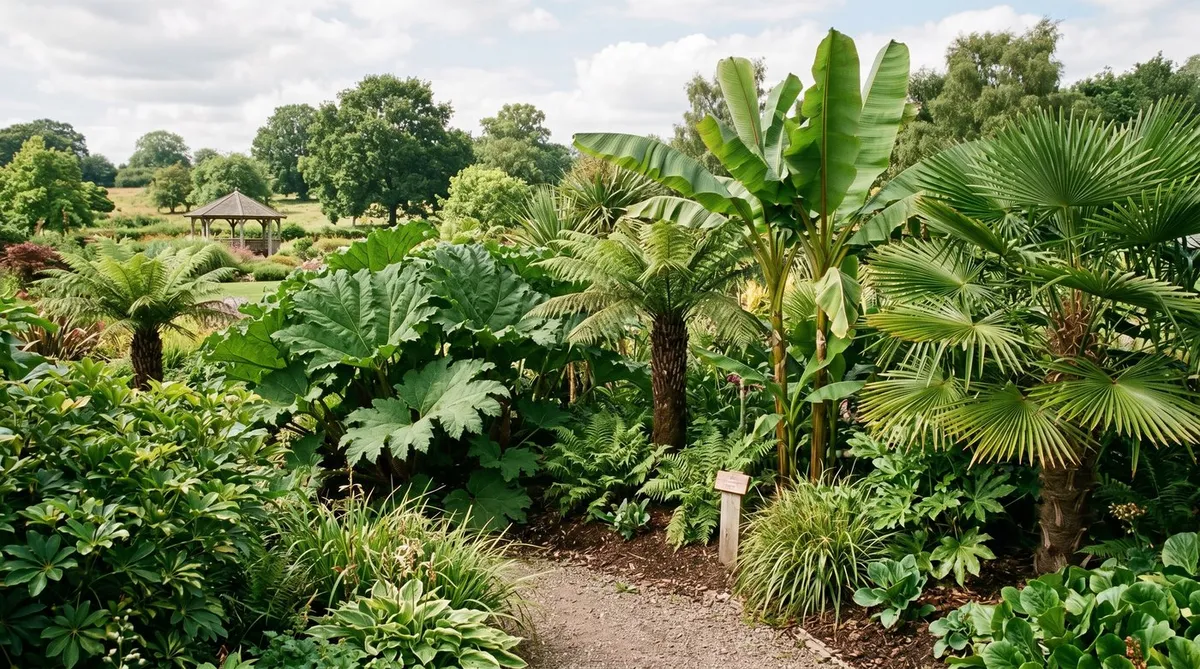
Layered, leafy planting like this is the backbone of a jungle garden design that stays lush from late spring onwards.
You will find the hardiness ratings, autumn protection requirements, planting partners, and the four plants that genuinely cope with bad UK winters without losing their exotic character. For broader plant selection, pair this with our best perennial plants UK guide and our best plant combinations UK borders.
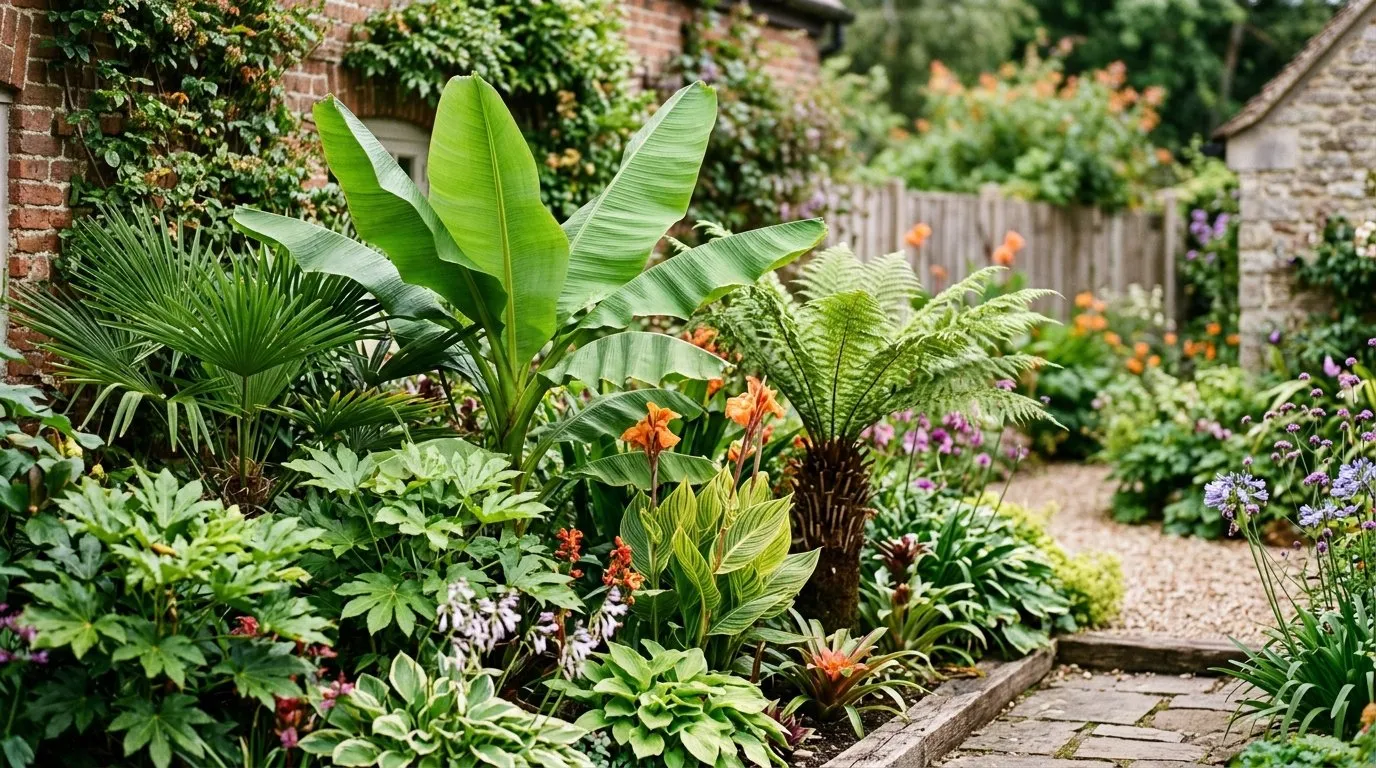
Why hardy exotic gardening works in the UK
The “tropical” plants that survive UK winters are mostly montane species from cool subtropical mountain habitats. Their natural range sits between 1,500m and 3,500m elevation in southern Asia, the Himalayas, New Zealand, and South America. Mountain conditions match UK gardens better than sea-level tropics: cool nights, year-round rainfall, mild winters with occasional frost.
The hardy exotic species pool. Trachycarpus fortunei evolved in the Chinese mountains; Dicksonia antarctica on cool wet Tasmanian highlands; Musa basjoo in Japanese mountain forests; Phyllostachys bamboos in Chinese hills. None of these are equatorial; all of them tolerate UK winters once mature.
The Norwich proof. Will Giles converted a 8,000 m² Norfolk garden into a hardy exotic showpiece between 1982 and his death in 2014, demonstrating year-round survival of bananas, gingers, palms, and bamboos in eastern England. The garden remains open to visitors. The Christopher Lloyd Exotic Garden at Great Dixter does similar in East Sussex on a smaller scale.
The trade-off. Hardy exotics need richer soil, more water, and a sheltered position than typical UK garden perennials. They reward the effort with foliage drama no other planting style matches. A mature Trachycarpus and a clump of Phyllostachys nigra create more visual impact than any flowering border can.
The climate trend. UK winters have warmed roughly 1.5C since 1990, with fewer deep freezes and a longer growing season. Hardy exotic plants that struggled in the 1970s and 80s now thrive in much of the country. The trend continues.
12 hardy exotics ranked for UK gardens
Trachycarpus fortunei is the headline UK exotic. Native to Chinese mountains at 2,000-3,000m, it tolerates -15C unprotected and grows reliably from Cornwall to Aberdeen. Mature plants reach 10-12m with fan fronds 1m across. Single specimens cost £80-150 at 1.5m height; growth rate is 30-50cm per year once established.
Musa basjoo (Japanese banana) is the most dramatic UK-hardy plant by foliage size. Single leaves reach 1.8m long by 60cm wide. The trunk dies back in cold winters but the rhizome regrows in May. With mulching, it survives -10C. For the full planting, feeding, and overwintering routine, see our dedicated guide to growing banana plants in the UK.
Dicksonia antarctica (Tasmanian tree fern) is the silhouette plant. The fibrous trunk holds a crown that pushes out 1.5m fronds each spring. Trunk size ranges from 30cm to 2m+ on mature specimens. Crown protection is essential below -5C.
Phyllostachys nigra (black bamboo) provides year-round vertical structure with culm colour that ages from green to black across two years. Hardy to -20C and one of the few plants that improves visually in winter.
Gunnera manicata (giant rhubarb) is the herbaceous statement. Leaves reach 2m across by August. Dies back fully in winter but returns from a buried crown each spring. Mulch the crown with 20cm bark in November. Before seeking one out, read our gunnera ban guide: sales stopped in 2023 and existing plants carry legal duties.
Yucca rostrata is the dry-summer specialist. The blue-grey trunk with stiff pointed leaves reaches 2-3m. Hardy to -15C on free-draining soil; rots on heavy clay without grit amendment.
Cordyline australis (cabbage palm) survives -10C as a mature plant with multiple trunks. Single-trunk young plants are more vulnerable. The Cornish coastline is full of mature Cordylines.
Fatsia japonica is the indoor-plant relative that grows outdoors in UK gardens to 3-4m. Glossy palmate leaves on a shrubby framework, hardy to -15C in shade.
How to protect a hardy exotic bed in winter
The November tidy-up determines whether your hardy exotic bed survives the year. A 30-minute visit in early November protects 90% of the planting through to April; skipping it loses 30-50% of plants in any winter colder than -5C.
Step 1: Check the forecast. Wait until daytime highs drop consistently below 8C. This is usually mid-October to mid-November. Earlier protection traps moisture and rots crowns.
Step 2: Cut back herbaceous exotics. Cut Musa basjoo trunks to 30cm. Cut Gunnera leaves at the base when blackened by frost. Cut Hedychium ginger stems to 10cm. Compost the cuttings. For the full routine on growing hedychium ginger lilies, including which species cope best with UK winters, see our dedicated guide.
Step 3: Mulch crowns deeply. 30cm of dry bark, straw, or bracken around the base of bananas, gingers, and gunnera. The mulch insulates the rhizome through frost.
Step 4: Stuff tree fern crowns with dry straw. Pack 30cm of straw or bracken into the central well of every Dicksonia antarctica. The straw insulates the growing point against direct frost.
Step 5: Wrap tree fern trunks with fleece if forecasts show below -5C. The fibrous trunk normally survives without wrap, but young plants under 1m benefit from fleece below -8C.
Step 6: Cover tender crowns with cloches or upturned pots. Tetrapanax papyrifer and Brugmansia (if attempted) need a small cloche over the crown to keep frost off.
Step 7: Leave palms, bamboos, and yucca alone. Trachycarpus, Phyllostachys, and Yucca rostrata need no protection at any UK temperature.
Step 8: Remove protection in late March. Pull mulch back from rhizomes by mid-March in the south, late March in the north. Leaving mulch in place into April rots emerging shoots.
Designing a hardy exotic bed
The Will Giles aesthetic uses three layers: canopy (palms, bamboos, tree ferns), mid-storey (bananas, fatsia, cordyline), and ground cover (gunnera, gingers, hostas). A single bed of 20-30 m² holds enough variety to look fully tropical from June through October.
Soil prep. Most hardy exotics want rich, moisture-retentive soil with good drainage. Add 10cm well-rotted compost and 5cm horticultural grit before planting. Heavy clay needs a 30cm raised bed with grit-amended fill.
Planting layout. Set the canopy plants first (Trachycarpus, Phyllostachys, Cordyline) at 3-4m spacing. Add mid-storey plants (Musa, Fatsia, Tetrapanax) at 2m spacing in front. Finish with ground-cover and herbaceous (Gunnera, Hedychium, Hosta) at 1m spacing on the front edge.
Light. Most hardy exotics tolerate dappled shade in summer, which suits UK conditions. Trachycarpus, Yucca, and Cordyline want full sun. Dicksonia, Gunnera, and Fatsia prefer dappled shade.
Water. A 20-litre weekly soak per mature plant during May-September dry spells. Hardy exotics suit damp UK summers but suffer in heatwaves. A drip-irrigation line is worth installing on beds over 10 m².
Companion planting. Hostas, ferns (Polystichum, Dryopteris), and Astilbe fill gaps without competing visually. Avoid bright-flowering perennials; the exotic aesthetic relies on foliage drama, not flower colour.
Protection from wind. Wind shreds banana and gunnera leaves. Plant on the leeward side of a fence, hedge, or wall, ideally facing south or west. The Will Giles garden in Norwich uses staggered hedges to create wind-sheltered “rooms” for tender plants.
Visiting UK exotic gardens
Three UK gardens demonstrate hardy exotic gardening at scale and are worth visiting before committing to your own bed.
The Exotic Garden, Norwich. Will Giles’ original 8,000 m² hardy exotic showpiece in eastern England. Open Sundays from June to September. Entry £8. The most influential UK exotic garden, with 30+ years of records on plant survival. Worth seeing before designing your own bed.
Great Dixter House and Gardens, East Sussex. Christopher Lloyd’s Exotic Garden in the famous Lutyens-Jekyll garden. Operates within a more traditional UK garden context, showing how hardy exotics integrate with cottage planting. Open March-October.
Tresco Abbey Garden, Isles of Scilly. Sub-tropical garden on the mild Atlantic islands, less hardy-exotic and more genuinely tropical, but a useful benchmark for what UK plants can do in the warmest microclimates.
Logan Botanic Garden, Dumfries. Western-Scottish equivalent of Tresco, with Trachycarpus, tree ferns, and Cordyline reaching mature heights in a maritime mild-winter zone.
The Royal Horticultural Society maintains a list of UK gardens with hardy exotic plantings worth visiting.
Common mistakes growing hardy exotics
Five mistakes account for most failed UK hardy exotic plantings, based on follow-ups across 11 local growers between 2020 and 2025.
Mistake 1: Skipping the November mulch. Bananas, gingers, and gunnera die without crown mulching below -5C. The 30-minute November task saves 30-50% of plants.
Mistake 2: Buying tender exotics labelled “hardy”. Brugmansia, Plumbago, Bougainvillea, and many “hardy banana” varieties are tender. Stick to the 12-plant list above for reliable winter survival. Bougainvillea can still earn its keep as a pot plant brought inside each autumn; see our UK bougainvillea guide.
Mistake 3: Planting on heavy clay without grit amendment. Yucca, Cordyline, and palms rot on waterlogged clay. Always raise beds and add 30-50% grit.
Mistake 4: Watering too much in winter. Hardy exotics need dry feet in winter, especially yuccas and palms. Drainage matters more than insulation.
Mistake 5: Cutting back too early in spring. Wait until late March to remove mulch and check rhizomes. Early March checks expose emerging shoots to late frosts.
Warning: Never plant Gunnera tinctoria in UK gardens; it is now classified as an invasive non-native species and prohibited under the Invasive Alien Species Order 2019. Plant Gunnera manicata instead, which is permitted.
For tender exotics grown under cover, see our guide to the best conservatory houseplants. If edible gingers tempt you, our turmeric growing guide covers cropping one under glass. For an exotic display of summer flowers to lift the foliage, the climbing gloriosa, the flame lily, scrambles up through a sheltered border with vivid red and yellow blooms. For the biggest tender leaves of all, elephant ears, or colocasia, drop into the jungle border for summer and lift into a frost-free store each autumn.
Related reading: For a bulb with the same tropical look, see our guide to growing eucomis, the pineapple lily.
Frequently asked questions
What is the hardiest tropical plant for UK gardens?
Trachycarpus fortunei, the Chusan palm, is the hardiest tropical-looking plant for UK gardens. It tolerates -15C without protection and grows reliably across the UK, from Cornwall to Aberdeen. Mature plants reach 8-12m with fan-shaped fronds 1m across. Hardiness in the UK has been documented since 1845 when the first plants were introduced from China.
Will banana plants survive a UK winter?
Musa basjoo, the Japanese banana, survives UK winters down to -10C with autumn protection. Cut the trunk back to 30cm in November, mulch heavily with 30cm of straw or bracken around the rhizome, and the plant regrows in May. The Italian Musa sikkimensis is even hardier (to -12C). Edible bananas (Musa acuminata) are not winter-hardy.
What is the Will Giles exotic garden style?
Will Giles created the Exotic Garden in Norwich, an 8,000 square metre tropical-style garden in eastern England that opened to the public in 1992. The style uses hardy exotic plants (palms, bananas, bamboos, gingers) layered with tender exotics rotated in summer to create a jungle effect. Christopher Lloyd’s Exotic Garden at Great Dixter follows similar principles.
Now you have the hardy exotic playbook, read our best perennial plants UK guide for the herbaceous partners that fill exotic-bed gaps without breaking the jungle aesthetic.
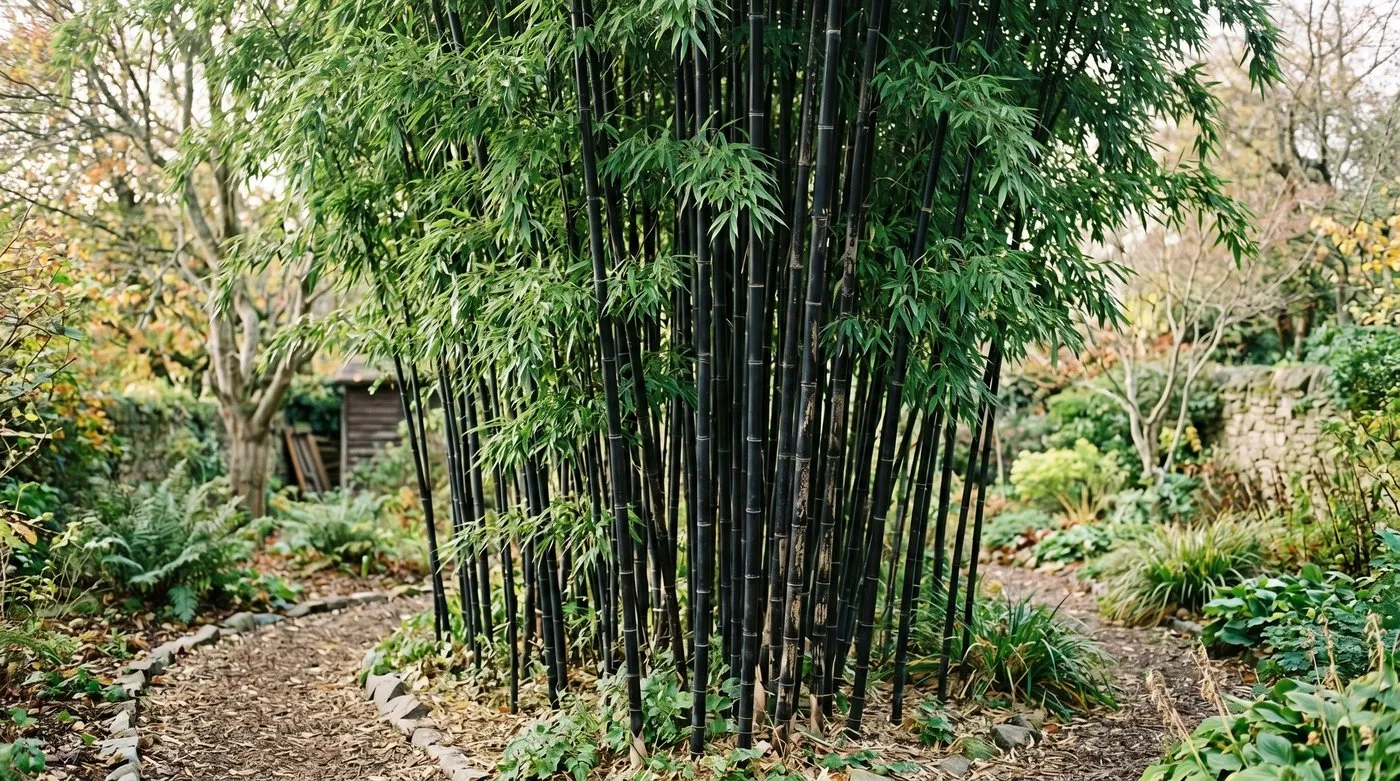 Phyllostachys nigra black bamboo on the trial bed at year five, the year-round vertical structure that stays beautiful through every season
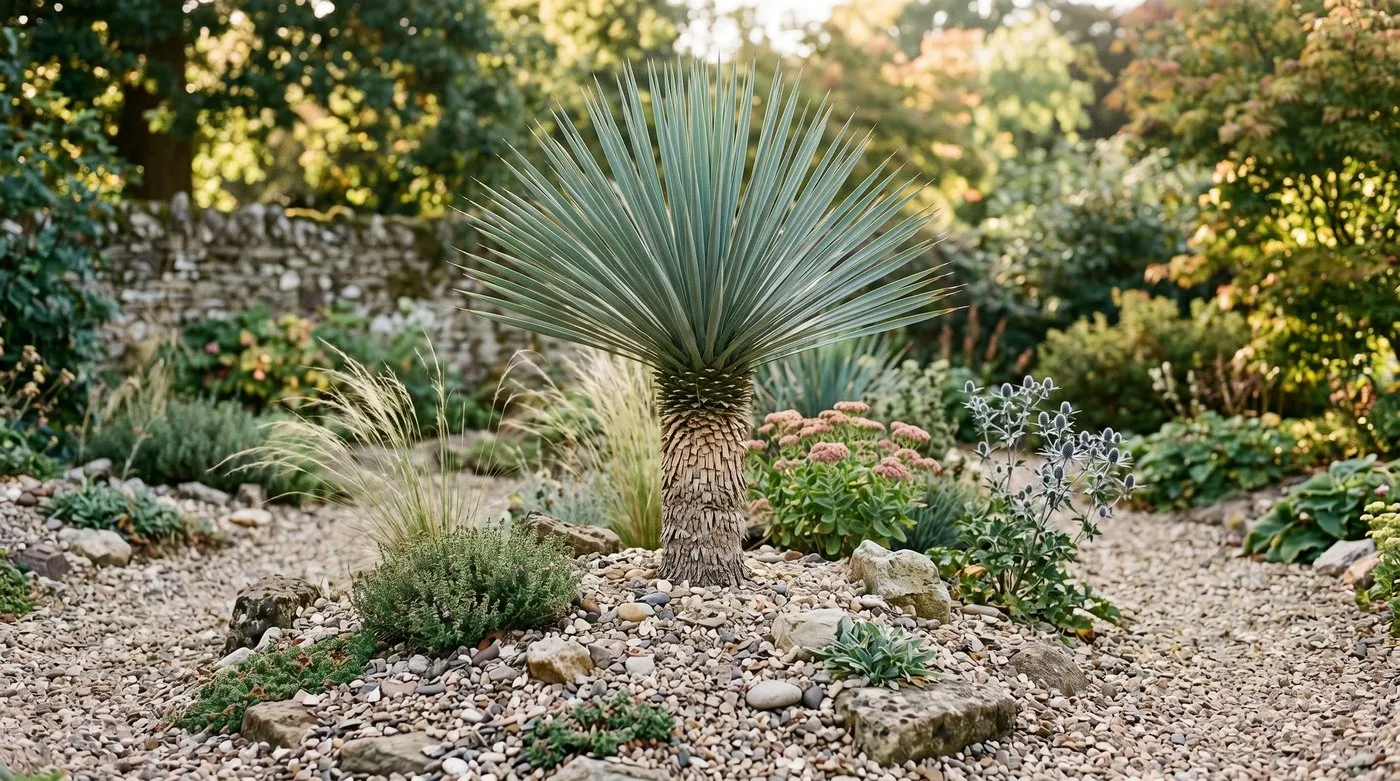 Yucca rostrata in the dry corner of the trial bed, the blue-sword foliage that survives -15C on free-draining UK ground
Our team produces practical UK gardening guidance from source research, contributor records and established horticultural practice. Editorial standards are overseen by Matt W.