Key takeaways
- The most scented kinds, Nicotiana sylvestris and N. alata, release their perfume from dusk
- Plant scented nicotiana close to seats, doors and evening paths so you actually smell it
- Many compact bedding mixes, such as 'Domino', have little scent, so choose by name
- Surface-sow the fine seed from February to April and don't cover it
- All parts are poisonous if eaten, so keep children and pets from chewing it
Nicotiana, the flowering tobacco, is one of the best annuals you can grow for evening scent. Getting it right comes down to two things: sowing the dust-fine seed on the surface, and choosing a kind that’s actually scented. The fragrant ones save their perfume for dusk, so where you plant them matters just as much.
If you love the idea of a garden that comes alive after dark, our guide to designing a moon garden is full of other pale, scented plants to go with it.
Why nicotiana smells strongest at dusk
The scented kinds are pollinated by night-flying moths. Their long, pale trumpets show up in low light, and the sweet scent guides moths in from a distance.
By day, the flowers of Nicotiana sylvestris and N. alata often hang half-closed with little smell. As the light fades, they open fully and the perfume builds. On a still, warm evening it’s wonderful.
So a scented nicotiana at the back of a deep border is wasted. Plant it where you sit and walk after dark, and you’ll get the full effect. The moths are good news for wildlife too. They’re food for bats, so a bat-friendly garden and nicotiana go hand in hand.

Long, pale trumpets are made for moths. Hawk-moths are some of the visitors you might spot on a summer evening.
Which nicotiana to grow for scent
Not all nicotiana is scented. Some kinds are grown for daytime colour instead, so choose by name.
| Type | Height | Flowers | Scent | Best use |
|---|---|---|---|---|
| N. sylvestris | About 1.5m | Drooping white trumpets | Strong, evening | Statement plant by a seat or path |
| N. alata (including ‘Grandiflora’) | 60cm-1m | White, cream or lime | Strong, evening | Near a patio or door |
| Perfume series | About 50cm | White, purple, red | Good, evening | Pots and front of borders |
| N. mutabilis | About 1.2m | Opens white, turns pink | Little | Airy daytime colour |
| N. langsdorffii | About 1m | Small lime-green bells | Little | Unusual daytime colour |
| ’Domino’ and similar mixes | About 30cm | Bright mixed colours | Little | Bedding and pots, daytime colour |
Nicotiana sylvestris is the scented giant, with big rosettes of leaves and clusters of drooping white trumpets. Give it shelter from strong wind. N. alata is shorter and easier to fit by a bench. If you want scent in a small pot, the Perfume series is a good compromise.
N. mutabilis and N. langsdorffii are grown for their looks. Mix them with a scented kind to get colour by day and perfume by night.

Nicotiana langsdorffii is grown for its quirky lime-green bells and blue pollen, not its scent.
How to sow nicotiana seed
Nicotiana seed is as fine as dust, and it needs light to germinate. The most common mistake is covering it.
- Sow indoors from February to April
- Fill a tray with fine, moist seed compost and firm it level
- Sprinkle the seed thinly over the surface. Don’t cover it
- Press it gently so it touches the damp compost
- Cover with a clear lid and keep at about 18-20°C in good light
- Water from below by standing the tray in shallow water
Seedlings usually appear within a couple of weeks. Keep the lid on until they do, then give them plenty of light so they don’t stretch. The guide to damping off explains how to stop young seedlings collapsing.
Gardener’s tip: Mix the seed with a pinch of dry silver sand before sowing. The pale sand shows where the seed has landed, so you sow evenly.

Tap the seed thinly from a folded paper onto the surface, and leave it uncovered.
Pricking out and planting nicotiana
When seedlings are big enough to handle, prick them out into modules or small pots. Hold each one by a leaf, never the stem. Grow them on somewhere bright and frost-free.
Nicotiana is half-hardy, so it can’t go out until the frosts are over. Harden plants off over a week or two from mid-May, putting them out by day and bringing them in at night. Plant out after the last frost, usually late May in the south and early June further north.
Space tall kinds about 45-60cm apart and compact ones about 25cm apart. They like moist, fertile soil in sun or light shade. Light afternoon shade suits them well, as the flowers last longer out of the hottest sun. Dig in some garden compost before planting.

Ease seedlings out with a dibber and hold them by a leaf. Grow them on frost-free until late May.
Where to plant nicotiana so you can smell it
Plant scented kinds close to where you spend summer evenings. Good spots include:
- Beside a patio or bench
- Next to the back door
- Along the path to the shed or gate
- Under a window you leave open on warm nights
Group three to five plants together for a stronger scent. Nicotiana sylvestris also does well in a big pot by the door. It sits nicely with other summer annuals such as cosmos, and with fellow evening performers like evening primrose.

By the door is perfect. You walk past it every evening, right when the scent is at its best.
Caring for nicotiana through summer
Nicotiana is easy once planted. Keep the soil moist, as dry plants flower less and smell less. In a dry spell, a good soak twice a week beats a daily sprinkle. Pots need checking daily in hot weather.
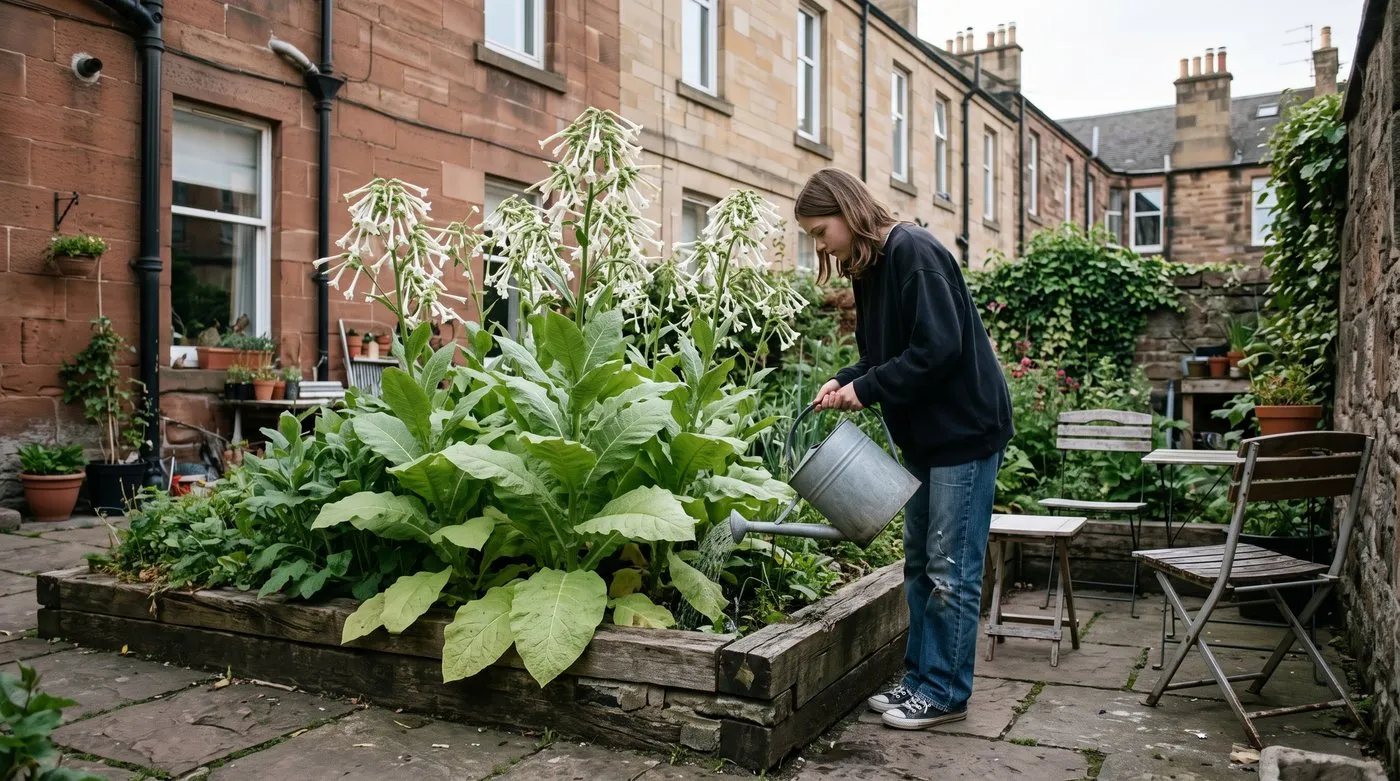
Moist soil keeps the flowers and the scent coming. Water at the base with a good soak rather than a daily sprinkle.
Feed plants in pots every two weeks from midsummer with a high-potash feed, such as tomato feed. Plants in good border soil rarely need it. Deadhead faded flower stems to keep new ones coming into autumn. Tall kinds may need a cane in a windy garden.
Slugs can shred young plants after planting out, so protect them until they’re growing strongly. Aphids sometimes gather on shoot tips. Squash them or wipe them off.
Warning: All parts of nicotiana are poisonous if eaten. It’s a close relative of tobacco. It’s safe to grow and handle, but keep children and pets from chewing it, and wash your hands after handling the sticky leaves.
Nicotiana month by month
| Month | What to do |
|---|---|
| January | Order seed. Choose scented kinds if you want evening fragrance |
| February | Start sowing indoors. Surface-sow only |
| March | Main sowing month. Prick out the first seedlings |
| April | Last sowings. Grow seedlings on, frost-free and bright |
| May | Harden off. Plant out after the last frost |
| June | Finish planting in the north. Water in and watch for slugs |
| July | Flowering begins. Keep the soil moist. Feed pots |
| August | Peak flowers and scent. Deadhead |
| September | Keep deadheading. Let a few seed heads ripen |
| October | Collect seed. Leave some on sylvestris to self-sow |
| November | Frost ends the season. Clear blackened plants |
| December | Plan next year’s spots near your evening seats |
Common nicotiana mistakes
Buying a scentless mix by mistake. Compact bedding mixes are bred for daytime colour. For scent, buy N. sylvestris, N. alata or the Perfume series by name.
Planting it too far away. Scent stays around the flowers. Plant it near seats, doors and paths.
Covering the seed. It needs light to germinate. Sprinkle it on the surface and leave it.
Planting out too early. A late frost will kill young plants. Wait until late May or early June.
Letting it go dry. Thirsty plants flower less and smell less, especially in pots.
Will nicotiana come back next year?
Most nicotiana is killed by the first hard frost, so treat it as an annual. In mild, sheltered gardens, N. alata and N. sylvestris sometimes survive winter, and sylvestris often self-seeds.
For free plants next year, leave two or three seed heads to ripen and scatter. Hold off the hoe in spring and keep the strongest seedlings. To save seed, snip ripe brown pods into a paper bag, let them dry indoors, and store the seed somewhere cool and dry until February.
Frequently asked questions
Does nicotiana smell at night or during the day?
The scented kinds smell strongest at dusk and after dark. Nicotiana sylvestris and N. alata often look a little limp and smell faintly by day. In the evening the flowers open fully and the perfume builds to draw in night-flying moths.
Why has my nicotiana not germinated?
The usual reason is that the seed was covered. Nicotiana seed is dust-fine and needs light to germinate. Sprinkle it on the surface of moist compost, don’t cover it, and keep it warm and bright. Water from below so the seed isn’t washed away.
Which nicotiana is the most fragrant?
Nicotiana sylvestris and Nicotiana alata are the most fragrant. Sylvestris has drooping white trumpets on stems about 1.5m tall. N. alata is shorter and easier to fit near a seat. For a compact plant with scent, look for the Perfume series.
When do you sow nicotiana seed in the UK?
Sow it indoors from February to April. Keep the tray warm, around 18-20°C, and in good light. Prick out the seedlings when they’re big enough to handle, then harden off and plant out after the last frost.
Is nicotiana poisonous to pets and children?
Yes, all parts are poisonous if eaten. It’s a close relative of tobacco and contains nicotine. It’s fine to grow and handle, but keep children and pets from chewing it. Wash your hands after handling the sticky leaves.
How tall does nicotiana grow?
From about 30cm to 1.5m, depending on the type. Nicotiana sylvestris is the tallest. N. alata, N. mutabilis and N. langsdorffii sit in between, and compact bedding mixes stay short. Put tall types mid-border and short ones at the front or in pots.
Will nicotiana come back every year?
Usually not, as it’s grown as an annual. In mild, sheltered gardens, N. alata and N. sylvestris sometimes survive winter. Sylvestris often self-seeds, so leave a few seed heads to ripen and look out for seedlings in late spring.
Where should I plant nicotiana for scent?
Plant it close to where you sit or walk in the evening. A patio, back door, bench or path all work well. Grouping three to five plants together gives a much stronger scent than single plants dotted about.
For another summer flower with a heady scent, read our guide to growing lilies, or browse all our plant guides.
Our team produces practical UK gardening guidance from source research, contributor records and established horticultural practice. Editorial standards are overseen by Matt W.