
Key takeaways
- Half-hardy annuals can't take frost, so sow them indoors from February to April
- Plant out after the last frost, usually mid to late May in England and early June in Scotland
- Harden off over 10-14 days before planting out
- Cosmos is the easiest and gives armfuls of flowers for cutting
- Zinnias, Mexican sunflowers and celosia need your sunniest, warmest spot
- Pinch out the tips of young plants for bushier plants and more flowers
Half-hardy annuals are the stars of a UK summer. They can’t take frost, so you sow them indoors from February to April. It’s a bit more effort, but they repay you with flowers from July right up to the first autumn frost.
What makes an annual half-hardy?
Half-hardy annuals come from warm parts of the world, so a frost will kill them. That means you can’t put them outside until late May in most of England, or early June in Scotland and the north. If you’d rather sow straight outside, our hardy annuals guide covers the frost-tough ones.
So you start them indoors. You’ll need a propagator or warm windowsill for them to come up, then good light while they grow on. After that, harden them off for about two weeks before planting out. Our guide to sowing seeds indoors takes you through it.
It sounds like work, but a single packet of cosmos seed gives you dozens of plants. Buying the same number as plug plants costs far more. If you’d rather skip the propagator, see our guide to buying and growing on plug plants.
 Seedlings need a few weeks on a bright windowsill before they’re ready for the great outdoors.
When to sow half-hardy annuals in the UK
Sow too early and seedlings go tall and floppy on dark windowsills. Sow too late and they’ve barely started flowering when frost arrives. For most, mid-March to mid-April is the sweet spot.
This calendar suits the Midlands, where the last frost usually falls in mid-May. Go about two weeks later in Scotland, a week later in northern England and a week earlier on the south coast.
| Plant | Sow indoors | Warmth to come up | Plant out |
|---|---|---|---|
| Cosmos | Mid-March | 18-21°C | Late May |
| Zinnia | Late March | 20-24°C | Early June |
| Nicotiana sylvestris | Early March | 20-25°C | Late May |
| Cleome | Mid-March | 21-24°C | Early June |
| Mexican sunflower (Tithonia) | Late March | 20-24°C | Early June |
| Rudbeckia hirta | February | 18-21°C | Mid-May |
| Celosia | Late March | 21-25°C | Early June |
| Annual salvia | Early March | 20-24°C | Late May |
| Verbena bonariensis | February | 18-22°C | Mid-May |
| Lobelia | February | 18-24°C | Late May |
Rudbeckia and Verbena bonariensis are slow, so sow them in February. Cosmos and zinnias grow fast, so wait until mid-March or they’ll outgrow their pots before it’s warm enough to plant out.
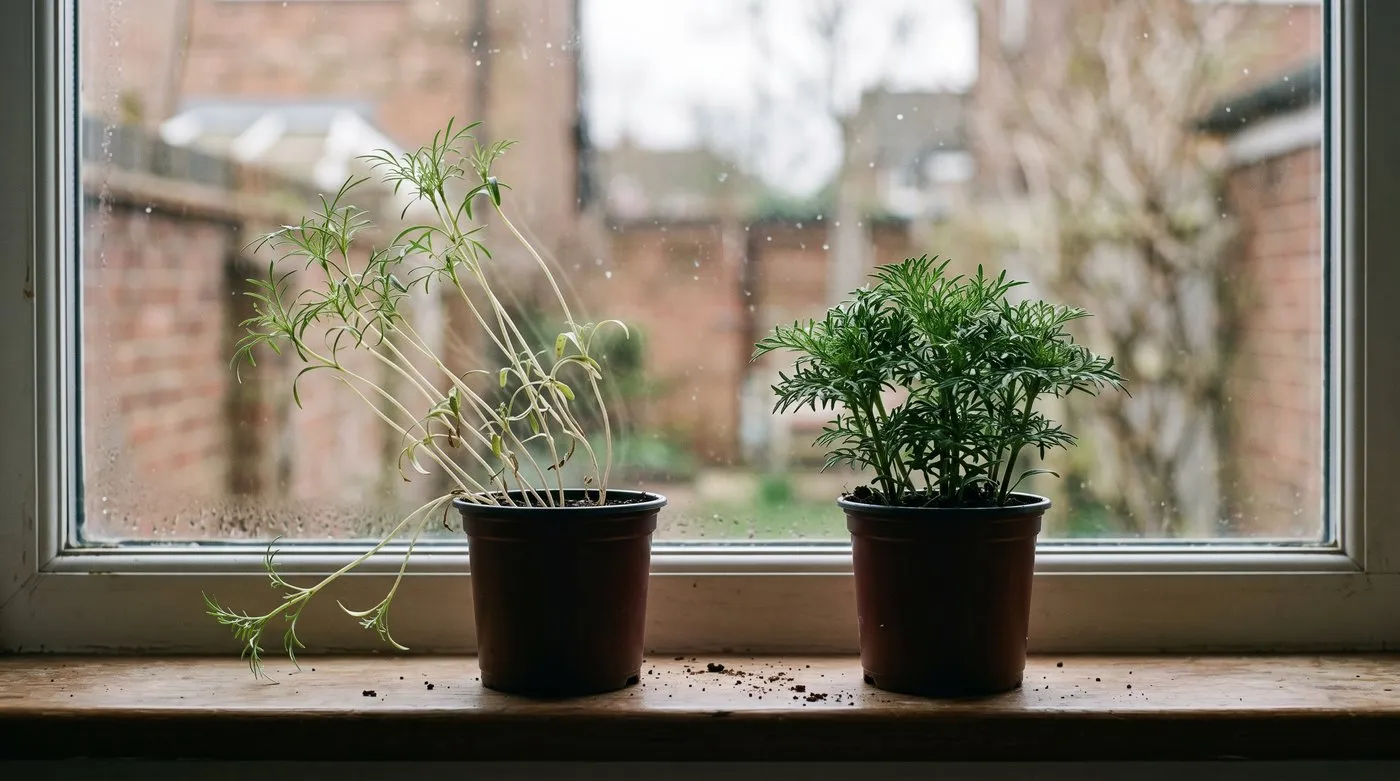
Sow too early and seedlings stretch for the light like those on the left. Waiting until mid-March gives you sturdy plants like those on the right.
How to harden off half-hardy annuals properly
Hardening off is where lots of half-hardy annuals come unstuck. Plants raised in a warm house can’t cope with a sudden move to chilly nights and wind. Their leaves and stems are soft, so they need time to toughen up.
Take about two weeks. On the first couple of days, put seedlings outside in a sheltered, shady spot for 2-3 hours in the warmest part of the afternoon. Bring them in before 4pm. Leave them out a little longer each day through the first week, with a bit more sun. In the second week, leave them out all day, and only bring them in if nights are forecast below about 8°C. By day 14 they’re ready. A cold frame makes the whole thing easier.
 A cold frame makes hardening off almost foolproof. Just open the lid a little more each day.
The top 15 half-hardy annuals for UK gardens
All of these flower well in an average UK summer and cope with clay, wind and our changeable weather.
Cosmos bipinnatus
The most generous half-hardy annual you can grow. Cosmos flowers from July to October and gives you armfuls of stems for the vase. The feathery plants reach 90-120cm, with flowers in white, pink, magenta and crimson. ‘Purity’ (white), ‘Dazzler’ (magenta) and ‘Rubenza’ (deep crimson) are lovely. It copes with light clay and a little shade, and self-seeds after mild winters. Our cosmos growing guide compares varieties.
Zinnia elegans
Zinnias want your warmest, most sheltered spot. In return you get big, double blooms in every colour but blue, which last well in a vase. ‘Benary’s Giant’ grows to 90cm, while compact ‘Zahara’ (25cm) suits pots. Wait until the soil has warmed up before planting out. Our zinnia growing guide has tips on pinching and mildew.
Nicotiana sylvestris
This tall tobacco plant reaches 150cm, with drooping white trumpets that smell gorgeous in the evening. Plant it near a seat or an open window. Hawk-moths visit at dusk. Smaller ones include N. alata (60-90cm, mixed colours) and N. langsdorffii (90cm, lime green bells). Nicotiana copes with part shade better than most.
 Nicotiana sylvestris fills the garden with scent at dusk. Perfect beside a seat.
Cleome hassleriana
Spider flower is tall and striking, reaching 120-150cm with big airy heads of pink, purple or white. The thorny stems put rabbits off. It needs warm nights and shelter from wind. ‘Violet Queen’ and white ‘Helen Campbell’ are good choices.
Tithonia rotundifolia
The Mexican sunflower has bright orange-red daisies on sturdy 150-180cm stems from August to frost. Butterflies love it late in the season, especially red admirals and painted ladies. ‘Torch’ is the classic tall one. ‘Fiesta del Sol’ is a compact 60-70cm for smaller gardens.
Rudbeckia hirta
Black-eyed Susan flowers non-stop from July to October. Plants reach 50-70cm, with golden, orange or two-tone daisies around a dark centre. ‘Cherokee Sunset’ is fully double. ‘Cappuccino’ has unusual brown-red tones. Sow in February, as it’s slow to get going. It’s really a short-lived perennial, but it’s best treated as an annual here.
Amaranthus
Love-lies-bleeding (A. caudatus) has long, dangling crimson tassels on 120cm plants. ‘Hot Biscuits’ has upright bronze-orange plumes. Both look dramatic in mixed borders and in a vase. It needs full sun and warmth but copes with poor soil. For a smaller relative that dries beautifully for winter vases, try gomphrena (globe amaranth).
Celosia
Cockscomb and plumed celosia bring a splash of tropical colour. The ‘Bombay’ series makes compact 30cm plants in hot pinks, oranges and reds. Celosia needs the most warmth to come up and the most sheltered spot in the garden.
Annual salvia
Painted sage (Salvia viridis) has colourful bracts in blue, pink and white on 45-60cm stems. Salvia coccinea ‘Lady in Red’ (60cm, scarlet) flowers from July to frost. S. farinacea ‘Victoria’ (45cm, blue spikes) is great in formal bedding. Bees love all of them.
Verbena bonariensis
This tall verbena reaches 150-180cm, with little purple flower clusters on wiry stems from July to November. You can see right through it, so it works at the front or middle of a border despite its height. It self-seeds more reliably than any other plant here, and butterflies adore it. Our guide to growing Verbena bonariensis covers sowing and overwintering.
 Verbena bonariensis flowers from July to November and loves to pop up around the garden.
Ricinus communis
The castor oil plant grows 150-200cm in one season, with huge, hand-shaped leaves in green, bronze or deep purple-red. ‘Carmencita’ is the best dark-leaved one. It’s grown for its leaves, not flowers. All parts are very poisonous, especially the seeds, so skip it if you have young children. It makes a bold statement in drought-tolerant borders. For something smaller, coleus is the other leafy half-hardy worth growing, with amazing leaf colour even in shade.
Dahlia from seed
Dahlias from seed flower in their first year and cost far less than tubers. ‘Bishop’s Children’ has dark leaves and single flowers in mixed colours. ‘Coltness Hybrids’ make compact 45cm plants. Sow in February at about 20°C and treat them like half-hardy annuals. They’ll form tubers by autumn that you can lift and store. Our dahlia growing guide covers tuber care.
Tagetes (French and African marigolds)
French marigolds (20-30cm) and African marigolds (60-90cm) are about as easy as it gets. French marigolds are a favourite companion plant, often grown beside tomatoes in the greenhouse. ‘Zenith’ and ‘Inca’ are reliable African types. Our marigold guide covers the lot.
Lobelia erinus
Trailing lobelia is the classic plant for baskets and pots. Bushy types reach 10-15cm, and trailing ones tumble 30-40cm. Flowers come in blue, purple, white or carmine. Sow in February on the surface of the compost, as the seed is as fine as dust. Keep it moist, or it stops flowering. A weekly liquid tomato feed keeps it going.
Petunia
Petunias flower from June to October in just about every colour. Big-flowered types suit pots. Smaller-flowered types cope better with rain in beds. Trailing ‘Surfinia’ types tumble from hanging baskets. Deadhead often. Our petunia growing guide covers all three.
The top 10 half-hardy annuals compared
| Plant | Height | Spacing | Sow indoors | Colours | Best for |
|---|---|---|---|---|---|
| Cosmos | 90-120cm | 40-50cm | Mid-March | White, pink, magenta, crimson | Cutting, borders |
| Zinnia | 60-90cm | 25-30cm | Late March | All but blue | Cutting, borders |
| Nicotiana sylvestris | 120-150cm | 50-60cm | Early March | White | Evening scent, back of border |
| Cleome | 120-150cm | 40-50cm | Mid-March | Pink, purple, white | Height, borders |
| Mexican sunflower | 150-180cm | 60cm | Late March | Orange-red | Butterflies, back of border |
| Rudbeckia hirta | 50-70cm | 30cm | February | Gold, orange, two-tone | Cutting, borders, pots |
| Verbena bonariensis | 150-180cm | 40cm | February | Purple | See-through planting |
| Celosia | 30-90cm | 20-30cm | Late March | Red, pink, orange, yellow | Bedding, pots |
| Annual salvia | 45-60cm | 25-30cm | Early March | Blue, red, pink, white | Bedding, bees |
| French marigold | 20-30cm | 20cm | Late March | Yellow, orange, red | Edging, veg patch |
How to pinch half-hardy annuals for more flowers
Pinching out the growing tip makes a plant branch out, so you get lots more flowering stems. It works on cosmos, zinnia, cleome, rudbeckia and dahlia. Don’t pinch nicotiana, lobelia or petunia.
Pinch when seedlings are 15-20cm tall with 4-5 pairs of proper leaves. Nip out the top just above a pair of leaves with your fingers or clean snips. Within a week, two or more side shoots grow from below, and each one gives you its own flowers.
Pinched plants start flowering a little later, but you get far more flowers over the summer. Our guide to growing annuals from seed covers pinching for all sorts of annuals.
 Pinched cosmos makes a bushy plant covered in flowers by midsummer.
Feeding and watering half-hardy annuals
Most half-hardy annuals are hungry. They grow fast and flower hard. A weekly liquid feed from the first buds until frost keeps them going. Use a tomato feed, diluted as the label says.
Water at the base, not over the leaves. Wet leaves invite grey mould and mildew. Water in the morning so the leaves dry before evening. Pots need watering every day in July and August.
After planting out, spread 5cm of garden compost around the plants. It holds in moisture, keeps weeds down and feeds the soil. On heavy clay, a 3cm layer of gravel round the stem helps water drain away, which stops celosia and cleome rotting at the base.
Common problems with half-hardy annuals in the UK
The usual troubles are late frosts, cool summers and slugs. For frost, harden off properly and be patient. Don’t plant out before mid-May in England or early June in Scotland, however warm April feels.
Cool summers hold back heat-lovers like zinnia, celosia and Mexican sunflower. In a cool year, cosmos, nicotiana and verbena do better. Or sow a frost-tough annual like candytuft straight outside instead. A sunny south-facing wall or fence gives a little extra warmth that helps the fussier ones.
Slugs love freshly planted seedlings. Protect them with copper tape rings, beer traps or wool pellets for the first few weeks. Once the stems toughen up, slugs leave them alone. Biological slug control with nematodes in spring covers the risky planting-out weeks.
Last frost dates across the UK
The last frost date tells you when to plant out. Get it wrong and you lose weeks of indoor growing. These are rough averages, so check your local forecast each year.
| Region | Usual last frost | Safe to plant out |
|---|---|---|
| South coast and London | Late April | Early May |
| South-west England | Early May | Mid-May |
| Midlands | Mid-May | Late May |
| Northern England | Late May | Early June |
| Scotland (lowlands) | Late May to early June | Mid-June |
| Scotland (highlands) | Mid-June | Late June |
To play it safe, wait a week after your usual last frost date. Losing a week’s growth is nothing compared to losing a tray of seedlings to a surprise frost. The RHS advice on frost is worth a read each spring.
Frequently asked questions
What is the difference between half-hardy and hardy annuals?
Half-hardy annuals are killed by frost, so you start them indoors. Hardy annuals cope with frost and can be sown straight outside from March. Half-hardy types like cosmos, zinnia and nicotiana need a propagator or warm windowsill and a few weeks indoors. Hardy ones like cornflower, nigella and calendula skip that step.
When should I sow half-hardy annuals in the UK?
Sow them indoors from late February to mid-April. Most like it warm to come up, around 18-24°C, and need a few weeks indoors before planting out. Plant out after the last frost. That’s often mid-May in southern England, late May in the Midlands and early June in Scotland and the north.
How do I harden off half-hardy annuals?
Start about two weeks before you plan to plant out. Put them outside in a sheltered spot for a couple of hours on day one, and a bit longer each day. Bring them in every night for the first week. In the second week, leave them out overnight if no frost is forecast. A cold frame makes it easier.
Can I direct sow half-hardy annuals outdoors in the UK?
Only after the last frost, in late May or June. Cosmos and nicotiana can work sown outside in a warm, sheltered garden, but they flower weeks later. Zinnias, celosia and cleome need warm soil to come up and rarely do well sown outside here.
Which half-hardy annuals are best for cutting?
Cosmos is the top cut flower and just keeps coming. Zinnias give big, long-lasting blooms. Nicotiana sylvestris adds height and scent. Rudbeckia flowers from July to October, and cleome gives unusual spidery blooms. Cut them in bud and stand them in cool water to make them last.
Do half-hardy annuals self-seed in UK gardens?
Some do in mild areas. Nicotiana sylvestris, Verbena bonariensis and cosmos self-seed in sheltered south-facing gardens. The seedlings come up late, though, and may not flower before frost in colder areas. Inland, Verbena bonariensis is usually the only reliable one. Collect seed from your best plants in September and keep it dry for spring.
What is the cheapest way to grow half-hardy annuals?
Grow from seed rather than buying plug plants. One packet of cosmos seed gives you dozens of plants for the price of a few plugs. You’ll need a warm windowsill or propagator and some seed trays, but they last for years. Save seed from your own plants and next year is almost free.
Our team produces practical UK gardening guidance from source research, contributor records and established horticultural practice. Editorial standards are overseen by Matt W.


