Key takeaways
- The RHS scale has 9 bands from H1a to H7; most UK mainland gardens need H4 (-10C to -5C) or H5 (-15C to -10C)
- USDA maps put the UK in zones 7b to 10a, the same as parts of Georgia and Texas, but our July average of 21C is far too cool to ripen the same plants
- The US system has a second map Britain never quotes: the AHS heat zone map, on which the UK scores 1 or 2 out of 12
- Winter wet kills more labelled-hardy plants than frost: our 'Hidcote' lavender died at -5.4C in clay and survived -6.1C in a gritty raised bed
- Altitude costs roughly 0.6C per 100m, so a garden at 300m runs about 2C colder than the same soil at sea level
- Deacclimation takes 3 to 5 days above 10C while acclimation takes 2 to 4 weeks, which is why April frosts kill plants that January could not
Britain runs on the RHS hardiness rating instead, a scale of nine bands from H1a to H7. No UK plant label has used a USDA zone since 2012. This guide sets out what each rating means in degrees Celsius, how the two systems roughly convert, why our maritime climate makes the American number flattering, and why on heavy soil the real killer is water rather than cold. Get this right and you stop replacing the same dead plant every third spring.
What the RHS hardiness ratings actually mean
The RHS hardiness rating arrived in 2012 and replaced the old wording of fully hardy, half hardy and tender. Those words had no agreed temperatures behind them, so two growers could label the same shrub differently and both be right. The H scale fixed that by attaching a defined Celsius band to every rating.
The scale runs H1a, H1b, H1c, H2, H3, H4, H5, H6, H7. Nine bands. Each one states the lowest air temperature the plant should survive in open ground, once established and fully hardened off. H7 sits below -20C and covers plants that shrug off a Cairngorm winter. H1a sits above 15C and covers tropicals that need a heated glasshouse all year.
What matters more is what the rating leaves out. It is a measurement of air temperature taken in a Stevenson screen 1.25m above short grass. It says nothing about your soil, your drainage, your wind exposure, how long the cold lasts, or how fast the temperature fell. Those four factors decide most UK plant deaths. The number on the label is one input, not a verdict.
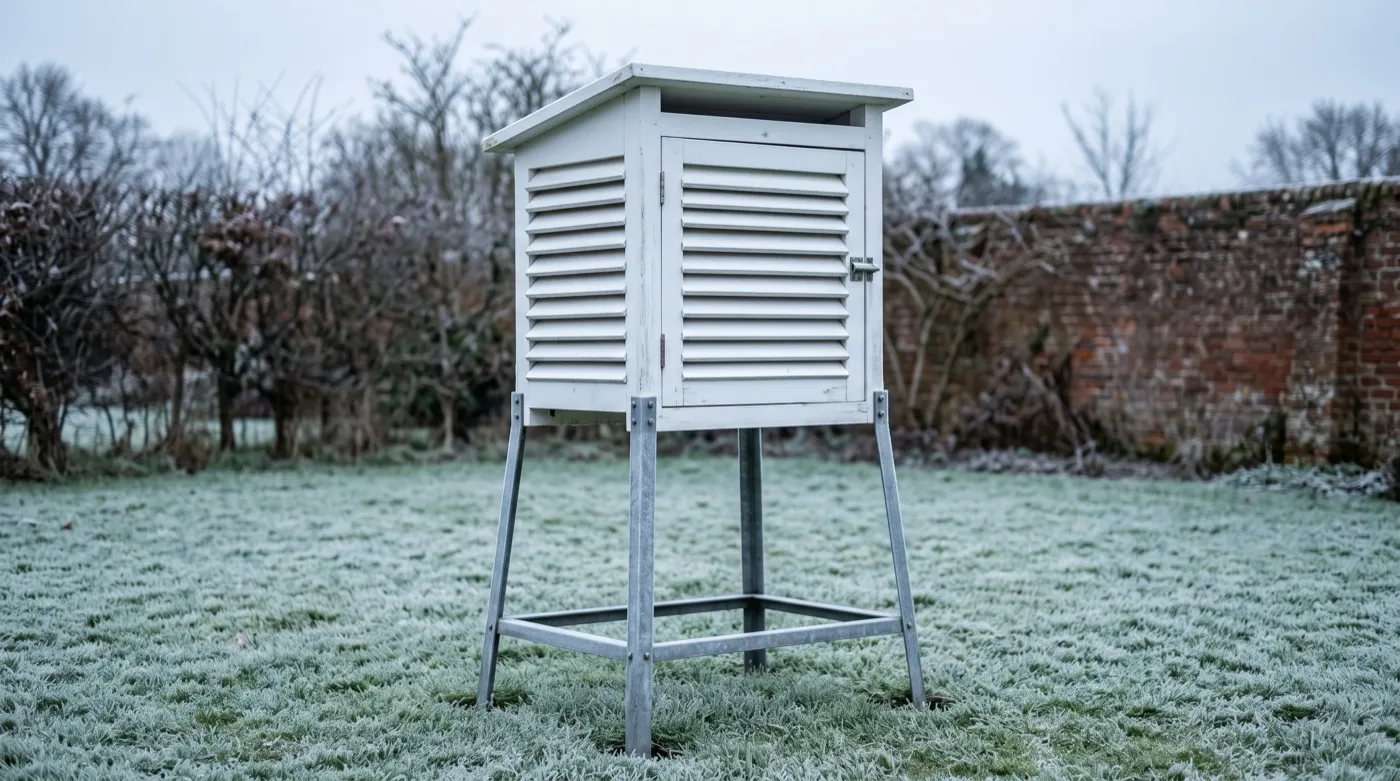 Every H rating traces back to a box like this: air temperature, 1.25m above short grass. Your plants live at ground level, in your soil.
Why USDA zones mislead UK gardeners
The USDA Plant Hardiness Zone Map was built for the continental United States in 1960 and revised in 2012 and 2023. It divides land by one variable only: the average annual extreme minimum temperature, in 5.6C zones split into 2.8C a and b halves. That is the whole system. Nothing else goes into it.
For a continental climate that works reasonably well, because in Ohio or Nebraska the coldest night predicts a great deal about the rest of the year. For a small island parked in the North Atlantic Drift it falls apart. The warm current keeps our winter minima strikingly mild for the latitude. Britain sits between 50N and 59N, the same band as Labrador and Moscow, yet Penzance rarely drops below -2C. On the USDA map that flattering minimum drags most of the UK into zones 8 and 9.
Then a gardener reads that a crepe myrtle is hardy in zone 8, orders one, and watches it sit there for six years without flowering. It never froze. It never ripened either. Our summers are too cool to finish the wood, and the USDA map has no column for that.
 West Cornwall reaches USDA 10a on winter lows alone, which is why echiums and tree ferns survive there. Summer heat still caps what will ripen and set seed.
RHS ratings and USDA zones compared
This is the conversion nobody publishes properly, with the reality check that makes it usable. Read the last column before you trust the third.
| RHS rating | Temperature band | Rough USDA equivalent | What survives it | UK reality check |
|---|---|---|---|---|
| H7 | Below -20C | Zone 6 and colder | Scots pine, birch, most native trees, Sedum | Safe anywhere in Britain, including Braemar |
| H6 | -20C to -15C | Zone 6b to 7a | Yew, hornbeam, Geranium, most hardy shrubs | Fine everywhere except the highest Highland gardens |
| H5 | -15C to -10C | Zone 7b to 8a | Lavender, rosemary, Ceanothus, bay | Only true on free-draining soil. Halve it on wet clay |
| H4 | -10C to -5C | Zone 8a to 8b | Hebe, Choisya, Phormium, many roses | The default for lowland England, risky above 200m |
| H3 | -5C to 1C | Zone 9a to 9b | Cordyline, Melianthus, Agapanthus, Salvia | Coastal and city gardens only. Lost in an inland frost hollow |
| H2 | 1C to 5C | Zone 10a | Pelargonium, Fuchsia ‘Thalia’, Streptocarpus | Frost-free glasshouse. Nowhere outdoors year round |
| H1c | 5C to 10C | Zone 10b | Cyclamen persicum, many houseplants | Unheated glasshouse. Outside from June to September |
| H1b | 10C to 15C | Zone 11 | Anthurium, Calathea, most tropical foliage | Heated glasshouse or a warm room |
| H1a | Above 15C | Zone 12 | Tropical orchids, Cocos | Heated glasshouse all year, no exceptions |
The USDA column is a rough map of winter lows and nothing more. Note how it collapses at H5: a plant sold as zone 8 hardy in America is being judged in a place with 90 days above 30C, and that heat load changes the plant completely. Our version of the same plant enters winter with soft, unripened growth and dies at a temperature its American twin ignores.
The heat map the US uses and Britain never mentions
Here is the point that undoes most zone advice. The United States runs two plant maps, not one. The USDA map handles cold. The AHS Plant Heat Zone Map, published in 1997, handles heat, and it grades land 1 to 12 by the number of days per year above 30C.
Zone 12 sees more than 210 such days. Zone 1 sees fewer than one. The UK averages roughly 5 to 10 days above 30C in the warmest parts of the south east and almost none in Scotland, which puts the whole country at AHS heat zone 1 or 2 out of 12. Almost every American plant description carries both numbers, written like “USDA 8-10, AHS 9-3”. UK gardeners copy the first pair and drop the second, and the second is the one that explains our failures.
Wood ripening is the mechanism. Many woody plants need accumulated summer warmth to convert soft green growth into lignified, cold-tolerant tissue. That process runs on growing degree days, roughly the total warmth above a 10C base. A Georgia summer banks two to three times the growing degree days of a Staffordshire one. Same USDA zone, entirely different plant going into November.
Winter wet kills more plants than cold ever does
This is the single biggest gap in hardiness advice, and it is the reason a rating can be honest and still get you killed. Waterlogging, not frost, is what finishes most so-called hardy Mediterranean plants in Britain.
Saturated soil holds no air. Roots respire and need oxygen, and a clay soil at field capacity runs anaerobic within 24 to 48 hours. The fine roots suffocate first. Then Phytophthora and Pythium, water moulds whose zoospores actually swim, colonise the dying tissue. By the time the plant collapses in March the gardener blames the frost in January. The damage was done in November, underground, with no frost involved at all.
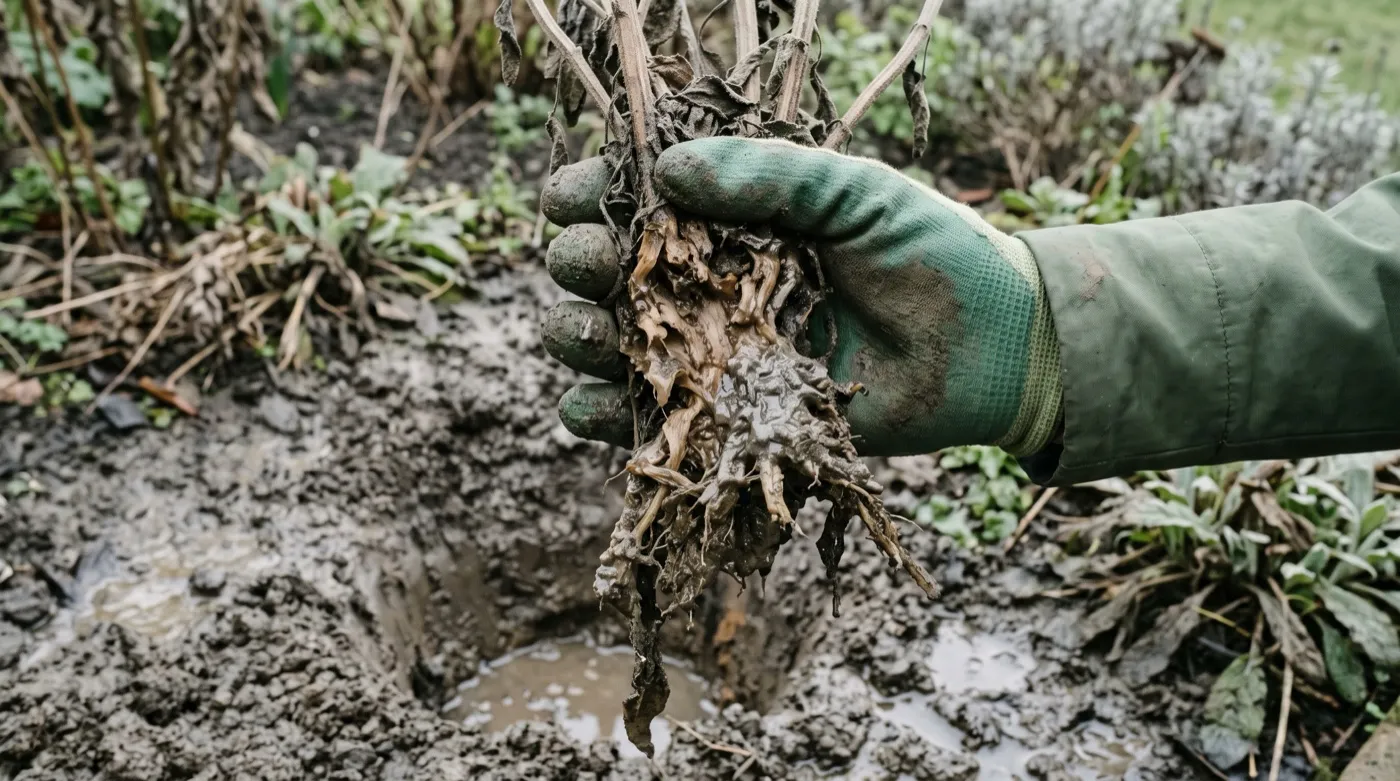 Winter wet damage: the crown is blackened, soft and smells sour. This plant was rated H5, hardy to -15C, and died at -5.4C in clay.
How cold actually kills a plant, stage by stage
Understanding the mechanism is what separates a rating from a prediction. Freezing damage runs through five stages, and the temperature number only describes stage three.
- Acclimation, September to November. Day length falling below about 11 hours plus a run of nights at 0C to 5C triggers cold hardening. The plant shifts sugars and proteins into its cells, lowering the freezing point of the sap. This takes 2 to 4 weeks and is not optional.
- Extracellular ice, -2C to -5C. Ice forms first in the spaces between cells, where the water is purest. Water is drawn out of the cells towards that ice. The plant survives this stage comfortably.
- Cellular dehydration, below -5C. More water leaves the cells. They shrink. Injury begins once roughly 60% of cell water has gone, and this is the point the H rating is trying to describe.
- Intracellular ice, any temperature if the drop is fast. If the temperature falls quicker than about 2C per hour, water inside the cell freezes before it can move out. The crystals shred the membranes. This damage is instant and permanent.
- Thaw desiccation, sunny mornings after a hard night. Frozen soil holds water the roots cannot reach while sun and wind pull moisture out of the leaves. Evergreens brown on the exposed side while the sheltered side stays green.
The critical mistake is treating the rating as a fixed floor. Deacclimation takes 3 to 5 days above 10C. Acclimation takes 2 to 4 weeks. So a mild fortnight in March unwinds a plant’s entire winter hardening in under a week, and the April frost that follows kills at -3C a plant that shrugged off -12C in January. The number never changed. The plant did. Our guide to hardening off bedding, perennials and half hardies covers the same process running in reverse each spring.
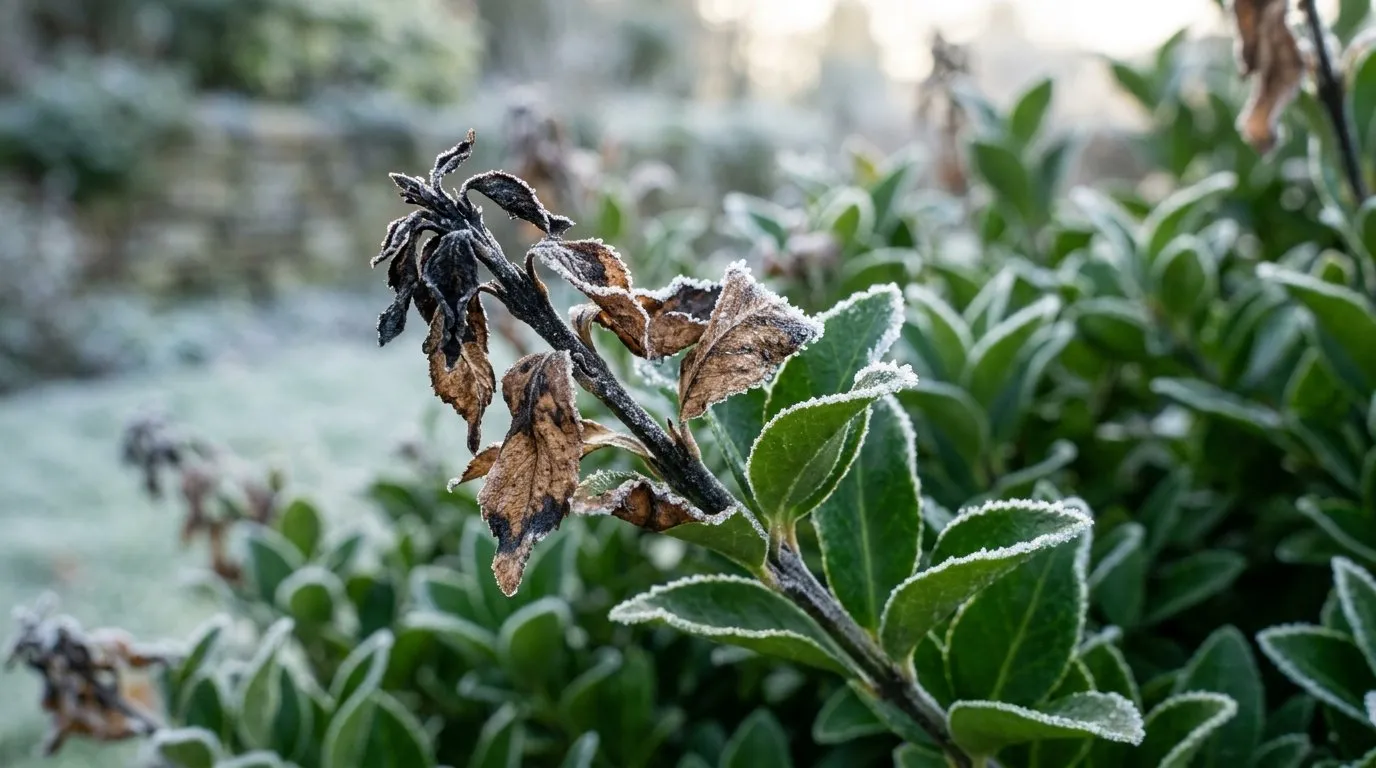 Cold damage runs tip-down and the tissue goes crisp. Compare the firm, pale crown here with the black mush of the waterlogged plant above.
How cold it really gets from Scilly to the Cairngorms
The UK is small and its hardiness range is enormous. Treating “the UK” as one zone is the second error after using USDA at all.
 Highland gardens need H6 or H7 as a floor. The same plant that thrives in Penzance has no chance here, four hundred miles north and 300m up.
Microclimates inside one garden
A frost pocket forms wherever cold air can flow downhill and then cannot escape. Cold air is denser than warm air and behaves like water: it drains to the lowest point and pools behind any solid barrier. A close-boarded fence or a dense conifer hedge across the bottom of a slope dams it. Expect 3C to 5C colder than ground 10m up the same slope. The fix is cheap: take two boards off, or leave a 100mm gap at ground level, and let the cold run through.
A south-facing wall does the opposite. Brick absorbs solar radiation all day and releases it overnight, holding the air within 300mm of the wall 2C to 4C warmer than open ground. That is a full RHS band, sometimes two. It is why a fig fruits in Leeds and a Ceanothus survives in Sheffield.
The catch is the rain shadow. The strip within 600mm of a house wall receives 30% to 50% less rain than open garden, because the roof throws it clear. That strip is warm and dry, the exact combination Mediterranean plants want, which is why the warmest spot in the garden is also the only place lavender behaves. It also means anything planted there needs watering in summer for its first two years.
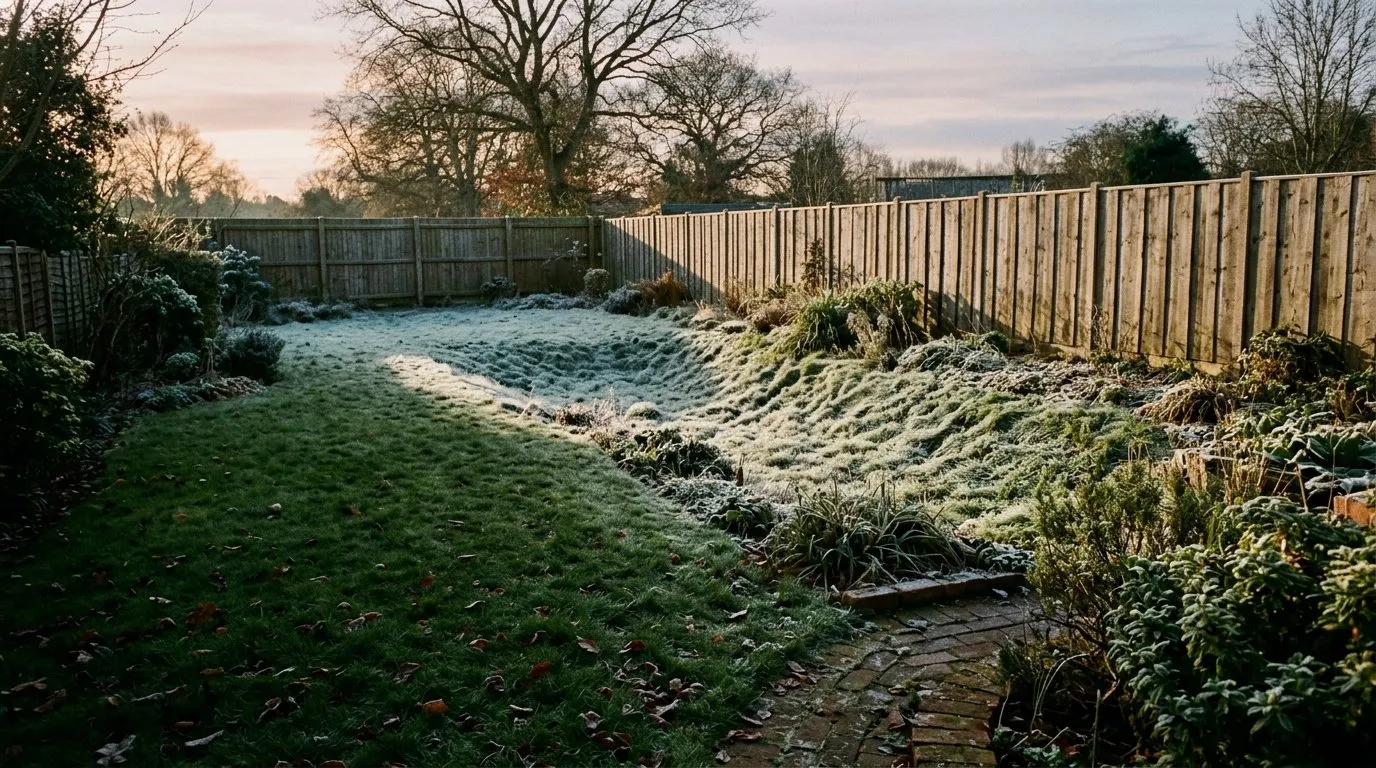 A textbook frost pocket at dawn. Cold air has drained downhill and pooled behind the fence, leaving the higher ground 4C warmer and frost free.
Reading a plant label without being fooled
Garden centre labels are marketing first and data second. Four words do most of the damage.
What to look for instead: the H number, usually on the reverse in small type next to the RHS logo. If it is absent, the botanical name will get you there in thirty seconds on your phone. Beware plants grown under glass in the Netherlands and sold in March. They have never been hardened, so their stated rating is theoretical until they have sat outside through an autumn.
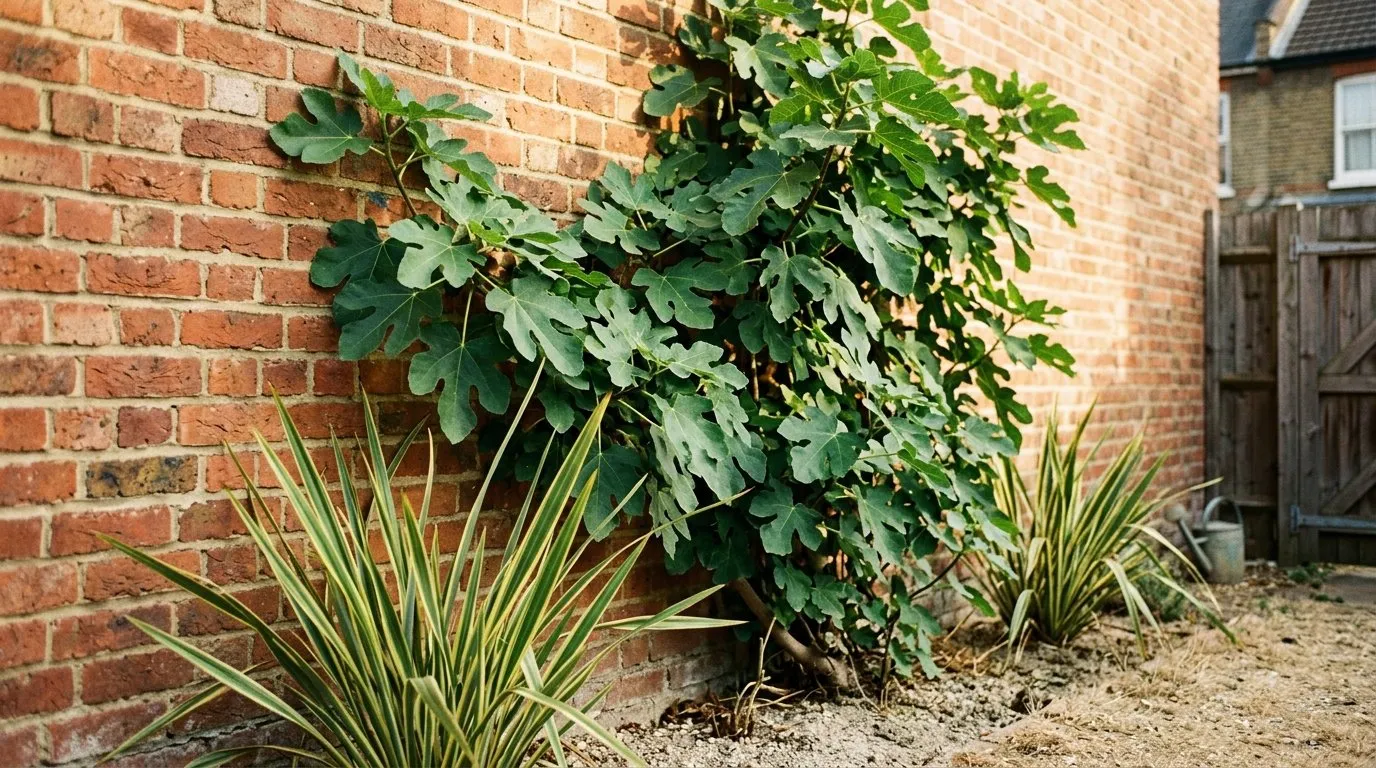 A south-facing wall holds the air 2C to 4C warmer overnight, a full RHS band. The dry rain shadow at its base suits Mediterranean plants perfectly.
Which hardiness data source should you trust?
The gold standard is the H rating combined with a drainage test, and neither half works without the other. The drainage test takes ten minutes: dig a hole 300mm deep and 300mm wide, fill it with water, let it drain, fill it again, and time the second drain. Under 4 hours is free-draining and the H rating stands. Over 12 hours is a wet site and you should treat the rating as one band softer, sometimes two.
A month-by-month hardiness calendar for UK gardens
| Month | What hardiness needs from you |
|---|---|
| January | Read and reset the min-max thermometer. Log the coldest night per position |
| February | Check crowns of borderline plants for black rot. Lift and replace before growth starts |
| March | Do not clear winter fleece yet. The deacclimation trap runs to late April |
| April | Plant anything borderline now, not in autumn. Watch for late radiation frosts on clear nights |
| May | Last frost date: roughly 10 May in the south west, 5 June inland and north. Plant H3 subjects out after it |
| June | Run the drainage test on any bed that lost plants. Dry ground gives a truer read of structure |
| July | Note which plants scorch. Heat stress in a 30C week predicts winter weakness |
| August | Take cuttings of H3 and H4 plants as insurance. Rooted backups cost nothing |
| September | Stop feeding. Nitrogen after early September pushes soft growth that will not ripen |
| October | Cut grit into wet beds now. Lift tender bulbs and tubers before the first frost |
| November | Fleece borderline evergreens. Raise pots onto feet so they drain rather than freeze solid |
| December | Check ties and stakes. Wind rock opens a hole round the crown that fills with water |
Timing beats protection. Autumn planting is standard advice for hardy stock and wrong for anything borderline, because a plant put in during October faces its first winter with three weeks of root growth behind it.
Why hardy plants still die on your plot
The root cause is a measurement mismatch, and almost nobody says it out loud. Published hardiness is an air temperature recorded 1.25m above short grass in a ventilated screen. Your plant dies at soil level, in your soil, in your garden. Those two places are not the same place, and on a clear still night they can differ by 4C or more because the ground radiates heat away faster than the air above it.
That mismatch gets missed because every source repeats the same air figure. The nursery copies the RHS. The website copies the nursery. The number travels intact through a dozen pages and never once touches your drainage, your slope, your aspect or the November water table. It looks authoritative precisely because everyone agrees on it.
The permanent fix is to stop treating the plant as the variable. Fix the site once and every future planting benefits. Cut 6mm horticultural grit into wet beds at roughly one 25kg bag per square metre and mix it through the top 300mm, or build up 200mm above the surrounding grade so water has somewhere to go. Do not dig a gritty hole in solid clay, because you have built a sump that fills and holds. Our guide to improving drainage in clay soil covers the earthworks, and if you would rather work with your ground than against it, the best plants for clay soil are the cheaper answer.
Common mistakes with hardiness ratings
If your garden is genuinely wet, cold and exposed, stop fighting it. The climate-resilient plants list and our roundup of hardy cacti and succulents that live outdoors both work from what survives rather than what a label claims. The wider plants section sorts everything else by conditions.
The honest summary on UK hardiness
The RHS scale is the right tool, and it is better than what came before it. It still only answers one question out of four. Cold matters, but wet, wind and duration matter as much, and none of them appear on any label or map. The RHS publishes its full hardiness rating definitions if you want the source rather than a summary of it.
Work in this order. Find your H number. Test your drainage. Buy a thermometer and learn your own coldest spot. Plant borderline things in spring. After that you can grow things your zone map says are impossible, and lose things it says are safe, and know exactly why in both cases.
Frequently asked questions
What hardiness zone is the UK in?
Most of the UK falls in USDA zones 8 and 9. The Isles of Scilly and west Cornwall reach 10a, London and the south coast sit around 9a to 9b, the Midlands and north are 8a to 8b, and the Scottish Highlands drop to 7a or lower. UK plant labels do not use these numbers. They use the RHS H1a to H7 rating instead.
Why do UK plant labels not use USDA zones?
The RHS replaced zone-style labels with its H1a-H7 rating in 2012. The old wording of fully hardy, half hardy and tender had no agreed temperatures behind it. The H ratings give a defined Celsius band for every plant. USDA zones were designed for the continental United States and never fitted a maritime island.
Does fully hardy on a garden centre label mean anything?
Very little: it has no fixed temperature and predates the current RHS scale. Growers still print it because it is familiar. Two plants both marked fully hardy can differ by 10C in real tolerance. Look for the H number on the back of the label, or check the variety before you buy.
Is the UK really the same zone as Georgia and Texas?
In winter lows yes, in summer heat nowhere close. USDA zones only measure the average annual minimum temperature. Atlanta and Leek can share a zone number while Atlanta bakes at 32C for weeks and Leek averages 20C in July. That heat gap decides whether wood ripens, so the shared zone number means nothing.
Why do hardy plants die in my clay soil?
Winter waterlogging drowns and rots the roots long before frost reaches them. Saturated clay runs out of oxygen within 24 to 48 hours. Roots then suffocate, and water moulds such as Phytophthora colonise the damaged tissue. The plant looks frost-killed in spring but the damage happened underground in November.
How much colder is a frost pocket?
A frost pocket typically runs 3C to 5C colder than ground 10m uphill. Cold air is denser than warm air and flows downhill at night, pooling behind any solid barrier. A close-boarded fence across the bottom of a slope turns the ground above it into a trap. Leaving a 100mm gap under the fence lets the cold drain away.
What RHS rating do I need for my garden?
H4 covers most UK gardens; choose H5 inland or above 200m. H4 means hardy to -10C, which handles an average winter across lowland England and Wales. Inland frost hollows, the Pennines and eastern Scotland regularly beat that, so H5 or H6 is the safer floor. Mild coastal gardens can risk H3.
Our team produces practical UK gardening guidance from source research, contributor records and established horticultural practice. Editorial standards are overseen by Matt W.