
Key takeaways
- Use the easy recipe: something tall, something bushy and something trailing
- Pick pots at least 30cm wide, always with drainage holes
- Buy pots labelled frost-proof if they'll stay out all winter
- Water daily in hot weather, and check with a finger the rest of the time
- Use ericaceous compost for acid lovers like skimmia and camellia
- An evergreen in the middle keeps a pot looking good all year
Lovely pots come down to three things: the right plant, the right pot and the right spot. Every patio, doorstep, balcony and courtyard in Britain has room for at least one cheerful container. How you put plants together matters more than which ones you pick, so here are some easy recipes to get you started.
What is the thriller-filler-spiller technique?
It’s a simple three-part recipe for a balanced pot. You pick one tall plant, some bushy ones and some trailing ones. It works in any pot 30cm or wider.
The thriller is the tall star. It goes in the middle, or at the back if the pot sits against a wall. Ornamental grasses like Pennisetum ‘Rubrum’, cannas and tall salvias all work. Aim for something roughly twice the height of the pot.
The filler is the bushy middle layer. Pelargoniums (bedding geraniums), heuchera, nemesia and osteospermum all do the job. Plant them about 10 to 15cm in from the edge.
The spiller tumbles over the rim and softens the pot. Trailing lobelia, bacopa, ivy, creeping Jenny and trailing verbena are all reliable. Space them about 8 to 10cm apart around the front and sides.
 The recipe in action: a tall grass in the middle, bushy plants around it and trailers spilling over the edge.
Seasonal container planting recipes
Spring container recipe (March to May)
- Tall: 7 tulip ‘Queen of Night’ bulbs, planted in October about 15cm deep
- Bushy: 3 viola ‘Sorbet XP Yellow’, about 10cm apart
- Trailing: 2 ivy ‘Glacier’, on opposite sides of the rim
- Extra: 10 grape hyacinth (muscari) bulbs tucked between the tulips, about 8cm deep
Plant it in October for a show in April and May. The near-black tulips look stunning against the yellow violas. Layering bulbs at different depths like this is called bulb lasagne planting, and it gives you flowers over a longer spell.
Summer container recipe (June to September)
- Tall: 1 salvia ‘Amistad’ in the middle
- Bushy: 3 pelargonium ‘Calliope Dark Red’, about 12cm in from the edge
- Trailing: 3 lobelia ‘Regatta Blue’ along the front, plus 2 white trailing verbena at the sides
Autumn container recipe (September to November)
- Tall: 1 ornamental cabbage ‘Osaka Red’ in the middle
- Bushy: 3 heathers (Calluna) ‘Garden Girls’ around it
- Trailing: 2 Carex ‘Evergold’ at the front
- Extra: 3 hardy cyclamen tucked between the heathers
Ornamental cabbages colour up best as the nights turn cold, so this pot gets better through autumn instead of fading. The carex stays green all winter, which tides you over to spring.
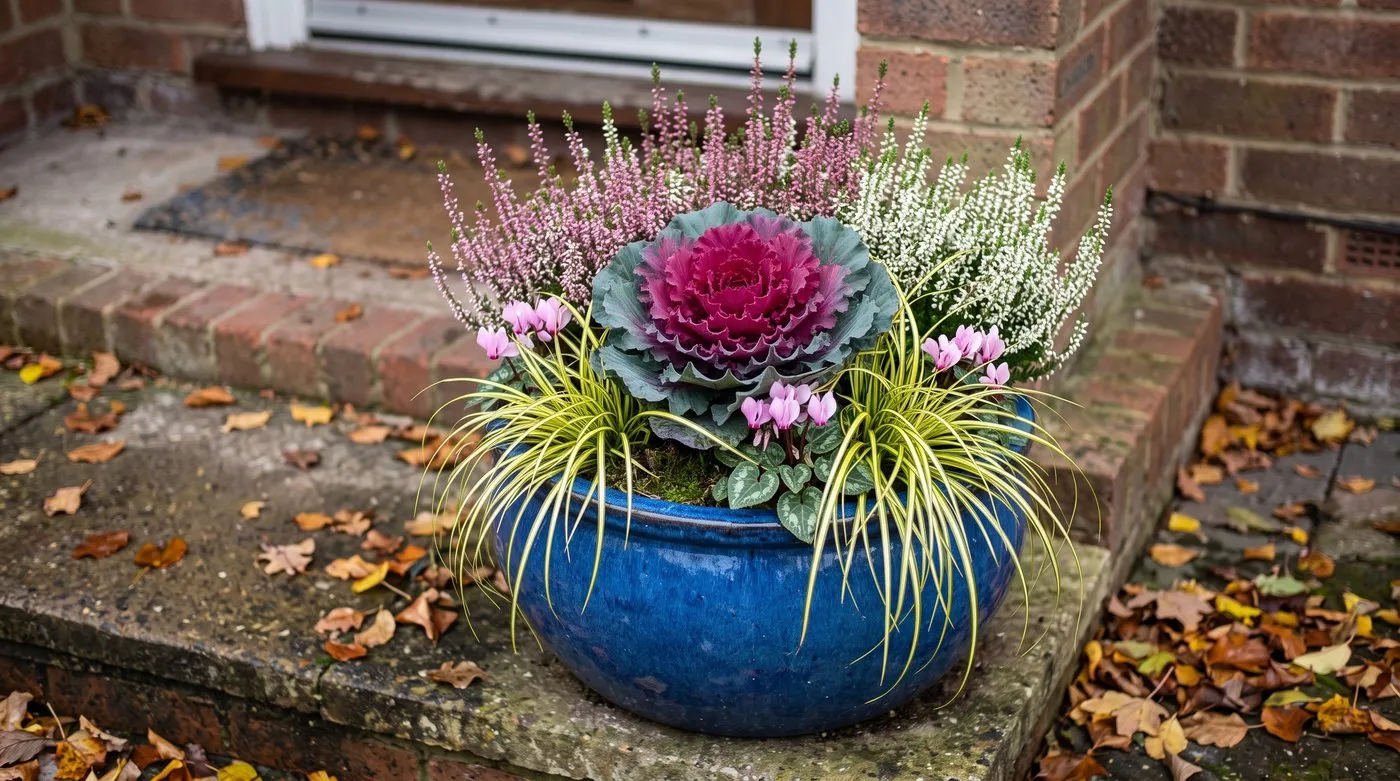
Ornamental cabbages colour up as nights turn cold, so this pot gets better through autumn. The carex carries on into winter.
Winter container recipe (November to March)
- Tall: 1 Skimmia japonica ‘Rubella’ in the middle
- Bushy: 2 Gaultheria procumbens at the front
- Trailing: 2 ivy ‘Glacier’ at the sides
- Extra: 1 Christmas rose (Helleborus niger) at the front
The skimmia holds red buds all winter and opens white flowers in spring. Gaultheria adds shiny red berries. Plant this one in ericaceous compost, because skimmia and gaultheria like acid conditions. All the plants are perennials, so you can keep them going for a few years.
 Keep the evergreens and swap the seasonal flowers around them, and your doorstep stays bright all year.
Which pot material is best for UK gardens?
For pots that stay out all year, frost-proof is the thing to look for. After that, it’s weight, looks and how quickly the compost dries out.
| Material | Frost | Weight | Dries out | Price |
|---|---|---|---|---|
| Terracotta (frost-proof) | Good if labelled frost-proof | Heavy | Quickly | Mid |
| Glazed ceramic | Good if labelled frost-proof | Heavy | Slowly | Mid to high |
| Fibre clay | Good | Light | Slowly | Mid to high |
| Plastic | Good | Very light | Slowly | Low |
| Stone or reconstituted stone | Good | Very heavy | Medium | High |
| Hardwood | Good | Medium | Medium | Mid |
| Metal (zinc, corten) | Good | Light to medium | Slowly | Mid to high |
Terracotta is the classic choice, and it lets roots breathe. The flip side is that it dries out faster than glazed pots in summer. Only buy pots labelled “frost resistant” or “frost proof”. Cheap terracotta can crack in its first cold winter.
Fibre clay is a great all-rounder. It looks like stone or clay but is much lighter, which matters on a balcony. Our balcony gardening ideas guide has more on keeping the weight down.
Wooden planters like half-barrels and Versailles boxes suit cottage and traditional gardens. Line them with heavy-duty plastic, with holes punched in the bottom, to keep wet compost off the wood. It’ll last much longer.
Best compost mix for containers
Use fresh peat-free multi-purpose compost and open it up with perlite or grit. Plain compost can pack down after weeks of watering, leaving roots short of air.
A good easy mix:
- Mostly peat-free multi-purpose compost, to hold water and food
- A few generous handfuls of perlite or grit, so it keeps draining well
- A little composted bark if you have it, for structure
Mix in slow-release fertiliser granules when you plant. They’ll feed the pot for months. From July, give flowering pots a liquid tomato feed every week or so, following the label.
For acid lovers like skimmia, camellia and blueberries, use ericaceous compost instead. Tap water in much of the UK is hard, so water these with rainwater where you can.
Container planting ideas for shade
Plenty of pots live in shade: north-facing doorsteps, shady courtyards and spots under trees. These combinations suit places that get only a few hours of sun.
Leafy shade pot:
- Tall: Japanese painted fern (Athyrium niponicum)
- Bushy: Heuchera ‘Palace Purple’ for deep burgundy leaves
- Trailing: Golden creeping Jenny for lime-green trails
Flowering shade pot:
- Tall: Astilbe ‘Fanal’ with dark red plumes
- Bushy: White bedding begonias, which flower for months
- Trailing: Lamium ‘White Nancy’ with silver-splashed leaves
Shady pots dry out more slowly, so check them every few days rather than daily. Slugs are the main nuisance in shade. A layer of sharp grit on top of the compost helps a little and looks smart too. These ideas sit nicely with our guide to the best plant combinations for borders.
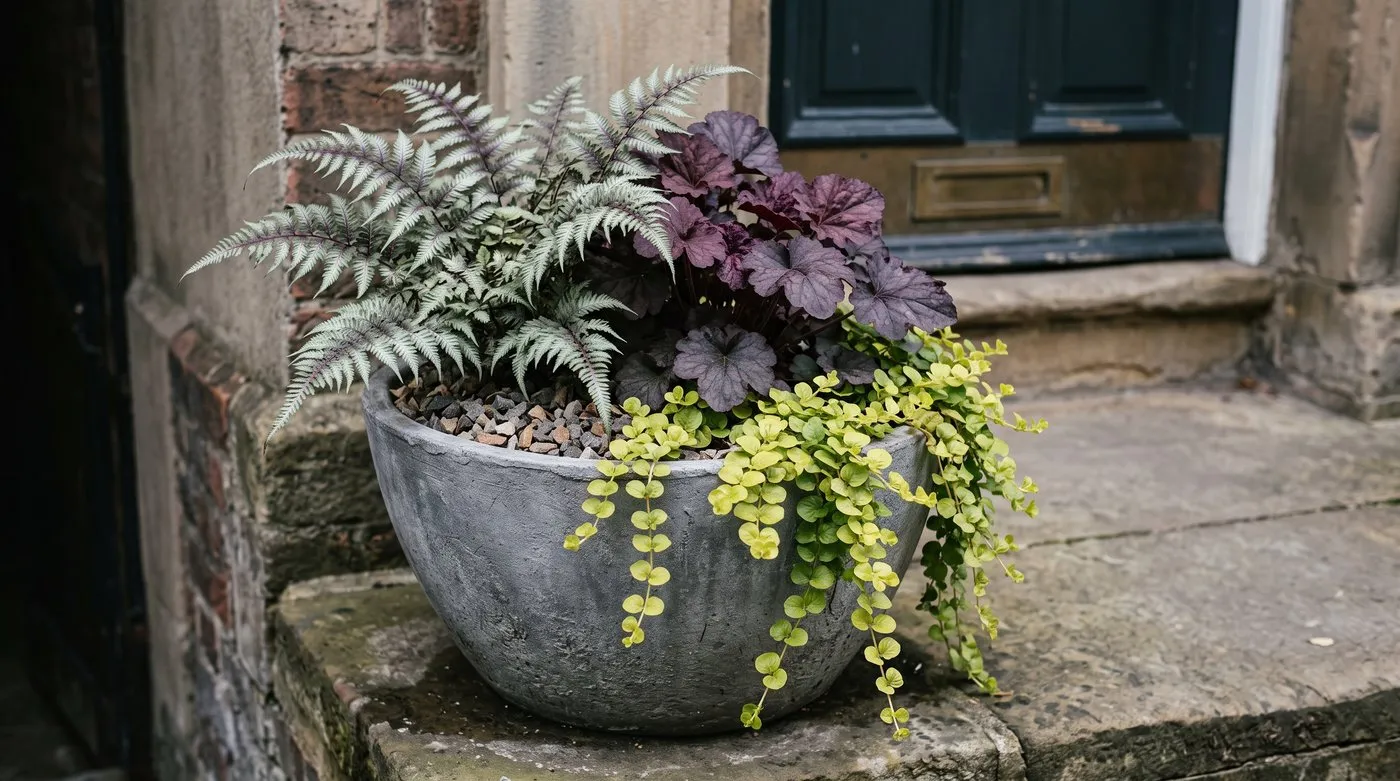
Leaf colour does the work in shade. Shady pots dry out more slowly, so check them every few days rather than daily.
Container planting ideas for full sun
South and west-facing spots get sun for most of the day. Mediterranean and drought-tolerant plants love it here, as long as the pot drains well. Add an extra handful of perlite or grit to the mix.
Mediterranean sun pot:
- Tall: Agapanthus ‘Midnight Star’ with deep blue flowers
- Bushy: Lavender ‘Hidcote’, clipped into neat mounds
- Trailing: Trailing rosemary tumbling over the edge
Bold colour sun pot:
- Tall: Canna ‘Tropicanna’ with striped bronze leaves
- Bushy: Osteospermum ‘Serenity Blue’ for daisies all summer
- Trailing: Bidens with masses of small yellow flowers
Once settled, both cope with dry spells better than most. Water them well and less often, rather than a splash every day, so roots grow down into the pot. To grow food in pots too, see our container vegetable gardening guide.
Many drought-tolerant plants that suit open ground are also brilliant in pots, especially against a hot south-facing wall.
Common mistakes with container planting
No drainage holes. This kills more pot plants than anything else. Every pot needs at least one hole in the base. A pretty pot without holes can be used as an outer sleeve, with a draining pot inside.
Cramming too much in. It’s tempting to pack a pot for instant impact, but crowded plants soon run short of water and food. Five to seven plants is plenty for a 40cm pot.
Using garden soil. Soil packs down in a pot, drains badly and can bring in weeds and pests like vine weevil. Always use fresh compost.
Forgetting to feed. The food in fresh compost runs out after a few weeks. Without more, flowers stop and leaves turn yellow. Slow-release granules at planting, then a liquid feed from midsummer, keeps things going.
Forgetting about frost. Roots in a pot get much colder than roots in the ground. Raise pots onto feet, group them against a house wall and wrap thin pots in bubble wrap from November.
 Evergreens and berries keep pots looking good through the winter. Grouping them by a wall helps keep the frost off.
Month-by-month container planting calendar
| Month | What to do |
|---|---|
| January | Order seeds and plug plants. Scrub empty pots clean. |
| February | Sow lobelia, petunias and begonias indoors in a warm spot. |
| March | Plant spring pots with violas, primroses and early bulbs. Top up permanent pots with fresh compost. |
| April | Start hardening off seedlings. Keep tender plants under cover until frosts are over. |
| May | Plant summer pots once the frosts have passed, usually around mid to late May. Add slow-release feed. |
| June | Deadhead often and water more as it warms up. Pinch back trailers to keep them bushy. |
| July | Start liquid feeding. Water daily in hot spells. |
| August | Keep feeding and deadheading. Take cuttings of pelargoniums and fuchsias for next year. |
| September | Plant autumn pots with heathers, ornamental cabbages and cyclamen. Water less as it cools. |
| October | Plant tulips, daffodils and grape hyacinths in pots for spring. |
| November | Move tender plants under cover. Raise pots onto feet and wrap thin pots. |
| December | Water evergreen pots now and then unless frozen. Add cut holly and dogwood stems for a festive touch. |
Use this alongside a wider container gardening plan, and our hanging basket guide for colour higher up.
How to keep containers looking good year-round
Build each pot around a permanent evergreen. Then swap the seasonal flowers around it a few times a year. You’ll always have something to look at, even in a grey January.
Good permanent plants for pots:
- Box, clipped into balls, spirals or cones
- Skimmia japonica, for red winter buds
- Phormium ‘Sundowner’, for bold bronze-pink sword leaves
- Carex ‘Evergold’, for golden-green grassy tufts all year
- Fatsia japonica, for big tropical-looking leaves in shade
Move permanent plants into a slightly bigger pot every 2 to 3 years. In the years between, scrape off the top 5cm of compost each spring and replace it with fresh compost and slow-release feed. Our guide to the best plants for pots year-round has many more ideas.
The RHS suggests grouping pots in odd numbers at different heights. Pot stands, upturned bricks or stacked slabs give you height without buying bigger pots.
Frequently asked questions
What is the thriller filler spiller method for containers?
It’s a simple three-layer recipe for a balanced pot. The thriller is a tall plant in the middle, like a grass, canna or salvia. The filler is bushy, such as geraniums, heuchera or nemesia. The spiller trails over the edge, like lobelia, bacopa or ivy. It works in any pot 30cm or wider.
What is the best compost for container planting in the UK?
Peat-free multi-purpose compost with added perlite or grit. The extra perlite or grit stops it packing down and keeps it draining well. Mix in slow-release fertiliser granules when you plant. Use ericaceous compost for acid lovers like skimmia and camellia.
How often should I water containers in summer?
Daily in hot weather, less often when it’s cool. Push a finger a few centimetres into the compost. If it feels dry, water until it runs out of the bottom. Terracotta dries out faster than glazed or plastic pots.
Can containers survive winter outdoors in the UK?
Yes, if the pot is labelled frost-proof. Fibre clay, plastic and good frost-proof terracotta or glazed pots can all stay out. Raise them on pot feet so they don’t sit in water. Wrap thin pots in bubble wrap during long cold spells.
What plants look good in pots all year round in the UK?
Evergreen shrubs make the backbone. Box, skimmia, euonymus and dwarf conifers keep their shape all winter. Plant seasonal flowers around them: cyclamen and heather for winter, violas and tulips for spring, petunias and geraniums for summer, and ornamental cabbage for autumn.
Do I need to put stones in the bottom of plant pots?
No, you don’t need to. A layer of stones or crocks doesn’t really help drainage. What matters is a drainage hole and a free-draining compost mix. Put a single crock over the hole if compost keeps washing out, and stand pots on feet.
How much does it cost to plant up a container display?
It depends mostly on the pot. The pot is the biggest cost, but it lasts for years. After that you’re buying compost, a handful of plants and some slow-release feed. Replanting the seasonal plants each time costs much less than starting from scratch.
Our team produces practical UK gardening guidance from source research, contributor records and established horticultural practice. Editorial standards are overseen by Matt W.


