Key takeaways
- Dig test holes about 60cm deep before you plan anything, to see what's under the turf
- Break up compacted ground by double digging or rotavating, and pick out rubble as you go
- Aim for at least 15cm of topsoil under a lawn and 30cm in borders
- Sort out drainage before planting if puddles hang around for hours after rain
- Plant hedges, trees and evergreen shrubs first to give the garden its shape
- Spread the work and the budget over three years
A new build garden usually comes with a neat rectangle of turf and not much else. Underneath, there’s often just a thin layer of topsoil sitting on rubble and ground that’s been squashed hard by months of building work.
Don’t worry, this is completely normal. And there’s good news: you have a blank canvas, with no overgrown jungle to clear and no inherited problems. You just need to fix the soil before you plant.
What is actually wrong with new build garden soil?
The ground under the turf has been squashed hard by building machinery, so water can’t drain away. Diggers, lorries and concrete mixers drive over your future garden for months. Their weight presses the air out of the soil.
On top of that hard layer, builders often spread only a thin skin of topsoil. A lawn wants at least 15cm of topsoil. Borders want at least 30cm.
How do I assess my new build garden soil?
Dig three test holes about 60cm deep in different parts of the garden. Use a spade so you can see what’s going on below the surface.
Note what you find as you go down:
- Top 15cm: How good the topsoil is, how deep the grass roots go, and any rubble
- 15-30cm: Where topsoil turns to subsoil, how hard it is, and more rubble
- 30-60cm: What the subsoil is (clay, sand or chalk) and whether it’s wet
Fill each hole with water and see how long it takes to drain. In healthy soil it should be gone within about 4 hours. If it’s still there after 12 hours, fix the drainage before you plant anything. Our soil drainage guide explains the test in more detail.
Test the pH too. New build soil is often a bit chalky, or alkaline, because of concrete and mortar dust. That limits what you can grow. Our guide to soil testing and pH adjustment shows you what to do about it.
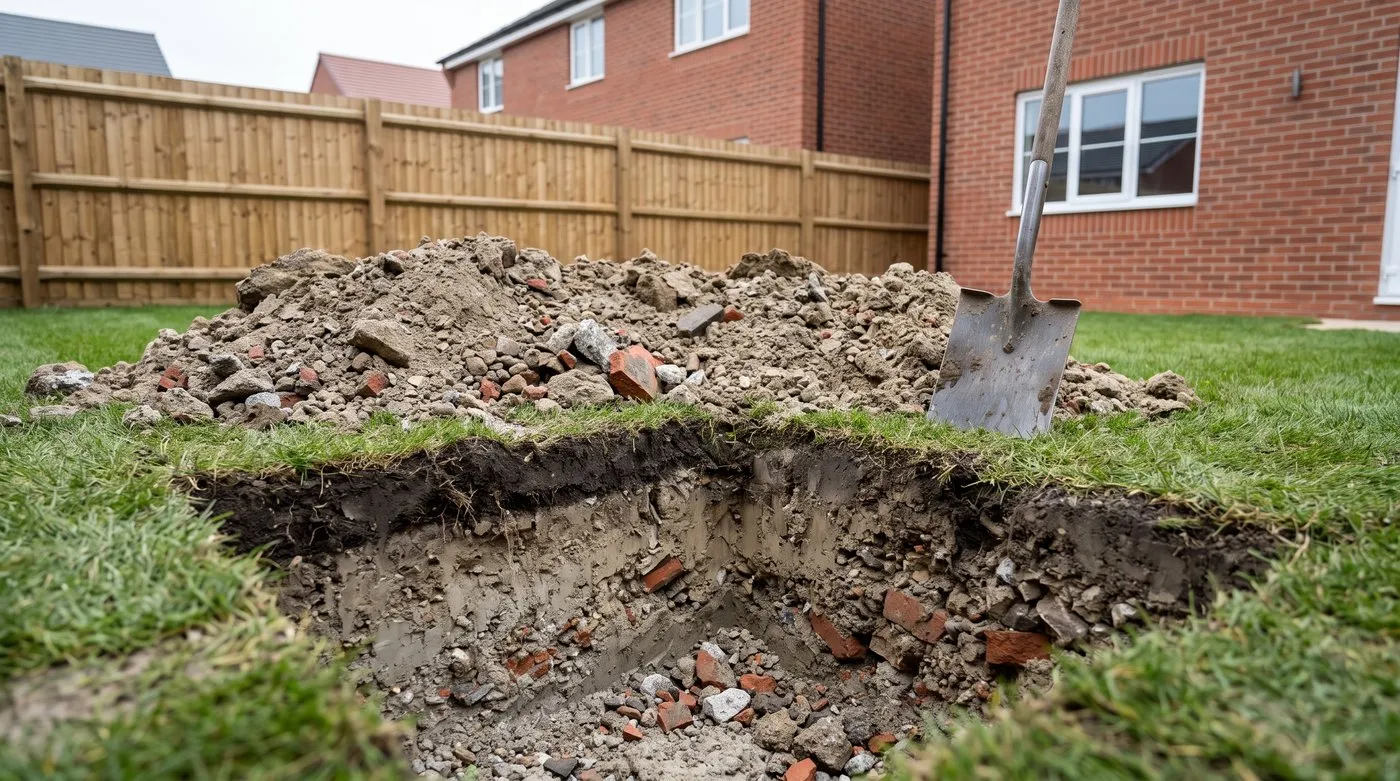
A test hole tells you more than any amount of guessing. If the dark layer stops after a few centimetres and the rest is rubble, sort the soil before you plant.
How do I fix compacted new build soil?
Break up the hard ground by rotavating or double digging to at least 30cm deep. This is the most important job of all. Skip it and every plant will struggle with soggy roots.
In a small garden, double digging by hand is doable. Dig out a trench one spade deep, fork over the bottom to break the hard layer, then move along. Allow a full weekend for a small back garden. It’s hard work, but it’s worth it.
For bigger gardens, hire a rotavator. Go over the ground twice, in two directions. A rotavator only reaches so deep, so follow up with a garden fork in planting areas to break any hard layer below.
Pick out rubble as you go, especially anything bigger than your fist. Bag it up and take it to your local recycling centre.
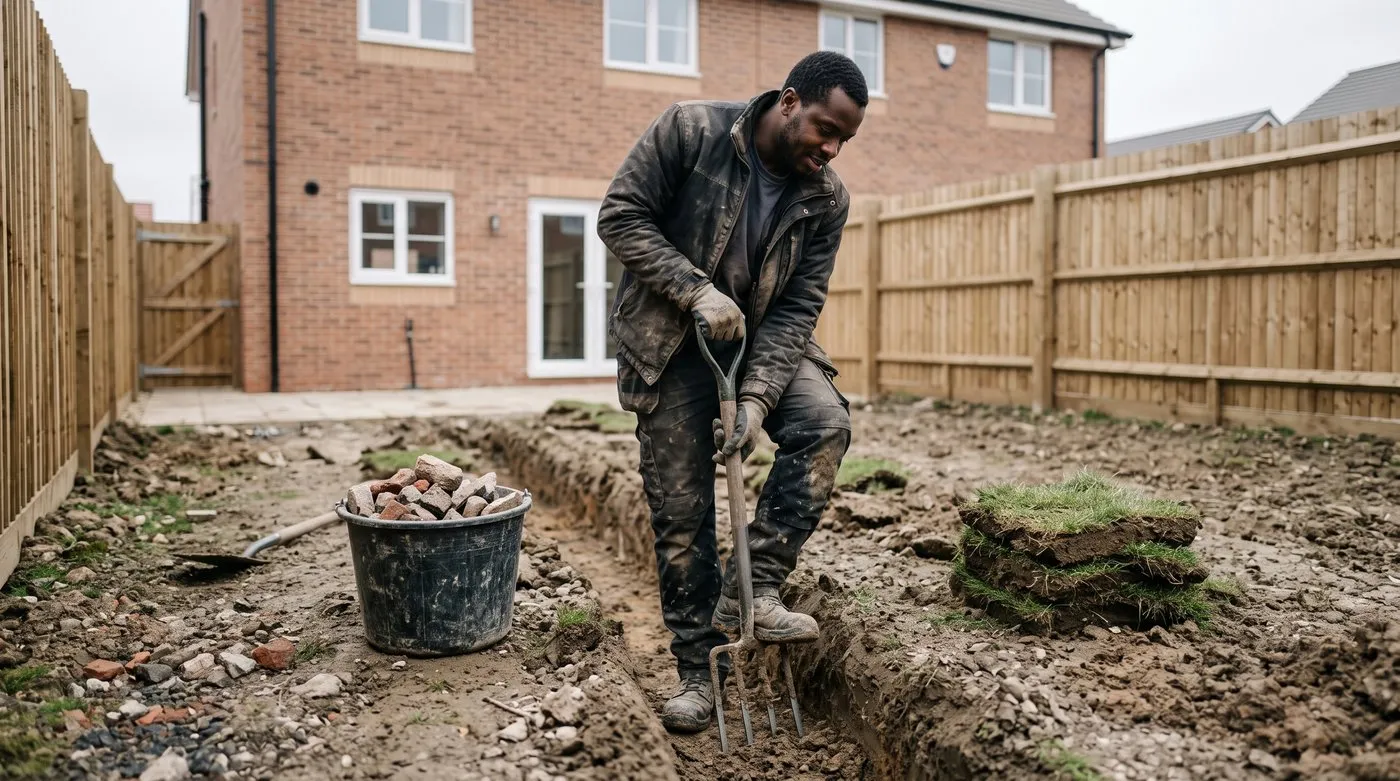
Fork over the bottom of each trench to crack the hard layer, and pick out any rubble bigger than your fist as you go.
How much topsoil does a new build garden need?
Multiply length by width by the extra depth you need, all in metres. That gives you cubic metres.
| Garden size | Topsoil already there | Extra depth | Topsoil to order |
|---|---|---|---|
| 30m² (small terrace) | 10cm | 10cm | 3 cubic metres |
| 48m² (typical semi) | 10cm | 15cm | About 7 cubic metres |
| 80m² (detached) | 15cm | 15cm | 12 cubic metres |
| 120m² (large plot) | 10cm | 20cm | 24 cubic metres |
Buy topsoil made to the BS3882 standard from a good supplier. Cheap soil of unknown origin can bring in weeds and rubbish.
Topsoil is heavy. It usually comes in bulk bags lifted off a lorry by crane, so make sure the lorry can get close. If there’s no side access, you may have to barrow it through the house, so allow extra time and cover the floors.
Should I install drainage in my new build garden?
Add drainage if puddles hang around for more than about 4 hours after decent rain. On heavy, squashed clay, it can be the difference between a garden and a bog.
The simplest fix is a French drain. That’s a gravel-filled trench across the lowest part of the garden, leading to a soakaway. Dig it 30-45cm deep, line it with landscape fabric, fill with gravel and fold the fabric over the top. Then cover with topsoil.
For very wet gardens, a network of perforated drainage pipes leading to a soakaway pit does a better job. It’s a bigger project, and many people get a professional in.
Many new estates have their own system for rainwater, such as permeable paving. Don’t connect new drains to the sewer without checking with building control or your water company first.
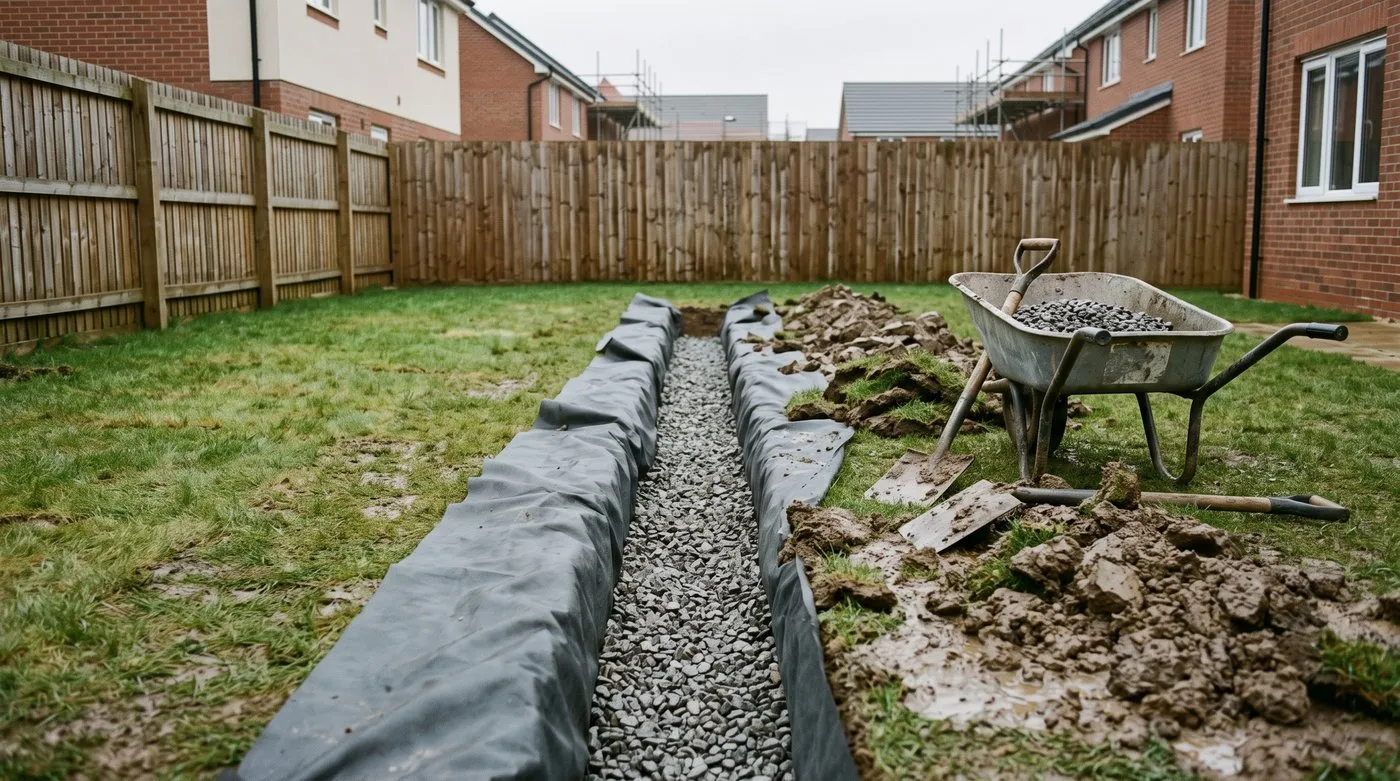
A French drain is just a fabric-lined trench of gravel across the wettest spot. Fold the fabric over the top before you add topsoil so silt can’t clog it.
What should I plant first in a new build garden?
Start with the garden’s shape: hedges, trees and evergreen shrubs in year one. Perennials, bulbs and ground cover can follow in years two and three.
Hedges come first on most new builds. A properly planted hedge gives lasting, good-looking screening that gets better every year. Bare-root whips planted between November and March are cheap. A native hedgerow mix of hawthorn, blackthorn, field maple and hazel grows quickly on decent soil.
For borders, choose tough shrubs that cope with poor soil while you improve it. Cotoneaster, buddleia, potentilla and spiraea all settle in well. If your soil is heavy, fill the gaps with clay-tolerant perennials.
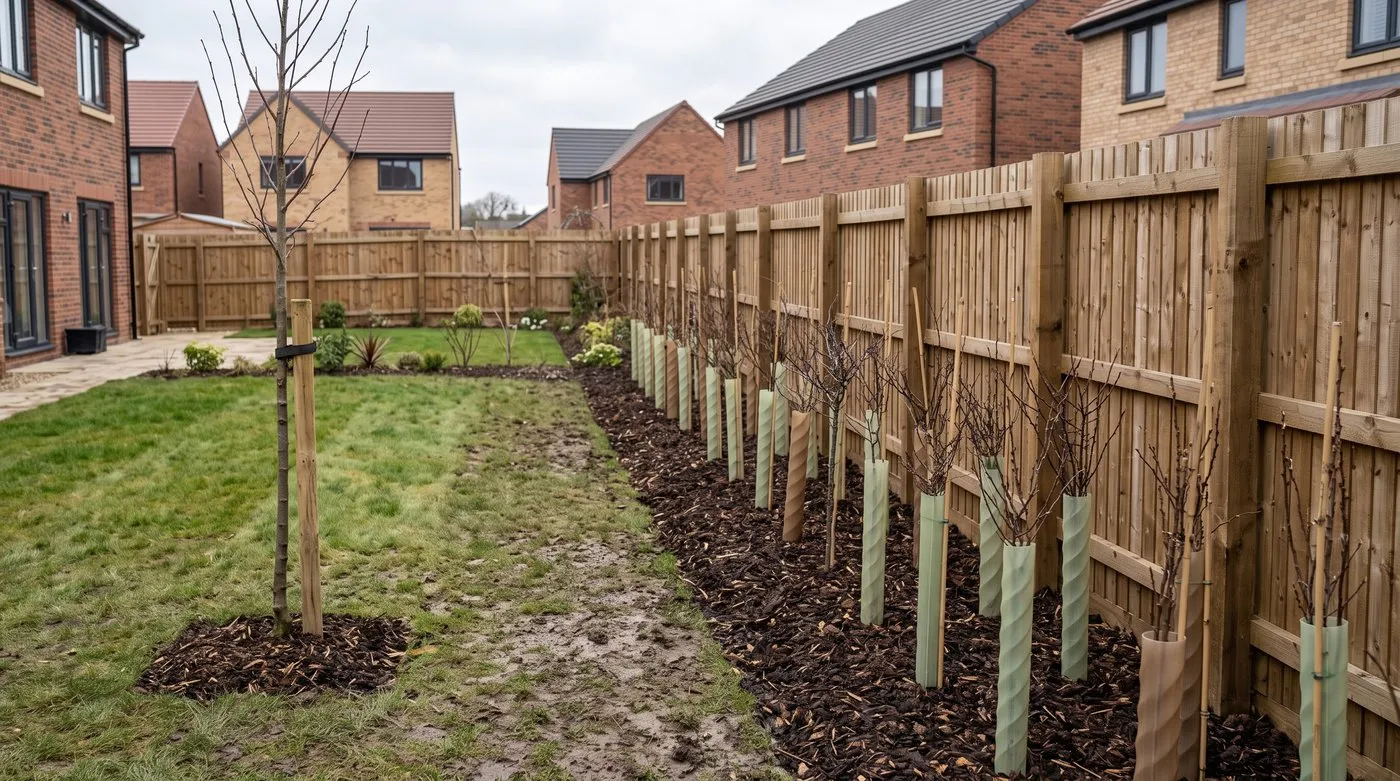
Bare-root whips look like twigs in winter, but a mixed native hedge fills out within a few seasons and handles wind far better than a fence.
How do I create a lawn on a new build plot?
Lift the developer turf, fix the soil, then re-turf or sow seed. Feeding the old turf rarely helps, as the problem is underneath.
Turf gives you a lawn straight away. Buy good-quality turf from a specialist grower and lay it on at least 15cm of well-prepared topsoil. Spring and early autumn are the best times. Our guide to laying turf covers every step.
Seed is cheaper but slower. Choose a hard-wearing mix with ryegrass and fescue, and sow in April or September. Follow the rate on the box. Our guide to growing grass from seed walks you through it.
Either way, prepare the surface well. Rake out stones, then firm the soil by shuffling across it in small overlapping steps. Rake again until it’s fine and level. Don’t skip the firming, as new build soil sinks unevenly and leaves dips that hold water. Give a new lawn a balanced lawn feed about six weeks later.
Year-by-year new build garden plan
Spread the work over three years. Doing everything at once often means buying plants that die in unready soil.
| Job | Year 1: Shape | Year 2: Planting | Year 3: Finishing touches |
|---|---|---|---|
| Soil | Test, break up, add topsoil | Add compost to borders | Mulch every year, start a compost heap |
| Drainage | Put in drains if needed | Keep an eye on wet spots | Look after soakaways |
| Boundaries | Plant hedges or fix fences | Fill gaps, add climbers | First hedge trim |
| Trees | Plant one or two trees | Add bulbs underneath | First light prune |
| Lawn | Prepare soil, turf or seed | First scarify and aerate | Reseed thin patches |
| Borders | Plant the main shrubs | Add perennials and bulbs | Split plants and fill gaps |
| Paths and patio | Path and patio | Raised beds if you want them | Lighting and finishing touches |
Year one isn’t glamorous, but it matters most. Good soil and drainage make everything else easier. Hold off on pretty perennials until the soil is ready for them.
What developers should leave you but rarely do
Your new home warranty may cover some drainage problems, so record anything you spot early. Ground near the house should drain without standing water, and there should be a reasonable layer of topsoil.
Check that any retaining walls have small drainage holes and that water isn’t building up behind them. Look at your purchase paperwork to see what fencing was promised and who looks after which side.
Take photos of standing water, rubble on the surface or other soil problems in your first year. Add them to your snagging list for the developer. Warranty claims usually need proof that the problem was there from the start. If you’re new to all this, our gardening for beginners guide covers the basics.
Not sure where to start? The 60-minute garden audit helps you map sun, wind and soil before you spend a penny.
Frequently asked questions
How long does it take for a new build garden to look established?
Give it about three growing seasons. Hedges and trees planted in year one need two or three years to fill out. Perennials reach full size in their second year. A turf lawn looks settled within a year, while one grown from seed takes a bit longer to thicken up.
How much topsoil do I need for a new build garden?
Multiply length by width by the extra depth you need. All three go in metres, so the answer comes out in cubic metres. An 8m by 6m garden needing another 15cm comes to about 7 cubic metres. Buy topsoil made to the BS3882 standard so you don’t bring in weeds or rubbish.
Why does water pool on my new build lawn?
Building machinery has squashed the soil underneath. Lorries, diggers and stacked materials press the air out of the ground. The thin turf then sits on a hard, almost waterproof layer. Breaking that layer up by deep digging or rotavating is the only lasting fix.
Should I keep the turf that came with my new build?
Strip it off if the soil underneath is poor. Developer turf is often laid on very little topsoil. If your test holes show less than 10cm of topsoil or lots of rubble, lift the turf, fix the soil, then re-turf or sow seed.
What trees grow well in new build gardens?
Birch, rowan and amelanchier are great starter trees. They cope with poor, compacted soil better than most. Hold off on fussier trees like magnolia or Japanese maple until the soil has improved. Bare-root trees planted in late autumn are cheapest and settle in well.
How do I stop my new build fence panels blowing down?
Check the posts first, as they’re often set too shallow. Reset any wobbly posts deeper and firmly in concrete. Add gravel boards along the bottom so the panels don’t sit on wet soil and rot.
Can I plant a hedge instead of using fence panels?
Yes, and a hedge handles wind better than a fence. A solid fence makes the wind swirl, while a hedge slows it down gently. Try a mix of hawthorn, blackthorn, field maple and hazel, planted as bare-root whips in a double row between November and March. Check any boundary rules in your deeds first.
Our team produces practical UK gardening guidance from source research, contributor records and established horticultural practice. Editorial standards are overseen by Matt W.