Key takeaways
- Fix horizontal wires about 30cm apart before you plant
- Plant 30-45cm out from the fence, where rain can reach the roots
- Clematis montana and honeysuckle give the quickest permanent cover in sun
- Climbing hydrangea copes with shade but takes a few years to get going
- Annual climbers hide the fence this summer while permanent ones settle in
- Avoid Russian vine unless you can keep cutting it back
The fastest way to hide an ugly fence is a mix of quick fixes and patience. Fix some wires, plant a vigorous climber, and sow annual climbers to fill the gaps this summer. In two or three years, the permanent climber takes over.
This guide gives you a simple plan: what to do this year, which climber suits your fence, and how to plant it so it grows fast. For a full rundown of climbing plants, see the guide to fast-growing climbers for fences and walls.
The quick plan for an ugly fence
- Check whose fence it is. If it belongs to your neighbour, ask before fixing wires or screws into it.
- Fix horizontal wires about 30cm apart up the fence.
- Plant one permanent climber per panel, 30-45cm out from the fence.
- Sow or plant annual climbers in the gaps for cover this summer.
- Tie in new shoots every week or two in spring and summer.
If the fence is tired or patchy, a coat of dark paint helps too. Black, charcoal or deep green makes a fence fade into the background and makes leaves stand out. The guide to fence paint colours has ideas.
Fix wires before you plant
Most climbers need something to twine around. Clematis, honeysuckle, jasmine and akebia all climb by wrapping stems or leaf stalks around a support. A flat fence panel gives them nothing to hold.
Horizontal wires are cheap, neat and almost invisible once plants grow. Use galvanised or stainless steel wire, run between screw eyes fixed into the fence posts. Space the wires about 30cm apart, starting about 30cm off the ground. Keep the wire a few centimetres away from the fence so air can move behind the plant.
Self-clinging climbers, such as climbing hydrangea, grip walls with tiny roots or pads. They’re best on brick walls. On smooth fence panels they often struggle to hold, so give them wires too.

Wires held off the fence on screw eyes give twining climbers something to grab, and let air move behind the leaves.
Which climber suits your fence?
Pick by aspect first. A climber in the wrong amount of sun will sulk however well you plant it.
| Fence | Good climbers | Notes |
|---|---|---|
| Sunny (south or west) | Clematis montana, honeysuckle, star jasmine, Clematis armandii | Quickest cover and the most flowers |
| Shady (north or east) | Climbing hydrangea, Clematis montana, some honeysuckles | Slower, but these cope with less sun |
| Want it evergreen | Clematis armandii, star jasmine, evergreen honeysuckle | Slower to fill, green all winter |
| Want it this summer | Sweet peas, nasturtiums, cup-and-saucer vine, morning glory | Annuals, gone by winter |
Warning: Clematis and climbing hydrangea aren’t safe for pets to chew. If you have a puppy or a cat that nibbles plants, keep an eye on them while the plants are young.
The best permanent climbers for quick cover
Clematis montana
Clematis montana is the classic choice for covering a fence quickly. It’s vigorous and smothered in pink or white flowers in late spring. It copes with sun or light shade. It needs little pruning: just trim it after flowering to keep it in bounds. The guide on how to prune clematis explains the groups.
Climbing honeysuckle
Honeysuckle (Lonicera periclymenum) is a native climber with scented flowers loved by moths and bees. ‘Belgica’ flowers in early summer and ‘Serotina’ later in the summer. It’s happy in sun or part shade, and twines tightly around wires. Trim it after flowering to keep it tidy.

Honeysuckle twines happily over fences and wires, and the scented flowers bring in bees by day and moths at dusk.
Climbing hydrangea
Climbing hydrangea (Hydrangea anomala subsp. petiolaris) is one of the best climbers for a shady fence. It has lacy white flower heads in early summer and yellow leaves in autumn. It’s slow for the first couple of years, then grows away well. Give it wires on a fence, as it grips best on brick.

Climbing hydrangea takes a while to settle, but once it does it covers a shady fence in white flowers.
Clematis armandii and other evergreens
Clematis armandii keeps its long, glossy leaves all year and has scented white flowers in early spring. It needs a sheltered, sunny fence. Star jasmine and evergreen honeysuckle are other good choices. All are slower than montana. The guide to evergreen climbers covers the full range.
Later-flowering clematis
Late-flowering clematis such as ‘Etoile Violette’ flower from midsummer into autumn. Cut them back hard in late winter, and they regrow from low down each year. Grow one alongside a montana to stretch the flowering season.

A well-established clematis can turn a whole run of fence into a wall of flowers. Pair early and late types for a longer show.
Annual climbers for cover this summer
Permanent climbers take a couple of years to fill a fence. Annual climbers grow from seed to full cover in a single summer, so they bridge the gap.
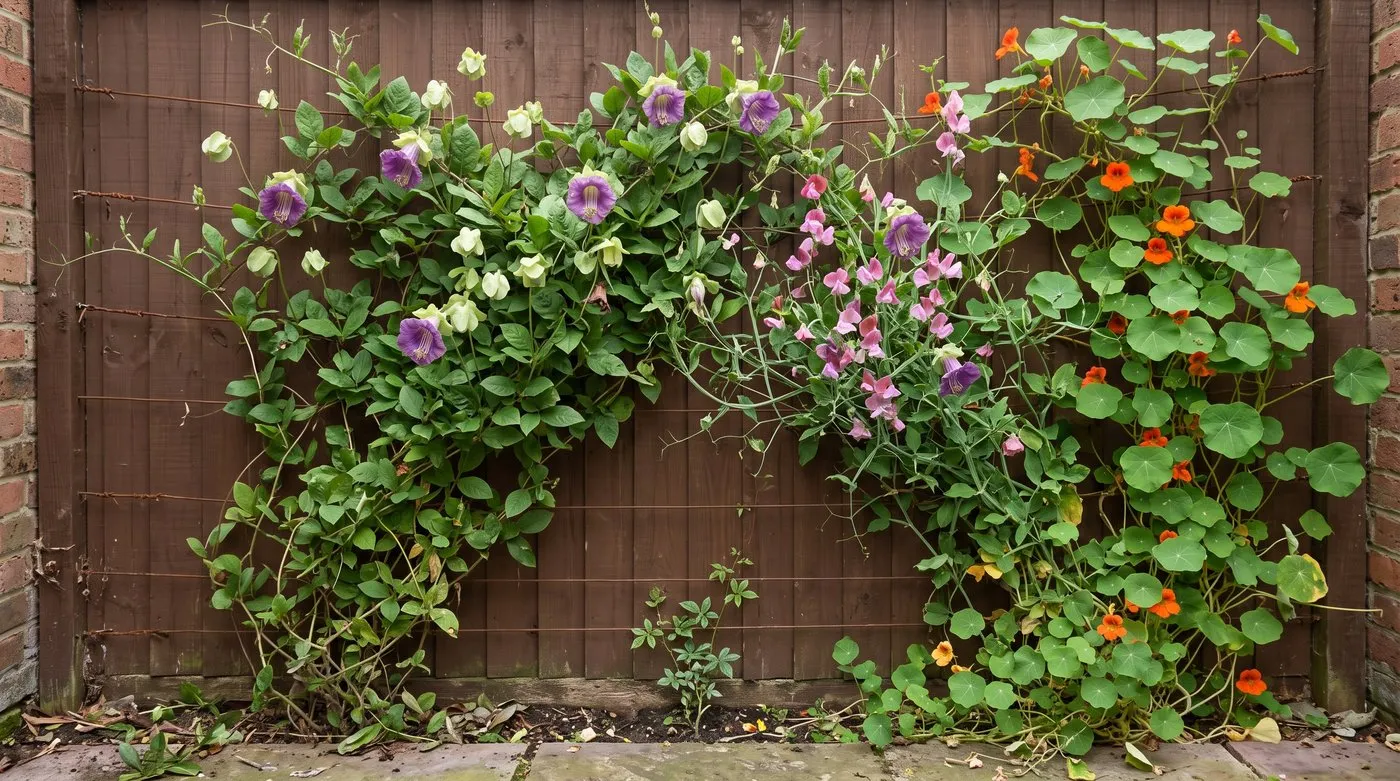
Annual climbers like these hide a bare fence in one summer, while the permanent climber at the base gets its roots down.
- Sweet peas: scented flowers from early summer, and the more you pick, the more you get.
- Climbing nasturtiums: easy, bright and happy in poor soil.
- Cup-and-saucer vine: very vigorous, with purple bell flowers. See the guide to growing cobaea.
- Morning glory: big trumpet flowers in a warm, sunny spot.
Sow or plant them between your permanent climbers in late spring, after the last frost. Pull them out in autumn so they don’t smother the young permanent plants.
How to plant a climber against a fence
- Dig the hole 30-45cm out from the fence. Soil right at the base stays dry, as the fence keeps rain off.
- Add some compost to the planting hole and the soil around it.
- Plant at the same depth as in the pot, except clematis. Plant clematis 5-8cm deeper, which helps it regrow if it’s damaged.
- Lean the plant towards the fence. Use a cane to lead the stems from the plant to the lowest wire.
- Water well and keep watering in dry spells for the first summer.
- Mulch around the base to keep the roots cool and moist.
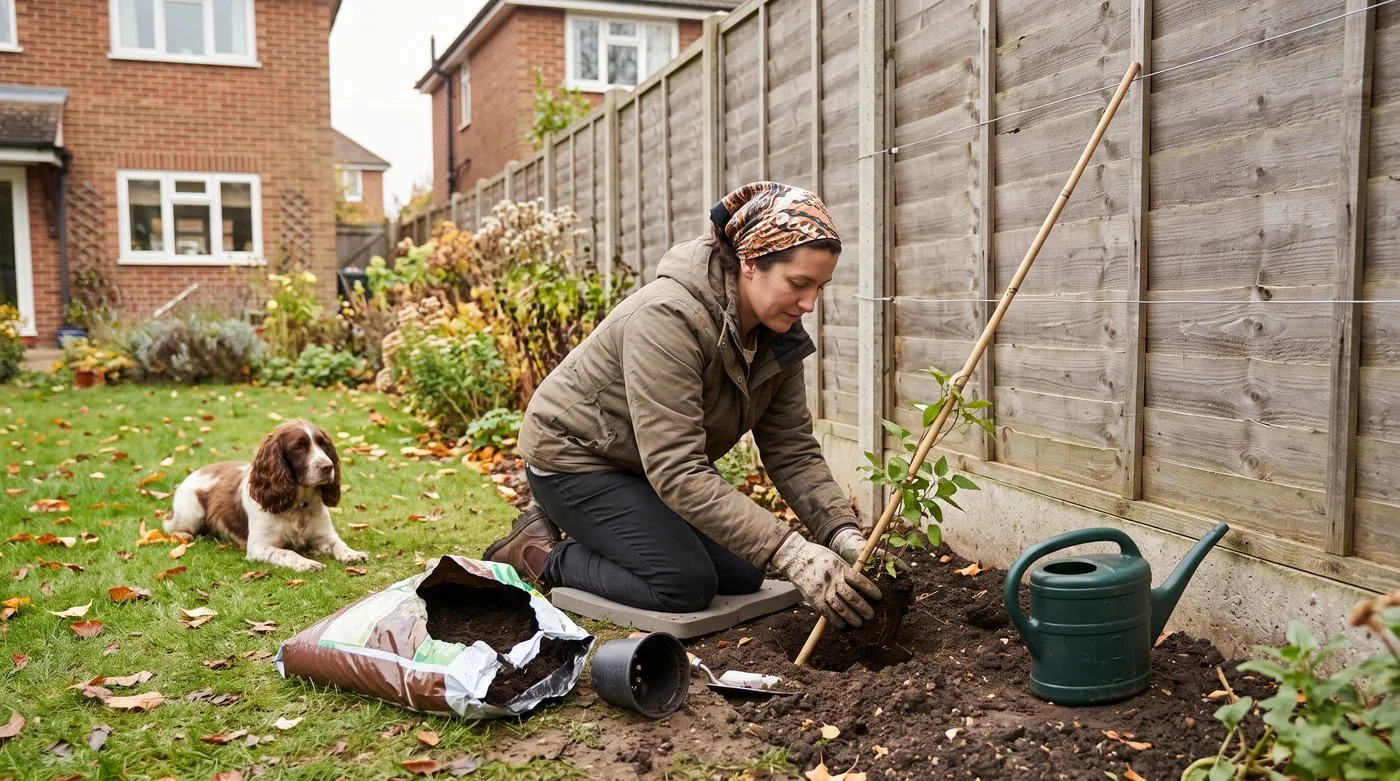
Plant 30-45cm out from the fence and lean the cane in towards the wires. Clematis goes in a little deeper than it sat in the pot.
Fan the stems out sideways along the wires as they grow. Sideways shoots cover more fence and flower better than stems heading straight up. The guide on training young climbers shows how.
Climbers to think twice about
- Russian vine grows very fast but quickly swamps fences, sheds and trees. Once it’s in, it’s hard to get rid of. The guide to Russian vine explains why.
- Common ivy covers fast and is great for wildlife, but its weight and grip can pull at old fence panels.
- Wisteria is far too heavy for most panel fences. Save it for a strong wall or pergola.
Fence climber care calendar
| Month | Job |
|---|---|
| February to March | Cut back late-flowering clematis. Check wires and ties |
| April | Tie in new shoots. Mulch the base. Sow annual climbers indoors |
| May | Plant out annual climbers after the last frost |
| June | Trim Clematis montana after flowering. Keep tying in |
| July to August | Water young climbers in dry spells. Trim honeysuckle after flowering |
| September to October | Pull out annual climbers. Plant new permanent climbers |
| November to January | Plant in mild spells. Check wires after storms |
Gardener’s tip: Dense climbers make great nesting spots for birds. Before trimming in spring and summer, check for nests. It’s an offence to damage an active nest, so wait until the young have flown.
Common mistakes when covering a fence
- Planting right against the fence. The soil there stays dry. Plant 30-45cm out.
- No support. Twining climbers can’t grip a flat panel. Fix wires first.
- Letting stems all go straight up. Fan them sideways for better cover.
- Choosing the wrong climber for the aspect. Sun lovers sulk on a shady fence.
- Planting Russian vine on a small fence. It soon takes over.
Frequently asked questions
What is the fastest way to hide an ugly fence?
Fix wires, plant a quick permanent climber and add annuals for this summer. Clematis montana or honeysuckle covers a panel in a couple of summers in sun. Sweet peas, nasturtiums or cup-and-saucer vine fill the gaps in the meantime. A coat of dark fence paint makes the fence itself fade into the background.
What is the fastest growing climber in the UK?
Russian vine is the fastest, but it’s a thug. It can smother a fence, shed and nearby trees within a few years. For quick cover you can control, choose Clematis montana or a climbing honeysuckle instead. Annual climbers such as cup-and-saucer vine give the fastest cover of all in one summer.
Can climbers damage a wooden fence?
Twining climbers on wires rarely cause harm. Problems come from heavy, woody climbers pulling on old panels, and self-clinging types gripping the wood. Fix wires on spacers so air can move behind the plant, and keep heavy climbers like wisteria for strong walls.
Which climbers cover a fence all year round?
Evergreen climbers keep their leaves all winter. Good choices include Clematis armandii, star jasmine and evergreen honeysuckle (Lonicera henryi). Most are slower to cover than Clematis montana, so be patient. Akebia is semi-evergreen and drops some leaves in cold winters.
When should I plant climbers?
Autumn and spring are the best times to plant climbers. Pot-grown plants can go in at any time when the soil isn’t frozen or bone dry. Autumn planting gives roots time to settle before spring growth. Water summer plantings well until they’re established.
How many climbers do I need for a fence panel?
One vigorous climber per panel is usually enough. Two per panel gives quicker cover, especially with less vigorous plants. Clematis montana can cover several panels on its own once established. Space plants so each has room to spread sideways along the wires.
Now your fence is sorted, find more ways to dress it up in the guide to garden fence ideas, or browse the plants section for more climbers.
Our team produces practical UK gardening guidance from source research, contributor records and established horticultural practice. Editorial standards are overseen by Matt W.