Key takeaways
- Slow-growing means under 20 to 30cm a year, which cuts trimming from two or three cuts to one
- Yew grows 20 to 30cm a year, reaches 4m and lives over 100 years on free-draining soil
- Box grows just 10 to 15cm a year but box blight and box tree moth now make it a risk in many UK gardens
- Holly grows 15 to 25cm a year, evergreen and dense, and gives berries for birds on female plants
- Ilex crenata and Euonymus are the safest box alternatives where blight is established
- Yew is toxic to horses, ponies, cattle and sheep, so never plant it where livestock can reach clippings
Slow-growing hedging plants are the smartest choice for any gardener who wants a neat evergreen boundary without the constant trimming. By slow-growing we mean roughly under 20 to 30cm of growth a year, which is a fraction of what privet or Leylandii put on. That single difference is what saves you the most work. A slow hedge needs one trim a year, not two or three, and it grows denser and tidier as a result.
This guide ranks the best slow growers for UK gardens, led by box, yew and holly, with hornbeam, berberis, cotoneaster, pyracantha and Lonicera nitida close behind. We cover real growth rates, planting spacing, bare-root timing and costs, and the disease problems that now make box a risk. The figures come from more than a decade of measuring these hedges on heavy clay in Staffordshire.
What counts as a slow-growing hedge
Compare the extremes. Leylandii can grow 75 to 100cm a year and needs cutting two or three times. Privet manages 30 to 60cm and wants two cuts. A yew hedge grows 20 to 30cm and needs one cut, while box crawls along at 10 to 15cm and also needs only one. The slow growers are evergreen, fine-textured and dense, which is exactly the look most UK gardeners want for a formal edge or a low boundary.
Slow does not mean weak. These plants live for decades, often centuries in the case of yew. They simply spend their energy on density and longevity rather than reaching for the sky. If you want a deeper grounding in soil prep and spacing before you choose, our hedge planting guide for the UK walks through the basics.
The slow-growing hedge comparison table
The table below ranks the main slow-growing hedging plants from slowest to fastest. Growth rates are typical figures for established plants on reasonable UK soil. Spacing is given as plants per metre for a single row.
| Plant | Growth rate (cm/yr) | Ultimate height | Evergreen? | Trims per year | Spacing | Best for |
|---|---|---|---|---|---|---|
| Box (Buxus sempervirens) | 10 to 15 | 1 to 3m | Yes | 1 | 5 per m | Low formal edging, parterres |
| Lonicera nitida | 15 to 20 | 1 to 1.5m | Yes | 2 | 5 per m | Cheap low hedge, topiary |
| Holly (Ilex aquifolium) | 15 to 25 | 3 to 5m | Yes | 1 | 3 per m | Secure boundary, wildlife |
| Cotoneaster (C. lacteus) | 15 to 25 | 2 to 3m | Yes | 1 to 2 | 3 per m | Berries, informal screen |
| Berberis (B. darwinii) | 15 to 25 | 1.5 to 2.5m | Yes | 1 | 4 per m | Spiny barrier, flowers |
| Pyracantha | 20 to 30 | 2 to 4m | Yes | 2 | 3 per m | Intruder-proof, berries |
| Yew (Taxus baccata) | 20 to 30 | 3 to 6m | Yes | 1 | 3 per m | Formal evergreen, long-lived |
| Hornbeam (Carpinus betulus) | 30 to 40 | 4 to 6m | No (marcescent) | 1 to 2 | 3 per m | Tall screen on heavy clay |
Box is the slowest at 10 to 15cm a year. Yew sits at the upper end of slow but earns its place through density and longevity. Hornbeam is included as the borderline fast grower for anyone needing height quickly on clay.
Box (Buxus sempervirens), the classic but risky choice
Box is the traditional slow-growing hedge, prized for fine evergreen leaves that clip into a crisp, formal edge. It grows just 10 to 15cm a year, the slowest of any common UK hedge. Plant it at five plants per metre for low edging up to 50cm, or three per metre for a hedge approaching 1m. It thrives on most soils and tolerates shade, which suits shaded parterres and knot gardens.
The second threat is the box tree moth (Cydalima perspectalis), whose caterpillars strip foliage in days. Both problems are covered in detail in our box tree moth treatment guide for the UK. If you still want the box look, read our box hedge alternatives first, because in many gardens the safer route is to skip box entirely.
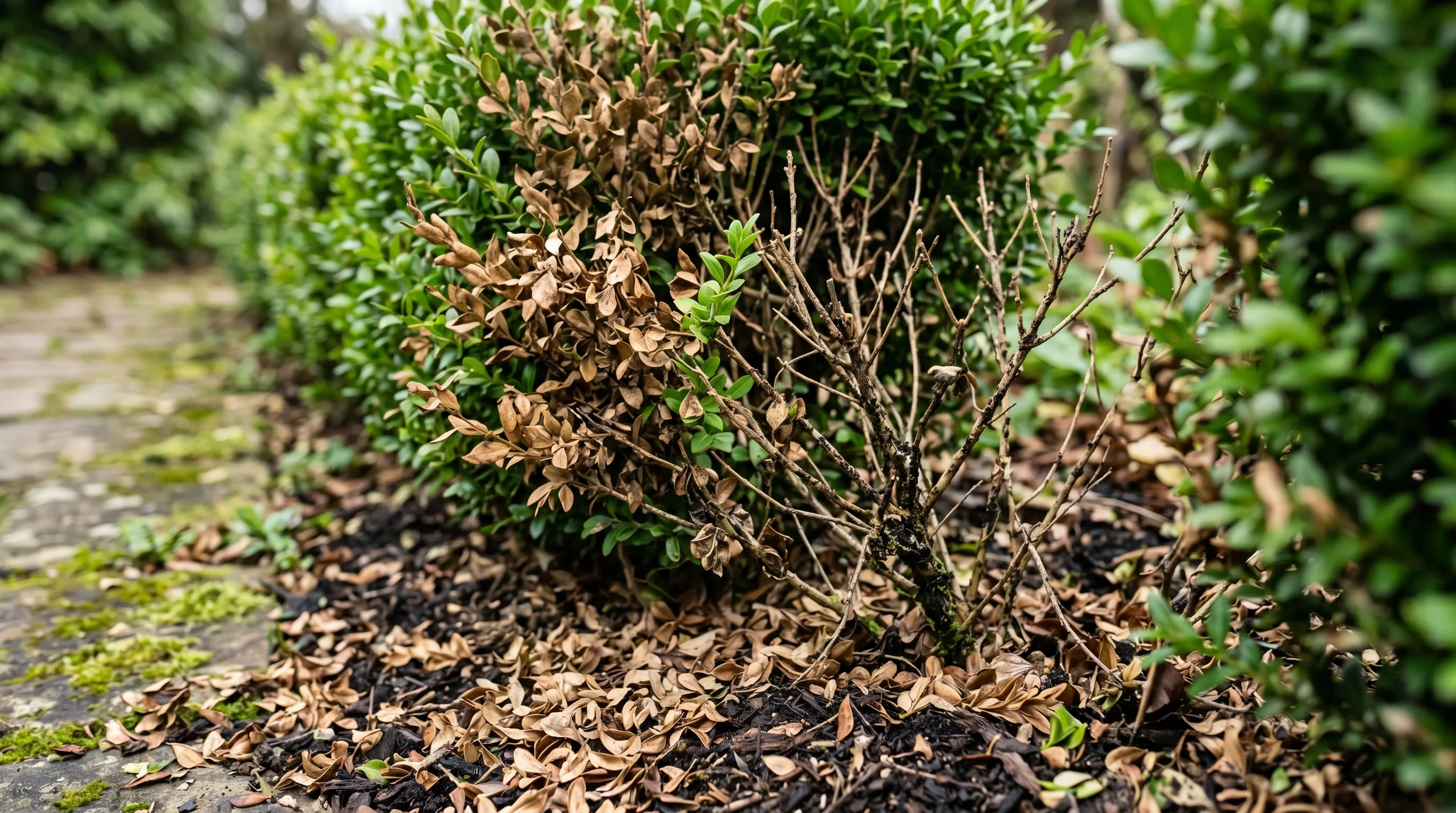 Box blight shows as brown patches, bare stems and rapid leaf drop. Once it takes hold in a clipped hedge it is very hard to clear.
Yew (Taxus baccata), the long-lived formal hedge
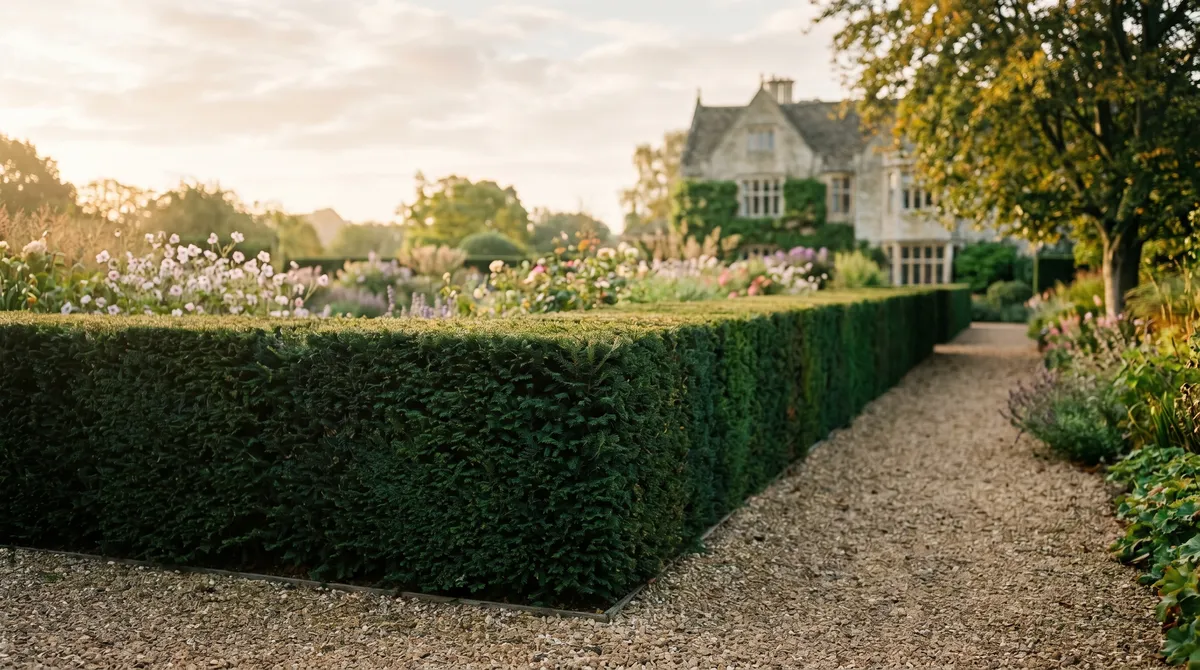
Yew is the finest slow-growing hedge for a permanent, formal boundary in the UK. Taxus baccata grows 20 to 30cm a year, which is slow for a plant that can reach 4 to 6m. It forms a dense, dark, near-black wall of evergreen needles that takes a crisp clipped edge better than anything else. A yew hedge needs only one trim a year, ideally in late August.
Yew tolerates clay and chalk but hates waterlogging, so it needs free-draining soil or a raised planting ridge on heavy ground. It also takes hard renovation cuts, regrowing from old bare wood, which almost no other conifer will do.
Warning: Yew is highly toxic to horses, ponies, cattle, sheep and dogs. Every part except the fleshy red aril contains taxine alkaloids, and a small mouthful of foliage or clippings can kill a horse within hours. Never plant yew on a paddock boundary, and always gather and burn clippings well away from grazing animals.
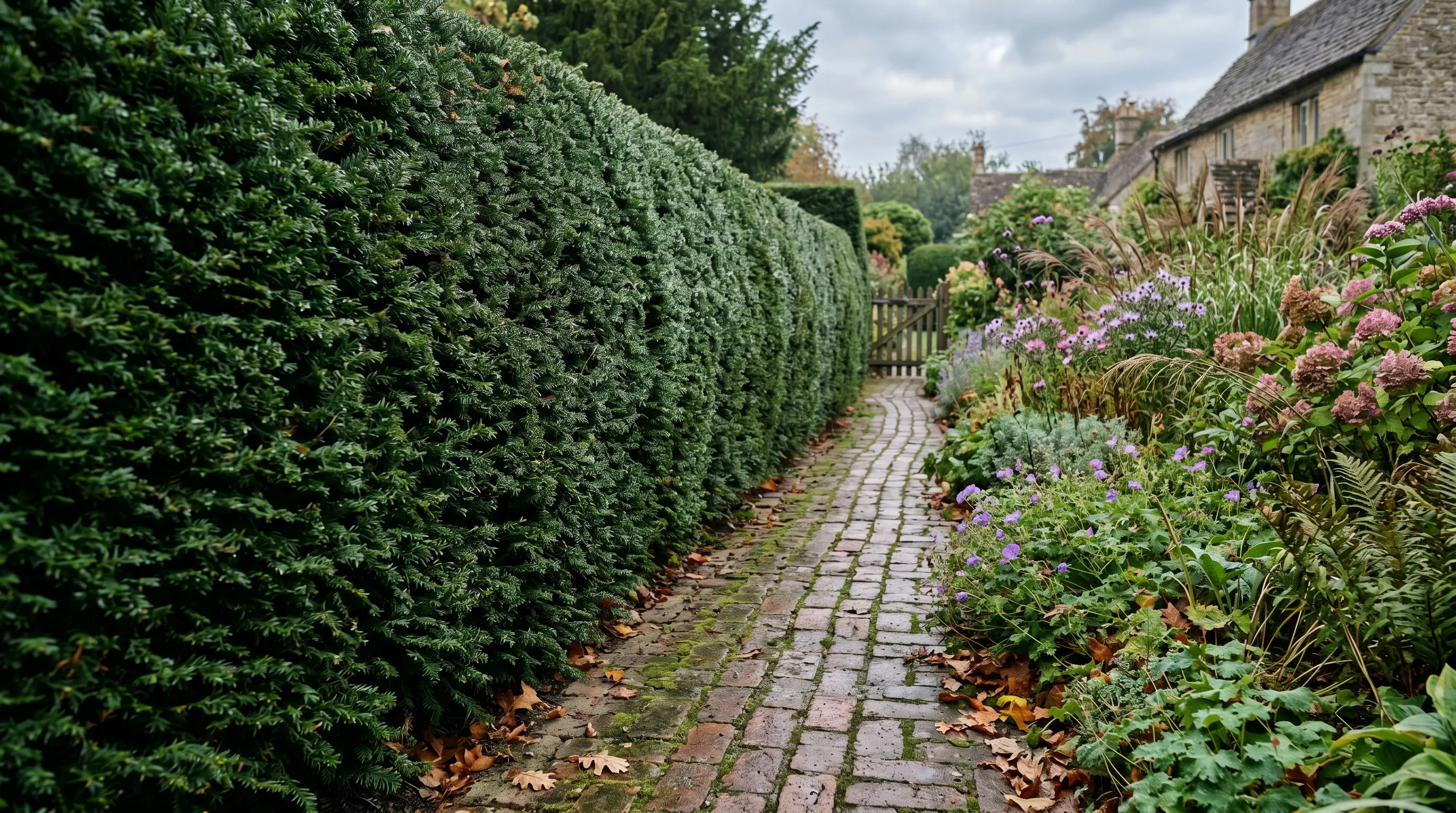 A clipped yew hedge after nine years, holding a crisp face on a single August trim a year. The dense, dark finish is unmatched.
Holly (Ilex aquifolium), the wildlife-friendly evergreen
Holly is the slow-growing hedge for gardeners who want security and wildlife in one plant. Ilex aquifolium grows 15 to 25cm a year and reaches 3 to 5m if left, though it clips happily to 1.5 to 2m. The spiny leaves form a barrier few intruders or animals push through, and the dense evergreen cover gives nesting birds excellent shelter. Plant at three per metre.
Holly carries red berries on female plants only, and you need a male holly within pollinating distance for a good crop. Cultivars such as ‘J.C. van Tol’ are self-fertile and berry reliably without a partner, which is the easy choice for a single hedge. Birds strip the berries through winter, so holly earns its place in any wildlife garden.
It is slow to establish, often sulking for a year or two after planting, but it is tough once away. Holly tolerates shade, clay, chalk and coastal wind better than box or yew. Trim it once a year in late summer, wearing thick gloves, and it forms one of the most weatherproof boundaries you can grow. For more permanent screening options see our guide to the best evergreen trees for UK gardens.
Hornbeam, berberis, cotoneaster and other slow options
Beyond the big three, several plants give slow to moderate growth with their own strengths. Hornbeam (Carpinus betulus) is the fastest of this group at 30 to 40cm a year, so it is a borderline slow grower, but it is the best choice for a tall hedge on cold, heavy clay where beech struggles. On free-draining ground, beech is the classic alternative; our beech hedge guide covers planting rates and the August trim. It is not evergreen, but it holds its coppery dead leaves through winter, a trait called marcescence, so it still screens.
Berberis darwinii grows 15 to 25cm a year into a spiny evergreen barrier with orange spring flowers and blue berries. Cotoneaster lacteus matches that rate and carries heavy red berry crops that birds love, making a good informal screen. Pyracantha grows 20 to 30cm a year and its vicious thorns make the most intruder-proof hedge of all, though it needs two trims to stay neat.
Plant spacing, bare-root versus pot, and costs
Getting spacing right is the difference between a dense hedge and a gappy one. As a rule, plant low fine hedges like box and Lonicera at five plants per metre, and taller hedges like yew, holly and hornbeam at three per metre. A single staggered double row at the same totals gives a thicker base for a stockproof boundary, but it costs more plants.
Bare-root plants are the cheapest and best-value way to start a hedge. They are lifted dormant and sold from November to March, the only window you can plant them. A bare-root yew whip costs around 3 to 6 pounds, a holly 2 to 4 pounds, and bare-root box or Ilex crenata 3 to 6 pounds. Pot-grown plants cost two to three times more but can go in any time the ground is workable and not frozen.
For most slow hedges, buy bare-root in late autumn and plant straight away. The roots establish over winter and the plant powers into growth in spring. Water well through the first two summers, as new hedges fail far more often from drought than cold. Our bare-root tree planting guide covers the soaking and heeling-in steps that stop young plants drying out before they go in.
| Plant | Bare-root cost each | Plants per metre | Cost per metre | Planting window |
|---|---|---|---|---|
| Box / Ilex crenata | 3 to 6 pounds | 5 | 15 to 30 pounds | Nov to Mar |
| Lonicera nitida | 2 to 4 pounds | 5 | 10 to 20 pounds | Nov to Mar |
| Holly | 2 to 4 pounds | 3 | 6 to 12 pounds | Nov to Mar |
| Yew | 3 to 6 pounds | 3 | 9 to 18 pounds | Nov to Mar |
| Hornbeam | 1.50 to 3 pounds | 3 | 4.50 to 9 pounds | Nov to Mar |
Why slow growth means less work and a denser hedge
The low-maintenance case for slow hedging plants comes down to trim frequency. A yew or box hedge needs one cut a year. A privet hedge needs two, and Leylandii needs two or three to stay under control. Over a 20-metre boundary, that is the difference between one afternoon a year and three, plus the fuel, the disposal of clippings, and the wear on shears or a trimmer.
There is one extra cost: patience. A slow hedge takes three to five years to close up fully, against one or two for a fast grower. That is the only real trade-off, and on a permanent boundary it is a small one for decades of easy upkeep. The Royal Horticultural Society rates yew, box and holly among the best hedges for exactly this reason.
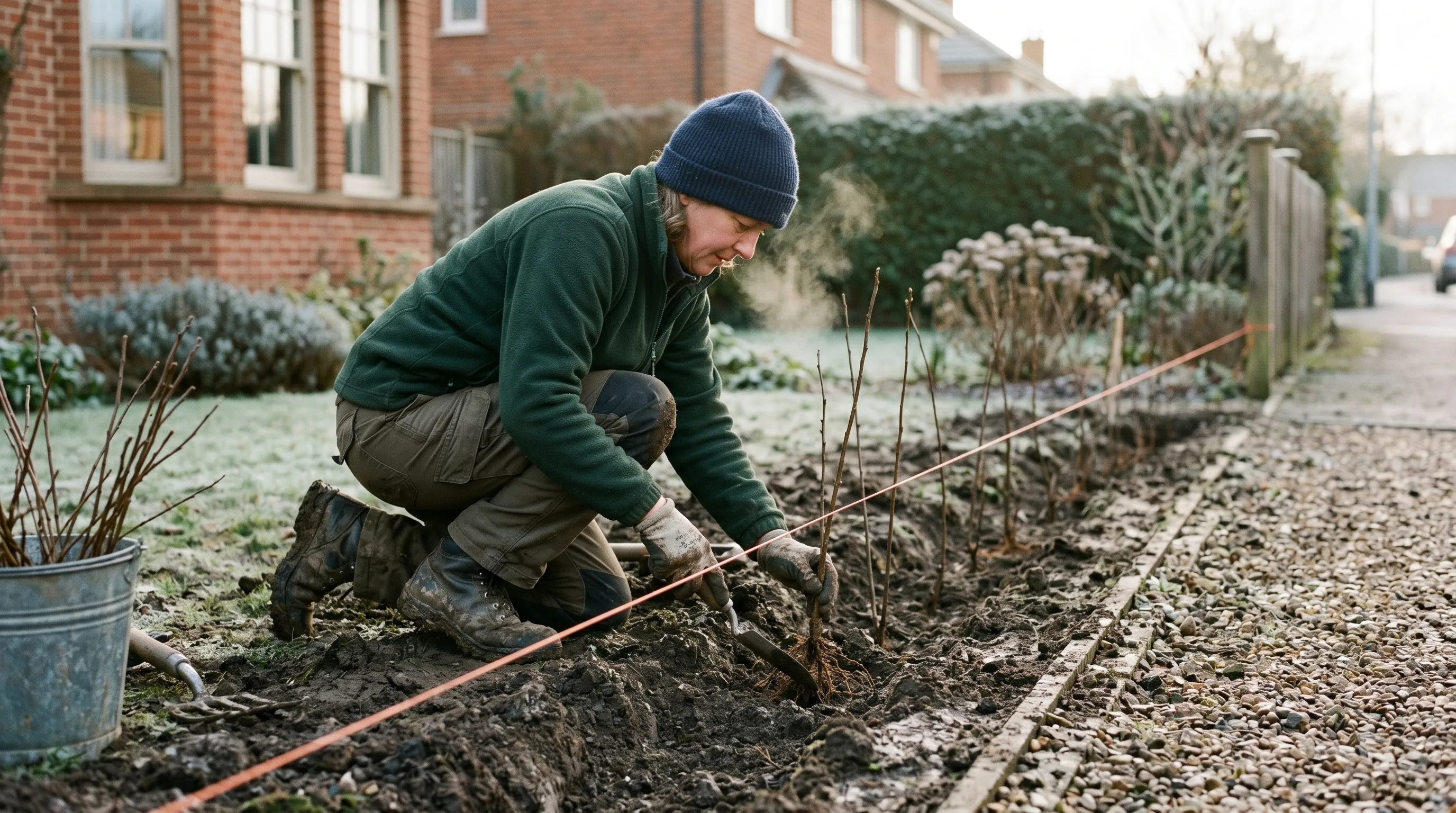 Bare-root whips set to a string line at correct spacing, three per metre for yew and holly, give an even, gap-free hedge as they grow.
Formative pruning, the step most people skip
Formative pruning in the first two or three years is what builds a thick, gap-free hedge, and it is the single most skipped step. The instinct is to let a young hedge grow tall fast, but cutting it back hard early forces dense branching low down, where you want it. Trim the sides lightly each year from the start, and reduce leading shoots by about a third in the first two winters.
Always cut a hedge with a slight batter, meaning wider at the base than the top. This lets light reach the bottom and stops the base going bare and leggy, the most common fault in old hedges. A vertical-sided hedge shades its own base and thins out below within a few years.
Time the annual trim for late August on yew, box, holly and most evergreens, once nesting season has ended. Hornbeam can take an earlier summer cut. Always check for active birds’ nests first, as cutting an occupied nest is illegal in the UK. Our guide to the legal dates for cutting hedges in the UK sets out the nesting rules in full.
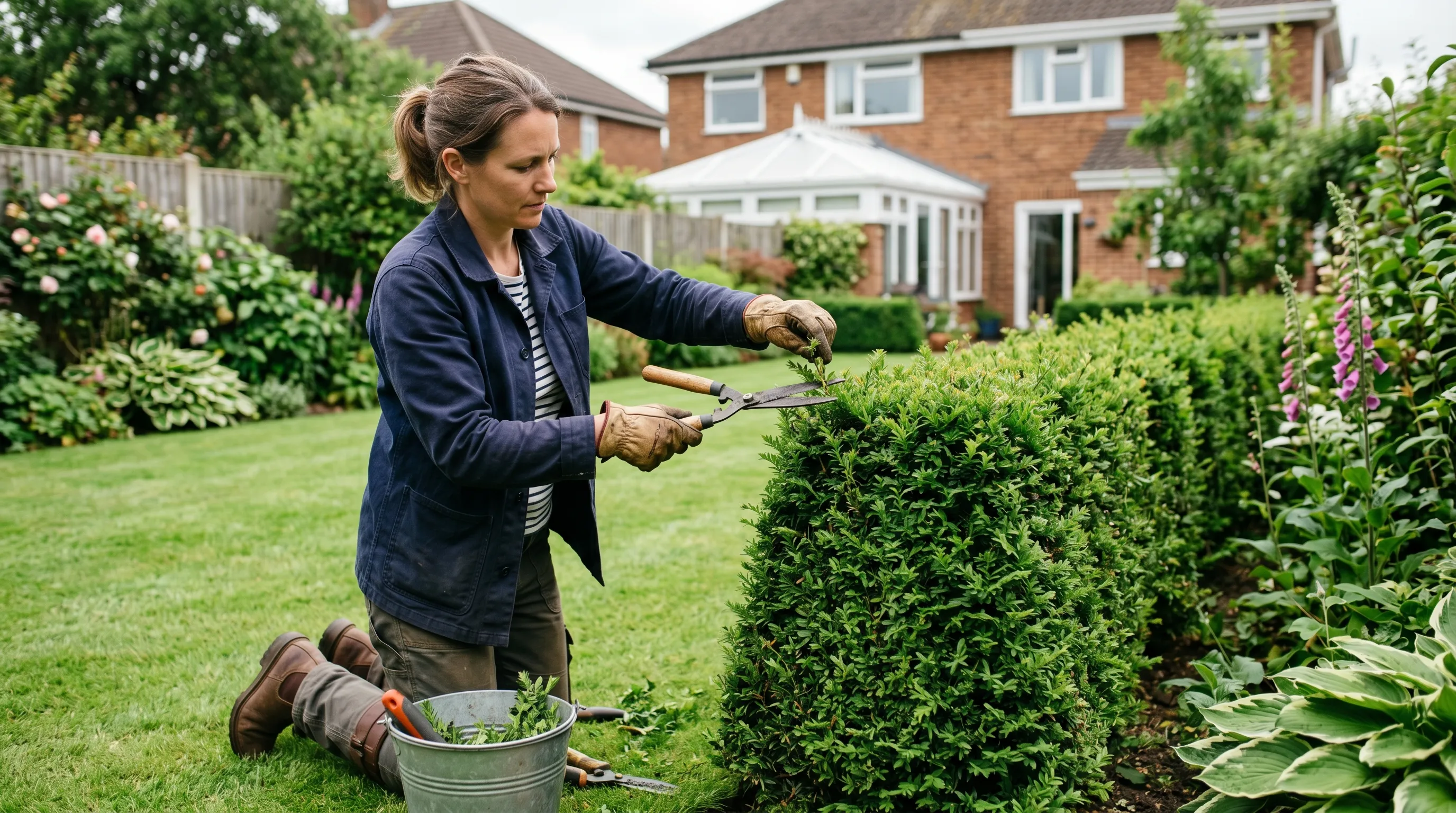 Cutting a young hedge with a slight batter, wider at the base than the top, lets light reach the bottom and stops it going bare and leggy.
Common mistakes with slow-growing hedges
A few avoidable errors cause most slow-hedge failures. Get these right and the hedge looks after itself for decades.
Planting box where blight is rife. If neighbours have lost box to blight, or your garden is damp and shaded, box will likely follow. Plant Ilex crenata or Euonymus instead. Forcing box into a high-risk spot wastes years and money on a hedge that browns out and dies back.
Spacing plants too far apart. Stretching plants to save money is a false economy. Wide spacing leaves gaps that never fully close, and the hedge looks thin for life. Stick to five per metre for box and Lonicera, three per metre for yew, holly and hornbeam.
Skipping formative pruning. Letting a young hedge race upward without early cutting back gives a tall, thin, see-through hedge with a bare base. Cut sides and leaders back in the first two or three years to force dense low branching.
Planting too deep. Bare-root and pot plants must sit at the same depth they grew before, shown by the soil mark on the stem. Burying the stem causes rot and slow death. Plant to the mark, firm gently, and water in well.
Letting new plants dry out. Drought, not cold, kills most new hedges. Water deeply through the first two summers, especially yew and holly, which sulk and die back when parched while establishing.
Month-by-month slow hedge planting and trimming calendar
The calendar below sets out the key jobs for a UK slow-growing hedge across the year. Timings suit most of the country, with the north running one to two weeks behind the south.
| Month | Task |
|---|---|
| January | Plant bare-root yew, box, holly and hornbeam while dormant. Avoid frozen ground. |
| February | Finish bare-root planting before bud break. Firm any plants lifted by frost. |
| March | Last chance for bare-root. Mulch new hedges and check ties and stakes. |
| April | Water new plants if spring is dry. Apply a balanced feed to establishing hedges. |
| May | Keep new hedges watered. Watch box for blight and box tree moth caterpillars. |
| June | Carry out formative pruning on young hedges. Check for and avoid active birds’ nests. |
| July | Water deeply in dry spells. Inspect holly and yew for drought stress. |
| August | Give the main annual trim to yew, box, holly and most evergreens. |
| September | Order bare-root plants for autumn delivery. Prepare planting trenches. |
| October | Begin pot-grown planting. Improve soil with compost and grit on heavy clay. |
| November | Bare-root planting season opens. Plant in mild, workable, unfrozen soil. |
| December | Continue bare-root planting. Protect new plants from wind rock on exposed sites. |
Frequently asked questions
What is the slowest-growing hedge for a UK garden?
Box is the slowest, growing just 10 to 15cm a year. Buxus sempervirens forms a dense, fine-textured evergreen hedge that needs only one trim a year. The catch is its vulnerability to box blight and box tree moth, both now widespread. Where those are a problem, Ilex crenata or Euonymus give the same slow, neat habit without the disease risk.
Which slow hedge needs the least trimming?
Yew needs only one trim a year, in late summer. Taxus baccata grows 20 to 30cm a year, which is slow for a tall hedge, so a single August cut keeps it crisp. Box and Ilex crenata also need just one trim. Fast hedges like privet and Leylandii need two or three cuts a season, which is far more work.
How long does a yew hedge take to grow?
A yew hedge takes around 8 to 10 years to reach 1.5 to 2m. Planted as bare-root whips at 30 to 60cm tall, yew grows 20 to 30cm a year, so it is not as slow as its reputation suggests. The dense, dark, formal finish and a lifespan over 100 years make the wait worthwhile for a permanent boundary.
Is yew poisonous to pets and livestock?
Yes, yew is highly toxic to horses, ponies, cattle, sheep and dogs. Every part except the red aril flesh contains taxine alkaloids. A small mouthful of foliage or clippings can kill a horse within hours. Never plant yew along a paddock boundary, and always remove and burn clippings well away from grazing animals.
What can I plant instead of box hedge?
Ilex crenata and Euonymus japonicus are the best box replacements. Ilex crenata (Japanese holly) has the same small, glossy leaves and clips into tight low hedges without box blight. Euonymus is tougher and faster. Both give the formal, slow-growing look of box at a low height of 30cm to 1m for edging and borders.
Choose slow, trim once, enjoy the boundary
Slow-growing hedging plants reward patience with decades of easy upkeep. Pick yew for a formal, long-lived wall, holly for security and wildlife, and Ilex crenata wherever box blight rules out the classic. Get the spacing and formative pruning right in the first three years, and a single annual trim keeps the hedge crisp for a generation.
Now you know which slow hedge suits your garden, browse all our plant guides for the rest of your borders. If you need height in a hurry on part of the boundary instead, compare the trade-offs in our guide to fast-growing hedging plants for UK gardens.
Our team produces practical UK gardening guidance from source research, contributor records and established horticultural practice. Editorial standards are overseen by Matt W.